


People on Both Sides of the Strait Are Chinese, Xi Tells Taiwan Opposition Leader

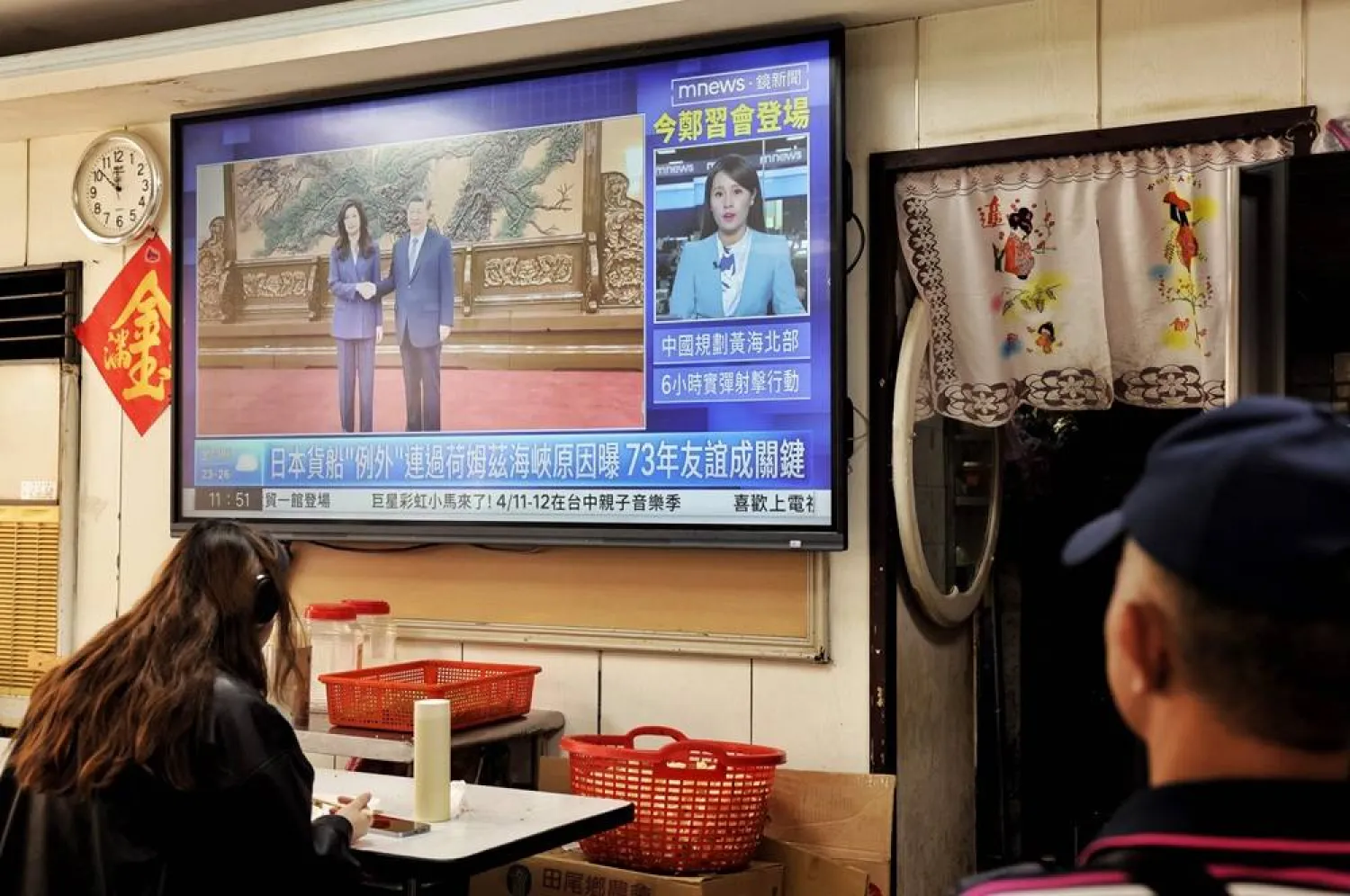
A television shows the meeting between Kuomintang (KMT) chairwoman Cheng Li-wun and Chinese President Xi Jinping in Beijing, at a restaurant in Taipei on April 10, 2026. (AFP)
TT

People on Both Sides of the Strait Are Chinese, Xi Tells Taiwan Opposition Leader

A television shows the meeting between Kuomintang (KMT) chairwoman Cheng Li-wun and Chinese President Xi Jinping in Beijing, at a restaurant in Taipei on April 10, 2026. (AFP)

People on both sides of the Taiwan Strait are Chinese and the future of relations lies in the hands of the Chinese people, President Xi Jinping told Taiwan opposition leader Cheng Li-wun on Friday.

Cheng, chairwoman of Taiwan's largest opposition party, the Kuomintang (KMT), is in China on what she has called a peace mission to reduce tensions at a time when Beijing has stepped up military pressure against the island it claims as its territory.

Meeting in the Great Hall of the People, Xi told Cheng that today's world is not entirely at peace, and peace is ‌precious.

"Compatriots on both ‌sides of the strait are all Chinese - people of one ‌family ⁠who want peace, ⁠development, exchange, and cooperation," he said, in comments carried by Taiwan television stations.

"This is the common voice of our people. The leaders of our two parties are meeting today in order to safeguard the peace and stability of our shared homeland, to promote the peaceful development of cross-strait relations, and to allow future generations to share in a bright and beautiful future."

Xi said China was willing, on the common political foundation of opposing Taiwan independence, to strengthen exchange and ⁠dialogue together with various political parties, including the KMT, "to firmly hold ‌the future of cross-strait relations in the hands of ‌the Chinese people themselves".

'CHESSBOARD'

The KMT once ruled all of China until the Republic of China government ‌it led fled to Taiwan in 1949 after losing a civil war with Mao ‌Zedong's communists, who founded the People's Republic of China.

No peace treaty or armistice has ever been signed and to this day neither government formally recognizes the other.

Cheng told Xi that mutually beneficial cross-strait relations are what the public on both sides longs for, and that interactions and exchanges should ‌be reciprocal.

"I, Li-wun, sincerely hope that one day in the future, I will have the opportunity to be the host and ⁠welcome General Secretary Xi ⁠and all of you here present in Taiwan," she added, using Xi's title as head of the communist party.

Cheng said she hoped that through the efforts of both parties, the Taiwan Strait will no longer be a focal point of potential conflict, and will certainly not become a "chessboard for outside forces to intervene in".

Both sides of the strait should further plan and build institutionalized and sustainable mechanisms for dialogue and cooperation, she added.

The US is Taiwan's most important international backer and arms supplier, despite a lack of formal diplomatic ties. Beijing has repeatedly demanded Washington stop arming Taipei. The US has backed the Taiwan government's plans to increase defense spending.

China refuses to talk to Taiwan President Lai Ching-te, saying he is a "separatist". Lai's administration has called on Cheng to tell China to stop its threats, and says Beijing should engage with the democratically elected government in Taipei.



Russia’s Putin Announces Orthodox Easter Ceasefire, Ukraine’s Zelenskiy Agrees

 Russian President Vladimir Putin listens to Deputy Prime Minister, Chief of the Government Staff Dmitry Grigorenko during their meeting at the Kremlin, in Moscow, Thursday, April 9, 2026. (Alexander Kazakov/Sputnik, Kremlin Pool Photo via AP)
Russian President Vladimir Putin listens to Deputy Prime Minister, Chief of the Government Staff Dmitry Grigorenko during their meeting at the Kremlin, in Moscow, Thursday, April 9, 2026. (Alexander Kazakov/Sputnik, Kremlin Pool Photo via AP)
TT

Russia’s Putin Announces Orthodox Easter Ceasefire, Ukraine’s Zelenskiy Agrees

 Russian President Vladimir Putin listens to Deputy Prime Minister, Chief of the Government Staff Dmitry Grigorenko during their meeting at the Kremlin, in Moscow, Thursday, April 9, 2026. (Alexander Kazakov/Sputnik, Kremlin Pool Photo via AP)
Russian President Vladimir Putin listens to Deputy Prime Minister, Chief of the Government Staff Dmitry Grigorenko during their meeting at the Kremlin, in Moscow, Thursday, April 9, 2026. (Alexander Kazakov/Sputnik, Kremlin Pool Photo via AP)

Russian President Vladimir Putin on Thursday announced a 32-hour ceasefire over a two-day period for Orthodox Easter and his Ukrainian counterpart Volodymyr Zelenskiy said Kyiv would abide by the measure.

The ceasefire for Orthodox Easter celebrations on Sunday coincides with a pause in US-led efforts to clinch a settlement to the four-year-old conflict amid hostilities in Iran and the broader Middle East.

Putin's announcement was similar to a 30-hour ceasefire he ordered last year. Each side accused the other of violating it.

The Kremlin said the Easter ‌ceasefire would ‌be in effect from Saturday at 4 p.m. (1300 GMT) to ‌midnight (2100 ⁠GMT) on Sunday evening. "We ⁠proceed on the basis that the Ukrainian side will follow the example of the Russian Federation," the Kremlin announcement said.

The announcement said Defense Minister Andrei Belousov had issued an order to Russia's top commander, Chief of the General Staff Valery Gerasimov, "to stop for this period military action in all directions".

"Troops are to be ready to eliminate all possible provocations by the enemy as well as any aggressive actions."

Zelenskiy said ⁠Ukraine had repeatedly proposed a halt to fighting for Orthodox ‌Easter.

"Ukraine has repeatedly stated that we are ‌ready for reciprocal steps. We proposed a ceasefire during the Easter holiday this year and will ‌act accordingly," Zelenskiy wrote on Telegram.

"People need an Easter without threats and ‌a real move towards peace, and Russia has a chance not to return to attacks even after Easter."

NO RESUMPTION OF THREE-WAY TALKS

Kremlin spokesman Dmitry Peskov told Russian state news agency TASS that Putin's ceasefire proposal had not been discussed in advance with the United States. ‌Nor was it linked to any notion of resuming three-way talks on a settlement.

Putin's special envoy Kirill Dmitriev is, ⁠meanwhile, now in the ⁠US and is meeting members of US President Donald Trump's administration for discussions on a peace deal and US-Russia economic cooperation, sources with knowledge of the visit told Reuters.

According to the calendar of the Orthodox faith, dominant in both Russia and Ukraine, Easter falls this year on April 12.

Zelenskiy had for more than a week proposed an Easter ceasefire and, citing air attacks on Ukrainian cities, said Moscow had chosen to respond instead with drones. Russia had previously reacted coolly to Zelenskiy's proposal, saying it preferred to pursue a long-term settlement.

The Ukrainian president has proposed a halt to fighting on a number of occasions, but has been turned down by Moscow.

For Easter, he called for each side to stop targeting the other’s energy infrastructure, saying he made the offer through the United States.


Cuban President Tells NBC He Won't Resign under US Pressure

Cuban President Miguel Diaz-Canel delivers a welcome address to politicians and activists of the Our America Convoy at the Convention Palace in Havana, Cuba, 20 March 2026. EPA/ADALBERTO ROQUE/ POOL
TT

Cuban President Tells NBC He Won't Resign under US Pressure

Cuban President Miguel Diaz-Canel delivers a welcome address to politicians and activists of the Our America Convoy at the Convention Palace in Havana, Cuba, 20 March 2026. EPA/ADALBERTO ROQUE/ POOL

Cuban President Miguel Diaz-Canel said Thursday that he would not resign under US pressure and called for open dialogue in his first television interview with an American broadcaster.

"We have a free sovereign state, a free state. We have self-determination and independence, and we are not subjected to the designs of the United States," Diaz-Canel told NBC News, according to their translation of his remarks.

"The US government that has implemented that hostile policy against Cuba has no moral to demand anything from Cuba," the 65-year-old leader added.

"The concept of revolutionaries giving up and stepping down -- it's not part of our vocabulary."

Washington has waged a pressure campaign on communist-ruled Cuba, imposing a virtual oil blockade on the island by threatening tariffs on any country that attempts to sell oil to the island, AFP said.

Cuba has been in the throes of an energy crisis since January when its main supply from Venezuela was cut off with the ouster of Venezuelan leader Nicolas Maduro.

The Caribbean island has been under a US trade embargo for more than six decades.

Trump has openly floated the idea of "taking" Cuba -- as he has with Greenland, Canada and Venezuela -- and his administration labels leaders in Havana a "threat" to US national security.

Last month, Diaz-Canel vowed "unbreakable resistance" to any such takeover effort.

US Secretary of State Marco Rubio, who is of Cuban descent, has taken the reins of negotiations with Havana and has called for major changes to Cuba's leadership, which he deems incompetent.

But Rubio denies calling for Diaz-Canel's resignation.

The Cuban leader told NBC that Havana wants "to engage in dialogue and discuss any topic without any condition -- not demanding changes from our political system, as we are not demanding changes from the American system, about which we have a number of doubts."

Cuba's Deputy Foreign Minister Josefina Vidal told AFP on Tuesday that talks with the United States were "in a very preliminary, very initial phase."

Despite bilateral tensions, the US allowed a shipment of crude oil from a Russian tanker to be unloaded in Cuba over a week ago.


Pentagon Denies Giving Vatican Envoy 'Bitter Lecture'

FILE PHOTO: The Pentagon building is seen in Arlington, Virginia, US October 9, 2020. REUTERS/Carlos Barria/File Photo
TT

Pentagon Denies Giving Vatican Envoy 'Bitter Lecture'

FILE PHOTO: The Pentagon building is seen in Arlington, Virginia, US October 9, 2020. REUTERS/Carlos Barria/File Photo

The Pentagon on Thursday denied a report that the Vatican's US envoy was summoned in January for a "bitter" dressing down over remarks by Pope Leo that were seen as criticizing the Trump administration's use of military force.

According to The Free Press, which shares common ownership with CBS News, Cardinal Christophe Pierre was given a "bitter lecture" by US Undersecretary of Defense for Policy Elbridge Colby, AFP said.

Colby reportedly told the Vatican representative that the United States "has the military power to do whatever it wants -- and that the Church had better take its side."

In a speech in January, Pope Leo XIV, the first American pontiff, denounced what he called "diplomacy based on force" and in his Easter blessing he urged "those who have the power to unleash wars" to "choose peace."

The Pentagon and the US ambassador to the Holy See denied The Free Press's account of the January meeting between Colby and Pierre, who has since retired.

"Recent reporting of the meeting is highly exaggerated and distorted," the Pentagon said on X. "The meeting between Pentagon and Vatican officials was a respectful and reasonable discussion."

"They discussed a range of topics, including issues of morality in foreign policy, the logic of the US National Security Strategy, Europe, Africa, Latin America and other topics," the post said.

Brian Burch, the US ambassador to the Vatican, said he had spoken on Wednesday with Pierre regarding the January meeting and the reporting about it "does not reflect what happened."

"The Cardinal emphatically denied the media's portrayal of his meeting with Colby," Burch said. "He described the meeting as 'frank, but very cordial' and a 'normal encounter.'