Iran Demands Lebanon Ceasefire, Unfreezing of Assets Before Peace Talks

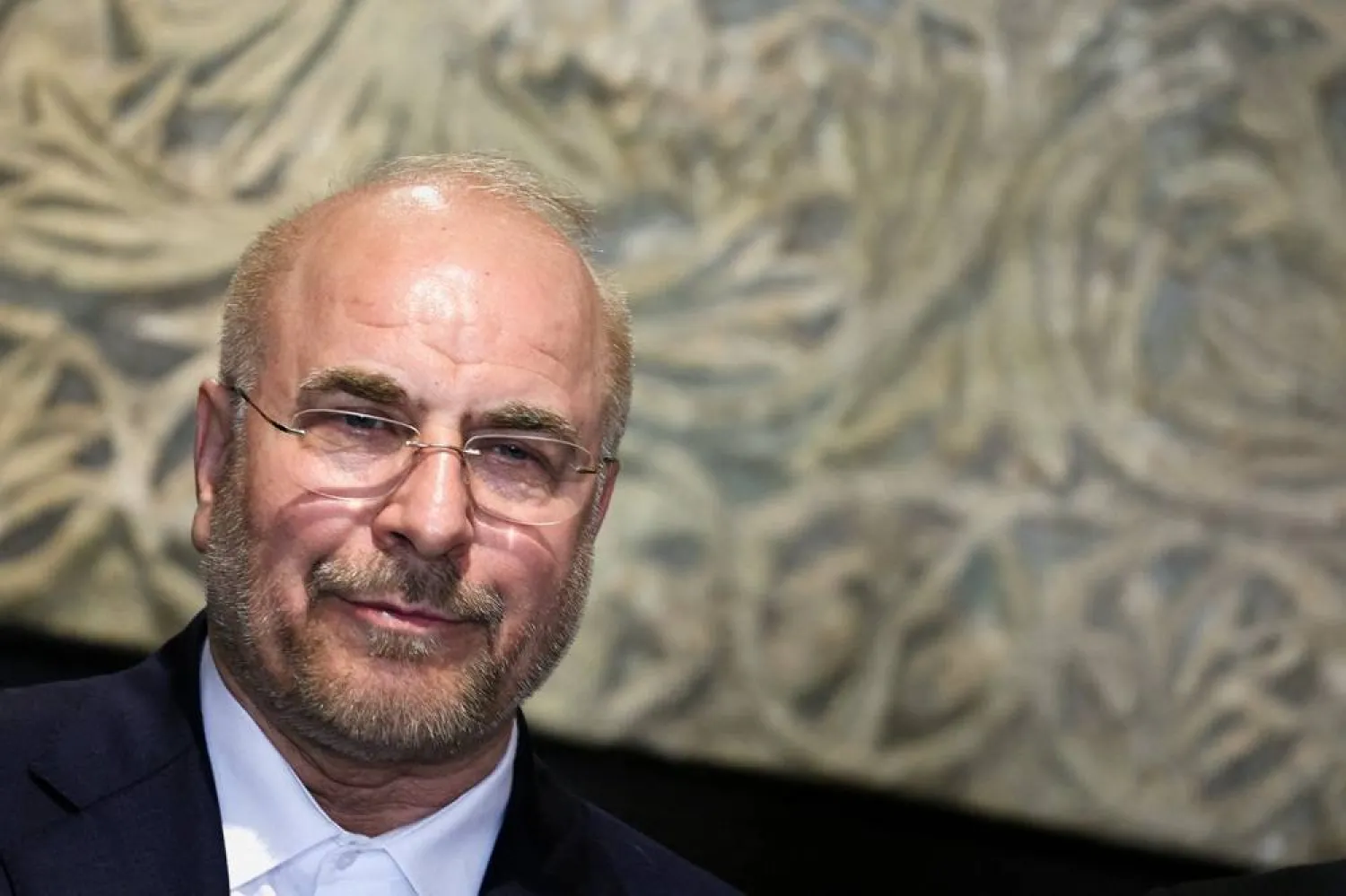
Iranian parliament Speaker Mohammad Baqer Qalibaf looks on after a press conference with Lebanese Parliament Speaker Nabih Berri, in Beirut, Lebanon, October 12, 2024. (Reuters)
TT

Iran Demands Lebanon Ceasefire, Unfreezing of Assets Before Peace Talks

Iranian parliament Speaker Mohammad Baqer Qalibaf looks on after a press conference with Lebanese Parliament Speaker Nabih Berri, in Beirut, Lebanon, October 12, 2024. (Reuters)

Iran said on Friday that blocked Iranian assets must be released and that a ceasefire must take hold in Lebanon before peace talks can proceed, throwing last-minute doubt over negotiations scheduled for Saturday in Pakistan.

Iran's parliament speaker Mohammad Baqer Qalibaf said on X that the two measures had been previously agreed with the US and warned that negotiations would not start until they are fulfilled.

There was no immediate comment from the ‌White House.

Earlier, Vice ‌President JD Vance, who will lead the ‌US delegation, ⁠set off for the ⁠talks in Pakistan saying he expected a positive outcome. But "if they're going to try to play us, then they're going to find the negotiating team is not that receptive", Vance added.

Iran has been unable to obtain tens of billions of dollars of its assets in foreign banks, mainly from exports of oil and gas, due to US sanctions on ⁠its banking and energy sectors.

TENUOUS TRUCE

US President Donald ‌Trump announced a two-week ceasefire in the ‌six-week war on Tuesday, just hours before a deadline after which he ‌had threatened to destroy Iran's civilization. However, the truce is tenuous with ‌Israel's continuing bombardment of Lebanon and the ongoing closure of the Strait of Hormuz proving key sticking points for both sides.

The ceasefire has halted the campaign of US and Israeli air strikes on Iran. But it has so ‌far done nothing to end the blockade of the strait, which has caused the biggest-ever disruption to global ⁠energy supplies, ⁠or to calm a parallel war waged by Israel against Iran's Hezbollah allies in Lebanon.

Iran was doing a "very poor job" of letting oil through the strait, Trump said in a social media post. He also warned Tehran against trying to collect fees from ships crossing it. "That is not the agreement we have!"

Israel has also said that its parallel campaign against Hezbollah in Lebanon was not part of the agreed ceasefire.

Israeli strikes continued across southern Lebanon on Friday, with more than a dozen people reported killed in various towns. One strike killed 13 members of Lebanese state security forces.


France to Try 14 over Channel Disaster that Left Iraqi Kurds Dead

15 June 2026, France, Berck: People thought to be migrants, who were previously detained by the French police, run across the sand as they try to board a small boat off the coast of Berck, France, during an attempt to cross the English Channel. Photo: Gareth Fuller/PA Wire/dpa
TT

France to Try 14 over Channel Disaster that Left Iraqi Kurds Dead

15 June 2026, France, Berck: People thought to be migrants, who were previously detained by the French police, run across the sand as they try to board a small boat off the coast of Berck, France, during an attempt to cross the English Channel. Photo: Gareth Fuller/PA Wire/dpa

Fourteen people will go on trial in France over the deaths of at least 27 migrants in November 2021 in the deadliest recorded small-boat crossing of the Channel, prosecutors said Tuesday.

The defendants, linked to people-smuggling networks, are accused of playing a role in the sinking in which at least 27 people, mainly Iraqi Kurds, died when their inflatable dinghy sank in the early hours of November 24, 2021.

Four others are still believed to remain missing, AFP reported.

The sinking remains the deadliest recorded small-boat crossing of the Channel, a route used by thousands of migrants each year to reach Britain from France.

The 14 individuals, most of them born in Afghanistan and Iraq, face charges including manslaughter and criminal conspiracy, the national organized crime prosecutor's office said, for roles ranging from drivers to those who organized the crossing.

Most deny any wrongdoing, with some Iraqi Kurdish defendants saying they were migrants rather than people smugglers.

It was not immediately clear when the trial would start.

In a separate probe linked to the sinking, at least seven French military personnel are under investigation for failing to help a person in danger.

A UK inquiry in February found some of the deaths would have been "avoidable" if British and French authorities had acted sooner to rescue those onboard.

Despite several distress calls, the boat was found by a French fishing vessel nearly 12 hours after the first pleas for help were made.

By that time, most of the people on board, including seven women and two children, had drowned.

France has long been a launchpad for migrants hoping to cross the Channel and start a better life in Britain.

Efforts by Britain and France to curb the crossings have largely failed, with some 41,000 people making the journey last year, the second-highest annual total after nearly 46,000 crossings in 2022.


Red Cross: Congo Ebola Epidemic Yet to Peak, May Last a Year

A doctor wearing personal protective equipment (PPE) sits in an ambulance at the Ebola Virus Disease Treatment Center at the Bunia General Reference Hospital, one month after cases were confirmed in Bunia, eastern Democratic Republic of Congo, June 15, 2026. REUTERS/Gradel Muyisa Mumbere
TT

Red Cross: Congo Ebola Epidemic Yet to Peak, May Last a Year

A doctor wearing personal protective equipment (PPE) sits in an ambulance at the Ebola Virus Disease Treatment Center at the Bunia General Reference Hospital, one month after cases were confirmed in Bunia, eastern Democratic Republic of Congo, June 15, 2026. REUTERS/Gradel Muyisa Mumbere

A Red Cross official said on Tuesday that the Ebola epidemic in eastern Democratic Republic of the Congo had not yet peaked, voicing fear it could last for a ⁠year.

"It's very difficult ⁠to know exactly to what extent the epidemic is spreading ... but yes, the ⁠peak is, I think, not behind us, but in front of us," Bruno Michon, operations manager for the Ebola outbreak for The International Federation of Red Cross and Red ⁠Crescent ⁠Societies, told reporters by video link from eastern Congo.

"We are afraid that this could last one year to end this disease.”

The number of confirmed Ebola cases in Democratic Republic of Congo has increased to 808, including 192 ⁠deaths, government data ⁠showed on Monday.

The number represented the ⁠total number of confirmed cases as of Sunday, according to a situation report that documented 26 new cases and ⁠11 new ⁠deaths in the previous 24 hours.

Medecins Sans Frontieres (MSF) has warned the window for containing the outbreak was narrowing. The worst outbreak was in West Africa in 2014-2016 and it killed more than 11,000 people.

“Diagnostics, surveillance, access to care, and community engagement must be urgently strengthened,” said Frederic Lai Manantsoa, MSF’s emergency coordinator in DRC.


US-Iran Deal Promises End to War but How It Will Work Remains Unclear

 Vessels at the Strait of Hormuz, as seen from Musandam, Oman, June 16, 2026. (Reuters)
Vessels at the Strait of Hormuz, as seen from Musandam, Oman, June 16, 2026. (Reuters)
TT

US-Iran Deal Promises End to War but How It Will Work Remains Unclear

 Vessels at the Strait of Hormuz, as seen from Musandam, Oman, June 16, 2026. (Reuters)
Vessels at the Strait of Hormuz, as seen from Musandam, Oman, June 16, 2026. (Reuters)

Doubts swirled around the US-Iran interim deal to end the war in the Middle East as shippers said it could take weeks for confidence to return after any reopening of the Strait of Hormuz, and fundamental questions remained unanswered.

US President Donald Trump said on Monday a preliminary agreement to end the conflict had been signed by the US and Iran, although details have yet to be made public and both countries said a permanent truce was yet to be negotiated.

The interim agreement would extend a tenuous ceasefire announced in April by another 60 days and reopen the Strait of Hormuz, which Iran has effectively blocked since the US and Israel attacked Iran in February.

Negotiators would address difficult issues like the future of Iran's nuclear program during the next phase of talks to be held during the 60-day window.

Two other issues that Trump and Israeli Prime Minister Benjamin Netanyahu used to justify the war - ending Iran's support for regional armed proxies and curbing its missile program - are not thought to be on the agenda for those negotiations.

"The deal's all signed," Trump said after he arrived ‌in France for a ‌summit of the G7 group of big economies. He said Vice President JD Vance would attend ‌a formal ⁠signing ceremony in Geneva ⁠on Friday.

Oil prices fell on Monday to their lowest level since March 10, shortly after the blockade of the Strait of Hormuz, a narrow waterway between Iran and Oman, cut off one-fifth of the world's oil trade.

But on Tuesday the price steadied, reflecting a more cautious stance, with Brent crude futures sliding 0.3% to $82.96 a barrel in Asian trading hours.

To be sure, the deal is the most significant step yet to resolve the conflict, which has killed at least 7,000 people, mostly in Iran and Lebanon, and upended global energy markets.

Iranian President Masoud Pezeshkian wrote on social media Monday that the interim agreement was an "important step" toward stopping the fighting but noted a final deal for a lasting truce "has yet to take shape."

Vance told CNN that the signed memorandum ⁠was a "very general document." Details would be released over the next two days, US officials said.

Vance said it ‌included "a very significant sanctions relief package" for Iran. He later told Fox News that Trump ‌may decide to release the agreement before Friday.

US officials, speaking on condition of anonymity, ‌said Iran would have to satisfy US demands never to build a nuclear weapon and cut off support for armed groups like Hezbollah in Lebanon in order to get benefits.

Iranian officials, who have always denied intending to build a nuclear weapon, say they have given up little by agreeing to resume diplomatic discussions over Iran's uranium enrichment program that were interrupted by the war.

REBUILDING CONFIDENCE

While the latest agreement could lift Iran's chokehold on the Strait of Hormuz, that only restores the prewar status ‌quo, and shippers say traffic will only restart once they are satisfied they can transit safely.

The chief executive of Japan's Mitsui O.S.K. Lines, a shipping giant with a fleet of more than 900 vessels ⁠including tankers, told the Financial Times shipowners ⁠would not sail through the Strait of Hormuz until they were confident the US-Iran deal was "material".

"Given the experiences in the last couple of months, I think it’s reasonable to assume that it may take at least a couple of weeks or if not a month," Tamura told the FT before Trump announced the deal.

The agreement between Washington and Tehran being finalized had not changed Tamura's view, the FT report said.

Iran has suggested it will retain control with Oman over the strait. The US said the strait will be open toll-free for 60 days and it would expect that provision to be part of a final agreement.

Trump said in a Truth Social post that ships loaded with oil were starting to move out of the strait, "going along the Southern 'Highway,' which is totally safe, secure, and pristine".

NETANYAHU 'STOOD FIRM'

The fighting between US ally Israel and the Iran-allied Hezbollah group in Lebanon, which has uprooted 1.2 million people, remains another key sticking point.

Iran has said the deal requires a full cessation of hostilities there, but Netanyahu said Israel would keep its forces in southern Lebanon and would retain the right to respond to Hezbollah attacks.

"Iran wanted us to withdraw from it, but I stood firm," he said on Monday at a news conference. Israel has not directly participated in the peace talks with Iran.

A US official said an Israeli withdrawal from Lebanon, which it invaded in March after Hezbollah joined the war, was not a condition of the deal.

Iranian Foreign Minister Abbas Araghchi said Israeli attacks must stop immediately.