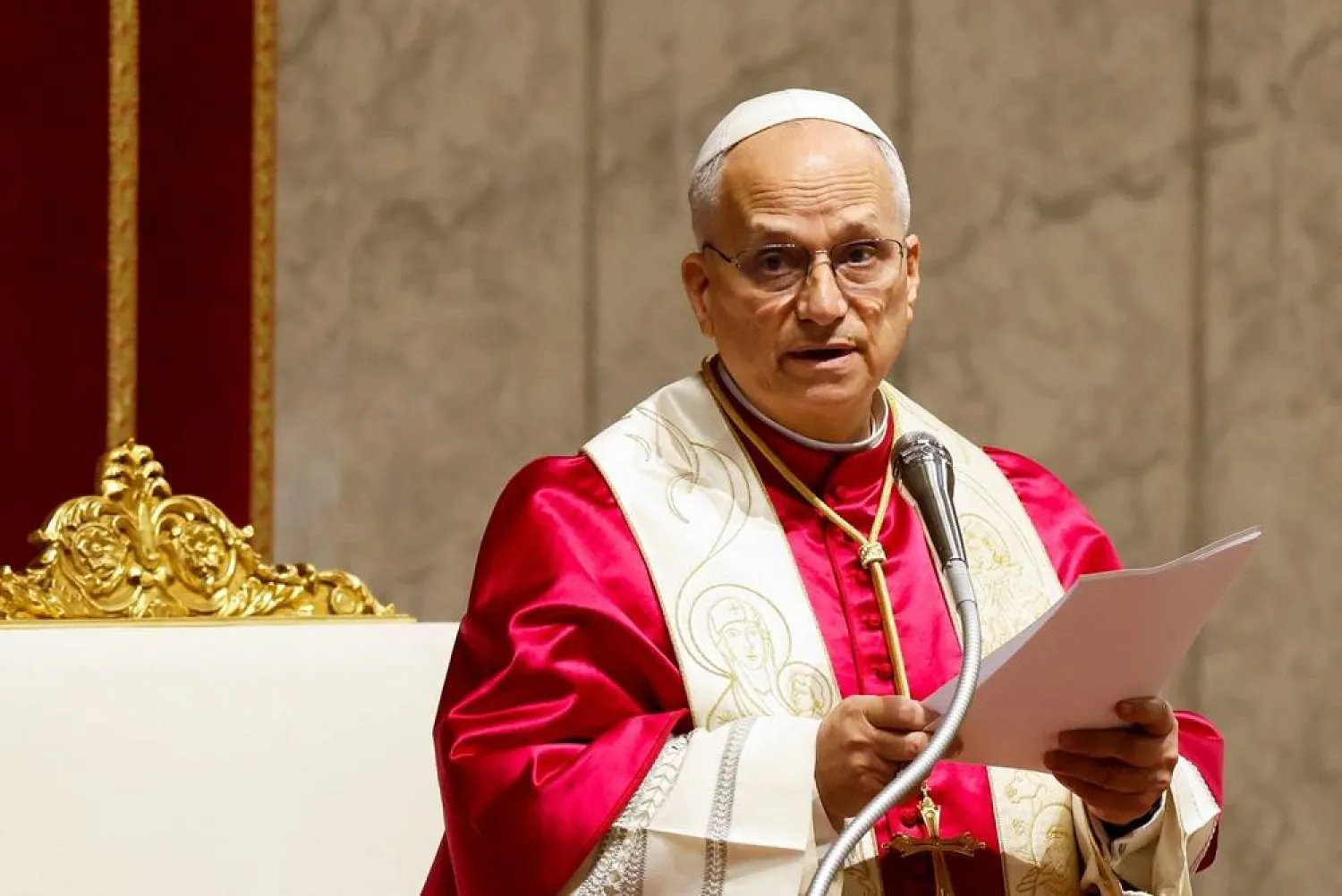
In Fiery Speech, Pope Leo Says ‘Enough to War!’

 Pope Leo XIV presides over a Prayer Vigil and Rosary for Peace, in Saint Peter's Basilica at the Vatican, April 11, 2026. (Reuters)
Pope Leo XIV presides over a Prayer Vigil and Rosary for Peace, in Saint Peter's Basilica at the Vatican, April 11, 2026. (Reuters)
TT

In Fiery Speech, Pope Leo Says ‘Enough to War!’

 Pope Leo XIV presides over a Prayer Vigil and Rosary for Peace, in Saint Peter's Basilica at the Vatican, April 11, 2026. (Reuters)
Pope Leo XIV presides over a Prayer Vigil and Rosary for Peace, in Saint Peter's Basilica at the Vatican, April 11, 2026. (Reuters)

Pope Leo lashed out against warmongers on Saturday while calling on billions of people around the globe to embrace peace and "believe once again in love, moderation and good politics".

In one of his most passionate entreaties yet to end the raging conflict in the Middle East, the American pope said faith was needed "in order to face this dramatic hour in history together".

"Enough of the idolatry of self and money! Enough of the display of power! Enough of war! True strength is shown in serving life," Pope Leo implored in an address during a prayer vigil for peace at St Peter's Basilica.

Uttered in measured tones, as is customary for the soft-spoken head of the world's 1.4 billion Catholics, the comments by the 70-year-old Leo nevertheless marked some of the most pointed criticism yet of the wave of conflicts inflaming the globe.

"Dear brothers and sisters, there are certainly binding responsibilities that fall to the leaders of nations. To them we cry out: Stop! It is time for peace! Sit at the table of dialogue and mediation, not at the table where rearmament is planned and deadly actions are decided!"

As he has done in the past, the Chicago native did not cite politicians by name, and did not call out specific countries.


Trump Expands US Sanctions on Cuban Government and Affiliates

People march while holding a giant Cuban national flag during a May Day rally in Havana, Cuba, May 1, 2026. (Reuters)
TT

Trump Expands US Sanctions on Cuban Government and Affiliates

People march while holding a giant Cuban national flag during a May Day rally in Havana, Cuba, May 1, 2026. (Reuters)

US President Donald Trump signed an executive order on Friday broadening US sanctions against the Cuban government, two White House officials told Reuters, as he seeks to put more pressure on Havana after ousting Venezuela's leader.

The fresh sanctions target people, entities and affiliates that support the Cuban government's security apparatus or are complicit in corruption or serious human rights violations, as well as agents, officials or supporters of the government, the officials said.

It was not immediately clear who exactly had been hit with sanctions under the order, which was first reported by Reuters.

But a copy of the order released by the White House said the sanctions could apply to "any ‌foreign person" operating ‌in the "energy, defense and related materiel, metals and mining, financial services, ‌or ⁠security sector of ⁠the Cuban economy, or any other sector of the Cuban economy."

The order authorizes secondary sanctions for conducting or facilitating transactions with those targeted under the order, the officials said.

Cuban President Miguel Diaz-Canel said the new "coercive" measures reinforce the US's "brutal, genocidal" blockade against the island.

"The blockade and its reinforcement cause so much harm because of the intimidating and arrogant behavior of the world's greatest military power," Diaz-Canel wrote on social media.

Cuba's foreign minister, Bruno Rodriguez, said the sanctions measures, which were announced as the island held its traditional May Day celebrations, ⁠aim to impose "collective punishment on the Cuban people" and that Cubans would not ‌be intimidated.

RATCHETING UP PRESSURE ON CUBAN GOVERNMENT

Jeremy Paner, a former ‌sanctions investigator at the US Treasury's Office of Foreign Assets Control, said the move was the most significant one ‌for non-American companies since the US embargo against Cuba began decades ago.

"Oil and gas, mining companies, ‌and banks that have carefully segregated their Cuba operations from the United States are no longer protected," said Paner, who is now a partner at Hughes Hubbard & Reed, a law firm.

The new sanctions are the latest broadside by the Trump administration against Cuba, which the president has repeatedly declared is near a state of collapse.

Under Trump, ‌US forces have launched strikes on boats allegedly carrying drugs off Venezuela and gone into Caracas to seize President Nicolas Maduro. Trump has said, without providing ⁠specifics, that "Cuba is ⁠next."

The officials said Trump's order contained an implicit warning to Cuba, accusing the Havana government of aligning itself with Iran and armed groups like Hezbollah.

"Cuba provides a permissive environment for hostile foreign intelligence, military, and terrorist operations less than 100 miles from the American homeland," one official said.

The US has long demanded Cuba open its state-run economy, pay reparations for properties expropriated by the government of former leader Fidel Castro and hold "free and fair" elections. Cuba has said its form of socialist government is not up for negotiation.

The US heaped additional sanctions and pressure on the island early this year, when it halted Venezuelan oil exports to Cuba after ousting Maduro on January 3. Trump later threatened to slap punishing tariffs on any other country that sent crude to Cuba, prompting Mexico, another top supplier, to stop shipments to the island.

The fuel shortage in Cuba has contributed to major national-level blackouts and prompted many foreign airlines to suspend flights to the island.


Mali Accuses Military Officers of Working with Extremists to Carry Out Attacks Against Govt

Commuters drive through the streets of Bamako, Mali, 27 April 2026. (EPA)
TT

Mali Accuses Military Officers of Working with Extremists to Carry Out Attacks Against Govt

Commuters drive through the streets of Bamako, Mali, 27 April 2026. (EPA)

Some military officers in Mali worked with extremists and separatists who recently launched their biggest round of attacks in over a decade in the conflict-battered country, authorities said late Friday.

The separatist fighters, meanwhile, said earlier in the day that they captured a strategic military camp in the northern town of Tessalit after the withdrawal of Mali's army and its Russian allies from there.

The claim by the Azawad Liberation Front separatist group was the latest setback for Mali’s ruling junta, which lost control of the major city of Kidal earlier in the week as part of the attacks that killed Malian Defense Minister Sadio Camara.

Mali has been run by the military since a 2020 coup and has long suffered violence as extremists groups expand in surrounding territories in the wider Sahel region south of the Sahara Desert, which is known as global hotspot for violent extremism.

The latest assault in the West African nation began Saturday after al-Qaeda-backed JNIM and the Azawad Liberation Front, or FLA, partnered to target the main international airport in the capital, Bamako, as well as other Malian towns and cities in near-simultaneous attacks, with the fighters riding on motorcycles and trucks.

A statement from the public prosecutor at the Military Court of Bamako, which was read on state television on Friday, noted that investigations found “solid evidence regarding the complicity of certain military personnel” in the attacks, including serving and recently dismissed officers.

The officers participated in “the planning, coordination, and execution” of the attacks, the prosecutor's statement said, while also alleging the involvement of politicians, including Oumar Mariko, a prominent Malian politician in exile.

Malian army withdraws from key town

Before the arrival of the FLA fighters Friday, the Malian army and members of Russia’s Africa Corp reportedly pulled out of the Tessalit military camp, which is strategically located near an airport and the border with Algeria.

Achafghi Ag Bouhanda, a top FLA commander, announced the capture of Tessalit in an online video verified by The Associated Press.

The AP could not independently confirm the situation at the camp. Malian authorities did not immediately respond to requests for comment.

At least 10 locations have been attacked by the militants since the latest assault began, forcing Malian and Russian forces to withdraw from the key northern city of Kidal, which was once a stronghold of the separatists.

The junta has vowed to continue its aerial and ground offensive against the militants.

“Military operations will continue until the armed groups involved have been completely neutralized and security has been sustainably restored throughout the country,” Assimi Goita, Malian military leader, said on Tuesday.

The extremists have at various times in recent days blocked roads leading to Mali’s capital Bamako, further squeezing the city that already was facing a fuel blockade imposed by the militants late last year.

JNIM earlier this week announced it would enforce a total blockade of Bamako's four major routes, which had previously been partially blocked by the militants.

Traffic leading to the city was disrupted Friday and there were reports of roadblocks. The partial blockade has forced some travel agencies to stop operating, travelers said.

“These days, traveling by road is a dangerous undertaking,” said Aminata Traoré, who travels between Bamako and the Sikasso region in the south of the country.


US to Withdraw About 5,000 Troops from Germany

US Secretary of Defense Pete Hegseth testifies during a Senate Armed Services Committee hearing on April 30, 2026 in the Dirksen Senate Office Building in Washington, DC. (Getty Images/AFP)
TT

US to Withdraw About 5,000 Troops from Germany

US Secretary of Defense Pete Hegseth testifies during a Senate Armed Services Committee hearing on April 30, 2026 in the Dirksen Senate Office Building in Washington, DC. (Getty Images/AFP)

US Defense Secretary Pete Hegseth has ordered the withdrawal of about 5,000 troops from Germany within the next year, the Pentagon said on Friday, in the latest rift in transatlantic ties over the Middle East war.

The move came as US President Donald Trump announced that tariffs on cars and trucks from the European Union will increase to 25 percent next week, accusing the bloc of not complying with a trade deal inked last summer.

Trump has renewed criticism of German Chancellor Friedrich Merz, who said Monday that Iran was "humiliating" Washington at the negotiating table. Trump said Merz "thinks it's OK for Iran to have a Nuclear Weapon. He doesn't know what he's talking about!"

On Wednesday, the American leader said Washington was "studying and reviewing the possible reduction" of US troops in Germany, and that he would decide in a "short period of time."

Pentagon spokesman Sean Parnell said in a Friday statement that "we expect the withdrawal to be completed over the next six to twelve months."

"This decision follows a thorough review of the Department's force posture in Europe and is in recognition of theater requirements and conditions on the ground," Parnell added.

During both of his terms in office, Trump has made a number of threats to slash US troop numbers in Germany and other European allies, saying he wants Europe to take on greater responsibility for its defense rather than depending on Washington.

Trump on Friday accused German automakers like Mercedes-Benz and BMW of ripping off Americans, saying that Germany and "other European nations have not adhered to our trade deal."

Germany would likely be hit hard by a sharp vehicle tariff, as it is responsible for a significant portion of EU auto exports.

- 'Why shouldn't I?' -

Trump now appears determined to punish allies who have failed to back the war or contribute to a peacekeeping force in the crucial Strait of Hormuz waterway, which Tehran's forces have effectively closed.

On Thursday, Trump said he may pull US troops from Italy and Spain due to their opposition to the war, telling reporters in the Oval Office: "Italy has not been of any help to us and Spain has been horrible, absolutely horrible."

"Yeah, probably, I probably will. Why shouldn't I?" Trump said.

As of December 31, 2025, there were 12,662 active-duty US troops in Italy and 3,814 in Spain. In Germany, there were 36,436.

Speaking during a visit to Morocco, German Foreign Minister Johann Wadephul said Thursday that Germany was "prepared" for a reduction in US troops and was "discussing it closely and in a spirit of trust in all NATO bodies."

While saying he was "relaxed" about the idea of fewer US troops in Germany, Wadephul said that large American bases in Germany are "not up for discussion at all."

He said for example that the Ramstein Air Base had "an irreplaceable function for the United States and for us alike."

- Ukraine support -

The EU said Thursday that the deployment of US troops in Europe was in Washington's interest, and that the United States was "a vital partner in contributing to Europe's security and defense."

Trump meanwhile took aim at Merz again, telling him to focus on ending the Ukraine war instead of "interfering" on Iran.

European powers have been on alert since Russia invaded Ukraine in 2022, and a spate of drone incursions in the last year -- as well as US promises to move away from defending the continent -- have pushed the issue to the top of the agenda.

Merz has made national security a priority, announcing unprecedented investments in an army that has been underfunded and under-equipped for decades.

He has also reaffirmed support for Ukraine, for whom Germany has been the second-largest individual supplier of aid after the US.