


Trump Threatens Strait of Hormuz Blockade after US-Iran Ceasefire Talks End without Agreement

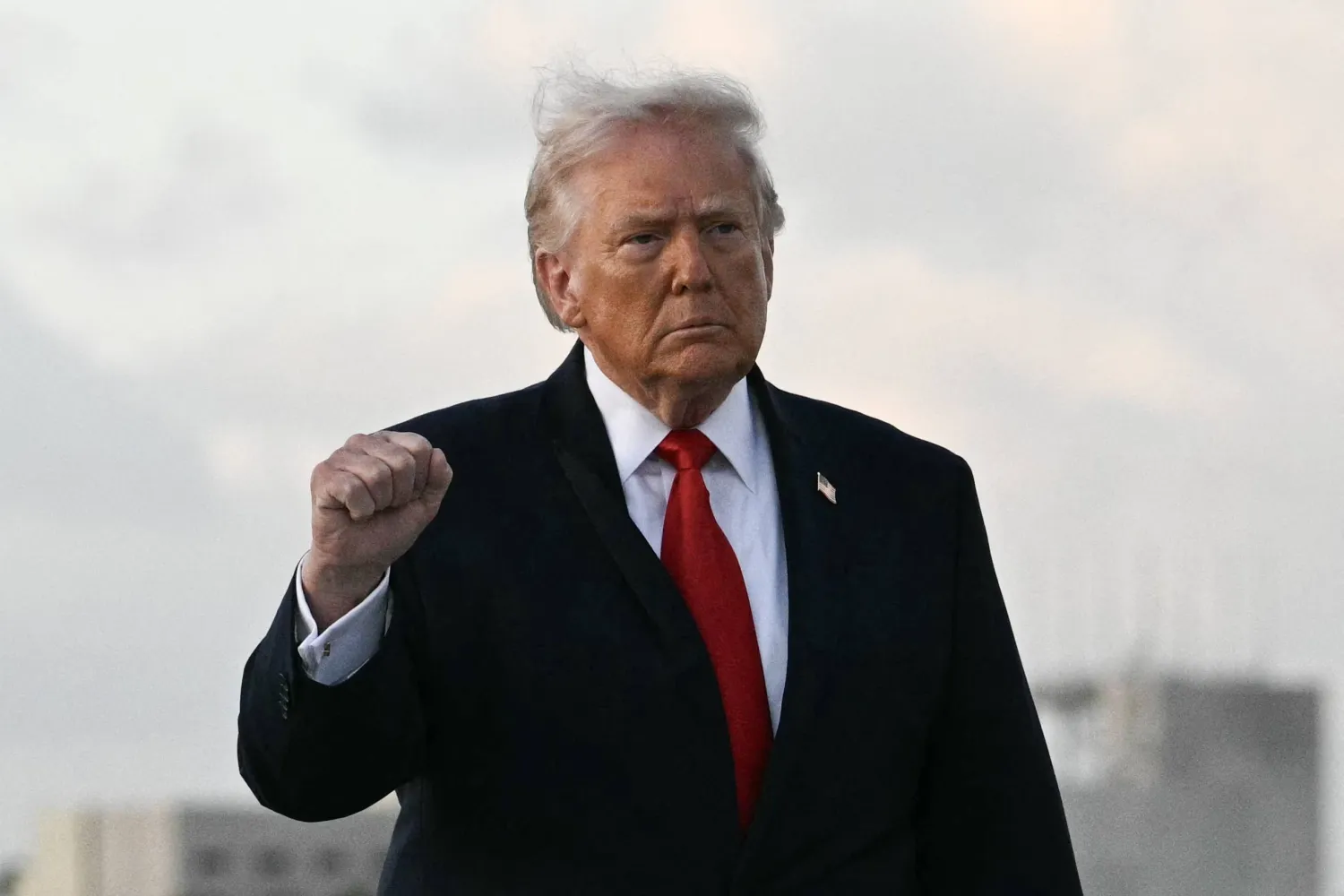
US President Donald Trump makes a fist upon arrival at Miami International Airport in Miami, on April 11, 2026. Trump is traveling to Florida to attend a UFC event and spend the weekend at his Mar-a-Lago residence. (Photo by Jim WATSON / AFP)
TT

Trump Threatens Strait of Hormuz Blockade after US-Iran Ceasefire Talks End without Agreement

US President Donald Trump makes a fist upon arrival at Miami International Airport in Miami, on April 11, 2026. Trump is traveling to Florida to attend a UFC event and spend the weekend at his Mar-a-Lago residence. (Photo by Jim WATSON / AFP)

President Donald Trump on Sunday said the US Navy would “immediately” begin a blockade to stop ships from entering or leaving the Strait of Hormuz, after US-Iran peace talks in Pakistan ended without an agreement.

Trump sought to exert strategic control over the waterway responsible for the transportation of 20% of global oil supplies before the war, hoping to take away Iran’s key source of economic leverage in the fighting.

The president added that he has “instructed our Navy to seek and interdict every vessel in International Waters that has paid a toll to Iran. No one who pays an illegal toll will have safe passage on the high seas.”

Trump also said the US was ready to “finish up” Iran at the “appropriate moment," stressing that Tehran's nuclear ambitions were at the core of the failure to end the war.

Face-to-face talks ended earlier Sunday after 21 hours, leaving a fragile two-week ceasefire in doubt.

US officials said the negotiations collapsed over what they described as Iran’s refusal to commit to abandoning a path to a nuclear weapon, while Iranian officials blamed the US for the breakdown of the talks without specifying the sticking points.

Neither side indicated what will happen after the 14-day ceasefire expires on April 22. Pakistani mediators urged all parties to maintain it. Both said their positions were clear and put the onus on the other side, underscoring how little the gap had narrowed throughout the talks, The AP news reported.

“We need to see an affirmative commitment that they will not seek a nuclear weapon, and they will not seek the tools that would enable them to quickly achieve a nuclear weapon,” Vice President JD Vance said after the talks.

Iran’s parliament speaker Mohammad Bagher Qalibaf, who led Iran in the negotiations, said it was time for the United States “to decide whether it can gain our trust or not.”

He did not mention the core disputes in a series of social media posts, though Iranian officials earlier said the talks fell apart over two or three key issues, blaming what they called US overreach.

Pakistani Foreign Minister Ishaq Dar said his country will try to facilitate a new dialogue between Iran and the US in the coming days.

“It is imperative that the parties continue to uphold their commitment to cease fire,” Dar said.

The deadlock — and Vance’s take-it-or-leave-it proposal that Iran end its nuclear program — mirrored February’s nuclear talks in Switzerland. Though Trump has said the subsequent war was meant to compel Iran’s leaders to abandon nuclear ambitions, each side's positions appeared unchanged in negotiations following six weeks of fighting.

An Iranian diplomatic official, speaking on the condition of anonymity because of the sensitivity of the closed-door talks, denied that negotiations had failed over Iran's nuclear ambitions.

“Iran is not seeking to acquire nuclear weapons, but it has the right to nuclear energy for peaceful purposes,” they said, reiterating Iran's longstanding negotiating position.

There was no word on whether they would resume, though Iran said it was open to continuing the dialogue, Iran’s state-run IRNA news agency reported.

“We have never sought war. But if they try to win what they failed to win on the battlefield through talks, that’s absolutely unacceptable,” 60-year-old Mohammad Bagher Karami said in downtown Tehran.



Cuba's President Warns US Against Attacking Island or Trying to Depose Him

Children walk down a street in Havana, Cuba, 09 April 2026 (issued 10 April 2026). EPA/ERNESTO MASTRASCUSA
TT

Cuba's President Warns US Against Attacking Island or Trying to Depose Him

Children walk down a street in Havana, Cuba, 09 April 2026 (issued 10 April 2026). EPA/ERNESTO MASTRASCUSA

Cuban President Miguel Díaz-Canel said the US has no valid reason to carry out a military attack against the island or to attempt to depose him.

Speaking in an interview on NBC News’ Meet the Press program, the president said an invasion of Cuba would be costly and affect regional security. But should it happen, Díaz-Canel said, Cubans would defend themselves.

“If the time comes, I don’t think there would be any justification for the United States to launch a military aggression against Cuba, or for the US to undertake a surgical operation or the kidnapping of a president,” Díaz-Canel said, speaking through a translator.

He added: “If that happens, there will be fighting, and there will be a struggle, and we will defend ourselves, and if we need to die, we’ll die, because as our national anthem says, ‘Dying for the homeland is to live'.”

His comments come as tensions between Cuba and the US remain high despite both sides acknowledging talks, although no details have been shared.

Díaz-Canel has accused the US government of implementing a “hostile policy” against Cuba and said it has “no moral to demand anything from Cuba.” He noted that Cuba is interested in engaging in dialogue and discussing any topic without conditions, “not demanding changes from our political system as we are not demanding change from the American system, about which we have a number of doubts.”

Cuba blames a US energy blockade for its deepening woes, with a lack of petroleum affecting the island’s health system, public transportation and the production of goods and services.

Cuba produces only 40% of the fuel it consumes, and it stopped receiving key oil shipments from Venezuela after the US military attacked the South American country in early January, seized President Nicolás Maduro and took him to New York to face drug trafficking charges. Then, with cooperation from ruling party leaders, the Trump administration began implementing a phased plan to end Venezuela’s entrenched crisis.

The arrival of a Russian tanker carrying 730,000 barrels of crude oil in Cuba in March marked the island’s first oil shipment in three months. Russia has promised to send a second tanker.

Despite threatening tariffs in January on countries that sell or provide oil to Cuba, the Trump administration allowed the tanker to proceed.

“Cuba’s finished,” President Donald Trump said at the time. “They have a bad regime. They have very bad and corrupt leadership and whether or not they get a boat of oil, it’s not going to matter.”

According to The Associated Press, Díaz-Canel said his government takes Trump’s words as a warning.

“You hear that Cuba is next, that Cuba is going to be next, that there are, there’s a way out, that they’re going to take over Cuba,” he said. “So, from the position of responsibility within the leadership of the country, that is a warning. And we need to responsibly protect our people, protect our project and protect our country.”


Some 100 People killed in Mistaken Air Force Attack on Nigerian Market

FILE - Nigerian soldiers ride on an armored personnel carrier during Eid al-Fitr celebrations in Maiduguri, in Borno state, Nigeria. Thursday, Aug. 8, 2013. (AP Photo/Sunday Alamba, File)
TT

Some 100 People killed in Mistaken Air Force Attack on Nigerian Market

FILE - Nigerian soldiers ride on an armored personnel carrier during Eid al-Fitr celebrations in Maiduguri, in Borno state, Nigeria. Thursday, Aug. 8, 2013. (AP Photo/Sunday Alamba, File)

A Nigerian Air Force strike targeting rebels hit a local market in northeastern Nigeria, killing over 100 residents and injuring many others, a rights group and local media reported on Sunday. Officials confirmed a misfire but did not provide details.

Amnesty International said it confirmed from survivors that at least 100 people were killed in the airstrike on a village in Yobe state near the border with Borno state, the epicenter of the militant insurgency ravaging the region for over a decade.

Such misfires are common in Nigeria where the military often conducts air raids to battle armed groups who use vast forest enclaves. The air raids have ended up killing at least 500 civilians since 2017, according to an AP tally of reported deaths. Security analysts point to loopholes in intelligence gathering as well as insufficient coordination between ground troops, air assets, and stakeholders.

The Yobe State Government confirmed in a statement that a Nigerian military strike was targeting a stronghold of the Boko Haram militant group in the area and that “some people ... who went to the Jilli weekly market were affected.”

“We are in touch with people that are there, we spoke with the hospital. We spoke with the person in charge of casualties and we spoke with the victims,” Isa Sanusi, Amnesty International Nigeria director, told The Associated Press.

The Nigerian Air Force did not immediately respond to an AP inquiry.


Putin Offers to Mediate Peace in Call with Pezeshkian, Tehran Says 3,375 Killed in US-Israel war

Rusya Devlet Başkanı Vladimir Putin, Moskova’daki Kurtarıcı İsa Katedrali’nde düzenlenen Ortodoks Paskalyası ayininde (AFP)
TT

Putin Offers to Mediate Peace in Call with Pezeshkian, Tehran Says 3,375 Killed in US-Israel war

Rusya Devlet Başkanı Vladimir Putin, Moskova’daki Kurtarıcı İsa Katedrali’nde düzenlenen Ortodoks Paskalyası ayininde (AFP)

Russian President Vladimir Putin told his Iranian counterpart Masoud Pezeshkian on Sunday that he was ready to help mediate efforts to achieve peace in the Middle East, the Kremlin said, AFP reported.

"Vladimir Putin emphasized his readiness to further facilitate the search for a political and diplomatic settlement to the conflict, and to mediate efforts to achieve a just and lasting peace in the Middle East," the Kremlin said in its readout of the call.

This came as head of the Iranian Legal Medicine Organization, which sits under the country's judiciary, said on Sunday that 3,375 people in Iran had been killed in the war with the United States and Israel.

"During the recent imposed war, the bodies of 3,375 martyrs were identified by the Legal Medicine Organization using scientific and specialised methods," said Abbas Masjedi, state news agency IRNA reported.

He said the toll included 2,875 males and 496 females, without specifying if they were adults or children, according to the agency.