Some 100 People killed in Mistaken Air Force Attack on Nigerian Market

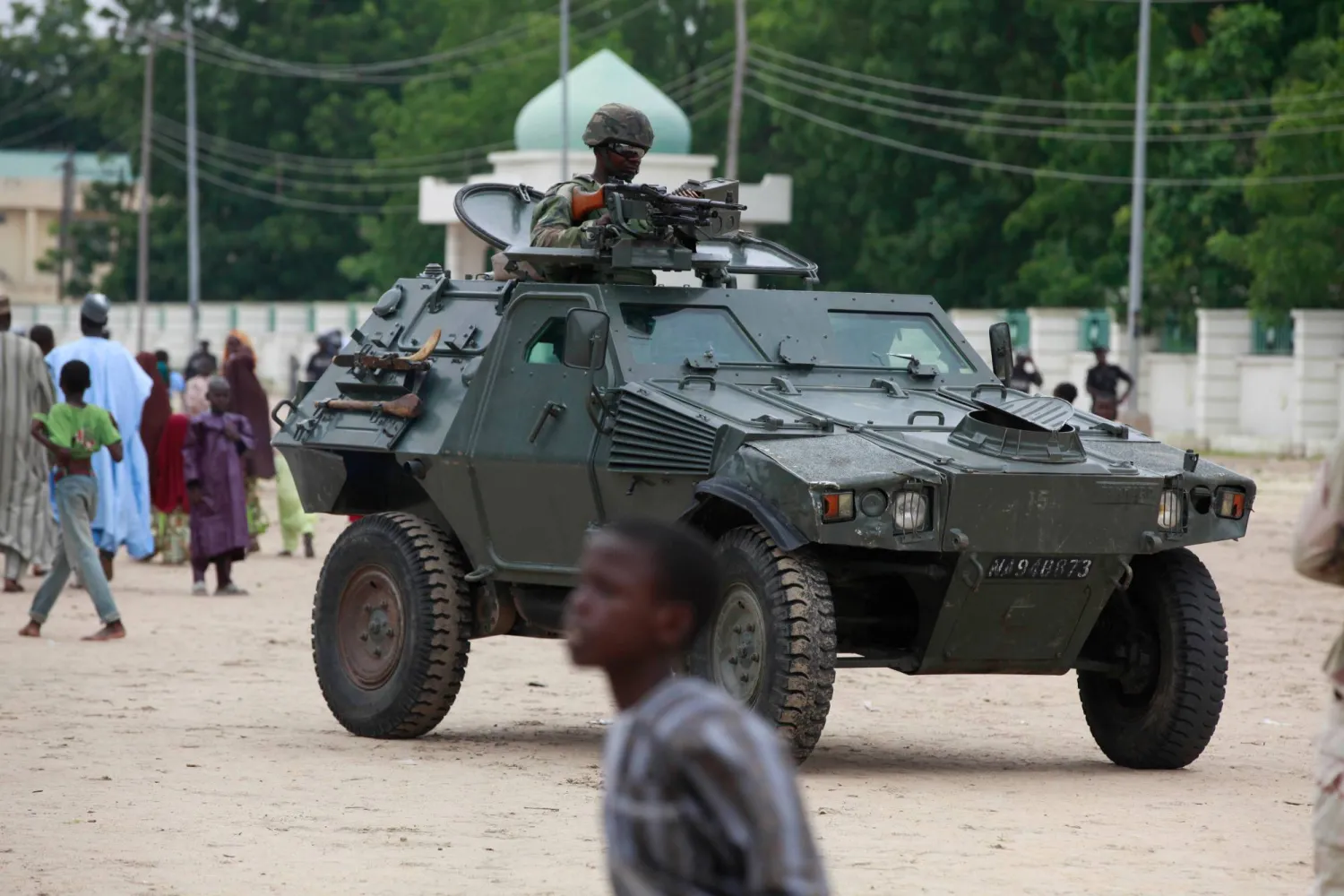
FILE - Nigerian soldiers ride on an armored personnel carrier during Eid al-Fitr celebrations in Maiduguri, in Borno state, Nigeria. Thursday, Aug. 8, 2013. (AP Photo/Sunday Alamba, File)
TT

Some 100 People killed in Mistaken Air Force Attack on Nigerian Market

FILE - Nigerian soldiers ride on an armored personnel carrier during Eid al-Fitr celebrations in Maiduguri, in Borno state, Nigeria. Thursday, Aug. 8, 2013. (AP Photo/Sunday Alamba, File)

A Nigerian Air Force strike targeting rebels hit a local market in northeastern Nigeria, killing over 100 residents and injuring many others, a rights group and local media reported on Sunday. Officials confirmed a misfire but did not provide details.

Amnesty International said it confirmed from survivors that at least 100 people were killed in the airstrike on a village in Yobe state near the border with Borno state, the epicenter of the militant insurgency ravaging the region for over a decade.

Such misfires are common in Nigeria where the military often conducts air raids to battle armed groups who use vast forest enclaves. The air raids have ended up killing at least 500 civilians since 2017, according to an AP tally of reported deaths. Security analysts point to loopholes in intelligence gathering as well as insufficient coordination between ground troops, air assets, and stakeholders.

The Yobe State Government confirmed in a statement that a Nigerian military strike was targeting a stronghold of the Boko Haram militant group in the area and that “some people ... who went to the Jilli weekly market were affected.”

“We are in touch with people that are there, we spoke with the hospital. We spoke with the person in charge of casualties and we spoke with the victims,” Isa Sanusi, Amnesty International Nigeria director, told The Associated Press.

The Nigerian Air Force did not immediately respond to an AP inquiry.


Netanyahu Acknowledges Difficulty Influencing Trump's Decisions on Iran

US President Donald Trump speaks alongside Israeli Prime Minister Benjamin Netanyahu during a meeting in the Oval Office of the White House in Washington DC, April 2025 (Reuters)
TT

Netanyahu Acknowledges Difficulty Influencing Trump's Decisions on Iran

US President Donald Trump speaks alongside Israeli Prime Minister Benjamin Netanyahu during a meeting in the Oval Office of the White House in Washington DC, April 2025 (Reuters)

Israeli Prime Minister Benjamin Netanyahu has told confidants in private conversations that Israel has little ability to influence US President Donald Trump’s decision-making on Iran as the president negotiates a deal in the nearly three-month-old war, according to two sources speaking to Reuters on Monday.

Netanyahu’s comments, described by two Israeli officials with knowledge of the conversations, come as Israel has largely been left out of talks to reach an initial deal to halt a war that began with joint US-Israeli strikes on February 28.

Both the US and Iran have played down hopes for an imminent breakthrough in talks, and they remain at odds over Iran's nuclear ambitions, Tehran's demands for the lifting of sanctions and the cessation of Israeli military attacks in south Lebanon.

Israeli Concerns

One of the Israeli officials, involved in Netanyahu's private conversations, said the Israeli leader had expressed concerns about the memorandum of understanding currently being negotiated. Both of the sources spoke ⁠on condition of anonymity to discuss private conversations.

The agreement would see Iran open the Strait of Hormuz in exchange for the US lifting its naval blockade, a senior Trump administration official said, followed by further negotiations on nuclear issues.

The US and Iran have been holding indirect talks mediated by Pakistan.

Iranian sources have told Reuters that in future stages, “feasible formulas” could be found to resolve the dispute over its highly enriched uranium stockpile, including diluting the material under the supervision of the UN nuclear watchdog.

Despite the agreement not immediately addressing Israel's concerns over Iran's nuclear program and stockpile, Netanyahu acknowledges that Israel “has no maneuver to influence the president right now,” the Israeli official said.

Netanyahu's office did not immediately respond to a request for comment.

Trump and Netanyahu have spoken by phone at least three times in the last week, a period during which Israeli officials said the country had made preparations for a return to joint air strikes with the US on Iran, targeting energy infrastructure.

After the first of their three conversations, on Tuesday night, Trump was asked by reporters what he told Netanyahu.

“He's a very good man, he'll do whatever I want him to do,” Trump said.

The two men spoke again on Friday night. On Saturday, after Trump held a joint call with leaders from ⁠the Gulf, Türkiye and Pakistan to update them on the status of the Iran negotiations, Trump and Netanyahu spoke for a third time.

After that call, Netanyahu, who had yet to publicly comment on any emerging deal with Iran, said in a statement that he and Trump discussed the “memorandum of understanding to reopen the Strait of Hormuz and the upcoming negotiations toward a final agreement on Iran's nuclear program.”

Netanyahu said he and Trump “agreed that any final agreement... means dismantling Iran's nuclear enrichment sites and removing its enriched nuclear material from its territory.”

He also said Trump “reaffirmed Israel's right to defend itself against threats on every front, including Lebanon.”

Israel and Hezbollah have continued fighting despite an April 16 ceasefire, struck after ⁠the US and Iran agreed to a broader truce.

Israeli troops have remained deployed across a swathe of southern Lebanon and the military has continued to carry out air strikes targeting Hezbollah, while the militants have fired drones towards troops and into northern Israeli towns.

Netanyahu Under Pressure Before Election

The deal's emergence comes at a sensitive time for Netanyahu ahead of a national election he is projected to lose. His opponents have criticized him for having failed to achieve his stated objectives in ⁠the war.

At the start of the US-Israeli attacks on Iran on February 28, Netanyahu said Israel aimed to create the conditions to topple Iran's clerical government, eliminate its nuclear and ballistic missile capabilities, and cripple its ability to project power across the region.

Trump gave a final order to launch the Iran operation after Netanyahu argued in a conversation with the US president for their forces' joint killing of Supreme Leader Ali Khamenei, ⁠Reuters has reported. Khamenei was killed in the first strikes.

Israeli and US war objectives have diverged since then, with the US focused on reopening the Strait of Hormuz, which before the war had carried a fifth of global shipments of oil and liquefied natural gas.

In a CBS TV interview this month, Netanyahu stressed that more needed to be done to ensure enriched uranium exits Iran, that it ends its support for regional proxies, and that it stops producing ballistic missiles.

“... there's work to be done,” Netanyahu said.


US Carries Out 'Self-defense' Strikes in Iran, Rubio Says Deal Still Possible Within Days

A woman walks next to a huge billboard in a street in Tehran, Iran, 25 May 2026. EPA/ABEDIN TAHERKENAREH
TT

US Carries Out 'Self-defense' Strikes in Iran, Rubio Says Deal Still Possible Within Days

A woman walks next to a huge billboard in a street in Tehran, Iran, 25 May 2026. EPA/ABEDIN TAHERKENAREH

The US military has said that it carried out “self-defense” strikes in southern Iran, including on missile launch sites and boats placing mines, even as President Donald Trump said on social media that negotiations with Tehran were “proceeding nicely.”

The strikes were done “to protect our troops from threats posed by Iranian forces,” but the military was “using restraint during the ongoing ceasefire,” Capt. Tim Hawkins, the spokesman for the US military's Central Command, said in a statement on Monday.

Further details were not immediately available, including more specifics on the threats from Iran and what this means for negotiations. There was no official response from Iran, which had sent its parliament speaker Mohammad Bagher Qalibaf to Qatar for negotiations over the possible deal with the US.

In Iran, the news website Tabnak, believed to be close to former Revolutionary Guard chief Mohsen Rezaei, identified four dead Guard troops it said had been killed in American strikes on boats.

Iranian state television separately reported blasts around Bandar Abbas, a city on the Strait of Hormuz home to a military port and a dual-use airport.

The strikes were the latest attacks to shake the weekslong ceasefire in the war. The Strait of Hormuz, through which a fifth of all crude oil and natural gas traded once passed, remains effectively in Iran's chokehold, disrupting global energy markets.

US Secretary of State Marco Rubio said on Tuesday that a deal with Iran was still possible despite the new American strikes.

"There were some talks going on in Qatar today, so we'll see if we can make progress. I think it's a lot of talking back and forth going on about specific language in the initial document, so it'll take a few days," Rubio told reporters in Jaipur during a visit to India.

"The president's expressed his desire to make it. He's either going to make a good deal or no deal," he said.

Rubio told reporters that "the straits have to be open.”

"They're going to be open one way or the other, so they need to be open. What's happening there is unlawful, it's illegal, it's unsustainable for the world, it's unacceptable."


WHO Urges DR Congo's Neighbors to Act Immediately on Ebola Risk

Response team members are helped to wear protective suits before burying a person suspected of having died from Ebola in Bunia, in the eastern Democratic Republic of the Congo, on May 25, 2026. (AFP)
TT

WHO Urges DR Congo's Neighbors to Act Immediately on Ebola Risk

Response team members are helped to wear protective suits before burying a person suspected of having died from Ebola in Bunia, in the eastern Democratic Republic of the Congo, on May 25, 2026. (AFP)

States neighboring the Democratic Republic of Congo are at great danger from Ebola and should act immediately to counter the deadly virus, the head of the World Health Organization said on Monday.

"Countries bordering DRC are at especially high risk and should take immediate action," said WHO director-general Tedros Adhanom Ghebreyesus, adding that he would travel on Tuesday to the DRC, the vast, central African country at the epicenter of the current outbreak.

"The outbreak is spreading rapidly," Tedros told a virtual ministerial meeting on the viral hemorrhagic fever, which spreads through direct contact with bodily fluids. It can cause severe bleeding and organ failure.

He said the current outbreak was "especially challenging".

"First, the delay in detecting the outbreak means that we are now playing catch-up with a very fast-moving epidemic. We are urgently scaling up operations but at the moment, the epidemic is outpacing us," he said by video link from Geneva.

Secondly, the eastern provinces of the DRC, where the outbreak was first detected in mid-May, "are highly insecure, with intensified fighting in recent months (and) there is also significant distrust of outside authorities among the local population".

Thirdly, he pointed out, there were "no approved vaccines or therapeutics" for the Bundibugyo strain of Ebola behind the current outbreak.

The WHO has recorded 10 confirmed Ebola deaths and 220 suspected deaths in the DRC since mid-May, while also recording a further 900 suspected cases since Kinshasa declared the outbreak on May 15.

The United Nations agency said the true spread of the virus -- which experts suspect was circulating under the radar for some time -- was probably much wider.

One person is confirmed dead in neighboring Uganda with a further six confirmed infected after Monday saw the health ministry confirm two new cases.

Ten other African countries are "at risk" of infection, the African Union's health agency, Africa CDC, warned on Saturday.

These are Angola, Burundi, the Central African Republic, the Republic of Congo, Ethiopia, Kenya, Rwanda, South Sudan, Tanzania and Zambia.

- Building trust -

Africa CDC head Jean Kaseya said "high mobility and insecurity" contributed to the regional spread of the outbreak, which the WHO has declared an international emergency.

Insecurity is a huge obstacle in the eastern DRC, which has been plagued for three decades by conflict involving a litany of armed groups.

State services in rural areas of Ituri province have been largely absent for decades.

South Kivu province is controlled by the M23 armed group, which has never managed an epidemic like Ebola.

Tedros said it was vital to address the trust deficit in Ebola-affected communities.

Two hospitals in Ituri have been attacked by suspicious locals in the past five days -- one in Mongbwala, where the outbreak was initially detected, and the other in Rwampara, where tents used to isolate Ebola patients were torched.

The violence in Rwampara erupted after a deceased man's family was prevented from taking his body away for burial because of contamination risks.

"Loved ones are throwing themselves at the bodies, touching the corpses... while organizing mourning rituals bringing together loads of people," Jean Marie Ezadri, a civil society leader in Ituri, told AFP last week.

Tedros said the WHO was pouring money, medical supplies and staff into the DRC to support the authorities and speeding up clinical trials on potential treatments.

"It will get worse before it gets better," he said. "But we know this virus and we know how to stop it."