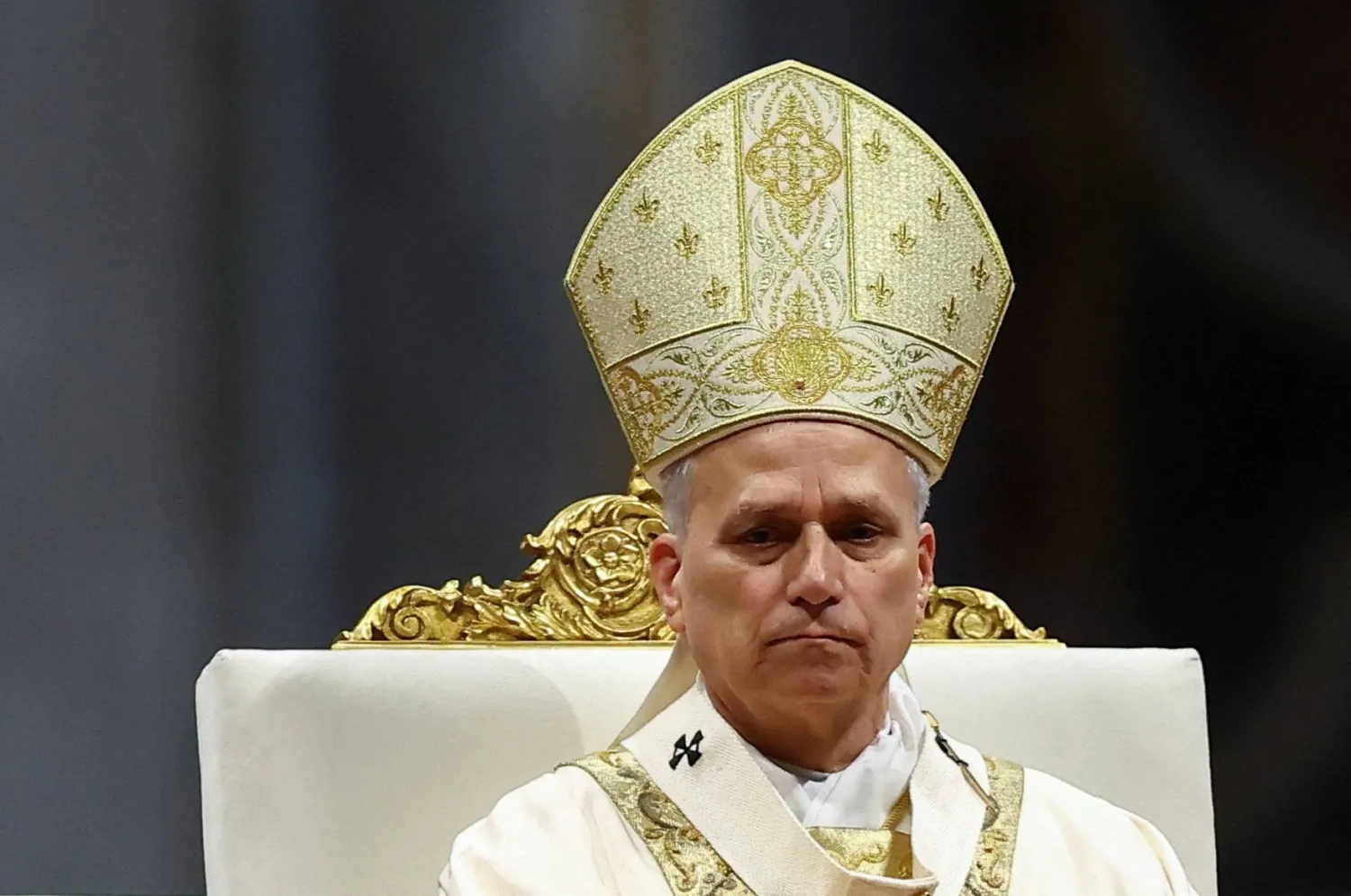
Trump Lambasts Pope Leo XIV, Calls him Weak on Crime

Pope Leo XIV leads the Chrism Mass in St. Peter's Basilica at the Vatican, April 2, 2026. REUTERS/Guglielmo Mangiapane
TT

Trump Lambasts Pope Leo XIV, Calls him Weak on Crime

Pope Leo XIV leads the Chrism Mass in St. Peter's Basilica at the Vatican, April 2, 2026. REUTERS/Guglielmo Mangiapane

President Donald Trump delivered an extraordinary broadside against Pope Leo XIV on Sunday night, saying he didn't think the US-born global leader of the Catholic Church is “doing a very good job” and that “he's a very liberal person," while also suggesting the pontiff should “stop catering to the Radical Left.”

Flying back to Washington from Florida, Trump used a lengthy social media post to sharply criticize Leo, then kept it up after deplaning, in comments on the tarmac to reporters.
“I’m not a fan of Pope Leo,” The Associated Press quoted him as saying.

Trump's comments came after Leo suggested over the weekend that a “delusion of omnipotence” is fueling the US-Israel war in Iran. While it’s not unusual for popes and presidents to be at cross purposes, it’s exceedingly rare for the pope to directly criticize a US leader — and Trump’s stinging response is equally uncommon, if not more so.

“Pope Leo is WEAK on Crime, and terrible for Foreign Policy,” the president wrote in his post, adding, “I don’t want a Pope who thinks it’s OK for Iran to have a Nuclear Weapon."
He repeated that sentiment in comments to reporters, saying, “We don’t like a pope who says it’s OK to have a nuclear weapon.”

Later, Trump posted a picture suggesting he had saint-like powers akin to those of Jesus Christ. Wearing a biblical-style robe, Trump is seen laying hands on a bedridden man as light emanates from his fingers, while a soldier, a nurse, a praying woman and a bearded man in a baseball cap all look on admiringly. The sky above is filled with eagles, an American flag and vaporous images.

All of that came after Leo presided over an evening prayer service in St. Peter’s Basilica on Saturday, the same day the United States and Iran began face-to-face negotiations in Pakistan during a fragile ceasefire. The pope didn’t mention the United States or Trump by name, but his tone and message appeared directed at Trump and US officials, who have boasted of US military superiority and justified the war in religious terms.


Strikes on Alleged Drug Boats Kill 5, Leave 1 Survivor in Eastern Pacific

President Donald Trump speaks with reporters after disembarking Air Force One, Sunday, April 12, 2026, at Joint Base Andrews, Md. (AP Photo/Julia Demaree Nikhinson)
TT

Strikes on Alleged Drug Boats Kill 5, Leave 1 Survivor in Eastern Pacific

President Donald Trump speaks with reporters after disembarking Air Force One, Sunday, April 12, 2026, at Joint Base Andrews, Md. (AP Photo/Julia Demaree Nikhinson)

The US military said Sunday that it blew up two boats accused of smuggling drugs in the eastern Pacific Ocean, killing a total of five people and leaving one survivor, as the Trump administration pursues its campaign against alleged traffickers in Latin America while preparing a naval blockade of Iranian ports.

The attacks on Saturday bring the number of people who have been killed in boat strikes by the US military to at least 168 since the Trump administration began targeting those it calls “narcoterrorists” in early September.

As with most of the military’s statements on the dozens of strikes in the eastern Pacific and Caribbean Sea, US Southern Command said it targeted the alleged drug traffickers along known smuggling routes.

The military did not provide evidence that the vessel was ferrying drugs. Videos posted on X showed small boats moving across the water before they each were engulfed in a bright explosion, The Associated Press reported.

US Southern Command stated on X that it notified the US Coast Guard to activate the search-and-rescue system for the survivor. The Coast Guard confirmed it was coordinating the search and said updates would be provided when available.

President Donald Trump has said the US is in “armed conflict” with cartels in Latin America and has justified the attacks as a necessary escalation to stem the flow of drugs into the United States and fatal overdoses claiming American lives. But his administration has offered little evidence to support its claims of killing “narcoterrorists.”

Critics have questioned the overall legality of the boat strikes as well as their effectiveness, in part because the fentanyl behind many fatal overdoses is typically trafficked to the US over land from Mexico, where it is produced with chemicals imported from China and India.


As US Talks Fail, Iranians Caught Between ‘War and Peace’

People walk past a wall mural along the roadside in Tehran on Sunday. AFP
TT

As US Talks Fail, Iranians Caught Between ‘War and Peace’

People walk past a wall mural along the roadside in Tehran on Sunday. AFP

Iranians reacted with a mixture of disappointment and defiance on Sunday after 21 hours of talks between the US and Iran ended without an agreement, casting fear over the future of a fragile two-week ceasefire and the possible comeback of military escalation, according to AP and AFP.

US officials said the talks collapsed over what they described as Iran's refusal to commit to abandoning its nuclear program. Iranian officials blamed the US for failing to reach a deal, without specifying the sticking points.

While the fragile ceasefire seems to hold, the war is not over and uncertainty remains on the streets of Tehran where some residents were reluctant to speak to the media.

After weeks of war between Iran and the US, Iranians clung to hopes that negotiations could bring an end to the fighting – only to have them dashed when the talks failed.

“I really wanted them to make peace,” said Mahsa, a 30-year-old employee of an export company in the Iranian capital.

“It’s been almost 45 days now that I’ve seen everyone stressed. It’s a bad situation,” she said.
Iranians have been living in digital blackout for over a month after the internet was blocked shortly after the war started on Feb. 28.

Since then, the population has been relying on state-controlled media, with a limited number of people having access to overseas satellite TV channels for access to information, according to AP.

Standing outside a newsstand in the capital, Tehran, Farhad Simia told AP he had hoped for successful negotiations and an end to the fighting, but stood with Iran despite the failure of the talks.

“I'm against war. I think negotiation is the better path,” Simia, 43, said. He blamed “inappropriate demands” by the US for the failure to reach a deal.

Mehdi Hosseini, also 43, agreed: “Considering the advantage Iran seemed to have on the battlefield, there was a real concern that we might lose all those gains in the negotiations.”
Hosseini added, “Whether the talks succeed or not is one matter, but the fact that the Iranian negotiating team managed to preserve what it achieved in the war, while refusing to back down and surrender, gives reason for hope.”

The streets of Tehran were lined up with large Iranian flags and giant billboards glorifying the country's leaders and military achievements. One large illustration depicted Iranian men in uniform lifting a fishing net out of the sea with a catch of miniature-sized US military aircraft and warships. “The Strait Remains Closed,” the billboard read.

Hamed, 37, said the failure to reach a deal signaled more fighting ahead.

“I would have preferred peace, but I think there is no other way but war and confrontation,” he told AFP. “Based on what I see and hear, unfortunately, we are going to war again, and it seems like we will have a long war,” he added.

Nahid, a 60-year-old housewife in Tehran, said: “We feel despair and hopelessness. We are tired of this uncertainty.”

Iran says 3,375 people were killed during the war with the United States and Israel, according to the head of the country’s Forensic Medicine.

But Iranian organizations operating from outside the country said more than 3,600 people were killed in the fighting, reflecting the high number of human losses.

Hours before the ceasefire was announced, US President Donald Trump warned that “a whole civilization will die... never to be brought back again” as he threatened to bomb infrastructure across Iran.

“I was stressed until 3am... No one slept that night,” Mahsa said.

Although disappointed, 42-year-old shop owner Farhad said he had expected the talks to fail.
“We knew from the beginning that the other side did not want to reach a conclusion,” he said, referring to the US.


Australia Appoints Woman to Lead its Army for 1st Time

Newly appointed Chief of Army Lieutenant General Susan Coyle poses for photographers after a press conference at Parliament House in Canberra, Australia, April 13, 2026. AAP Image/Mick Tsikas/via REUTERS
TT

Australia Appoints Woman to Lead its Army for 1st Time

Newly appointed Chief of Army Lieutenant General Susan Coyle poses for photographers after a press conference at Parliament House in Canberra, Australia, April 13, 2026. AAP Image/Mick Tsikas/via REUTERS

Australia on Monday said a woman would lead its army for the first time in history, as part of a reshuffle of the country's defense force leadership.

Lieutenant General Susan Coyle, the current chief of joint capabilities, will become chief of army in July, the government said in a statement. She will replace Lieutenant General Simon Stuart, Reuters reported.

Coyle's appointment comes as Australia's military seeks to boost the number of female officers in its ranks. It faces a wave of allegations of systematic sexual harassment and discrimination.

"From July, we ⁠will have the ⁠first ever female chief of army in the Australian Army's 125-year history," Prime Minister Anthony Albanese said in a statement.

Defense Minister Richard Marles called Coyle's appointment a "deeply historic moment."

"As Susan said to me, you cannot be what you cannot see," he said.

"Susan's achievement will ⁠be deeply significant to women who are serving in the Australian Defense Force today and women who are thinking about serving in the Australian Defense Force in the future."

Coyle, 55, enlisted in the military in 1987 and has held a number of senior command roles. She will be the first woman to lead any service branch of the military, Marles said.

Women currently make up around 21% of the Australian Defense Force (ADF) and 18.5% ⁠of senior ⁠leadership roles. The ADF has set a target of 25% of overall participation for women by 2030.

Last October, a class action lawsuit was filed against the ADF alleging it failed to protect thousands of female officers from systematic sexual assault, harassment and discrimination.

The government on Monday also appointed Vice Admiral Mark Hammond, the current chief of the navy, as the head of the ADF, succeeding Admiral David Johnston.

The current deputy chief of navy, Rear Admiral Matthew Buckley, will replace Hammond as head of the branch.