


As US Talks Fail, Iranians Caught Between ‘War and Peace’

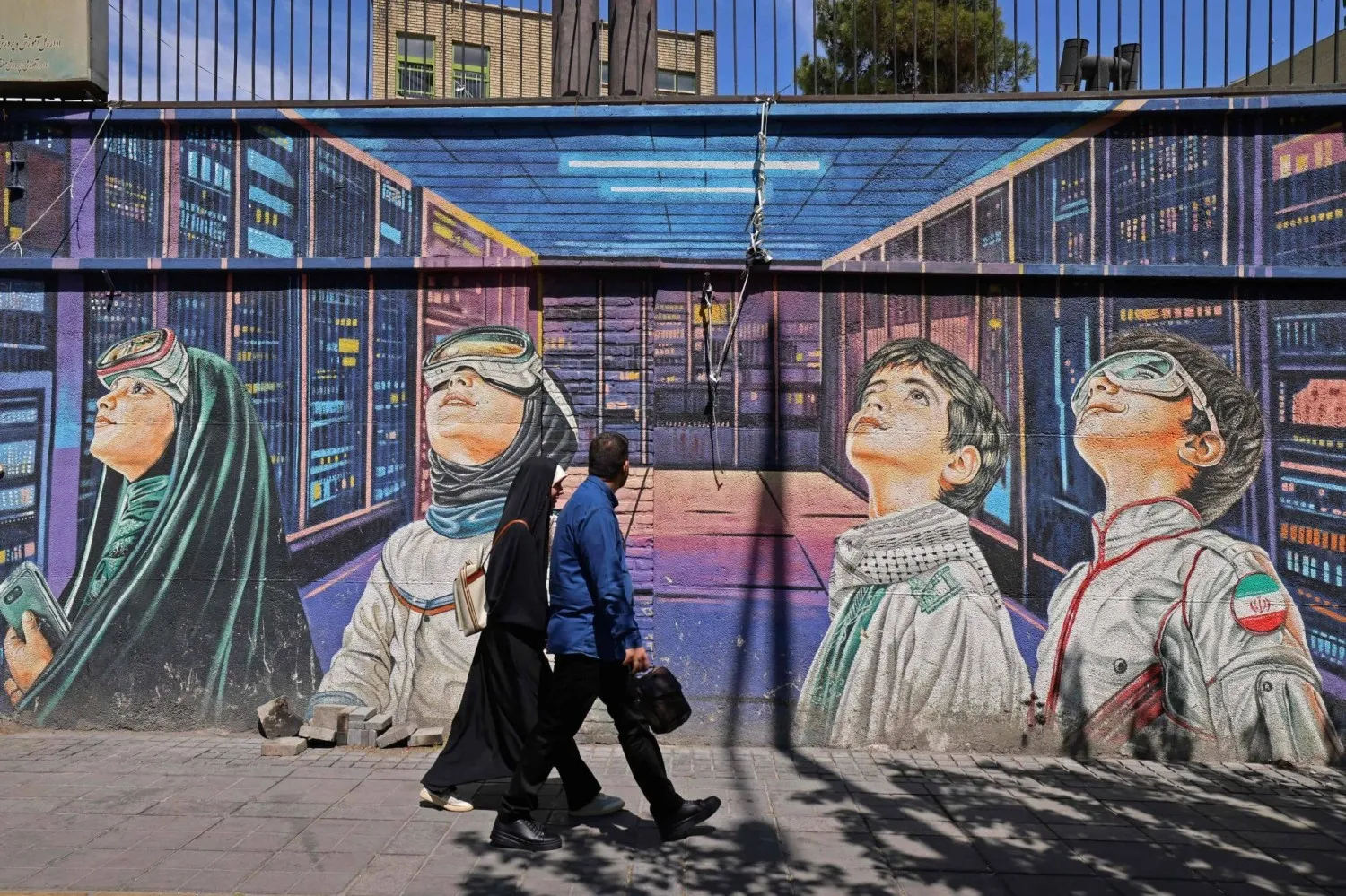
People walk past a wall mural along the roadside in Tehran on Sunday. AFP
TT

As US Talks Fail, Iranians Caught Between ‘War and Peace’

People walk past a wall mural along the roadside in Tehran on Sunday. AFP

Iranians reacted with a mixture of disappointment and defiance on Sunday after 21 hours of talks between the US and Iran ended without an agreement, casting fear over the future of a fragile two-week ceasefire and the possible comeback of military escalation, according to AP and AFP.

US officials said the talks collapsed over what they described as Iran's refusal to commit to abandoning its nuclear program. Iranian officials blamed the US for failing to reach a deal, without specifying the sticking points.

While the fragile ceasefire seems to hold, the war is not over and uncertainty remains on the streets of Tehran where some residents were reluctant to speak to the media.

After weeks of war between Iran and the US, Iranians clung to hopes that negotiations could bring an end to the fighting – only to have them dashed when the talks failed.

“I really wanted them to make peace,” said Mahsa, a 30-year-old employee of an export company in the Iranian capital.

“It’s been almost 45 days now that I’ve seen everyone stressed. It’s a bad situation,” she said.
Iranians have been living in digital blackout for over a month after the internet was blocked shortly after the war started on Feb. 28.

Since then, the population has been relying on state-controlled media, with a limited number of people having access to overseas satellite TV channels for access to information, according to AP.

Standing outside a newsstand in the capital, Tehran, Farhad Simia told AP he had hoped for successful negotiations and an end to the fighting, but stood with Iran despite the failure of the talks.

“I'm against war. I think negotiation is the better path,” Simia, 43, said. He blamed “inappropriate demands” by the US for the failure to reach a deal.

Mehdi Hosseini, also 43, agreed: “Considering the advantage Iran seemed to have on the battlefield, there was a real concern that we might lose all those gains in the negotiations.”
Hosseini added, “Whether the talks succeed or not is one matter, but the fact that the Iranian negotiating team managed to preserve what it achieved in the war, while refusing to back down and surrender, gives reason for hope.”

The streets of Tehran were lined up with large Iranian flags and giant billboards glorifying the country's leaders and military achievements. One large illustration depicted Iranian men in uniform lifting a fishing net out of the sea with a catch of miniature-sized US military aircraft and warships. “The Strait Remains Closed,” the billboard read.

Hamed, 37, said the failure to reach a deal signaled more fighting ahead.

“I would have preferred peace, but I think there is no other way but war and confrontation,” he told AFP. “Based on what I see and hear, unfortunately, we are going to war again, and it seems like we will have a long war,” he added.

Nahid, a 60-year-old housewife in Tehran, said: “We feel despair and hopelessness. We are tired of this uncertainty.”

Iran says 3,375 people were killed during the war with the United States and Israel, according to the head of the country’s Forensic Medicine.

But Iranian organizations operating from outside the country said more than 3,600 people were killed in the fighting, reflecting the high number of human losses.

Hours before the ceasefire was announced, US President Donald Trump warned that “a whole civilization will die... never to be brought back again” as he threatened to bomb infrastructure across Iran.

“I was stressed until 3am... No one slept that night,” Mahsa said.

Although disappointed, 42-year-old shop owner Farhad said he had expected the talks to fail.
“We knew from the beginning that the other side did not want to reach a conclusion,” he said, referring to the US.



Iran Issues Security Directives to Control Narrative Around Khamenei Funeral

Satellite image of Tehran’s Grand Mosalla during the funeral ceremony for former Iranian Supreme Leader Ali Khamenei in Tehran, July 5, 2026. (Planet Labs/Reuters) 
TT

Iran Issues Security Directives to Control Narrative Around Khamenei Funeral

Satellite image of Tehran’s Grand Mosalla during the funeral ceremony for former Iranian Supreme Leader Ali Khamenei in Tehran, July 5, 2026. (Planet Labs/Reuters) 

Iran’s security agencies have ordered media outlets and public relations departments at state institutions to adhere to a unified framework when covering news and analysis related to the funeral of former Supreme Leader Ali Khamenei, in an effort to tightly manage the public narrative during one of the country’s most sensitive political moments since the leadership transition.

The directives, obtained by Asharq Al-Awsat, instruct media organizations to reinforce specific messaging, remove accounts that deviate from the official narrative, and portray the funeral as proof of the continuity of the leadership and the resilience of the political system in the face of what the document describes as the enemy’s “cognitive warfare.”

The document treats the funeral as a political, security, and media event simultaneously. It instructs outlets to depict public attendance as a unique “human shield” and as a “strategic declaration of loyalty” to Khamenei’s legacy and the Iranian Revolution’s “strategic depth.”

Media observers in Tehran said the directives reflect an effort to shape public opinion and curb media pluralism during a delicate transitional period.

The guidance requires coverage to revolve around three themes: “continuity of leadership,” “continuity of resistance,” and “a bright future.” It warns that inconsistent messaging would create space for competing narratives and urges all media to adopt a unified account on behalf of what it calls the “Front of the Revolution.”

The document also calls for highlighting the attendance of foreign delegations and republishing favorable analyses from Western media in domestic outlets as evidence of the success of Iran’s public diplomacy and the failure of efforts to isolate the country despite sanctions.

It instructs media to counter arguments by supporters of the former Pahlavi monarchy while avoiding defensive responses, instead emphasizing what it describes as the regime’s achievements in the nuclear, missile, and regional arenas.

Emphasis is placed on rebutting narratives of a “succession vacuum” and an “uncertain future.” The directives call for calm, well-documented explanations of Iran’s constitutional succession process to prevent what they describe as a cascading collapse in public confidence.

The guidance also bans coverage that could inflame political or sectarian divisions, urging media to stress national unity and consensus.

Media are further instructed to portray the funeral crowds as a historic display comparable to the 1979 Iranian Revolution and a decisive rebuttal to predictions of state collapse. They are encouraged to use statistics, photographs, and field reports to project national strength and cohesion, while incorporating deterrent messages emphasizing Iran’s military readiness and continued commitment to the “path of resistance.”

Finally, the directives warn against what they describe as pessimistic analyses or forecasts rooted in fear and uncertainty, urging media instead to promote an image of “a proud and advancing Iran” through what the document calls the “engineering of hope,” while affirming that “Iran’s future is bright and remains connected to the path of the Imam and the leadership.”


Iran Fires Two Missiles at Commercial Ships in Strait of Hormuz, Axios Report

Vessels in the Strait of Hormuz (Reuters) 
TT

Iran Fires Two Missiles at Commercial Ships in Strait of Hormuz, Axios Report

Vessels in the Strait of Hormuz (Reuters) 

Iran's Revolutionary Guards fired at least two missiles at commercial ships transiting through the Strait of Hormuz on Monday night, Axios reported, citing two US officials.

Two commercial ships suffered significant damage but had no casualties, the report said, citing a US official.

Separately, Britain's maritime security agency said a tanker caught fire after being hit by an unknown projectile early on Tuesday.

The United Kingdom Maritime Trade Operations (UKMTO) said the incident took place eight nautical miles east of Limah, Oman, according to AFP.

“A tanker has reported being hit by an unknown projectile on the port side causing a fire, whilst travelling southbound,” UKMTO said in a post on X.

The agency said there were no reports of casualties or environmental damage.

“Vessels are advised to transit with caution and report any suspicious activity to UKMTO,” the agency added, saying authorities were investigating.

Since March, a number of commercial vessels came under attack in the Strait of Hormuz when Iran blockaded the waterway in response to US-Israeli attacks.

In return, the United States imposed its own naval blockade and later launched retaliatory strikes against Iran after accusing Tehran of targeting commercial shipping.

Maritime traffic resumed after Washington and Tehran signed a memorandum of understanding on June 17 aimed at ending the conflict and reopening the strategic route.

However, Iran has insisted there will be no return to pre-war arrangements, under which vessels could pass freely through the strait.

Tehran has warned ships against using routes outside a corridor it has authorized along its coastline.


Iran Foreign Minister Says US Threats are an Impediment to Deal-making

A handout photo made available by the Iranian foreign ministry office shows Iranian Foreign Minister speaking during a meeting with foreign ambassador and diplomats at the foreign ministry office, in Tehran, Iran, 16 June 2026.EPA/IRANIAN FOREIGN MINISTRY OFFICE HANDOUT
TT

Iran Foreign Minister Says US Threats are an Impediment to Deal-making

A handout photo made available by the Iranian foreign ministry office shows Iranian Foreign Minister speaking during a meeting with foreign ambassador and diplomats at the foreign ministry office, in Tehran, Iran, 16 June 2026.EPA/IRANIAN FOREIGN MINISTRY OFFICE HANDOUT

Talks to reach a final deal between Tehran and Washington won't start if US threats continue, Iran's foreign minister said ‌on Tuesday, ‌following US President ‌Donald ⁠Trump's threat to "finish ⁠the job" if a deal is not made.

"Negotiations on final deal will ⁠not commence if ‌threats continue. ‌Honor your signature," ‌Abbas Araghchi ‌wrote in a post on X.

Araghchi's post was referring to ‌an interim deal signed last month by ⁠Iran ⁠and the US that calls upon both sides to refrain from the threat or use of force against each other.