


China Urges Restraint Over US Blockade of Strait of Hormuz, Backs Talks

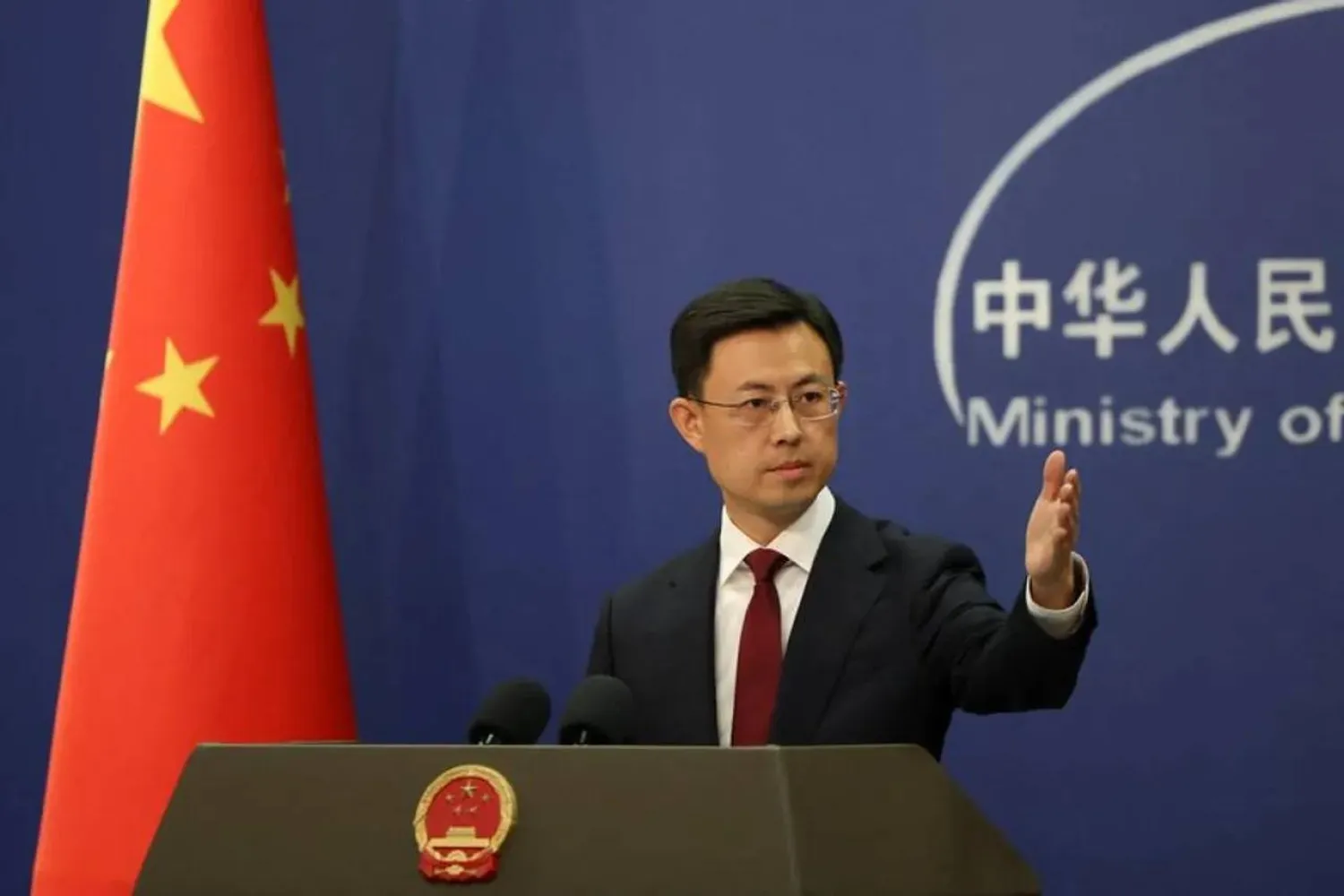
Chinese foreign ministry spokesperson Guo Jiakun answers a journalist's question during a press briefing in Beijing, China, January 7, 2025. (Reuters)
TT

China Urges Restraint Over US Blockade of Strait of Hormuz, Backs Talks

Chinese foreign ministry spokesperson Guo Jiakun answers a journalist's question during a press briefing in Beijing, China, January 7, 2025. (Reuters)

China urged calm and restraint by all sides on Monday, following US President Donald Trump's threat to blockade the Strait of Hormuz after the failure of weekend talks in Islamabad aimed at ending the Iran war. 

Before the war, most Iranian oil exports were shipped to China, the top global importer of crude. 

Keeping the key Strait of Hormuz waterway safe, stable and unimpeded served the interest of ‌the international community, foreign ‌ministry spokesperson Guo Jiakun told ‌a ⁠regular press conference, when ⁠asked about the blockade threat. 

"China hopes the relevant parties will abide by the temporary ceasefire arrangements, remain committed to resolving disputes through political and diplomatic means, and avoid a resumption of hostilities," he said. 

China stood ready to "play a positive and constructive role" in ⁠resolving the crisis, Guo added, calling ‌the opening talks in the ‌Pakistani capital a step in a direction conducive to ‌easing tension. 

After the marathon talks failed, the US ‌Central Command said its forces would begin a blockade of all maritime traffic with Iranian ports from 10 a.m. ET (1400 GMT) on Monday. 

China and Pakistan had backed peace ‌talks in March while urging an immediate ceasefire in the Iran war and restoration ⁠of normal ⁠navigation in the Strait of Hormuz, a conduit for about a fifth of global oil and gas supplies. 

Guo rejected reports that China had plans to supply weapons to Iran as "groundless smears and malicious associations". 

Last week, Trump threatened immediate tariffs of 50%, with no exemptions, on imports from countries supplying Iran with military weapons. 

"China has consistently taken a prudent and responsible approach to arms exports," Guo said, adding that its strict controls were in line with domestic laws and international obligations. 


Russia Offers to Take in Iran's Enriched Uranium

FILE - This satellite image provided by Vantor shows the Natanz nuclear complex in Iran on March 7, 2026, with no new damage seen at the facility or the tunnels. (Satellite image ©2026 Vantor via AP, file)
TT

Russia Offers to Take in Iran's Enriched Uranium

FILE - This satellite image provided by Vantor shows the Natanz nuclear complex in Iran on March 7, 2026, with no new damage seen at the facility or the tunnels. (Satellite image ©2026 Vantor via AP, file)

Russia is ready to take in Iran's enriched uranium as part of a future peace deal with the United States, the Kremlin said on Monday.

Failed talks between Iran and the United States over the weekend dashed hopes of a swift deal to permanently end the war that has killed thousands and thrown the global economy into turmoil since it began in late February.

Russia, which possesses the world's largest stockpile of nuclear weapons, has repeatedly offered to host Iran's enriched uranium as part of any peace deal.

"This proposal was voiced by President (Vladimir) Putin in contacts with both the United States and regional states. The offer still stands, but has not been acted upon," the Kremlin's spokesman Dmitry Peskov told reporters on Monday in response to a question by AFP.

The Kremlin also criticized Trump's threat to blockade the Strait of Hormuz, a key waterway that has been at a standstill since the US and Israel began striking Iran in late February.

"Such actions will likely continue to negatively impact the international market," Peskov said.


Suspected Militants Kill Police Officer Assigned to Guard Polio Team as Nationwide Campaign Begins in Pakistan

Health workers administer polio vaccines to children during a campaign in Dera Ismail Khan, Pakistan, 13 April 2026.  EPA/SAOOD REHMAN
Health workers administer polio vaccines to children during a campaign in Dera Ismail Khan, Pakistan, 13 April 2026. EPA/SAOOD REHMAN
TT

Suspected Militants Kill Police Officer Assigned to Guard Polio Team as Nationwide Campaign Begins in Pakistan

Health workers administer polio vaccines to children during a campaign in Dera Ismail Khan, Pakistan, 13 April 2026.  EPA/SAOOD REHMAN
Health workers administer polio vaccines to children during a campaign in Dera Ismail Khan, Pakistan, 13 April 2026. EPA/SAOOD REHMAN

Suspected militants opened fire on a vehicle carrying police officers assigned to protect polio workers in northwestern Pakistan on Tuesday, killing one of them and wounding four others before fleeing the scene, police said. Two attackers were killed when police returned fire, The Associated Press said.

The shooting occurred in Hangu, a district in Khyber Pakhtunkhwa province bordering Afghanistan, shortly after Pakistan launched its second nationwide anti-polio campaign of the year, according to local police official Mahmood Alam.

No group immediately claimed responsibility, but suspicion is likely to fall on the Pakistani Taliban and local militant groups, which often carry out similar attacks in the region and elsewhere. Pakistan and neighboring Afghanistan remain the only countries where polio has not been eradicated, according to the World Health Organization.

First lady Aseefa Bhutto Zardari urged families to ensure their children are vaccinated during the weeklong drive, which aims to reach more than 45 million children under 5 across all provinces and regions. She said the campaign will be conducted in coordination with Afghanistan, reflecting a shared commitment to interrupt cross-border transmission and close remaining gaps.

Aseefa is the daughter of President Asif Ali Zardari and former Prime Minister Benazir Bhutto, who was killed in a 2007 gun and bomb attack by militants, and who had personally overseen initiatives aimed at eliminating polio during her tenure. In a statement, she said “Pakistan stands at a crucial moment in the fight against polio.” She said while the country is closer than ever to eradication, “the final stretch remains the most challenging.”

Highlighting recent gains, she said 31 polio cases were reported nationwide in 2025, while only one case has so far been recorded this year, but warned against complacency.

Pakistan’s polio eradication program has been running anti-polio campaigns for years, though health workers and the police assigned to protect them are often targeted by militants who falsely claim the vaccination campaigns are a Western conspiracy to sterilize children.

Authorities have deployed thousands of police officers to protect workers following intelligence warnings of possible attacks. More than 200 polio workers and the police assigned to guard them have been killed in Pakistan since the 1990s, according to officials.


Israelis Oppose Iran Ceasefire, Divided Over Whether to Respect It, Poll Says

Israeli left-wing activists demonstrate with placards in HaBima Square against the ongoing war with Iran and against the Israeli government in Tel Aviv on April 11, 2026. (AFP)
TT

Israelis Oppose Iran Ceasefire, Divided Over Whether to Respect It, Poll Says

Israeli left-wing activists demonstrate with placards in HaBima Square against the ongoing war with Iran and against the Israeli government in Tel Aviv on April 11, 2026. (AFP)

Nearly two-thirds ‌of Israelis oppose the Iran ceasefire, but the public is divided over whether Israel should respect the two-week truce or resume attacks on Iran, according to a poll from the Hebrew University of Jerusalem.

The poll was the first national survey of Israelis conducted after the US and Iran agreed last week to a ceasefire brokered by Pakistan, the survey's authors said. The two sides failed to reach a broader deal to end the war in weekend talks in Islamabad.

The ceasefire has halted ‌US and Israeli ‌airstrikes on Iran. But it has not ‌ended ⁠a parallel war ⁠between Israel and the Iranian-backed Hezbollah in Lebanon, where the Israeli military has continued deadly bombardment that has killed many civilians. Hezbollah has continued to fire rockets at Israeli towns in the country's north.

On Lebanon, more than 61 percent of Israelis believe the truce should not extend to the fighting with ⁠Hezbollah, a core demand by Iran in talks with ‌the US, according to ‌the poll, conducted by researchers at Hebrew University's Agam Labs.

Asked what Israel ‌should do about Iran, 39 percent said Israel should ‌continue attacks, 41 percent said their country should respect the ceasefire, and 19 percent said they weren't sure, the poll said.

The poll was based on a sample of 1,312 Israelis interviewed from April 9-10, ‌with a margin of error of 3.2 percent.

With the fate of the Iran ceasefire ⁠unclear, Israel ⁠is digging in for a long, drawn-out conflict across the Middle East, with Israeli officials concluding that their enemies in Iran, Lebanon, Gaza and beyond cannot be eliminated outright.

The public's perception of Israel's military success in Iran holds high stakes for Prime Minister Benjamin Netanyahu, who faces an election due by October that most public opinion polls show he will lose.

According to the Hebrew University poll, Netanyahu's standing among Israelis has decreased since the start of the Iran war, with 34 percent of Israelis preferring him as premier now versus 40 percent at the start of the conflict.
