


How Would a Blockade of the Strait of Hormuz Work?

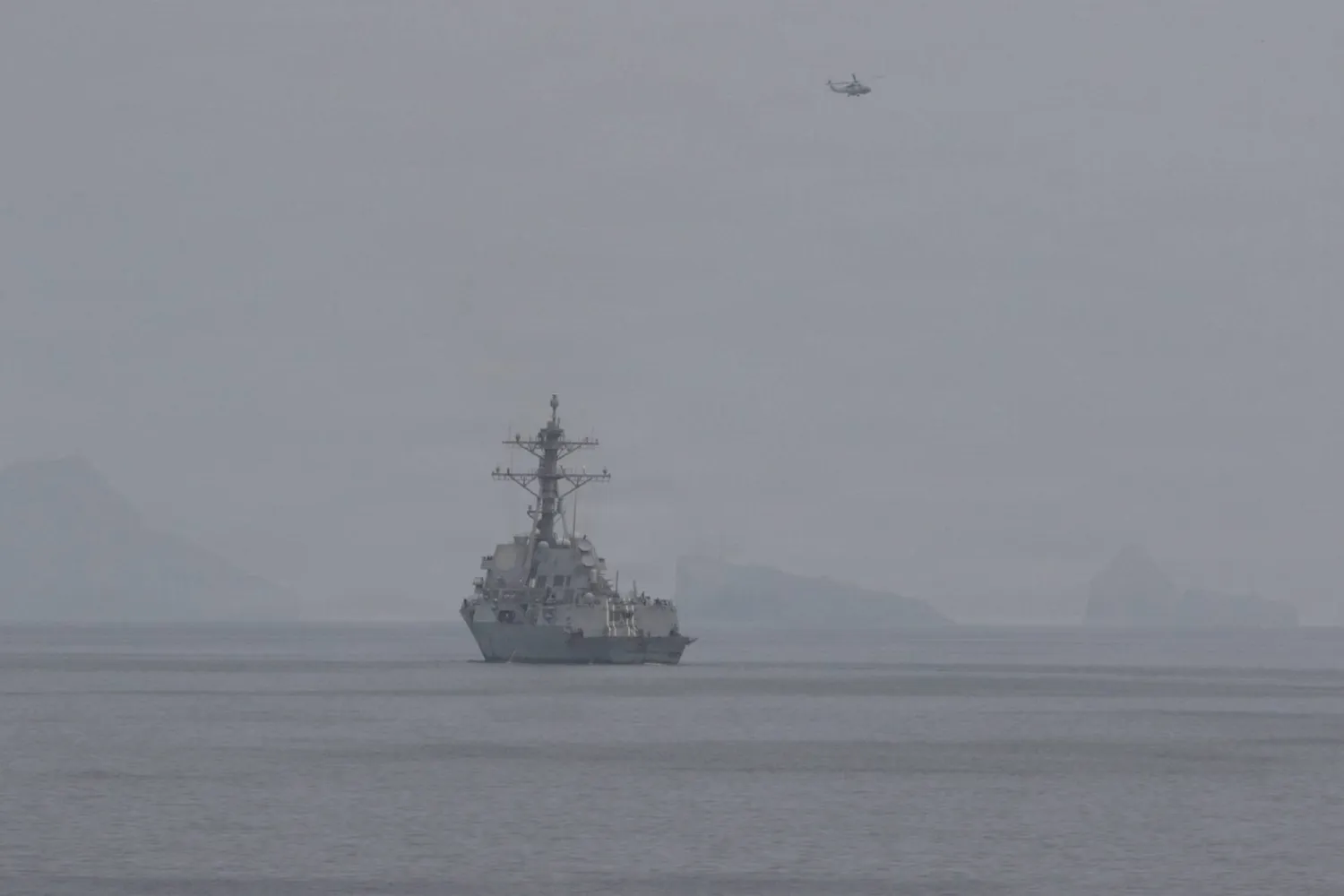
Two US Navy guided-missile destroyers conduct operations in the Strait of Hormuz on Saturday (CENTCOM)
TT

How Would a Blockade of the Strait of Hormuz Work?

Two US Navy guided-missile destroyers conduct operations in the Strait of Hormuz on Saturday (CENTCOM)

Washington: Ephrat Livni

After weekend peace talks in Pakistan between the United States and Iran ended with no agreement, President Trump on Sunday said the US Navy would impose a blockade in the Strait of Hormuz, a vital shipping waterway that Iran has mostly choked off since the war began in late February.

“Effective immediately, the United States Navy, the Finest in the World, will begin the process of BLOCKADING any and all Ships trying to enter, or leave, the Strait of Hormuz,” Trump said in a post on social media. “At some point, we will reach an ‘ALL BEING ALLOWED TO GO IN, ALL BEING ALLOWED TO GO OUT’ basis.”

The statement came as traffic in the strait, through which a major portion of the world’s seaborne oil and natural gas passes, has ground to a practical halt for more than a month amid Iranian strikes on commercial vessels in the region.

While Iran has allowed some ships to pass through the waterway — possibly for a fee — it has used control over the strait, including threats that it has been mined, to disrupt the global economy and to pressure the Trump administration.

The United States Central Command, known as CENTCOM, said on Sunday that a blockade would be enforced “impartially against vessels of all nations entering or departing Iranian ports and coastal areas, including all Iranian ports on the Arabian Gulf and Gulf of Oman.”
Here’s what to know about the US plan for a blockade.

How might it be enforced?

American forces will not impede freedom of navigation for vessels transiting the strait to and from non-Iranian ports, CENTCOM said. The blockade will begin Monday at 10 am Eastern Time, it said.

Parties at war can exercise the right of “visit and search,” meaning that they can stop and inspect even private vessels in waters that are not neutral and decide whether or not they may pass, said James Kraska, a professor of international maritime law at the US Naval War College and a visiting professor at Harvard Law School.

A US blockade of the Strait of Hormuz would mean that any ship that attempts to transit the waterway would have to submit to a search if asked to do so and US forces would be able to determine whether or not to allow it to proceed, he said.

Such a blockade could inflict economic damage on Iran that would undermine its ability to keep fighting over the long term by denying it the ability to export oil and earn revenue. But it could also leave countries that rely on Iranian oil, like China, in a bind, Kraska said.

But there still may be mines in the strait and Iran maintains the ability to fire missiles and drones, Kraska noted.

What would a blockade mean for Iran?

A US blockade on Iranian ports would quite likely mean that Iranian vessels, which have been able to transit the Strait of Hormuz amid the war, would no longer be able to do so and that other ships that have been stuck at port or at sea could begin to move supplies in and out through this route.

This would be a reversal of the US approach so far. Even as the United States has been attacking Iran, American officials have taken steps that enabled Iranian oil to flow to limit pressure on energy prices around the world.

Last month, Scott Bessent, the Treasury secretary, said that the United States was allowing Iranian oil tankers to traverse the strait to keep up global supplies. The United States also temporarily lifted sanctions on Iranian oil at sea, allowing it to be sold to most countries, including the United States, for a month.

Some economic analysts have called on the United States to block the flow of Iranian oil as a means to end its effective control of the strait.

Robin J. Brooks, a senior fellow at the Brookings Institution, has argued that Iran’s dependence on oil exports means it will not be able to afford to keep attacking ships once its own economy takes a hit. On Sunday, he said in a post on social media that a blockade “collapses Iran’s business model.”

But Iranian officials, who have been keenly aware of the pressure on Trump as a result of spikes in energy prices, appear unconcerned. In a post on social media on Sunday, the speaker of Iran’s Parliament and the country’s top negotiator, Mohammad Bagher Ghalibaf, wrote: “Enjoy the current pump figures. With the so-called ‘blockade’, Soon you’ll be nostalgic for $4–$5 gas.”

What would the consequences be for the world?

Normally about 150 vessels transit through the Strait of Hormuz daily. In March, a little more than 150 passed through the waterway all month, according to data from S&P Global Market Intelligence. Those that did transit had made arrangements with the Iranian authorities and may have paid a toll or fee for passage, shipping intelligence firms have reported.

The halt in traffic has led to a spike in oil prices. If an American blockade on ships to and from Iran leads to freedom of navigation for vessels transiting the waterway with oil from Arabian Gulf countries, it could mean lower prices, though how quickly that could happen is not clear.
Trump said on Sunday that “any Iranian who fires at us, or at peaceful vessels, will be BLOWN TO HELL!”

But much remains unclear. Whether vessel operators will run the risk of transiting the strait at this point could depend on how Iran responds to the blockade. And whether the United States will be able to control vessel passage is also an open question.

After CENTCOM announced that it would not impede freedom of navigation for vessels transiting the Strait of Hormuz to and from non-Iranian ports, vessel trackers expressed doubts about enforcement, pointing to tricks ships have used, like changing their identification data, to evade notice.

“This will get tricky as a number of Iran-linked tankers make bogus port calls in the region with the help of AIS spoofing,” the company Tanker Trackers posted, referring to Automatic Identification Systems. “Good luck with that, CENTCOM.”

A retired Navy admiral, James Stavridis, welcomed the blockade announcement a post on social media on Sunday. “In recent days,” he wrote, “the ONLY people benefiting from Gulf transit were the Iranians,” He said that the United States and its allies “are no worse off than we were after the Iranians started holding the Strait hostage.”

The New York Times


WHO Chief Tells Tenerife People that Risk from Hantavirus-hit Ship 'Low'

Crew members of the hantavirus-stricken cruise ship, MV Hondius, wait their turns for a first interview with epidemiologists, during the voyage to Spain’s port of Tenerife, May 6, 2026. (AP Photo)
TT

WHO Chief Tells Tenerife People that Risk from Hantavirus-hit Ship 'Low'

Crew members of the hantavirus-stricken cruise ship, MV Hondius, wait their turns for a first interview with epidemiologists, during the voyage to Spain’s port of Tenerife, May 6, 2026. (AP Photo)

The WHO chief told the people of Tenerife Saturday that the risk to them from an arriving cruise ship hit with a deadly hantavirus outbreak was "low".

"I need you to hear me clearly: this is not another Covid," World Health Organization director-general Tedros Adhanom Ghebreyesus wrote in an open letter to the people of the Spanish island where the MV Hondius was expected to arrive Sunday.

"The current public health risk from hantavirus remains low."

The Dutch-flagged cruise ship was expected to reach waters off Tenerife at dawn, with Tedros also due on the archipelago to help coordinate the evacuation of around 150 people on board, The AP news reported.

Three passengers from the ship -- a Dutch husband and wife and a German woman -- have died, while others have fallen sick with the rare disease, which usually spreads among rodents.

The only hantavirus type that can transmit from person to person -- the Andes virus -- has been confirmed among those who have tested positive, fuelling international concern.

It has also sparked fears among people of the Canary Islands, with regional authorities having refused to allow the vessel to dock, deciding it will remain offshore while passengers are screened and evacuated.

- 'Serious' -

In his open letter, Tedros hailed the people of Tenerife for their solidarity and said he had thanked Spanish Prime Minister Pedro Sanchez personally for Spain agreeing to take on its "moral duty" and receive the ship.

"I know you are worried," Tedros wrote in his open letter.

"I know that when you hear the word 'outbreak' and watch a ship sail toward your shores, memories surface that none of us have fully put to rest. The pain of 2020 is still real, and I do not dismiss it for a single moment," he said.

Tedros acknowledged that the Andes strain of hantavirus "is serious".

"Three people have lost their lives, and our hearts go out to their families," he said, stressing though that "the risk to you, living your daily life in Tenerife, is low".

"This is the WHO's assessment, and we do not make it lightly."

An expert with the United Nations health agency was on board and had determined that currently "there are no symptomatic passengers", Tedros said.

He also highlighted that "medical supplies are in place" and stressed that Spanish authorities had prepared a "careful, step-by-step plan" for the evacuation.

According to that plan, he said, "passengers will be ferried ashore at the industrial port of Granadilla, far from residential areas, in sealed, guarded vehicles, through a completely cordoned-off corridor, and repatriated directly to their home countries".

"You will not encounter them. Your families will not encounter them."

- Deemed 'nearest port' -

The WHO chief insisted the request for Spain to receive the ship "was not made arbitrarily", pointing out that under International Health Regulations, "the nearest port with sufficient medical capacity must be identified to ensure the safety and dignity of those on board".

"Nearly 150 people from 23 countries have been at sea for weeks, some of them grieving, all of them frightened, all of them longing for home," he said.

Tedros said he was travelling to Tenerife to observe the evacuation operation personally, to "stand alongside" health workers and port staff, and to "pay my respects" to the island and its response.

"The WHO stands with you, and with every person on that ship, every step of the way," he said.


Frontier Airlines Plane Suffers Engine Fire, Reportedly Hits Pedestrian in Denver

Frontier airlines planes are parked at the boarding gates at Tampa International Airport in Tampa, Florida, US, July 19, 2024. REUTERS/Octavio Jones/File Photo
TT

Frontier Airlines Plane Suffers Engine Fire, Reportedly Hits Pedestrian in Denver

Frontier airlines planes are parked at the boarding gates at Tampa International Airport in Tampa, Florida, US, July 19, 2024. REUTERS/Octavio Jones/File Photo

A Frontier Airlines passenger jet abandoned its take-off for Los Angeles late on Friday after suffering an engine fire and reportedly striking a pedestrian on the runway at Denver International Airport, the airline and the airport said.

Denver ⁠International Airport said ⁠that a brief engine fire had been promptly extinguished by the fire department.

According to Reuters, Frontier said that smoke was reported in ⁠the cabin of the Airbus A321 and the pilots aborted takeoff.

The company said the flight was carrying 224 passengers and seven crew members, all of whom safely evacuated.

Neither the airline nor the airport gave details on ⁠the pedestrian ⁠who was reportedly struck. Frontier said it was investigating the incident and gathering more information in coordination with the airport and other safety authorities.

At least one passenger suffered a minor injury, ABC News reported.


Putin Attends Scaled-back WW2 Victory Parade

Russian servicemen march during the Victory Day military parade on the Red square in Moscow, Russia, 09 May 2026. EPA/MAXIM SHIPENKOV
TT

Putin Attends Scaled-back WW2 Victory Parade

Russian servicemen march during the Victory Day military parade on the Red square in Moscow, Russia, 09 May 2026. EPA/MAXIM SHIPENKOV

Russia held its most scaled-back Victory Day parade in years on Saturday due to the threat of attack from Ukraine, where victory for Moscow's forces has proven elusive more than four years into the deadliest European conflict since World War Two.

The May 9 parade on Red Square marks Russia's most revered national holiday - a time to celebrate the Soviet Union's victory over Nazi Germany and to pay homage to the 27 million Soviet citizens, including many from Ukraine, who perished. Once used to show off Russia's vast military, including its nuclear-capable intercontinental ballistic missiles, the parade this year had no tanks or other military equipment rolling over the cobbles of Red Square.

Instead, weapons including a Yars intercontinental ballistic missile, the new Arkhangelsk nuclear submarine, the Peresvet laser weapon, the Sukhoi Su-57 fighter, the S-500 surface-to-air missile system and a host of drones and artillery were shown on giant screens on Red Square, and on state television.

Soldiers and sailors, some of whom have served in Ukraine, marched and cheered as President Vladimir Putin looked on, seated beside Russian veterans in the shadow of Vladimir Lenin's Mausoleum. North Korean troops, who fought against Ukrainians in Russia's Kursk region, also marched.

Reuters said fighter ⁠planes flew above ⁠the towers of the Kremlin and Putin made an eight minute speech, promising victory in the war in Ukraine which the Kremlin calls the "special military operation.”

"The great feat of the victorious generation inspires the soldiers carrying out the tasks of the special military operation today," Putin said. "They are confronting an aggressive force armed and supported by the entire NATO bloc. And in spite of that, our heroes march forward."

After Russia and Ukraine accused each other of violating unilateral ceasefires they had each declared over recent days, US President Donald Trump announced a three-day ceasefire from Saturday to Monday that was supported by the Kremlin and Kyiv.

The two sides also agreed to exchange 1,000 prisoners. "I'd like to see it stop. Russia-Ukraine - it's the worst thing since ⁠World War Two in terms of life.

Twenty-five thousand young soldiers every month. It's crazy," Trump told reporters in Washington. He added that he would "like to see a big extension" of the ceasefire. There were no reports of violations of the ceasefire from either Moscow or Kyiv.

Russia, which invaded Ukraine in 2022, had warned that any attempt by Kyiv to disrupt Saturday's event would lead to a massive missile strike on the Ukrainian capital. Moscow told foreign diplomats that they should evacuate Kyiv staff in the event of such an attack.

Ukrainian President Volodymyr Zelenskiy issued a tongue-in-cheek decree "allowing" Russia's May 9 military parade to proceed and saying Ukrainian weapons would not target Red Square. Security was tight in Moscow.

Reuters pictures showed soldiers with guns atop pickup trucks and roads blocked around the center of the capital, which along with the surrounding region has a population of 22 million.

After Nazi Germany invaded the Soviet Union in 1941, the Red Army eventually pushed Nazi forces back to Berlin, where Adolf Hitler killed himself and the red Soviet Victory Banner was raised over the Reichstag in May 1945.

Nazi Germany's unconditional surrender came into force at 11:01 p.m. ⁠on May 8, 1945, marked as "Victory ⁠in Europe Day" by Britain, the United States and France.

In Moscow it was already May 9, which became the Soviet Union's "Victory Day" in what Russians call the Great Patriotic War of 1941-45. But this year's parade comes amid a wave of anxiety in Moscow about the ultimate outcome of the conflict in Ukraine.

The war has killed hundreds of thousands of people, left swathes of Ukraine in ruins and drained Russia's $3 trillion economy, while Russia's relations with Europe are worse than at any time since the depths of the Cold War.

"The crisis is still deepening gradually, but any sharp movement can send the economy (and not only the economy) into a tailspin," jailed pro-war Russian nationalist Igor Girkin, who has criticized the Kremlin for its conduct of the war, said in a post on Telegram.

Girkin, a former Federal Security Service officer, used a naval analogy to say that Russia's leaders were more worried about being kicked out of their cabins than about a shipwreck.

Kremlin spokesman Dmitry Peskov this week dismissed CNN and other Western media reports that Putin's protection had been intensified because of fears of a coup or assassination. Russian officials have dismissed reports of a coup plot as nonsense.

CNN cited an unidentified European intelligence agency as saying that Putin's former defense minister, Sergei Shoigu, was seen as a potential coup leader.

Security Council Secretary Shoigu, who attended an online meeting of the Security Council chaired by Putin on Friday, was at the parade on Saturday, sitting beside some of Putin's most powerful officials.
