

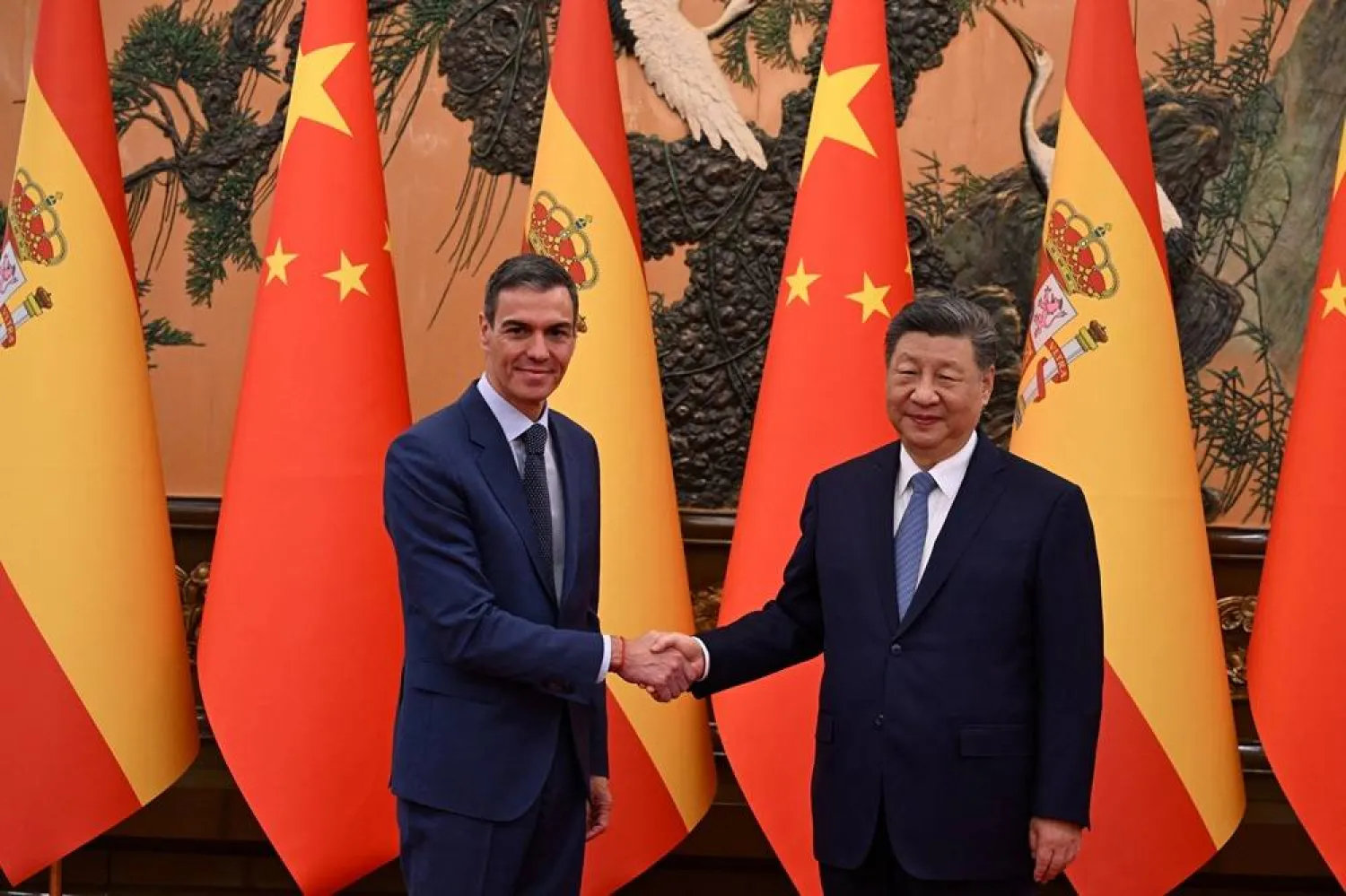

Xi Calls for Tighter Ties to Spain in Face of Global ‘Chaos’

Chinese President Xi Jinping and Spain's Prime Minister Pedro Sanchez shake hands at the Great Hall of the People in Beijing, China April 14, 2026. (Spanish Government/Handout via Reuters)
TT

Xi Calls for Tighter Ties to Spain in Face of Global ‘Chaos’

Chinese President Xi Jinping and Spain's Prime Minister Pedro Sanchez shake hands at the Great Hall of the People in Beijing, China April 14, 2026. (Spanish Government/Handout via Reuters)

China's President Xi Jinping warned against a return to the "law of the jungle" in international relations and called for closer economic ties with Spain as he met Prime Minister Pedro Sanchez in Beijing on Tuesday, according to Chinese state media.

The meeting of the two leaders comes on the second day of Sanchez's visit as he seeks to position Spain as a bridge between Beijing and the European Union, whose relations with the United States are under strain.

Xi told Sanchez the sides should strengthen cooperation in the face of global "chaos and turmoil" and "a contest between justice and force", according to a readout of the talks from state broadcaster CCTV.

"Both China and Spain are principled countries that stand for justice. They should strengthen communication, consolidate mutual trust, and cooperate closely to oppose the world's regression to the law of the jungle," Xi said during talks at Beijing's Great Hall of the People.

"How a country treats international law and the international order reflects its worldview, its conception of order, its values, and its sense of responsibility," Xi said.

The two countries should "seize opportunities" for cooperation in trade, new energy and technology fields, he added.

At a press conference after the talks, Sanchez welcomed China's role in seeking to resolve the conflict in the Middle East.

"The role China can play is important in order to find diplomatic means that end this war and contribute to stability and peace," Sanchez said.

The pair also discussed "the reforms our multilateral system needs to better recognize the multipolar reality of today's world," he said.

The Spanish prime minister is seeking to strengthen economic ties with the world's second largest economy, but called China's trade imbalance with the EU "unsustainable" on Monday.

He is on his fourth visit to China in four years and follows a steady flow of Western leaders visiting Beijing in recent months as President Donald Trump's tariffs and unpredictable foreign policy have rattled the US' traditional allies.

Sanchez is keen to boost trade with China after Trump, who is due to visit Beijing in May, threatened to cut trade with Spain.

Trump's threats came after Spain denied the use of its military bases for US strikes against Iran, a key economic partner of Beijing.

Spanish government sources said a primary goal of Sanchez's China trip is to secure greater market access for agricultural and industrial goods, and to explore joint ventures in the technology sector.



US Imposes Sanctions on 13 Tied to Iran Weapons Procurement

The seal of the Treasury Department is seen before a news conference, Aug. 24, 2026, at the Treasury Department in Washington. (AP)
TT

US Imposes Sanctions on 13 Tied to Iran Weapons Procurement

The seal of the Treasury Department is seen before a news conference, Aug. 24, 2026, at the Treasury Department in Washington. (AP)

The US government announced fresh sanctions on Tuesday against 13 individuals and entities, including some based in Russia, China, Hong Kong and Pakistan, saying they helped Iran procure weapons and components.

The sanctions announced by the Treasury and State departments are part of the Trump administration's effort to isolate Iran economically and force it to negotiate an end to the war that began with a US-Israeli strike on Iran on February 28.

Treasury Secretary Scott Bessent said: “Treasury will not tolerate any support to the ‌regime and ‌will continue to identify, expose, and isolate Iran’s ‌enablers.”

Treasury ⁠said the sanctions ⁠were aimed at degrading Tehran's ability to reconstitute its weapons programs, while increasing the costs for those who supported its procurement efforts.

Those targeted in Tuesday's sanctions announcements include:

* Seyyed Asghar Alizadeh Tabatabai, a Beijing-based representative of Iran's Ministry of Defense and Armed Forces Logistics agency, who Treasury said had coordinated ⁠the procurement of finished weapons systems and dual-use ‌components in China on Iran’s behalf.

* ‌Iran-based Kavoshcom Asia R and D Group, which Treasury said had ‌procured electronics including connectors for Iran Aircraft Manufacturing Industrial Company.

* ‌Hong Kong-based EC Mojo Technology Co Limited, which Treasury said had provided electronic components in support of Kavoshcom’s procurement efforts, and EC Mojo's China-based representative Li Fen.

* Pakistan-based Waseem Pasha Tajammal, who serves ‌as chairman of Cavalier Group, a privately owned defense company with locations in Pakistan and internationally.

* ⁠Joint Stock ⁠Company Experimental Design Bureau Named After A.S. Yakovlev, a Russia-based aircraft manufacturer.

* MG-Flot LLC, a Russia-based shipping company whose vessels transport weapons for the Russian government.

* Saha Airlines, an Iran-based airline affiliated with the country's air force.

Brett Erickson, managing principal with Obsidian Risk Advisors, said the latest sanctions action would do little to impede Iran's ability to launch missiles and drones in the Strait of Hormuz.

"This is optics management for the Trump administration to claim 'We're hammering them,' when the reality is we're poking them with a toothpick," he said.


Trump Says He Does Not Know if Iran Is Going to ‘Give Up Yet’

 Cargo ships are anchored in the Strait of Hormuz off Bandar Abbas, Iran, before sunrise Monday, Sept. 28, 2026. (Amirhosein Khorgooi/ISNA via AP)
Cargo ships are anchored in the Strait of Hormuz off Bandar Abbas, Iran, before sunrise Monday, Sept. 28, 2026. (Amirhosein Khorgooi/ISNA via AP)
TT

Trump Says He Does Not Know if Iran Is Going to ‘Give Up Yet’

 Cargo ships are anchored in the Strait of Hormuz off Bandar Abbas, Iran, before sunrise Monday, Sept. 28, 2026. (Amirhosein Khorgooi/ISNA via AP)
Cargo ships are anchored in the Strait of Hormuz off Bandar Abbas, Iran, before sunrise Monday, Sept. 28, 2026. (Amirhosein Khorgooi/ISNA via AP)

President Donald Trump said on Tuesday he does not know if Iran is going to "give up yet" but cast the country as doing "very poorly" in its war with the US.

"I don't know if they are going to give up ‌yet but ‌they'll give up," Trump told reporters.

"They ‌are ⁠doing very poorly," ⁠he added.

A US blockade has cut Iran's financial lifeline - oil exports, and economic costs of the war have made life tougher for Iranians.

Iran's president told the UN General Assembly last ⁠week that Tehran would never surrender to ‌US pressure.

The rise in oil prices due to the ‌war has also become a major issue ‌for Trump's Republican Party heading into the November US midterm elections.

The war has led to the blockade of the Strait of ‌Hormuz, which carried a fifth of global supplies of crude oil ⁠and ⁠LNG before the conflict.

Trump has offered shifting goals and timelines for the Iran war that began on February 28 when the US and Israel attacked Iran and Tehran responded with its own strikes on Israel and Gulf states.

US-Israeli strikes on Iran and Israeli attacks on Lebanon have killed thousands and displaced millions.


Ceuta Mass Migrant Crossing Handling ‘Responsibility of All EU,’ Spanish King Says

Migrants wait for food distribution to begin on El Trampolin Beach in the Spanish enclave of Ceuta, Monday, Sept. 28, 2026. (AP)
TT

Ceuta Mass Migrant Crossing Handling ‘Responsibility of All EU,’ Spanish King Says

Migrants wait for food distribution to begin on El Trampolin Beach in the Spanish enclave of Ceuta, Monday, Sept. 28, 2026. (AP)

European countries should have shown ‌more solidarity and offered more support to Spain after the mass arrival in Ceuta of tens of thousands of migrants, Spanish King Felipe VI said on Tuesday during a gala dinner to mark a visit by French President Emmanuel Macron.

In an unusually outspoken address reflecting the depth of the crisis facing Spain following the Ceuta border rush that took place two months ago on Wednesday, the king said what happened in the enclave on the North African coast was "unacceptable" and ‌generated an enormous ‌security, public order and humanitarian challenge.

"It's a ‌situation ⁠that ought to ⁠have as a consequence a reinforcement of collaboration between member states in resources and cooperation," he said. "The European countries that suffer the most pressure from being on the external borders of the European Union cannot alone bear a responsibility that also belongs to everyone."

The king spoke during a dinner at the Royal ⁠Palace in Madrid also attended by Spain's Socialist ‌prime minister, Pedro Sanchez, a rare ‌European proponent of the benefits of migration who launched a mass ‌regularization of irregular migrants that concluded in the summer.

Sanchez, however, ‌has proposed possible changes to asylum rules to return arrivals more quickly, which NGOs and lawyers say would violate human rights conventions.

Asked in a news conference about the plans, territorial policy minister Angel Victor Torres ‌said the government was "analyzing the possibility" of a legislative amendment but that it was "not easy" ⁠due to ⁠questions of international law.

Following the mass crossing of 72,000 migrants into Ceuta on July 30, European Commission President Ursula von der Leyen commended Spain's swift action in returning most arrivals to Morocco. Other leaders were less understanding, however, with Italy suspending the European Union's border-free Schengen arrangements with Spain for one month.

European Migration Commissioner Magnus Brunner unveiled a plan on Tuesday to strengthen EU border controls in the wake of Ceuta.

The plan, which requires the approval of member states, would strengthen the mandate of Frontex, the EU border protection agency, and give it a standing corps ready for immediate deployment.