


Mounting Pressure on Iran Revives the Specter of the 2000 Aden Attack

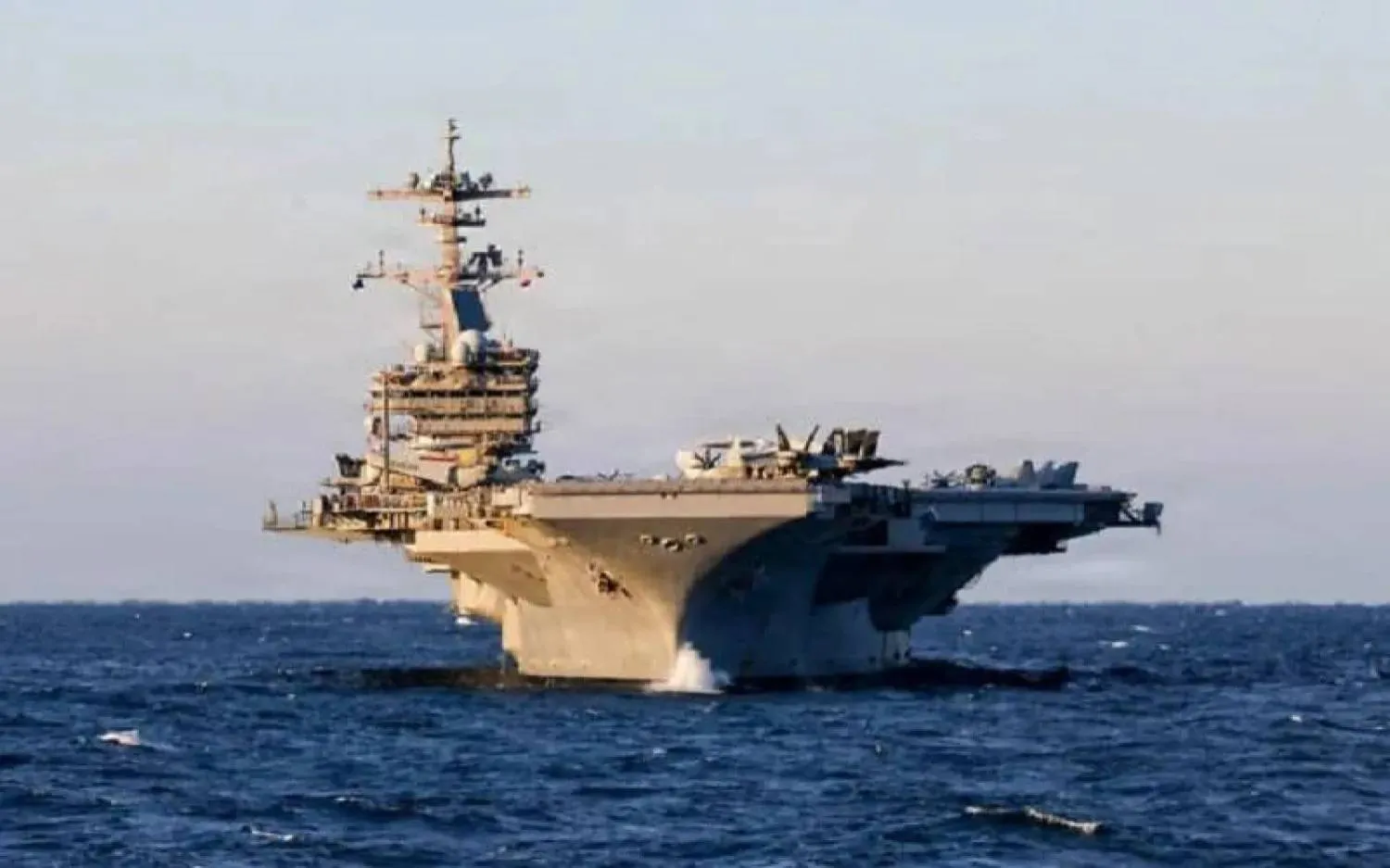
US Navy aircraft carrier USS George H.W. Bush
TT

Mounting Pressure on Iran Revives the Specter of the 2000 Aden Attack

US Navy aircraft carrier USS George H.W. Bush

US author Anne-Marie Slaughter argues in The Chessboard and the Web: Strategies of Connection in a Networked World that the world no longer operates or interacts according to the logic of a traditional chessboard.

The old model was linear and two-dimensional, centered on a single objective: toppling the king by controlling territory.

That logic no longer defines 21st-century conflict. Today’s world operates across overlapping, interlocking layers that interact and often collide simultaneously, within a continuously evolving network that includes military, economic, political, alliance, and informational dimensions.

As this network evolves, it generates both solutions and complications so rapidly that they outpace the ability of leadership to make timely decisions. Improvisation comes to dominate decision-making, errors multiply and accumulate, feeding back into the system and further deepening its complexity.

On the escalation ladder

Escalation depends on strategic flexibility and the tools available. In practical terms, the greater the flexibility, the greater the ability of actors to climb the escalation ladder, from low-intensity conflict to higher levels, until reaching a peak where one side yields, either on the battlefield or at the negotiating table.

But this climb is inherently a trap. Each step builds on the last. As these steps accumulate over time, the cost compounds, making it increasingly difficult to step back without incurring significant losses.

The US blockade

This is not the first time the US Navy has imposed a maritime blockade. The most notable case was Cuba in the 1960s during the Cuban Missile Crisis, labeled a “quarantine,” a term deliberately used to indicate a measure short of full wartime blockade. Cuba’s geography made it relatively easy to encircle.

A similar approach was later applied to Venezuela. Today, the focus has shifted to Iranian ports, both inside and outside the Gulf.

Direct comparisons are limited by differing contexts. Still, one constant remains: the US Navy possesses the capability to enforce such blockades, particularly given its dominance over global seas and oceans.

In Cuba, Soviet missiles targeted major US cities and the world was divided between two superpowers. In Venezuela, President Donald Trump invoked the Monroe Doctrine and implemented a national security strategy prioritizing the Western Hemisphere and America’s immediate sphere.

The Strait of Hormuz, however, is fundamentally different. Other waterways can be bypassed; Hormuz cannot. It is a closed corridor through which oil, gas, petrochemicals, helium, fertilizers, and other critical goods must pass. There is no alternative route; all shipments must transit Hormuz in both directions.

Iran’s strategy

Since the Shah’s era, aligned with the Nixon Doctrine, Tehran has pursued control over Gulf waters and influence over the Strait of Hormuz. The continued occupation of the UAE islands of Greater Tunb, Lesser Tunb, and Abu Musa since the 1970s underscores this long-standing strategic objective.

More than 30 islands are scattered across the Gulf’s deep waters, precisely along the routes used by oil tankers that require significant depth to pass safely. If linked together as part of a military-security network, they reveal long-term planning for scenarios such as the current one.

Iran’s naval doctrine relies on both the Revolutionary Guards and the regular navy, employing small submarines, torpedoes, fast attack boats, naval mines, drones, and ballistic missiles.

At its core lies an anti-access strategy designed to deny adversaries freedom of movement in Gulf waters.

Centers of gravity

Qeshm Island is critical for controlling access to the Strait of Hormuz. Kharg Island follows, serving as the hub for more than 80 percent of Iran’s oil exports, supplied by the oil fields of Khuzestan.

Beyond the islands, the South Pars gas field in Bushehr province is central to Iran’s energy system, providing more than 70 percent of the country’s domestic electricity needs.

These key sites have already been targeted during the conflict by US or Israeli airpower. To expand the scope of escalation and increase pressure, Trump deployed additional forces, including Marine units and elements of the 82nd Airborne Division, aimed at broadening military options and forcing Iran to soften its negotiating position. After talks in Pakistan failed, he moved to announce the blockade.

The current US approach

By declaring the blockade, Trump effectively altered the existing rules of engagement in the Gulf, imposing an asymmetric approach that avoids Iran’s strengths and prevents it from dictating the battlefield dynamics.

Instead, the US leverages distance, operating from the Arabian Sea, along with its technological superiority and strategic flexibility.

This effectively turns Iran’s own strategy against it. What once constrained US freedom of movement inside the Gulf is now being used to impose external pressure on Iran from the Arabian Sea.

If successful, the strategy could deprive Iran, according to The Wall Street Journal, of roughly $435 million per day, or $13 billion per month, while avoiding the costs of direct military action such as seizing islands like Kharg.

It would also confine Iran’s asymmetric capabilities within the Gulf and strip it of its most effective operational tools.

The central question now is how Iran will respond. How will it adapt its strategy in the face of this pressure? Will escalation continue? And could that escalation take the form of a maritime attack similar to the 2000 strike on the US destroyer USS Cole near Aden?



Iran Says Redirects US-sanctioned Oil Tanker to Its Shores

FILE PHOTO: An aerial view of the Iranian shores and the island of Qeshm in the strait of Hormuz, December 10, 2023. REUTERS/Stringer/File Photo
TT

Iran Says Redirects US-sanctioned Oil Tanker to Its Shores

FILE PHOTO: An aerial view of the Iranian shores and the island of Qeshm in the strait of Hormuz, December 10, 2023. REUTERS/Stringer/File Photo

Iran said on Friday it redirected a US-sanctioned oil tanker carrying Iranian oil back to its shores, though it was unclear from its statement why it would have returned it, reported AFP.

"The Islamic Republic of Iran's navy, through a specially planned operation in the Sea of Oman, seized the offending tanker Ocean Koi," the army said in a statement carried by state television, adding that the oil belonged to Iran.

It said the ship was redirected to Iran's southern shores after it sought "to damage and disrupt Iran's oil exports," without elaborating.


Meloni Meets Rubio as Iran War Strains Italy-US Ties

US Secretary of State Marco Rubio leaves the San Damaso courtyard after meeting Pope Leo XIV at the Vatican, May 7, 2026. REUTERS/Yara Nardi
TT

Meloni Meets Rubio as Iran War Strains Italy-US Ties

US Secretary of State Marco Rubio leaves the San Damaso courtyard after meeting Pope Leo XIV at the Vatican, May 7, 2026. REUTERS/Yara Nardi

Italian Prime Minister Giorgia Meloni met US Secretary of State Marco Rubio on Friday at a moment of unusual strain between her government and President Donald Trump's administration, driven largely by the war with Iran.

Rubio is in Italy for a two-day trip aimed at easing ties with Pope Leo after unprecedented attacks on the pontiff by Trump, while also addressing Washington's frustration over Italy's refusal to support the US-Israeli war on Iran.

Meloni had been one of Trump's firmest supporters in Europe, cultivating close ties with him and presenting herself as a natural ‌bridge between Washington ‌and other EU states that had no natural political ‌affinity ⁠with the Republican ⁠US leader.

But that alignment has come under increasing strain in recent months, as the Iran war has forced her to balance loyalty to the United States against Italian public animosity to the war and the growing economic cost of the conflict.

Before heading to the prime minister's office, Rubio met Italy's Foreign Minister Antonio Tajani, who said the talks had been positive.

"I am convinced ⁠that Europe needs America, Italy needs America, but the United ‌States also needs Europe and Italy," Tajani ‌told reporters.

Meloni and Rubio were expected to discuss the situation in the Gulf, as ‌well as Russia's war on Ukraine, US tariffs on European goods and ‌the outlook for Cuba, which Washington is seeking to isolate both diplomatically and economically.

TRUMP'S ATTACKS ON POPE

The Italians will also be keen for a readout on Rubio's meetings at the Vatican. Trump's recent attacks on Pope Leo crossed a sensitive ‌line in overwhelmingly Catholic Italy and prompted Meloni to call them "unacceptable."

Her criticism in turn drew a sharp rebuke ⁠from Trump, who said ⁠she lacked courage and had let Washington down. He subsequently threatened to withdraw US troops from Italy.

Meloni said on Monday she would not support such a move, but acknowledged that the decision "doesn't depend on me".

Italy last month refused to allow US aircraft to use the Sigonella air base in Sicily for combat operations linked to the Iran conflict. Italian officials have said Washington had not sought prior authorization from Rome for the use of the site.

Defense Minister Guido Crosetto, a close Meloni ally, later warned that the Iran war was putting US global leadership at risk and said he feared the "madness" of nuclear escalation.

Pollsters say Meloni's ties to Trump could prove a potential liability with voters ahead of national elections due next year.


Trump Says Ceasefire Still Holds after Fighting Between the US and Iran Flares

US President Donald Trump looks on as he speaks to reporters near the Lincoln Memorial Reflecting Pool as it undergoes renovations, in Washington, D.C., US, May 7, 2026. REUTERS/Kylie Cooper
TT

Trump Says Ceasefire Still Holds after Fighting Between the US and Iran Flares

US President Donald Trump looks on as he speaks to reporters near the Lincoln Memorial Reflecting Pool as it undergoes renovations, in Washington, D.C., US, May 7, 2026. REUTERS/Kylie Cooper

US and Iranian forces clashed in the Gulf, but President Donald Trump said a ceasefire was still holding despite the flare-up, which dented hopes for a swift diplomatic resolution to the crisis.

The escalation came as Washington awaited Tehran's response to a US proposal to end the war, which began on February 28 when the US and Israel launched airstrikes on Iran.

Trump said on Thursday three US Navy destroyers were attacked as they moved through the Strait of Hormuz, a conduit for around a fifth of the world's oil and liquefied natural gas flows that Iran has all but closed since the conflict began.

"Three World Class American Destroyers just transited, very successfully, out of the Strait of Hormuz, under fire. There was no damage done to the three Destroyers, but great damage done to the Iranian attackers," Trump wrote on Truth Social.

He later told reporters the ceasefire remained in effect and played down the exchange.

"They trifled with us today. We blew them away," Trump said in Washington.

Iran, however, accused the United ⁠States of breaching ⁠the ceasefire, an agreement that has been punctuated by intermittent clashes since it was announced on April 7.

Iran's top joint military command said US forces had targeted an Iranian oil tanker and another ship, and carried out air attacks on civilian areas on Qeshm Island in the Strait of Hormuz and nearby coastal areas. It said Iranian forces responded by attacking US military vessels east of the strait and south of the port of Chabahar.

A spokesperson for Iran's Khatam al-Anbiya Central Headquarters said the Iranian strikes inflicted "significant damage," but US Central Command said none of its assets were hit.

Iranian state media later signaled a de-escalation, with Press TV reporting that, after several hours of exchanges, "the situation on Iranian islands and coastal cities by the Strait of Hormuz is back to normal now."