


Australia to Boost Defense Spending Citing Growing Threats

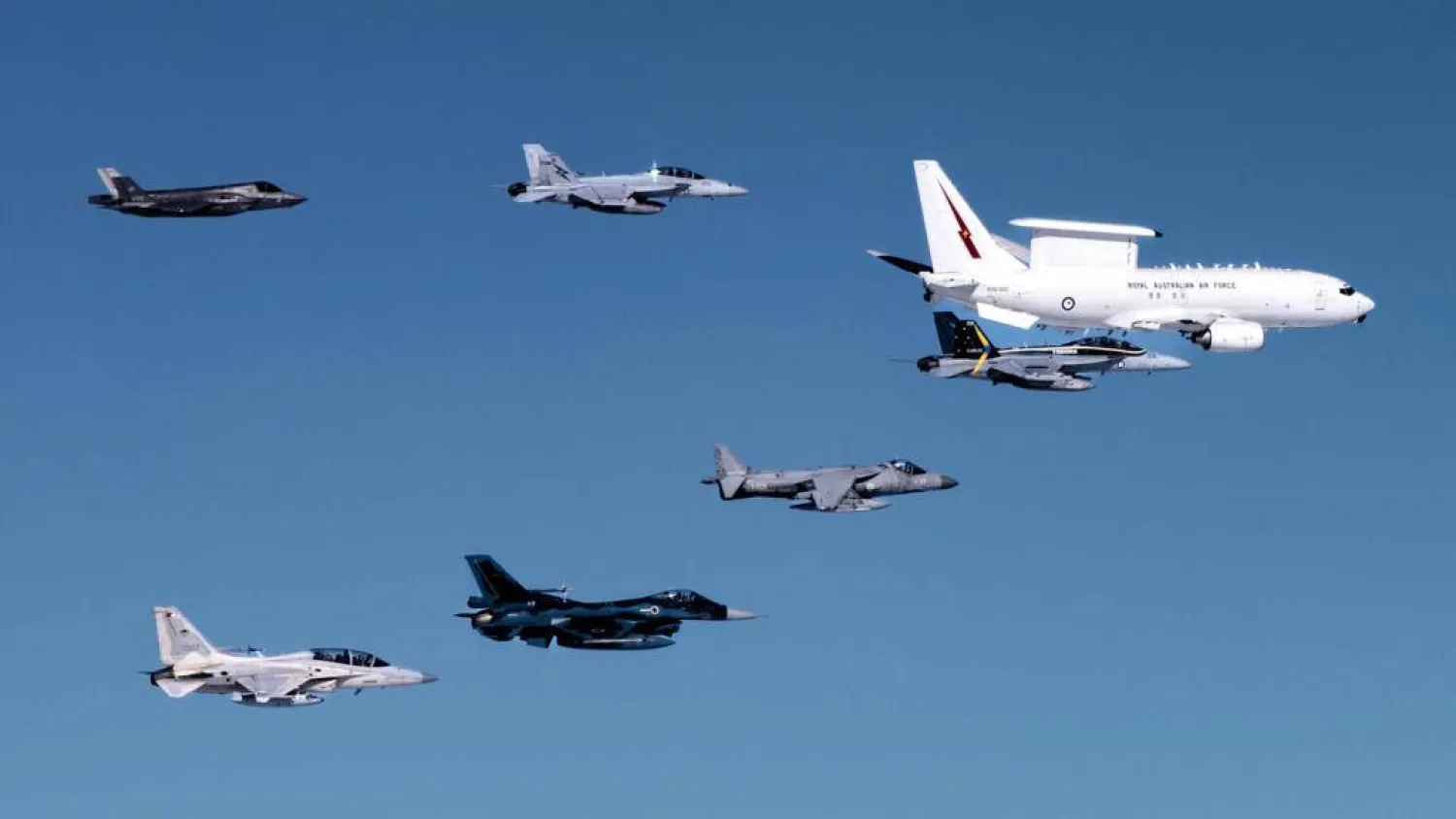
 This handout image taken on July 23, 2024 and released by the Australian Defense Force shows a Royal Australian Air Force (RAAF) E-7A Wedgetail airborne early warning and control aircraft (top R) in formation flight with an RAAF EA-18G Growler electronic warfare aircraft (bottom R), RAAF F/A-18F Super Hornet (top C), a Spanish Navy AV-8B Harrier II (bottom C), an F-35 Lightning II (top L), a Japan Air Self-Defense Force Mitsubishi F-2 (bottom 2nd L), and a Philippine Air Force FA-50 Golden Eagle (bottom L) over northern Australia during Exercise Pitch Black 2024.  Handout / AUSTRALIA DEFENCE FORCE/AFP
This handout image taken on July 23, 2024 and released by the Australian Defense Force shows a Royal Australian Air Force (RAAF) E-7A Wedgetail airborne early warning and control aircraft (top R) in formation flight with an RAAF EA-18G Growler electronic warfare aircraft (bottom R), RAAF F/A-18F Super Hornet (top C), a Spanish Navy AV-8B Harrier II (bottom C), an F-35 Lightning II (top L), a Japan Air Self-Defense Force Mitsubishi F-2 (bottom 2nd L), and a Philippine Air Force FA-50 Golden Eagle (bottom L) over northern Australia during Exercise Pitch Black 2024. Handout / AUSTRALIA DEFENCE FORCE/AFP
TT

Australia to Boost Defense Spending Citing Growing Threats

 This handout image taken on July 23, 2024 and released by the Australian Defense Force shows a Royal Australian Air Force (RAAF) E-7A Wedgetail airborne early warning and control aircraft (top R) in formation flight with an RAAF EA-18G Growler electronic warfare aircraft (bottom R), RAAF F/A-18F Super Hornet (top C), a Spanish Navy AV-8B Harrier II (bottom C), an F-35 Lightning II (top L), a Japan Air Self-Defense Force Mitsubishi F-2 (bottom 2nd L), and a Philippine Air Force FA-50 Golden Eagle (bottom L) over northern Australia during Exercise Pitch Black 2024.  Handout / AUSTRALIA DEFENCE FORCE/AFP
This handout image taken on July 23, 2024 and released by the Australian Defense Force shows a Royal Australian Air Force (RAAF) E-7A Wedgetail airborne early warning and control aircraft (top R) in formation flight with an RAAF EA-18G Growler electronic warfare aircraft (bottom R), RAAF F/A-18F Super Hornet (top C), a Spanish Navy AV-8B Harrier II (bottom C), an F-35 Lightning II (top L), a Japan Air Self-Defense Force Mitsubishi F-2 (bottom 2nd L), and a Philippine Air Force FA-50 Golden Eagle (bottom L) over northern Australia during Exercise Pitch Black 2024. Handout / AUSTRALIA DEFENCE FORCE/AFP

Australia will raise defense spending to 3.0 percent of GDP by 2033 as armed conflicts flare worldwide, Defense Minister Richard Marles said Thursday.

The new commitment follows pressure from US President Donald Trump's administration for Canberra to boost military expenditure as a share of total annual economic output.

"International norms that once constrained the use of force and military coercion continue to erode," Marles said in a speech in Canberra, outlining a boost to spending on missile defense, drones and guided weapon stockpiles.

"More countries are engaged in conflict today than at any time since the end of World War II, and this is occurring across every region of the world."

Australia's defense spending had previously been forecast to rise to 2.3 percent of GDP by 2033, AFP said.

But the country will spend an additional AU$53 billion ($38 billion) over the next decade when compared to its 2024 defense strategy, Marles said.

In the shorter term, spending would climb by an extra AU$14 billion over four years.

To reach the 3.0 percent figure, Australia changed how it calculates the defense budget to match a NATO definition that includes factors such as military pensions and defense intelligence.

Marles said Thursday this allowed better comparisons with other countries and put Australia ahead of comparable European and Asian nations with a defense spend this year of 2.8 percent.

- China build-up -

But the new spending still falls short of the 3.5 percent of GDP that US Defense Secretary Pete Hegseth demanded Australia shell out last year.

Wary of China's navy build-up, US ally Australia has reshaped its defense force in recent years to focus on its missile strike capability and deterring an adversary from its northern approaches.

It has also embarked on its largest-ever military spending project to build nuclear-powered submarines next decade under the AUKUS agreement with the United States and the UK.

Marles emphasized Australia would focus in 2026 on building greater military self-reliance but was not jettisoning its US security alliance, which he said remained "fundamental".

"There is no effective balance of power in the Indo-Pacific absent the continued presence of the United States," he said.

Spending to build a missile defense system will accelerate -- up to AU$30 billion over the next decade.

Another AU$36 billion will be spent to build guided missiles locally.

Australia's vast coastline and small population have also spurred a focus on developing large autonomous submarines and fighter jets, dubbed the Ghost Shark and Ghost Bat.

This week, Canberra said it would boost spending on drones by up to AU$5 billion in response to shifts in warfare tactics in the Middle East and Ukraine.

Under the AUKUS agreement, the United States will sell Australia two nuclear-powered submarines from 2032.

Australia and Britain will then build a new class of submarine in the 2040s.

Critics have alleged the deal does not guarantee that Australia will ever receive the submarines.



Trump to Make First Flight on Qatar-Gifted Jet This Week

(FILES) In this February 15, 2025 a Qatari Boeing 747 sits on the tarmac of Palm Beach International airport after US President Donald Trump toured the aircraft on February 15, 2025. (Photo by ROBERTO SCHMIDT / AFP)
TT

Trump to Make First Flight on Qatar-Gifted Jet This Week

(FILES) In this February 15, 2025 a Qatari Boeing 747 sits on the tarmac of Palm Beach International airport after US President Donald Trump toured the aircraft on February 15, 2025. (Photo by ROBERTO SCHMIDT / AFP)

US President Donald Trump will make his first flight on a new Air Force One plane gifted by Qatar later this week, the White House said Monday.

Trump will take the jet on Wednesday to North Dakota for an event marking the 250th anniversary of US independence, a White House official told AFP.

As he unveiled the plane earlier this month, Trump praised the Gulf emirate for being “so nice and providing” the modified Boeing 747, which previously served Qatar's head of state.

Trump has been obsessed since his first term with replacing the aging jets that serve as Air Force One, and he hand-picked the new plane's red, white and blue livery.

But critics have raised a host of ethical, constitutional and security concerns about the gifting of an aircraft worth hundreds of millions of dollars by a foreign power like Qatar.

The US Constitution prohibits presidents and other officeholders from receiving “any present, Emolument, Office, or Title, of any kind whatever, from any King, Prince, or foreign State” unless approved by Congress.

Trump's administration has said the plane is a direct gift to the US Department of Defense -- while stoking further concern by saying the plane would eventually be donated to Trump's presidential library.

The Qatari-gifted plane is meant to be a stopgap until US planemaker Boeing delivers two new 747-8 aircraft to serve as the presidential jet in a program plagued by delays and cost overruns.


Türkiye Must Be ‘Included’ in Europe Security Structures, Says Erdogan

Turkish President Recep Tayyip Erdogan speaks during the opening ceremony of Antalya Diplomacy Forum in Antalya, Türkiye, April 17, 2026. (Reuters)
TT

Türkiye Must Be ‘Included’ in Europe Security Structures, Says Erdogan

Turkish President Recep Tayyip Erdogan speaks during the opening ceremony of Antalya Diplomacy Forum in Antalya, Türkiye, April 17, 2026. (Reuters)

Türkiye must be included in all of Europe's defense structures and defence trade restrictions between NATO members must be removed, President Recep Tayyip Erdogan said Monday ahead of a key NATO summit.

His remarks come as Europe revamps its defenses to counter Russia and the risk of a US pullback from NATO, which is to hold a summit in the Turkish capital Ankara on July 7-8.

"Türkiye's indispensable contributions to European security are sometimes overlooked," Erdogan told parliamentary delegates from all 32 NATO member states in Istanbul. He said Türkiye wanted "to participate in all defense and security initiatives" on the continent.

At issue is Türkiye's access to the European Union's 150-billion-euro ($176-billion) Security Action for Europe (SAFE) initiative, intended to strengthen European defense capabilities.

"We expect your support, lawmakers, for Türkiye's inclusion in the defense and security initiatives announced by the European Union," Erdogan told them.

Within SAFE, firms from non-EU countries such as Türkiye, Britain and the United States can only supply up to 35 percent of the component costs of weaponry funded by the scheme.

If Türkiye wants its companies to be able to tap a bigger part of the funds Ankara needs to sign a security partnership with the EU and then negotiate special access with Brussels -- a process that would require approval from all 27 EU members. Greece has threatened to block such a move.

"Under SAFE, any third country can participate in a defense project up to a level of 35 percent. Any negotiations with a view to potentially increasing or lifting this 35 per cent cap ... would require a bilateral agreement," said Thomas Regnier, a European Commission spokesperson.

"For now, this is not an agreement we have concluded with Türkiye."

- 'Remove the obstacles' -

Erdogan also urged NATO to remove all barriers blocking defense industry trade between alliance members.

"If we want to overcome the challenges we face, we need to remove obstacles to defense industry trade while ensuring a balanced and fair burden-sharing among allies," he said.

Türkiye has the second-biggest army of the alliance after the United States and a burgeoning defense industry which has gone from strength to strength fueled by bilateral defense deals.

But its defense industry has been hit by US sanctions imposed over Ankara's purchase of an S-400 Russian surface-to-air missile defense system. Washington also booted Türkiye out of its F-35 program, in a move that has soured relations between the NATO allies.

Although Washington has expressed a desire to draw a line under the dispute, lifting the sanctions requires Congressional approval. Observers say there is little chance the showdown would be resolved before the summit.

US President Donald Trump has however pledged to give Erdogan something that would make him "very happy" when he flies in next week for the NATO gathering.

Analysts said it was likely to be a delivery of several dozen US-made F110 engines Türkiye needs for its fifth-generation KAAN fighter jets that are under development. Delivery of the engines had been blocked since the imposition of the US sanctions.


Trump Says Iran Requested Meeting to be Held in Doha Tuesday

US and Iran flags are seen in this illustration taken June 18, 2025. REUTERS/Dado Ruvic/Illustration/File Photo
TT

Trump Says Iran Requested Meeting to be Held in Doha Tuesday

US and Iran flags are seen in this illustration taken June 18, 2025. REUTERS/Dado Ruvic/Illustration/File Photo

US President Donald Trump said that Iran has requested a meeting that will be held in the Gulf state of Qatar on Tuesday, despite an earlier denial from Tehran that talks were planned.

"IRAN HAS REQUESTED A MEETING. IT WILL TAKE PLACE TOMORROW IN DOHA!" Trump posted on his Truth Social platform on Monday.

Shortly afterwards, White House spokesperson Karoline Leavitt said US negotiators Jared Kushner and Steve Witkoff would be "flying to Doha for high level meetings this week".

Iran's foreign ministry earlier on Monday denied reports that Iranian and American technical teams will meet this week to discuss the implementation of the deal to end the Middle East war.

Uncertainty over the talks followed renewed tit-for-tat attacks between the United States and Iran in recent days despite an April ceasefire and a memorandum of understanding, brokered by Pakistan and Qatar, aimed at permanently ending the war.

A diplomat with knowledge of the talks confirmed to AFP on Monday that officials from the US and Iran are to meet in Doha to discuss the accord.

"Technical teams working on the implementation of the MoU are scheduled to meet in Doha in the coming days," the diplomat said on condition of anonymity to discuss the sensitive talks.

The diplomat added "communications channels created to de-escalate any incidents are in place," following strikes between the US and Iran.