


Senate Republicans Again Block Bid to Limit Trump’s Iran War Powers

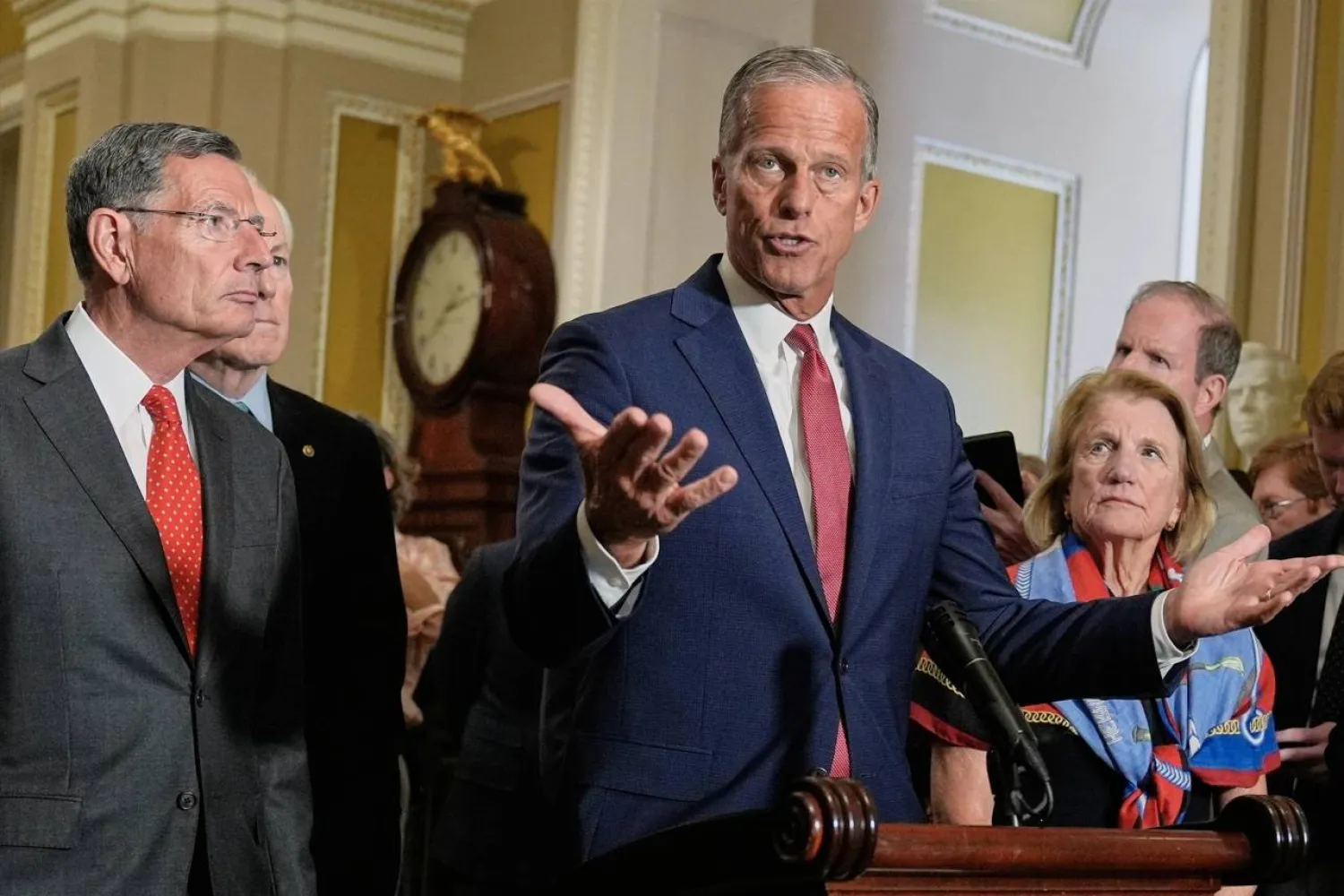
Senate Majority Leader John Thune speaks at a news conference at the Capitol on September 5, 2025 (AP)
 
Senate Majority Leader John Thune speaks at a news conference at the Capitol on September 5, 2025 (AP)  
TT

Senate Republicans Again Block Bid to Limit Trump’s Iran War Powers

Senate Majority Leader John Thune speaks at a news conference at the Capitol on September 5, 2025 (AP)
 
Senate Majority Leader John Thune speaks at a news conference at the Capitol on September 5, 2025 (AP)  

Washington: Robert Jimison, Megan Mineiro

Senate Republicans on Wednesday blocked the latest Democratic-led effort to curb President Trump’s authority to wage war on Iran, as a fragile ceasefire frays, dueling blockades choke traffic through the Strait of Hormuz and failed talks leave the next phase of the conflict uncertain.

The move to take up the measure failed on a vote of 52 to 47. It fell largely along party lines, with Republicans and a single Democrat, Senator John Fetterman of Pennsylvania, opposed and Democrats joined by a lone Republican, Senator Rand Paul of Kentucky, in favor.

Fourth Trial

It was the fourth time in recent weeks that Democrats have tried and failed to force Congress to reassert its war powers as the conflict, now stretching into its second month, continues. The repeated defeats underscore the durability of Republican backing for Trump, as his allies on Capitol Hill have foregone oversight of the war and repeatedly sought to avoid placing meaningful constraints on his authority.

Still, in the run-up to the vote, some GOP lawmakers suggested that their patience was wearing thin as the conflict drags on, its economic fallout reverberates among their constituents, and the president’s bellicose statements intensify.

“I hope that we are arriving at an exit strategy here to bring this to a close to preserve our security interests and bring down the cost of gasoline,” Senator Josh Hawley of Missouri said of the war, now in its seventh week.

Other Republicans said the administration should do more to lay out its objectives and plan for the conflict. They expressed a fervent desire to see it end promptly.

60-Day Mission

Senator Mike Rounds of South Dakota said that should the president expect Congress to support continuing the conflict beyond 60 days — the initial window that the law gives a president to deploy armed forces into hostilities without congressional approval — officials from the administration should “come in and give us a full description of it and sell the point and the plan.”

The statutory deadline for Trump to either pull out US troops or request a 30-day extension would fall on May 1. Senator Bill Hagerty, Republican of Tennessee, on Tuesday appeared to suggest that such an extension would not be necessary.

“This is going to be over soon,” he said.

While home during a two-week recess, some Republicans said they had heard concerns from their constituents about the conflict, which has sent oil prices above $100 per barrel, natural gas costs rising more than 80% and fertilizer prices surging, raising costs for farmers.

Wednesday’s vote was forced by Senator Tammy Duckworth, Democrat of Illinois, who argued that the war was the latest demonstration of the president reneging on promises he made during his 2024 campaign.

“It’s clear that none of this is making America safer, bringing prices down or ending wars like he promised,” Duckworth said in a statement ahead of the vote. “Americans are sick and tired of being lied to, and Republicans cannot continue to sit by and abdicate their responsibilities as Trump continues to spiral out of control at the expense of our national security.”

Democrats’ Bet

Democrats hope that mounting Republican frustration will eventually pull the party asunder, yielding enough defections for a handful to join them in delivering a rebuke of the president.

“I have not seen, in a long time, the level of frustration,” Senator Chuck Schumer, Democrat of New York and the minority leader, said in an interview last week. “There’s always been Republican frustration with Trump, but the frustration is sort of peaking.”

Senator Tommy Tuberville, Republican of Alabama, said he held events across his state in recent weeks and fielded questions from voters about the war. He said his response to concerned constituents was: “We just have to wait and see.”

Tuberville, who voted against the resolution, said: “I think we need to let the president of the United States handle this.”

In a recent address providing an update on the war, Trump said his administration was “on track to complete all of America’s military objectives shortly, very shortly.” He added that “we’re going to hit them extremely hard over the next two to three weeks.”

The United States and Iran have since agreed to a two-week ceasefire, while diplomatic talks between the two nations took place but ended with no resolution. Tensions have also risen as the United States has placed a blockade of vessels using Iran’s ports.

During that crucial period, Congress was out of session.

Now back in Washington, many Democrats and some Republicans have begun to press for additional information.

Hawley said that senators who do not sit on the Armed Services and Foreign Relations Committees — which have received a series of confidential briefings since the war began — have been kept in the dark, noting that he and others “have not been briefed since the first week of March.”

“I would welcome more,” Hawley added.

The New York Times


Israeli Opposition Leader Lapid Says Trump’s Emerging Deal with Iran Is ‘Bad for the Region’

Yair Lapid, founder of the new "Together" party and head of the Israeli opposition, speaks during a press briefing for the foreign media in Jerusalem, 25 May 2026. (EPA)
TT

Israeli Opposition Leader Lapid Says Trump’s Emerging Deal with Iran Is ‘Bad for the Region’

Yair Lapid, founder of the new "Together" party and head of the Israeli opposition, speaks during a press briefing for the foreign media in Jerusalem, 25 May 2026. (EPA)

The deal being discussed between the US and Iran fails to achieve any of Israel’s goals for the war, Israel’s opposition leader Yair Lapid said on Monday, as he accused Prime Minister Benjamin Netanyahu of failing to influence a better agreement.

Lapid, who is part of an alliance attempting to unseat Netanyahu in elections this year, said details of the emerging deal are “disturbing.”

“The deal is bad for Israel, bad for the region, bad for the citizens of Iran,” Lapid told reporters in Jerusalem.

Israel and the US launched the war on Feb. 28 vowing to destroy Iran’s ballistic missile program, end its support for proxy armed groups across the region and end Iran’s ability to pursue a nuclear bomb. Both Netanyahu and President Donald Trump also said they hoped to create conditions to topple Iran’s government.

According to regional officials, under the current deal being discussed Iran would give up its stockpile of highly enriched uranium and reopen the strategic Strait of Hormuz in exchange for ending a US blockade of Iranian ports and the lifting of sanctions against Iran. Key details on Iran’s nuclear program would then be negotiated during a 60-day period. It is unclear if the deal will address Iran’s missiles or support for regional militant groups.

Lapid expressed gratitude to Trump for launching the war with Israel, but criticized Netanyahu for allowing Washington to negotiate a potential deal with little coordination with Israel.

“The Israeli government is at an all-time low in its ability to influence decisions in Washington,” he said, noting that Trump said last week: “Netanyahu will do whatever I want him to do.”

Netanyahu has repeatedly stressed to Trump that Israel maintains “freedom of action” against threats in any arena, according to an official familiar with Israel prime minister's conversations with Trump, who spoke on the condition of anonymity because they were not authorized to speak to the media.

“Israel is a sovereign state, we are not a vassal state and we are not a protectorate,” Lapid said.

Lapid, head of the centrist “Yesh Atid” party, briefly served as prime minister in 2022 under a rotation agreement with Naftali Bennett, leader of a small conservative party. Their coalition government ended 12 years of Netanyahu’s rule.

They have once again merged their parties into a single faction headed by Bennett as they attempt to unseat Netanyahu in elections which will be held by the end of October.

Lapid has served as Israel’s opposition leader since Netanyahu returned to power in late 2022, while Bennett took a break from politics. Their alliance is aimed at uniting a fragmented opposition united in large part by their shared hostility toward Netanyahu.

Lapid, one of a shrinking number of Israeli politicians who supports the idea of Palestinian independence, said the issue would not be on the next government’s agenda. He said the conditions are not right following the trauma of the Hamas attacks on Oct. 7, 2023, and wars that have followed.

“There will be no two-state solution in the coming years, because Israelis now understand this will become just another failing terrorist state on our borders,” said Lapid, adding that the Palestinian Authority does not have the ability to effectively prevent attacks against Israel.

But Lapid said he would oppose unilateral steps that would make a future Palestinian state impossible and had received assurances from Bennett, a former West Bank settlement leader, that Israel will not move toward annexing the occupied territory.

Lapid also ruled out cooperation with Arab parties to build a coalition to unseat Netanyahu.

Opinion polls indicate that Bennett and Lapid might not be able to form a governing majority coalition without the support of some Arab lawmakers, as they did in their previous government. They broke a longstanding taboo in 2021 when they invited Mansour Abbas, leader of a small Arab faction, into Israel’s governing coalition for the first and only time in Israel’s history.

Lapid said his previous cooperation with Abbas was “the right government for the moment,” but that Israel is in a very different place after nearly three years of wars and he and Bennett will not build a coalition with Abbas’ party in the next elections.


Leaders Keep a Wary Eye on Belarus for Signs It Might Offer Russia Help in Ukraine

 27 January 2024, Russia, St. Petersburg: Belarus' President Alexander Lukashenko attends an event at the Gazprom Arena stadium in Saint Petersburg. (Vyacheslav Prokofiev/Kremlin/dpa)
27 January 2024, Russia, St. Petersburg: Belarus' President Alexander Lukashenko attends an event at the Gazprom Arena stadium in Saint Petersburg. (Vyacheslav Prokofiev/Kremlin/dpa)
TT

Leaders Keep a Wary Eye on Belarus for Signs It Might Offer Russia Help in Ukraine

 27 January 2024, Russia, St. Petersburg: Belarus' President Alexander Lukashenko attends an event at the Gazprom Arena stadium in Saint Petersburg. (Vyacheslav Prokofiev/Kremlin/dpa)
27 January 2024, Russia, St. Petersburg: Belarus' President Alexander Lukashenko attends an event at the Gazprom Arena stadium in Saint Petersburg. (Vyacheslav Prokofiev/Kremlin/dpa)

Belarus' exiled opposition leader visited Kyiv on Monday as the Ukrainian capital cleaned up after Russia’s biggest missile attack of the year, and world leaders kept a close eye on how much support the Belarusian government is ready to provide for Moscow’s all-out invasion.

Russia and ally Belarus held joint nuclear drills last week, and Ukrainian President Volodymyr Zelenskyy has warned in recent days that Belarus could provide a launchpad for Russia to open a new front in northern Ukraine. Some Russian troops entered Ukraine from Belarusian territory in Moscow's invasion on Feb. 24, 2022.

In a further sign of concern, French President Emmanuel Macron spoke by phone with Belarusian President Alexander Lukashenko on Sunday about the war in Ukraine, their first call since the invasion began.

Russia warns of more 'systemic strikes'

Further “systemic strikes” on Kyiv are in store, the Russian Foreign Ministry said in a statement Monday. It urged foreign citizens, including members of diplomatic missions, to leave the city as quickly as possible and told residents to stay away from military and government facilities.

The ministry said Friday’s deadly Ukrainian drone strike on a college dormitory in Starobilsk was “the final straw.” Ukraine said it hit only targets supporting Russia’s invasion.

The Russian army is locked in a hard and costly slog on the 1,250-kilometer (780-mile) front line that mostly snakes through eastern and southern Ukraine.

“Russia hit a dead-end on the battlefield, so it terrorizes Ukraine with deliberate strikes on city centers,” Kaja Kallas, the European Union’s foreign policy chief, said on X, after the weekend barrage that killed two people and damaged buildings across the Ukrainian capital.

With US-made air defense missiles in short supply because of the Iran war, Russian missiles are harder for Ukraine to stop. Meanwhile, US efforts to stop the fighting have stalled.

Countries keep a wary eye on Belarus

In his call with Lukashenko, Macron “underscored the risks for Belarus of allowing itself to be dragged into Russia’s war of aggression in Ukraine,” according to a presidential aide in the French leader’s office who spoke on condition of anonymity in accordance with the presidential palace’s practices. Macron also spoke Sunday with Zelenskyy.

Belarusian opposition leader Sviatlana Tsikhanouskaya, on her first visit to Kyiv, told The Associated Press on Sunday that “Lukashenko’s regime knows well what needs to be done to improve ties with the European Union, but it isn’t happening. Instead, hybrid attacks, nuclear blackmail and threats to the entire region continue."

A terse readout released by the Belarusian presidential press service said the call with Macron took place “on the French side’s initiative” and the leaders discussed “regional issues” and Belarusian relations with the EU and France.

Lukashenko, who has governed his country of some 9.5 million people with an iron fist for more than three decades, relies on the Kremlin for cheap energy, loans and other support. Western countries have repeatedly slapped sanctions on Belarus, including for its crackdown on human rights and for allowing Moscow to use its territory to invade Ukraine.

More recently, Lukashenko has been trying to improve ties with the West. Since President Donald Trump returned to the White House, Lukashenko has released hundreds of political prisoners as part of deals that lifted some US sanctions.

Russia fires hypersonic missile at Ukraine

Sunday’s bombardment included Russia’s powerful hypersonic Oreshnik ballistic missile, which can carry multiple warheads. Russian President Vladimir Putin has boasted it can travel up to 10 times the speed of sound and evade air defense systems.

Zelenskyy said Ukrainian intelligence services had received tipoffs from the United States and European countries that Russia was preparing to launch an Oreshnik.

In addition to the two deaths, at least 91 people were wounded in Sunday's barrage, according to Tymur Tkachenko, the head of the Kyiv City Administration.

Shattered glass littered sidewalks on Monday after Ukrainian authorities said the assault damaged buildings across the city, including near government offices, residential buildings, schools and a market.

Ukrainian Foreign Minister Andrii Sybiha on Monday led ambassadors from more than 70 countries on a visit to the sites of the strikes. He urged the international community to step up pressure on Moscow and ensure Ukraine gets more air defense support.

In other developments, Russia’s Federal Security Service said divers found magnetic mines attached to the hull of a liquefied petroleum gas tanker in the Russian Baltic port of Ust-Luga. The tanker Arrhenius was bound for Samsun, Türkiye, it said, adding that the limpet mines were made in a NATO member country. Ukrainian officials made no immediate comment.

Meanwhile, a Russian missile hit a business in the northeastern Ukrainian city of Derhachi, killing two people and wounding 19 others Monday, Kharkiv regional administration head Oleh Syniehubov said. Seventeen people were hospitalized.


Iran Warns Deal with US Not Yet Close, despite Some Progress

TOPSHOT - People cross a street past a billboard on the facade of a building depicting the Strait of Hormuz with a caption in Persian reading "Forever in Iran's Hand", at Vanak Square in Tehran on May 25, 2026.   (Photo by ATTA KENARE / AFP)
TOPSHOT - People cross a street past a billboard on the facade of a building depicting the Strait of Hormuz with a caption in Persian reading "Forever in Iran's Hand", at Vanak Square in Tehran on May 25, 2026. (Photo by ATTA KENARE / AFP)
TT

Iran Warns Deal with US Not Yet Close, despite Some Progress

TOPSHOT - People cross a street past a billboard on the facade of a building depicting the Strait of Hormuz with a caption in Persian reading "Forever in Iran's Hand", at Vanak Square in Tehran on May 25, 2026.   (Photo by ATTA KENARE / AFP)
TOPSHOT - People cross a street past a billboard on the facade of a building depicting the Strait of Hormuz with a caption in Persian reading "Forever in Iran's Hand", at Vanak Square in Tehran on May 25, 2026. (Photo by ATTA KENARE / AFP)

Iran warned Monday that, while some progress had been made, it was not yet close to striking a deal with the United States to end the Middle East war, after a weekend of mixed messages from Washington and Tehran.

World oil prices tumbled on renewed optimism about an agreement, after top US diplomat Marco Rubio suggested a deal could be reached within the day -- but Iran's foreign ministry spokesman responded: "No one can make such a claim."

Meanwhile, Pakistan's Prime Minister Shehbaz Sharif -- whose government is spearheading efforts to mediate a negotiated agreement between the United States and Iran -- met China's President Xi Jinping in Beijing.

US and Iranian forces have observed a ceasefire since April 8 while diplomats push for a negotiated settlement, although Iran has maintained controls on Gulf shipping through the Strait of Hormuz and the US Navy has sought to blockade Iran's ports.

"We thought we might have some news last night, maybe today," US Secretary of State Rubio told reporters during a visit to New Delhi, referring to hopes for a deal.

"We have what I think is a pretty solid thing on the table in terms of their ability to open up the straits, get the straits open," he said.

"We're either going to have a good agreement or we're going to have to deal with it another way. We'd prefer to have a good agreement," he said.

But in Tehran, foreign ministry spokesman Esmaeil Baqaei poured cold water on hopes for a quick final settlement.

- 'Certain fees' -

"It is correct to say that we have reached a conclusion on a large portion of the issues under discussion," he told a weekly news briefing.

"But to say that this means the signing of an agreement is imminent -- no one can make such a claim."

Baqaei stressed that Iran would continue to manage maritime traffic through the Strait of Hormuz by charging service fees -- arguing that this did not amount to Tehran "seeking to collect tolls".

"The services that are provided -- navigational services in addition to the measures necessary to protect the environment of the Strait of Hormuz”, the Arabian Gulf “and the Sea of Oman -- require the collection of certain fees," he said.

Earlier, President Donald Trump had said that he had told his negotiators "not to rush into a deal, in that time is on our side", and warned that the US naval blockade would remain in place until a deal was reached.

A post on Trump's Truth Social read: "If I make a deal with Iran, it will be a good and proper one," adding that: "It isn't even fully negotiated yet."

Israel's Prime Minister Benjamin Netanyahu said Sunday that he and Trump had agreed that "any final agreement with Iran must eliminate the nuclear threat entirely."

- 'Lasting peace' -

Iranian officials have stressed that, despite the long-standing US demand for an end to its uranium enrichment, talks on the issue of Iran's contested nuclear program have been deferred until after an initial agreement.

The war, which erupted after the United States and Israel attacked Iran on February 28 and saw Iran respond with missile and drone attacks across the region, drove energy prices higher.

Crude oil remains expensive by recent standards, but prices have see-sawed and Monday's mood of relative optimism caused prices to plunge by almost five percent.

The price of North Sea Brent crude and West Texas Intermediate slipped to $99.00 and $92.10 a barrel respectively.

On Saturday, leaders from Saudi Arabia, the United Arab Emirates, Qatar, Egypt, Jordan and Bahrain, as well as representatives from Türkiye and Pakistan, joined a call with Trump to discuss the deal.

The focus of international efforts moved to Beijing on Monday, where Pakistan's Sharif and army chief Asim Munir, who visited Tehran on Saturday, met senior leaders including Xi and Premier Li Qiang.

Speaking to Chinese leaders, Sharif said "the world is passing through a critical moment", Pakistan's state-run PTV channel showed.

"Things are moving in the right direction. I would like to thank China's support to promote peace."
