


Iran Reopens Strait of Hormuz, but Trump Says Blockade on Iranian Ships and Ports Will Stay in Force

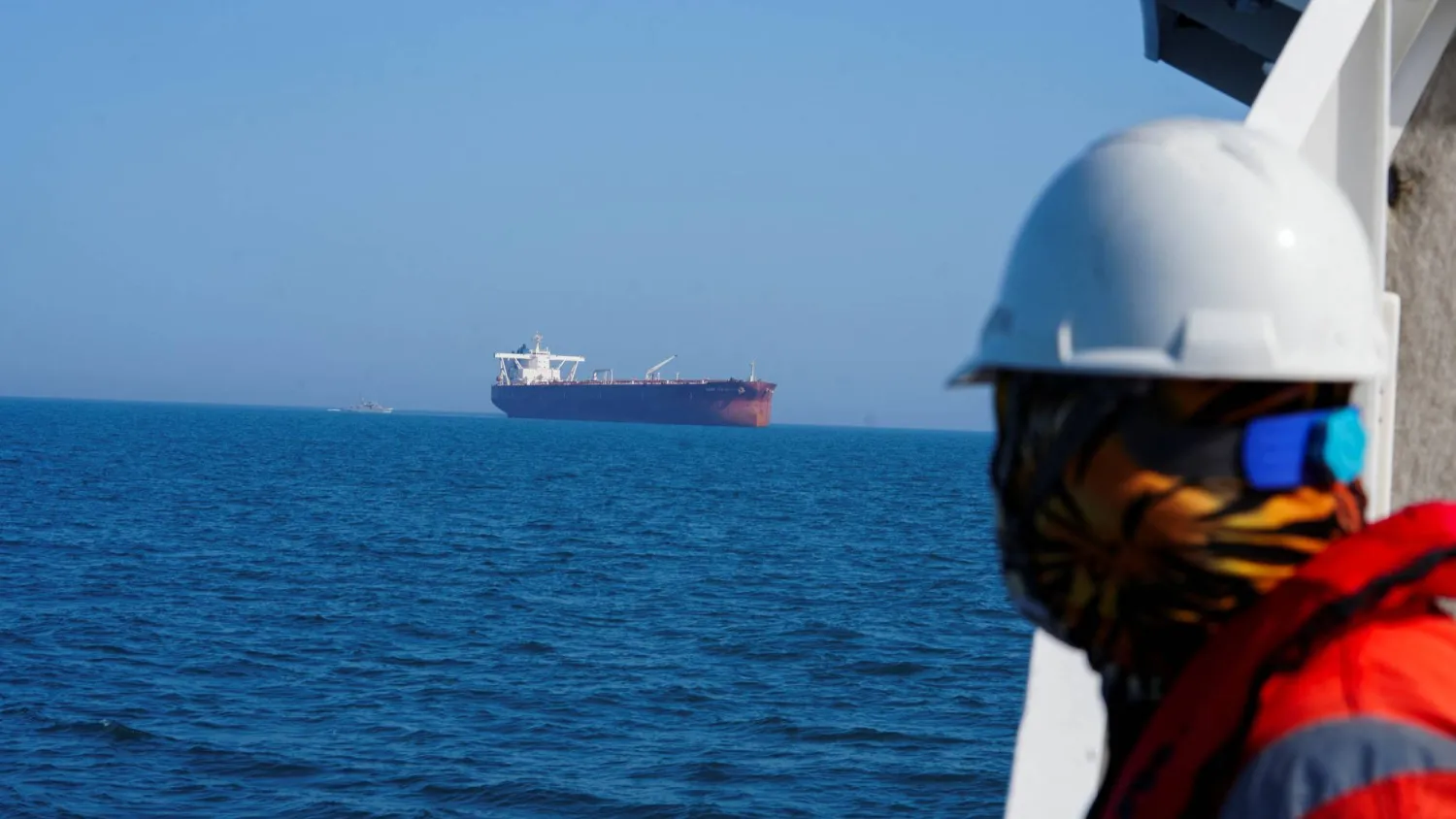
The Malta-flagged tanker Agios Fanourios I, an oil tanker that sailed through the Strait of Hormuz, arrives in Iraq’s territorial waters off Basra, Iraq April 17, 2026. (Reuters)
TT

Iran Reopens Strait of Hormuz, but Trump Says Blockade on Iranian Ships and Ports Will Stay in Force

The Malta-flagged tanker Agios Fanourios I, an oil tanker that sailed through the Strait of Hormuz, arrives in Iraq’s territorial waters off Basra, Iraq April 17, 2026. (Reuters)

Iran said Friday it fully reopened the Strait of Hormuz to commercial vessels, but President Donald Trump said the American blockade on Iranian ships and ports “will remain in full force” until Tehran reaches a deal with the US, including on its nuclear program.

Iranian Foreign Minister Abbas Araghchi posted on X that the crucial waterway, through which about 20% of the world's oil is shipped, was now fully open to commercial vessels, as a 10-day truce between Israel and the Iran-backed Hezbollah group in Lebanon appeared to hold.

Trump initially celebrated the Iranian announcement, posting on social media that the strait was "fully open and ready for full passage.” But minutes later, he issued another post saying the US Navy's blockade would continue “UNTIL SUCH TIME AS OUR TRANSACTION WITH IRAN IS 100% COMPLETE.”

The president also said Iran, with help from the US, is working to remove all mines from the strait.

Trump imposed the blockade earlier this week after Iran restricted traffic through the strait due to fighting in Lebanon, which Iran claimed to be a breach of the Pakistan-brokered ceasefire reached between the US, Israel and Iran.

At the time, Trump said the blockade would enforce an “all or none” policy in hopes of pressuring Iran to reopen the strait.

The president's decision to continue the blockade despite Iran’s announcement appeared aimed at sustaining pressure on Tehran as the fate of the two-week ceasefire reached last week remains uncertain. Direct talks between the US and Iran last weekend were inconclusive, as the two nations differed over Iran’s nuclear program and other points.

Truce in Lebanon could help US-Iran peace efforts

Oil prices fell on hopes of a deal. The head of the International Energy Agency had warned that energy shocks could get worse if the strait did not reopen.

The truce in Lebanon could clear one major obstacle to a deal between Iran, the United States and Israel to end weeks of devastating war. But it was unclear to what extent Hezbollah would abide by a deal it did not play a role in negotiating and which will leave Israeli troops occupying a stretch of southern Lebanon.

Trump said in another post that Israel is “prohibited” by the US from further strikes on Lebanon and that “enough is enough” in the Israel-Hezbollah war. The White House did not immediately respond to a question about whether the prohibition spans both offensive and defensive strikes.

Shortly before Trump's social media post, Israeli Prime Minister Benjamin Netanyahu said Israel agreed to the ceasefire in Lebanon “at the request of my friend President Trump,” but that the campaign against Hezbollah is not complete.

He claimed Israel had destroyed about 90% of Hezbollah’s missile and rocket stockpiles and added that Israeli forces “have not finished yet” with the dismantling of the group.

Celebrations in Beirut

In Beirut, celebratory gunshots rang out across the Lebanese capital at the start of the truce. Displaced families began moving toward southern Lebanon and Beirut’s southern suburbs despite warnings by officials not to return to their homes until it became clear whether the ceasefire would hold.

A spokesperson for the UN peacekeepers in southern Lebanon said Friday they had not observed any airstrikes since midnight, but accused the Israeli military of violating airspace and of artillery shelling in southern Lebanon. The Israeli military did not immediately comment.

According to the agreement shared by the State Department, Israel can act in self-defense against imminent attacks but cannot carry out offensive operations against southern Lebanon.

Trump heralded the deal a “historic day for Lebanon” and expressed confidence the war with Iran would soon end.

“I will say the war in Iran is going along swimmingly,” Trump said in a Las Vegas speech. “It should be ending pretty soon.”

An end to Israel’s war with Hezbollah was a key demand of Iranian negotiators, who previously accused Israel of breaking the current ceasefire with strikes on Lebanon. Israel said that deal did not cover Lebanon.

Pakistan’s army chief met Thursday with Iran’s parliament speaker as part of international efforts to press for an extension of the ceasefire.

The fighting has killed at least 3,000 people in Iran, more than 2,290 in Lebanon, 23 in Israel and more than a dozen in Gulf Arab states. Thirteen US service members have also been killed.

Israel says it will keep troops in Lebanon

Israeli forces have engaged in fierce battles with Hezbollah in the border area as they pushed into southern Lebanon to create what officials have called a “security zone.”

Israel’s hardline Defense Minister Israel Katz said Israel would continue to hold all the places it is currently stationed, including a buffer zone extending 10 kilometers (6 miles) from the border into southern Lebanon. He said many homes in the area would be destroyed and Lebanese residents will not return.

Hezbollah has said Lebanese people have “the right to resist” Israeli occupation of their land and that their actions “will be determined based on how developments unfold.”

Israel and Hezbollah have fought several wars and have been fighting on and off since the day after the start of the Gaza war. Israel and Lebanon reached a deal to end that war in November 2024, but Israel has kept up near-daily strikes in what it says is an effort to prevent the party from regrouping. That escalated into another invasion after Hezbollah again began firing missiles at Israel in response to its war on Iran.

Pakistan army chief meets with Iranian parliament speaker

Pakistan’s army chief met Thursday with Iran’s parliament speaker as part of efforts to press for an extension to a ceasefire that has paused almost seven weeks of war between Israel, the US and Iran.

Regional officials reported progress, telling AP the United States and Iran had an “in-principle agreement” to extend it to allow for more diplomacy. They spoke on condition of anonymity to discuss sensitive negotiations.

Mediators are pushing for a compromise on three main sticking points: Iran’s nuclear program, the Strait of Hormuz and compensation for wartime damages, according to a regional official involved in the mediation efforts.

Trump on Friday suggested Iran has agreed to hand over its enriched uranium.

“The USA will get all Nuclear ‘Dust,’ created by our great B2 Bombers — No money will exchange hands in any way, shape, or form,” he said in a post. Nuclear dust is the shorthand Trump frequently uses to refer to the highly enriched uranium that is believed buried under nuclear sites the US bombed during last year’s 12-day war between Israel and Iran.

If true, it would be a major concession from Iran, and would lock in a key demand of the US to end the conflict. But neither Iran nor countries acting as intermediaries in the conflict have said Tehran has made such an agreement.

Trump also asserted Thursday that Iran had “agreed to give us back the nuclear dust.”


Iran Condemns 'Flagrant Ceasefire Violation' after US Strikes

Iranian Foreign Ministry spokesman  Esmaeil Baghaei (Iranian News Agency)
Iranian Foreign Ministry spokesman Esmaeil Baghaei (Iranian News Agency)
TT

Iran Condemns 'Flagrant Ceasefire Violation' after US Strikes

Iranian Foreign Ministry spokesman  Esmaeil Baghaei (Iranian News Agency)
Iranian Foreign Ministry spokesman Esmaeil Baghaei (Iranian News Agency)

Iran condemned on Saturday a nighttime US attack on coastal radar installations in the Gulf, calling it a "flagrant" violation of the ceasefire in place since April.

The foreign ministry said it was an attack "on the national sovereignty and territorial integrity of the Islamic republic", denouncing Washington's "hostile and provocative behavior".

It added that the United States would bear responsibility for any consequences arising from its unlawful actions and any further escalation.

Tensions between Iran and the United States escalated on Saturday after Iran's Revolutionary Guard Corps (IRGC) announced attacks on US bases in the region following confrontations linked to shipping traffic in the Strait of Hormuz and strikes on sites inside Iran.

While Tehran said it had launched missile attacks on US bases, Washington said it intercepted most of the projectiles and rejected Iranian claims that facilities associated with the US Fifth Fleet in Bahrain had been hit.

The IRGC said on Saturday that it had carried out attacks on US bases in the region following an attack on the city of Sirik and Qeshm Island, as well as the targeting of four oil tankers that had attempted to transit the Strait of Hormuz without coordination, according to dpa.

For its part, US Central Command (CENTCOM) said in a statement posted on X on Saturday that Iran had launched seven missiles toward Kuwait and Bahrain after US forces shot down four drones that had been launched toward the Strait of Hormuz.


Pope Urges Leaders to Temper Divisions at Start of Spain Trip

Spain's King Felipe VI (L), Queen Letizia (R), Crown Princess Leonor (L, rear), and Princess Sofia (R, rear) go up the Ambassadors Staircase with Pope Leo XIV during the welcoming ceremony held at the Royal Palace in Madrid, Spain, 06 June 2026.   EPA/DANIEL GONZALEZ
Spain's King Felipe VI (L), Queen Letizia (R), Crown Princess Leonor (L, rear), and Princess Sofia (R, rear) go up the Ambassadors Staircase with Pope Leo XIV during the welcoming ceremony held at the Royal Palace in Madrid, Spain, 06 June 2026. EPA/DANIEL GONZALEZ
TT

Pope Urges Leaders to Temper Divisions at Start of Spain Trip

Spain's King Felipe VI (L), Queen Letizia (R), Crown Princess Leonor (L, rear), and Princess Sofia (R, rear) go up the Ambassadors Staircase with Pope Leo XIV during the welcoming ceremony held at the Royal Palace in Madrid, Spain, 06 June 2026.   EPA/DANIEL GONZALEZ
Spain's King Felipe VI (L), Queen Letizia (R), Crown Princess Leonor (L, rear), and Princess Sofia (R, rear) go up the Ambassadors Staircase with Pope Leo XIV during the welcoming ceremony held at the Royal Palace in Madrid, Spain, 06 June 2026. EPA/DANIEL GONZALEZ

Pope Leo on Saturday urged global leaders to avoid dividing their electorates with "sterile simplifications" to gain popularity and called on them to listen to the world's cries for peace, in a forceful speech opening a week-long tour of Spain.

"Today, the temptation to gain popularity by fanning the flames of polarization seems to have grown rather than diminished, and human dignity continues to be violated," Leo said in a speech before King Felipe VI at the Royal Palace in Madrid, Reuters reported.

"I invite everyone to set aside the divisive and polarizing narratives of your societal reality and history, so as to overcome sterile simplifications through the fruitful appreciation of complexity," he added.

Technology was partly to blame for creating an environment which magnifies prejudices and weakens critical thinking, Leo said. The world was crying "from its depths for peace," he said.

He drew on Spain's history as an example of peaceful co-habitation between religions and cultures, making reference to how Christians, Muslims and Jews cooperated during medieval times to enhance human knowledge by translating Arabic texts into Latin, Spanish and Hebrew at the School of Translators in Toledo.

"Your own history suggests that a culture of encounter, not confrontation, is what fosters stability and prosperity. In reality, the message of peace, which at present unfortunately strikes some as naïve and others as confrontational, is welcomed by those who do not shut themselves off in preconceived ideologies, but are rather open to the truth," he said.

Thousands lined the streets of central Madrid, some waving Vatican and Spanish flags under clear spring skies, as Leo toured in an open-air popemobile. Huge gatherings are expected in the coming days for the first visit to Spain by a pope since 2011.

Leo, who has adopted a more assertive tone against the direction of global leadership in recent months, is scheduled to give more than 20 speeches during his first trip to a European Union country outside Italy, and will be the first pope to address the Spanish parliament.

Leo spent decades as a missionary and bishop in Peru before becoming pope last May, and will speak Spanish throughout most of the trip.


Pakistan's Interior Minister Heads to Iran for Talks

Pakistani Interior Minister Mohsin Naqvi (from his account on X).
TT

Pakistan's Interior Minister Heads to Iran for Talks

Pakistani Interior Minister Mohsin Naqvi (from his account on X).

Officials said on Saturday that Pakistan's Interior Minister Mohsin Naqvi was heading to Tehran as part of Islamabad's diplomatic efforts to promote dialogue between Iran and the United States amid renewed attacks.

Diplomatic and security sources said: "Interior Minister Mohsin Naqvi is travelling to Tehran today for a series of high-level meetings with Iranian officials."

Naqvi is widely seen as being close to Army Chief Field Marshal Asim Munir, who has also visited Iran as part of Islamabad's efforts to mediate between the warring parties.

Photo released by Iran's Foreign Ministry showing Iranian Foreign Minister Abbas Araghchi and Pakistani Interior Minister Mohsin Naqvi in Tehran.

The interior minister has made repeated visits to Tehran and Islamabad since the first round of direct talks between Iran and the United States.

The visit comes after Naqvi met his Iranian counterpart, Eskandar Momeni, on the sidelines of a meeting of Shanghai Cooperation Organization interior ministers in Kyrgyzstan on Thursday and Friday.

In a statement issued after the meeting, Pakistan's Interior Ministry said: "The two interior ministers emphasized the need to continue diplomatic efforts steadfastly in pursuit of lasting peace in the region."

The visit also comes after the United States and Iran recently resumed attacks against each other in the Gulf despite a ceasefire that has been in place for nearly two months since the outbreak of the war on Feb. 28.
