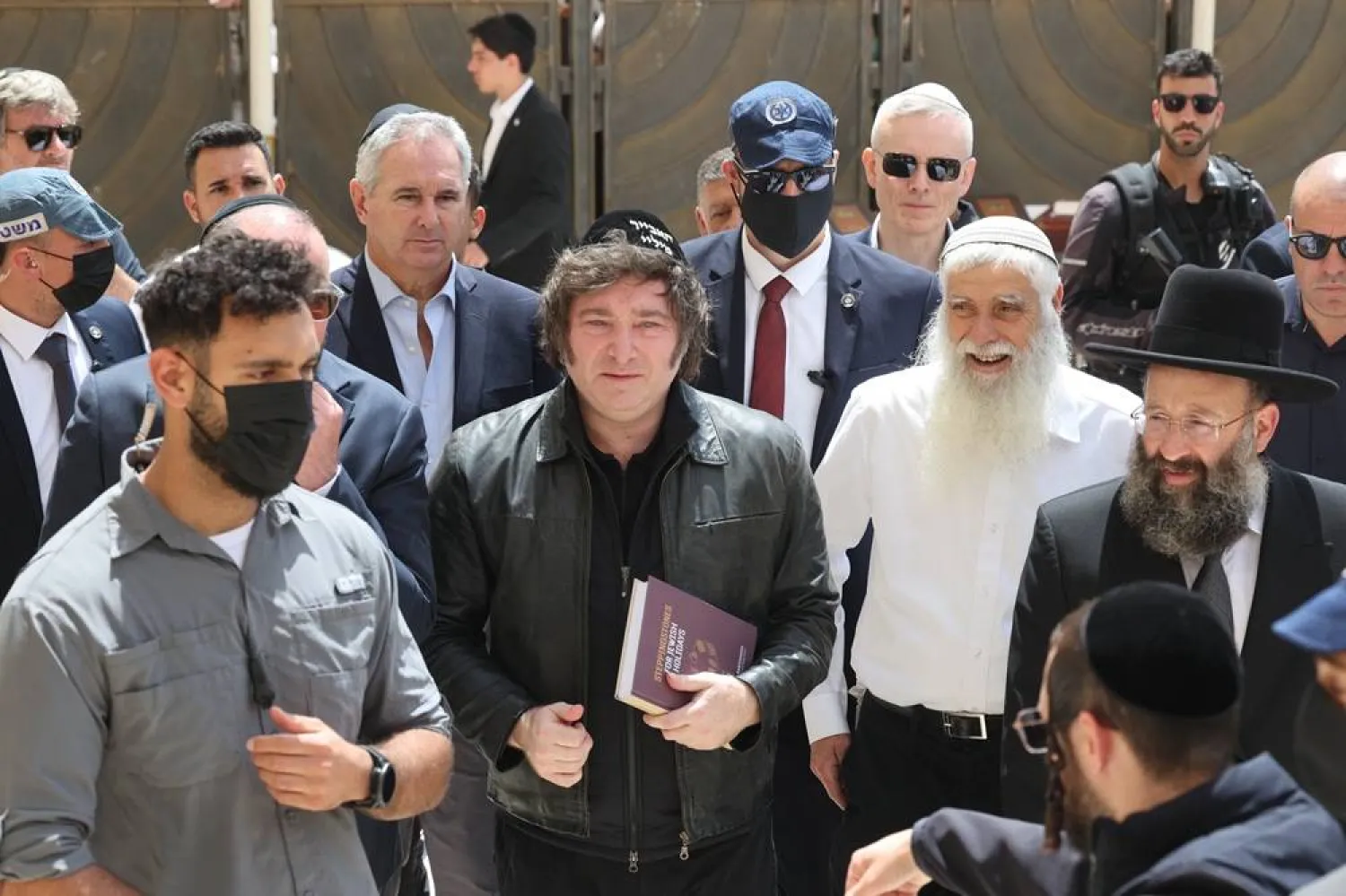
Argentina’s Milei Says US-Israel War Against Iran ‘Right Thing to Do’

Argentinian President Javier Milei (C) visits the Western Wall in Jerusalem’s Old City, 19 April 2026. (EPA)
TT

Argentina’s Milei Says US-Israel War Against Iran ‘Right Thing to Do’

Argentinian President Javier Milei (C) visits the Western Wall in Jerusalem’s Old City, 19 April 2026. (EPA)

Argentine President Javier Milei declared Sunday that the joint US-Israel war against Iran was the "right thing to do", as he signed on to the so-called Isaac Accords aimed at deepening bilateral ties between Israel and Latin American countries.

Making his third visit to Israel as president, Milei reaffirmed Argentina's support for the campaign against Iran, citing his government's earlier decision to designate Iran's Revolutionary Guards a "terrorist organization".

"We expressed our firm support for the United States and Israel in their war against terrorism and against the Iranian regime, not only because it is the right thing to do, but because our countries are brothers in suffering," Milei said in a joint statement with Israeli Prime Minister Benjamin Netanyahu.

"Argentina was the victim of cowardly terrorist attacks on the AMIA and on the Embassy of Israel, both instigated by Iran," he added.

Argentina has accused Iran of not cooperating with a probe into a 1994 bombing in Buenos Aires that killed 85 people and injured more than 300 at a Jewish community center.

Prior to that, in 1992, an explosion at the Israeli embassy killed 29 and wounded 200.

Argentine courts have blamed both attacks on Iran, which has always denied involvement and refused to hand over suspects.

"To this day, we still demand justice," said the libertarian leader, an outspoken supporter of both Netanyahu and US President Donald Trump.

"We reiterate our willingness to move the Argentine embassy to Jerusalem as soon as conditions allow. We consider it necessary, but above all, just," he added.

The US-backed Isaac Accords are an initiative designed to boost Israel's ties with Latin America, mirroring the Abraham Accords under which some Arab countries normalized relations with Israel during Trump's first term.

Israel and Argentina also inked a deal to launch direct flights between Buenos Aires and Tel Aviv from November -- a move Milei said would cement "an unbreakable bond" between the two countries.

Netanyahu hailed Milei for showing "moral clarity" in standing with Israel.

"President Milei... has shown that by standing up with the Jewish people, standing up against anti-Semitic vilifications, standing up in our hour of need, standing up when we fight the battle of civilization against barbarism," Netanyahu said.

Argentina is home to the largest Jewish community in Latin America, numbering nearly 300,000 people living mostly in Buenos Aires.

Earlier on Sunday, Milei visited the Western Wall in Jerusalem's Old City, considered the holiest site where Jews are allowed to pray.

He had also visited the site in February 2024 and June 2025.


Erdogan Takes Russia, Ukraine to Task Over Black Sea Attacks

Turkish President Recep Tayyip Erdogan and Ukrainian President Volodymyr Zelensky shake hands during a press conference in Istanbul, Türkiye, October 31, 2026. (Reuters)
TT

Erdogan Takes Russia, Ukraine to Task Over Black Sea Attacks

Turkish President Recep Tayyip Erdogan and Ukrainian President Volodymyr Zelensky shake hands during a press conference in Istanbul, Türkiye, October 31, 2026. (Reuters)

Türkiye’s President Recep Tayyip Erdogan said on Saturday attacks aimed at civilian vessels in the Black Sea were unacceptable, urging Russia and Ukraine to "act responsibly".

Despite its ties with both Russia and Ukraine, Türkiye has been infuriated by the attacks on commercial vessels in the Black Sea.

"It is clear that attacks against civilian vessels and actions that further escalate tensions in the Black Sea serve no one's interests," Erdogan told a news conference with Ukraine's President Volodymyr Zelensky in Istanbul.

"We cannot accept these attacks under any circumstances, regardless of who carries them out or what justification is offered. We call on all parties to act responsibly on this matter," he said.

Ankara has sent a proposal to Russia and Ukraine to end strikes on civilian ships, but says the two foes have failed to act on it.

"We will continue our talks with the parties concerned with a view to restoring the safety of navigation in the Black Sea," the Turkish leader said.

"I believe that reaching an agreement on this issue would also give fresh impetus to efforts to secure lasting peace in Ukraine."

Türkiye has also hosted several rounds of talks between Russia and Ukraine aiming for a lasting ceasefire and peace deal.

In a phone call with US President Donald Trump on Wednesday, Erdogan said Türkiye was ready to support efforts to revive the diplomatic process between Ukraine and Russia and bring the war to an end through negotiations, according to the Turkish leader's office.


Rubio Says US Yet to Decide on New Iran Strikes

Iranian people walk past a mural depicting late Iranian supreme leader Ali Khamenei, in a street of Tehran, Iran, 31 October 2026. (EPA)
TT

Rubio Says US Yet to Decide on New Iran Strikes

Iranian people walk past a mural depicting late Iranian supreme leader Ali Khamenei, in a street of Tehran, Iran, 31 October 2026. (EPA)

US President Donald Trump has not made a decision about fresh strikes on Iran amid stalled peace talks, US Secretary of State Marco Rubio said Saturday.

"We can achieve military objectives if we seek to," Rubio told a press conference in Atlanta, Georgia, where he was hosting G20 foreign ministers for a two-day meeting.

But Rubio added that Trump "hasn't made a decision" on further military action, amid reports that the US leader could attack after key midterm elections on Tuesday.

"I have no announcement in that regard with you today, and nor do we take any of it lightly," Rubio said.

While he slammed Tehran for "actively and openly" targeting commercial vessels for attack, Rubio also expressed Trump's preference for a diplomatic solution to end war with Iran.

But he did not commit to a timeline for talks.

"I'm not going to characterize neither the progress on those talks nor any timeframe on it, other than to tell you that if there is a diplomatic solution, we would be open to it," Rubio said.

Iran's supreme leader on Saturday warned the United States and Israel against launching new attacks, following threats to resume strikes after crucial elections.

Trump earlier warned of the potential for fresh military action after US midterms, saying previously that he was weighing up whether to "finish them off."

But any further attack would spark concern among US allies.

On Thursday, EU foreign policy chief Kaja Kallas told AFP: "We are calling for a diplomatic solution, and really, escalation does not benefit anyone."


Iranian Envoys Meet Qatari Mediators as Threat Looms of US Strikes After Midterms

A man holds Iran's national flag in a street of Tehran, Iran, 31 October 2026. (EPA)
TT

Iranian Envoys Meet Qatari Mediators as Threat Looms of US Strikes After Midterms

A man holds Iran's national flag in a street of Tehran, Iran, 31 October 2026. (EPA)

Iranian negotiators held talks in Doha with Qatari mediators on Saturday to discuss paths out of war in the region, a source told Reuters, as diplomats try to avert a new outbreak of fighting after the US midterm elections this week.

Saturday's talks in the Qatari capital followed more than 12 hours of discussions on Friday between Iranian and Qatari envoys in Tehran, said the source, who was briefed on the negotiations and spoke on condition of anonymity. The source said the talks were being coordinated in regular contacts with Washington.

Countries in the region have been anticipating that US President Donald Trump, who has held off on strikes on Iran during the weeks leading ‌up to Tuesday's ‌midterm elections, could restart attacks once the voting is over. Iran has repeatedly ‌said ⁠it would respond ⁠to new attacks by striking at US and Israeli targets in neighboring countries.

Iran's Supreme Leader Mojtaba Khamenei issued a statement on Saturday ordering the armed forces to be prepared to respond to any attacks. The Iranian military later announced it was taking steps to improve its readiness.

"Any level or type of threat must be met with an immediate, impactful, and geographically unrestricted response," Khamenei, who has not appeared in public since replacing his father slain at the war's outset, said on Saturday in the statement posted on his official Telegram account.

He said ⁠that senior commanders had reported high readiness along the Gulf coast, in ‌and around the Strait of Hormuz and Gulf of Oman, and ‌on Iran's northwestern and southeastern borders.

DIPLOMACY CONTINUES DESPITE GAPS

Trump, who launched the war alongside Israel in February, has repeatedly hinted ‌at plans to restart strikes on Iran. Last week he called on Israelis ahead of their ‌own election to keep his wartime ally Prime Minister Benjamin Netanyahu in power so the two leaders can "finish the job".

But Washington has also lately taken steps to indicate it is open to diplomacy. Earlier this week, Vice President JD Vance, who led the US delegation at previous rounds of talks with Iran, wrote a letter to a hardline senior ‌Iranian security official, which the New York Times and Wall Street Journal described as an initiative to see if it was possible to restart talks.

Trump ⁠played the letter down, ⁠saying he approved it only to discuss the possibility of letting more medical supplies into Iran: "I said if you want to do that, that's ok. Basically, it's getting supplies in to help people that are not well."

In the latest Qatari-mediated discussions, the Qataris brought a proposal to Tehran a week ago for a seven-day plan, under which the US and Iran would take daily steps to build trust ahead of broader peace talks, the source briefed on the negotiations said. A senior Iranian official told Reuters on Friday that this proposal was not deemed satisfactory by Tehran.

Iran has been proposing its own seven-day plan since September, so far rejected by Trump. That calls for Washington to lift a blockade of Iranian ports, unfreeze assets and approve an Iranian-backed route through the Strait of Hormuz, after which the contested strait would be reopened.

Foreign Minister Abbas Araghchi said in remarks reported by Al Jazeera on Saturday that Iran was studying Vance's letter. He said the Iranian plan was the only proposal on the table to reopen the strait.