


World Weighs Fate of Middle East Ceasefire After US Seizes Iranian Cargo Ship

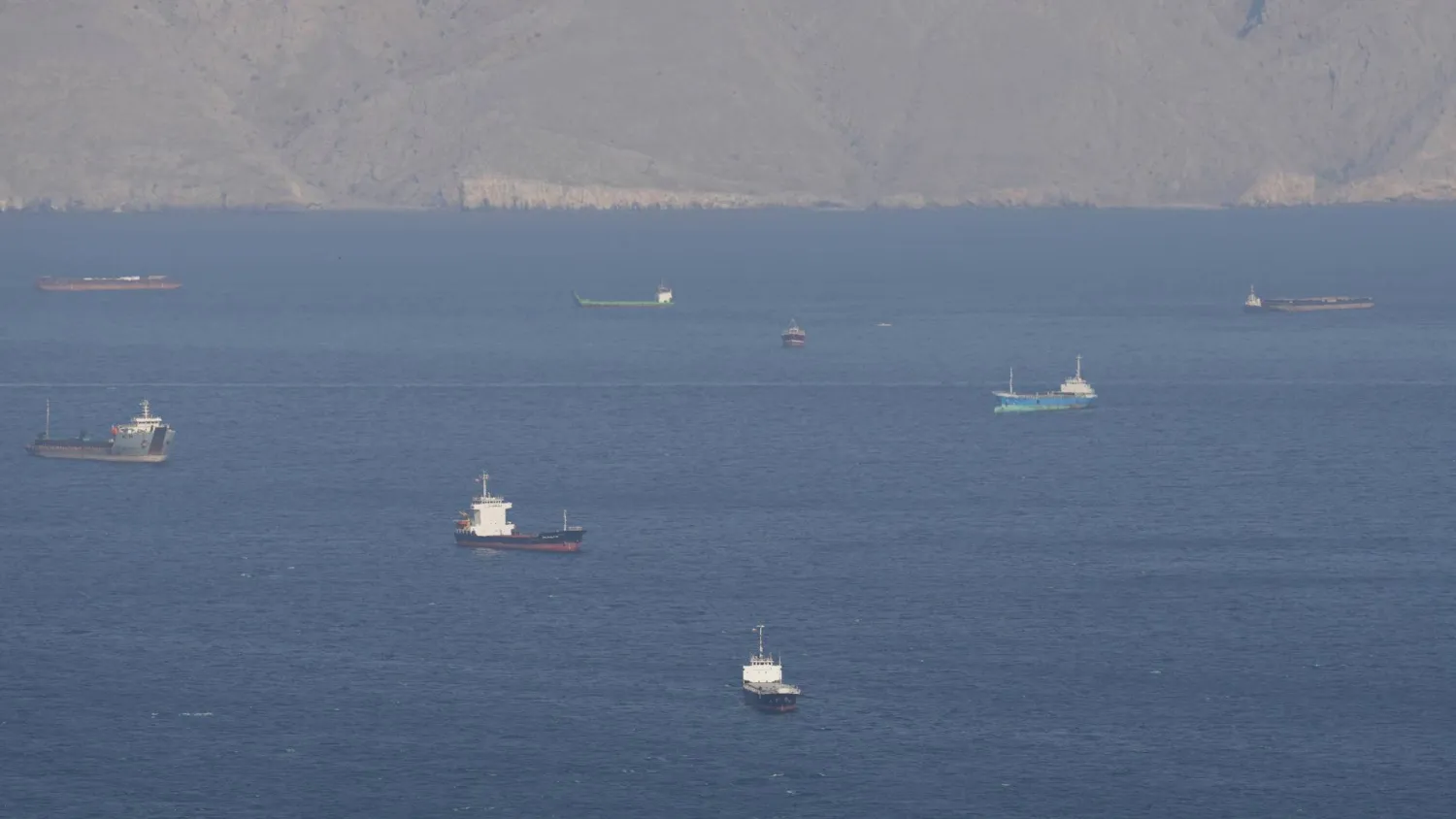
 Ships and tankers in the Strait of Hormuz off the coast of Musandam, Oman, April 18, 2026. (Reuters)
Ships and tankers in the Strait of Hormuz off the coast of Musandam, Oman, April 18, 2026. (Reuters)
TT

World Weighs Fate of Middle East Ceasefire After US Seizes Iranian Cargo Ship

 Ships and tankers in the Strait of Hormuz off the coast of Musandam, Oman, April 18, 2026. (Reuters)
Ships and tankers in the Strait of Hormuz off the coast of Musandam, Oman, April 18, 2026. (Reuters)

Concerns grew on Monday that the ceasefire between the United States and Iran might not hold after the US said it had seized an Iranian cargo ship that tried to run its blockade and Iran vowed to retaliate.

Efforts to build a more lasting peace in the region likewise appeared to be on shaky ground, as Iran said it would not participate in a second round of negotiations that the US had hoped to kick off before the ceasefire expires on Tuesday.

The US has maintained a blockade of Iranian ports, while Iran has lifted and then reimposed its own blockade on marine traffic passing through the Strait of Hormuz, which typically handles roughly one-fifth of the world's oil supply.

The US military said Sunday it fired on an Iranian-flagged cargo ship as the vessel sailed toward Iran's Bandar Abbas port. "We have full custody ‌of their ship, ‌and are seeing what's on board!" President Trump wrote on social media.

Iran's military said ‌the ⁠ship had been ⁠traveling from China. "We warn that the armed forces of Iran will soon respond and retaliate against this armed piracy by the US military," a military spokesperson said, according to state media.

Oil prices jumped and stock markets wobbled, as traders pondered the prospect that traffic in and out of the Gulf would remain at a bare minimum.

IRAN REJECTS PEACE TALKS

Iranian state media reported that Tehran had rejected new peace talks, citing the ongoing blockade, threatening rhetoric, and Washington's shifting positions and "excessive demands."

"One cannot restrict Iran's oil exports while expecting free security for others," Iran's First Vice President Mohammadreza Aref wrote on social ⁠media. "The choice is clear: either a free oil market for all, or the risk ‌of significant costs for everyone."

Trump earlier warned Iran that the US would ‌destroy every bridge and power plant in Iran if Tehran rejected his terms, continuing a recent pattern of such threats.

Iran has said ‌that if the United States were to attack its civilian infrastructure it would hit power stations and desalination plants ‌of Gulf Arab neighbors.

PREPARING FOR TALKS THAT MIGHT NOT HAPPEN

Trump said his envoys would arrive in Islamabad on Monday evening, one day before a two-week ceasefire ends.

A White House official told Reuters the US delegation would be headed by Vice President JD Vance, who led the war's first peace talks a week ago, and also include Trump's envoy Steve Witkoff and son-in-law Jared Kushner. But ‌Trump told ABC News and MS Now that Vance would not go.

Pakistan, which has served as the main mediator, appeared to be preparing for the talks.

Two giant ⁠US C-17 cargo planes landed ⁠at an air base on Sunday afternoon, carrying security equipment and vehicles in preparation for the US delegation's arrival, two Pakistani security sources said.

Municipal authorities in the Pakistani capital of Islamabad halted public transport and heavy-goods traffic through the city. Barbed wire was rolled out near the Serena Hotel, where last week's talks were held. The hotel told all guests to leave.

Now in its eighth week, the war has created the most severe shock to global energy supplies in history, sending oil prices surging because of the de facto closure of the strait.

Thousands of people have been killed by US-Israeli strikes on Iran and in an Israeli invasion of Lebanon conducted in parallel since the war began on February 28.

Iran responded to the attacks with missiles and drones against Israeli and nearby Arab countries that host US bases.

Iran's parliament speaker, Mohammad Baqer Qalibaf, who has led Iran's side in the talks, had earlier said the two sides had made progress but were still far apart on nuclear issues and the Strait.

European allies, repeatedly criticized by Trump for not aiding his war effort, worry that Washington's negotiating team is pushing for a swift, superficial deal that would require months or years of technically complex follow-on talks.



North Korea Launches Ballistic Missile, Other Weapons Over the Sea

People watch the news on a television screen at a station in Seoul, South Korea, 26 May 2026. EPA/JEON HEON-KYUN
TT

North Korea Launches Ballistic Missile, Other Weapons Over the Sea

People watch the news on a television screen at a station in Seoul, South Korea, 26 May 2026. EPA/JEON HEON-KYUN

North Korea launched a close-range ballistic missile and other weapons toward the sea on Tuesday, South Korea's military said, the latest in a series of weapons demonstrations by North Korea this year.

The missile fired from Jongju, a city near the North's west coast, flew about 80 kilometers (50 miles), South Korea’s Joint Chiefs of Staff said. North Korea launched other kinds of projectiles, it said, but didn't elaborate.

South Korea's military, under a solid alliance with the US, maintains a readiness to repel any provocations by North Korea, the Joint Chiefs of Staff said. South Korea’s military has bolstered a surveillance posture, it said.

It was North Korea's first weapons launch event since April 19, when the country fired multiple short-range missiles in what state-media described as a demonstration of cluster bomb warheads, The Associated Press reported.

North Korean leader Kim Jong Un has focused on expanding his nuclear and missile arsenals since his nuclear diplomacy with US President Donald Trump collapsed in 2019.

Trump has repeatedly expressed his desire to resume talks with Kim, but Pyongyang has so far ignored the overtures and urged Washington to drop demands for the North’s nuclear disarmament as a precondition for talks.

Kim has taken an increasingly hard-line stance toward South Korea, calling it his country’s permanent and most hostile enemy and taking steps to terminate all ties with its neighbor.

During a Cabinet meeting earlier Tuesday, South Korean President Lee Jae Myung called for stronger efforts to advance the country’s military. He emphasized artificial intelligence and drone capabilities, and the potential acquisition of a nuclear-powered submarine, an issue that has been part of his diplomacy with Washington.

Lee, a liberal who espouses improved ties with North Korea, didn't specifically comment on the threats posed by the North. But he stressed the importance of South Korea demonstrating the “resolve to take responsibility for and protect our own security ourselves,” saying such a posture would also strengthen the country’s alliance with the United States.


Netanyahu Acknowledges Difficulty Influencing Trump's Decisions on Iran

US President Donald Trump speaks alongside Israeli Prime Minister Benjamin Netanyahu during a meeting in the Oval Office of the White House in Washington DC, April 2025 (Reuters)
TT

Netanyahu Acknowledges Difficulty Influencing Trump's Decisions on Iran

US President Donald Trump speaks alongside Israeli Prime Minister Benjamin Netanyahu during a meeting in the Oval Office of the White House in Washington DC, April 2025 (Reuters)

Israeli Prime Minister Benjamin Netanyahu has told confidants in private conversations that Israel has little ability to influence US President Donald Trump’s decision-making on Iran as the president negotiates a deal in the nearly three-month-old war, according to two sources speaking to Reuters on Monday.

Netanyahu’s comments, described by two Israeli officials with knowledge of the conversations, come as Israel has largely been left out of talks to reach an initial deal to halt a war that began with joint US-Israeli strikes on February 28.

Both the US and Iran have played down hopes for an imminent breakthrough in talks, and they remain at odds over Iran's nuclear ambitions, Tehran's demands for the lifting of sanctions and the cessation of Israeli military attacks in south Lebanon.

Israeli Concerns

One of the Israeli officials, involved in Netanyahu's private conversations, said the Israeli leader had expressed concerns about the memorandum of understanding currently being negotiated. Both of the sources spoke ⁠on condition of anonymity to discuss private conversations.

The agreement would see Iran open the Strait of Hormuz in exchange for the US lifting its naval blockade, a senior Trump administration official said, followed by further negotiations on nuclear issues.

The US and Iran have been holding indirect talks mediated by Pakistan.

Iranian sources have told Reuters that in future stages, “feasible formulas” could be found to resolve the dispute over its highly enriched uranium stockpile, including diluting the material under the supervision of the UN nuclear watchdog.

Despite the agreement not immediately addressing Israel's concerns over Iran's nuclear program and stockpile, Netanyahu acknowledges that Israel “has no maneuver to influence the president right now,” the Israeli official said.

Netanyahu's office did not immediately respond to a request for comment.

Trump and Netanyahu have spoken by phone at least three times in the last week, a period during which Israeli officials said the country had made preparations for a return to joint air strikes with the US on Iran, targeting energy infrastructure.

After the first of their three conversations, on Tuesday night, Trump was asked by reporters what he told Netanyahu.

“He's a very good man, he'll do whatever I want him to do,” Trump said.

The two men spoke again on Friday night. On Saturday, after Trump held a joint call with leaders from ⁠the Gulf, Türkiye and Pakistan to update them on the status of the Iran negotiations, Trump and Netanyahu spoke for a third time.

After that call, Netanyahu, who had yet to publicly comment on any emerging deal with Iran, said in a statement that he and Trump discussed the “memorandum of understanding to reopen the Strait of Hormuz and the upcoming negotiations toward a final agreement on Iran's nuclear program.”

Netanyahu said he and Trump “agreed that any final agreement... means dismantling Iran's nuclear enrichment sites and removing its enriched nuclear material from its territory.”

He also said Trump “reaffirmed Israel's right to defend itself against threats on every front, including Lebanon.”

Israel and Hezbollah have continued fighting despite an April 16 ceasefire, struck after ⁠the US and Iran agreed to a broader truce.

Israeli troops have remained deployed across a swathe of southern Lebanon and the military has continued to carry out air strikes targeting Hezbollah, while the militants have fired drones towards troops and into northern Israeli towns.

Netanyahu Under Pressure Before Election

The deal's emergence comes at a sensitive time for Netanyahu ahead of a national election he is projected to lose. His opponents have criticized him for having failed to achieve his stated objectives in ⁠the war.

At the start of the US-Israeli attacks on Iran on February 28, Netanyahu said Israel aimed to create the conditions to topple Iran's clerical government, eliminate its nuclear and ballistic missile capabilities, and cripple its ability to project power across the region.

Trump gave a final order to launch the Iran operation after Netanyahu argued in a conversation with the US president for their forces' joint killing of Supreme Leader Ali Khamenei, ⁠Reuters has reported. Khamenei was killed in the first strikes.

Israeli and US war objectives have diverged since then, with the US focused on reopening the Strait of Hormuz, which before the war had carried a fifth of global shipments of oil and liquefied natural gas.

In a CBS TV interview this month, Netanyahu stressed that more needed to be done to ensure enriched uranium exits Iran, that it ends its support for regional proxies, and that it stops producing ballistic missiles.

“... there's work to be done,” Netanyahu said.


US Carries Out 'Self-defense' Strikes in Iran, Rubio Says Deal Still Possible Within Days

A woman walks next to a huge billboard in a street in Tehran, Iran, 25 May 2026. EPA/ABEDIN TAHERKENAREH
TT

US Carries Out 'Self-defense' Strikes in Iran, Rubio Says Deal Still Possible Within Days

A woman walks next to a huge billboard in a street in Tehran, Iran, 25 May 2026. EPA/ABEDIN TAHERKENAREH

The US military has said that it carried out “self-defense” strikes in southern Iran, including on missile launch sites and boats placing mines, even as President Donald Trump said on social media that negotiations with Tehran were “proceeding nicely.”

The strikes were done “to protect our troops from threats posed by Iranian forces,” but the military was “using restraint during the ongoing ceasefire,” Capt. Tim Hawkins, the spokesman for the US military's Central Command, said in a statement on Monday.

Further details were not immediately available, including more specifics on the threats from Iran and what this means for negotiations. There was no official response from Iran, which had sent its parliament speaker Mohammad Bagher Qalibaf to Qatar for negotiations over the possible deal with the US.

In Iran, the news website Tabnak, believed to be close to former Revolutionary Guard chief Mohsen Rezaei, identified four dead Guard troops it said had been killed in American strikes on boats.

Iranian state television separately reported blasts around Bandar Abbas, a city on the Strait of Hormuz home to a military port and a dual-use airport.

The strikes were the latest attacks to shake the weekslong ceasefire in the war. The Strait of Hormuz, through which a fifth of all crude oil and natural gas traded once passed, remains effectively in Iran's chokehold, disrupting global energy markets.

US Secretary of State Marco Rubio said on Tuesday that a deal with Iran was still possible despite the new American strikes.

"There were some talks going on in Qatar today, so we'll see if we can make progress. I think it's a lot of talking back and forth going on about specific language in the initial document, so it'll take a few days," Rubio told reporters in Jaipur during a visit to India.

"The president's expressed his desire to make it. He's either going to make a good deal or no deal," he said.

Rubio told reporters that "the straits have to be open.”

"They're going to be open one way or the other, so they need to be open. What's happening there is unlawful, it's illegal, it's unsustainable for the world, it's unacceptable."