


Tsunami Warning as 7.4-Magnitude Quake Hits Northern Japan

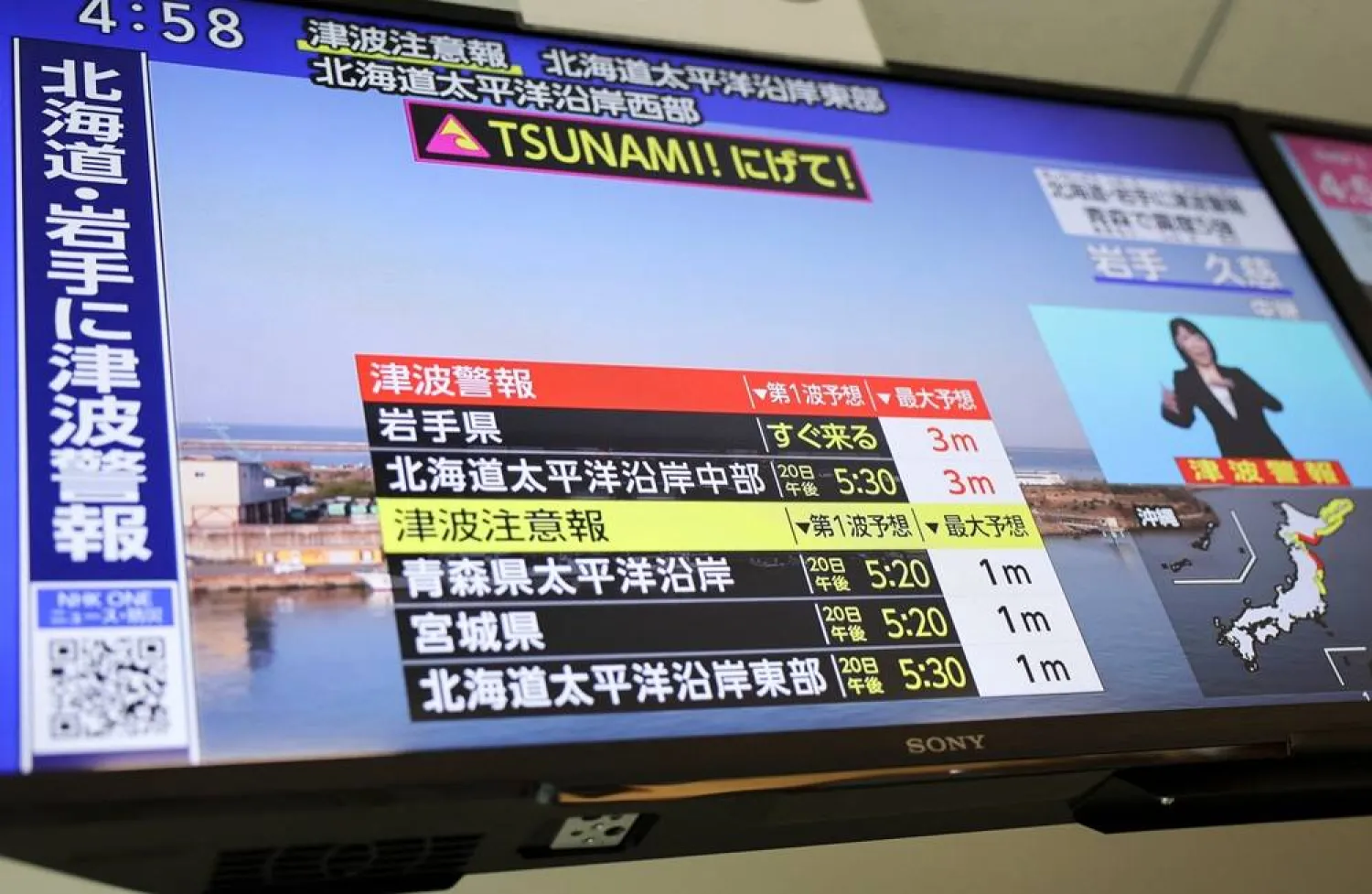
A television screen shows a news report on Japan Meteorological Agency's tsunami warning, saying it expected tsunami waves of up to 3 meters (9.84 feet) to reach large coastal areas in northern Japan after an earthquake with a preliminary magnitude of 7.4 struck off the northeastern coast of Japan, in Tokyo, Japan April 20, 2026.(Reuters)
TT

Tsunami Warning as 7.4-Magnitude Quake Hits Northern Japan

A television screen shows a news report on Japan Meteorological Agency's tsunami warning, saying it expected tsunami waves of up to 3 meters (9.84 feet) to reach large coastal areas in northern Japan after an earthquake with a preliminary magnitude of 7.4 struck off the northeastern coast of Japan, in Tokyo, Japan April 20, 2026.(Reuters)

A 7.4-magnitude earthquake struck northern Japan Monday, Japan's Meteorological Agency (JMA) said, issuing a tsunami warning for waves up to three meters (10 feet).

The quake, which hit at 4:53 pm (0753 GMT) in Pacific waters off northern Iwate prefecture, was strong enough to shake large buildings as far as Tokyo, hundreds of kilometers away.

Around 40 minutes later, an 80-centimeter (31-inch) tsunami wave hit a port in Kuji in Iwate, according to the JMA.

"Evacuate immediately from coastal regions and riverside areas to a safer place such as high ground or an evacuation building," it said, warning that damage due to tsunami waves was expected.

"Tsunami waves are expected to hit repeatedly. Do not leave safe ground until the warning is lifted," it said.

Footage from national broadcaster NHK did not show any immediate visible damage around several ports in Iwate.

A JMA official warned in a televised press briefing that more quakes could strike the area.

The prime minister's office said it had set up a crisis management team.

"For those of you who live in areas for which the warnings have been issued, please evacuate to higher, safer places such as higher ground," Prime Minister Sanae Takaichi told reporters, adding that the government was trying to confirm whether there were any casualties or property damage.

Japan is one of the world's most seismically active countries, sitting on top of four major tectonic plates along the western edge of the Pacific "Ring of Fire".

The archipelago, home to around 125 million people, typically experiences around 1,500 jolts every year and accounts for about 18 percent of the world's earthquakes.

The vast majority are mild, although the damage they cause varies according to their location and the depth below the Earth's surface at which they strike.

Japan is haunted by the memory of a massive 9.0-magnitude undersea quake in 2011, which triggered a tsunami that killed around 18,500 people and caused a devastating meltdown at the Fukushima nuclear plant.

In 2024, the JMA issued its first special advisory of a possible "megaquake" along the Nankai Trough.

This 800-kilometer undersea trench is where the Philippine Sea oceanic tectonic plate is "subducting" -- or slowly slipping -- underneath the continental plate that Japan sits atop.

The government has said a quake in the Nankai Trough and subsequent tsunami could kill as many as 298,000 people and cause up to $2 trillion in damage.

The JMA lifted the 2024 advisory after a week but it led to panic-buying of staples like rice and prompted holidaymakers to cancel hotel reservations.

It issued a week-long second "megaquake" advisory in December 2025 after a magnitude-7.5 tremor struck off the northern coast.

The December 8 quake triggered tsunami waves of up to 70 centimeters (28 inches) and injured more than 40 people, but no major damage was reported.



Ukraine Recovery Summit Opens, Overshadowed by Kyiv-Warsaw Row

President Volodymyr Zelensky's decision not to attend the summit comes after nationalist Polish president Karol Nawrocki revoked a state order given to the Ukrainian leader. Wojtek RADWANSKI / AFP
TT

Ukraine Recovery Summit Opens, Overshadowed by Kyiv-Warsaw Row

President Volodymyr Zelensky's decision not to attend the summit comes after nationalist Polish president Karol Nawrocki revoked a state order given to the Ukrainian leader. Wojtek RADWANSKI / AFP

A landmark conference on Ukraine's post-war reconstruction is set to open Thursday in Poland without President Volodymyr Zelensky, who is snubbing the event over a diplomatic row with ally Warsaw.

Kyiv needs hundreds of billions of dollars to repair the damage caused by Russia's invasion and is trying to whip up international support for investment, said AFP.

But the event comes with no end to the fighting in sight and could be overshadowed by the spat between Ukraine and Poland -- triggered when Ukraine named a military unit after an insurgent group that took part in the massacres of Poles during World War II.

Leaders from Poland, Bulgaria, Estonia, Finland, Latvia, Lithuania, Romania and Sweden, as well as EU Commission President Ursula von der Leyen and EU Council head Antonio Costa will meet in the northeastern port city of Gdansk to urge businesses and countries to pour cash into Ukraine when the conflict ends.

Kyiv's delegation -- led by Zelensky in previous years -- will be headed up by Prime Minister Yulia Svyrydenko.

A joint report by Ukraine, the World Bank, the United Nations, and the EU in February estimated post-war reconstruction in Ukraine would cost around $588 billion.

But with no progress in US-brokered talks on halting the fighting, convincing investors to support Kyiv's recovery has been a challenge.

Still, Svyrydenko has said her country plans to "sign a number of important agreements with international partners, particularly to strengthen our energy sector".

- 'Unnecessary politicization' -

Aside from energy, critical infrastructure and logistics, discussions are also set to focus for the first time on Ukraine's security capacities.

In December, the European Union approved a 90-billion-euro loan for Ukraine -- most of it earmarked for defense.

But according to Glib Vyshlinsky, director of the Center for Economic Strategy in Kyiv, "it will be impossible for Ukraine to defend the country without reconstruction in the process".

"We need to provide critical services and housing to people in Ukraine who pay taxes and support the military," he said.

Ukraine's economy has been decimated by the war and Kyiv relies on external funding to keep afloat amid spiraling costs of defending against the Russian invasion.

Zelensky's decision not to attend the summit comes after nationalist Polish president Karol Nawrocki revoked a state order given to the Ukrainian leader.

Nawrocki -- at loggerheads with Poland's Prime Minister Donald Tusk -- was riled by Zelensky's move to name a military unit after the Ukrainian Insurgent Army (UPA).

The UPA killed thousands of Polish civilians between 1943 and 1945 in Volhynia -- a Ukrainian region that was part of Poland before World War II.

But some in Ukraine revere them for having fought both the Nazis and the Soviets in their quest for a Ukrainian state.

The argument over their status and memorials to UPA figures has long cast a shadow over diplomatic relations between the allies and neighbors.

Ukrainian Foreign Ministry spokesman Georgiy Tykhy said Wednesday that Kyiv hoped the row would not spoil the summit.

Kyiv wanted to "avoid any unnecessary politicization of this international event" in order to "focus on pragmatism as well as concrete decisions in favor of Ukraine", he said.

Seeking to distance himself from the nationalist president and right-wing opposition, pro-European Tusk said he hoped the event would "be a kind of step forward or a way to defuse the emotional escalation".


Venezuela Declares State of Emergency, Closes Airport after Powerful Twin Quakes

Emergency responders conduct rescue operations in Caracas, Venezuela, 24 June 2026. EPA/RAYNER PENA
TT

Venezuela Declares State of Emergency, Closes Airport after Powerful Twin Quakes

Emergency responders conduct rescue operations in Caracas, Venezuela, 24 June 2026. EPA/RAYNER PENA

Venezuela's interim leader declared a state of emergency Wednesday as two massive earthquakes caused buildings in the capital to crumble and forced the closure of the country's main airport, prompting US President Donald Trump to offer aid.

Delcy Rodriguez said 20 aftershocks had followed the earthquakes of magnitude 7.2 and 7.5, which struck the same area of Venezuela, according to the United States Geological Survey (USGS).

The quakes triggered panic in the capital and drove people into the streets, AFP journalists saw.

"The stairs came away, the whole wall cracked. Things fell from the ceiling. It was horrible," said 54-year-old bank employee Odalis Escalona.

It remained unknown if there were fatalities, but some people were injured and buildings had collapsed, Interior Minister Diosdado Cabello said.

Trump said late Wednesday that "the two major earthquakes that just hit the great people of Venezuela are both massive in scale and have left a devastating number of deaths."

"The U.S.A. stands ready, willing, and able to help! I have instructed all agencies of our government to get ready to move quickly," the American president wrote on his Truth Social platform.

"We will be there for our new and great friends. Early reports are not good!!!"

An AFP journalist saw a 22-story building completely destroyed in the capital's Altamira neighborhood, where people cried out relatives' names as volunteers climbed over the rubble.

"We need flashlights," one of them said.

The first quake, with an epicenter 21 kilometers (13 miles) west of the coastal town of Moron, occurred at 2204 GMT, USGS said. Within a minute, a 7.5-magnitude quake struck about 45 kilometers away.

"This earthquake was the second event in a doublet. This magnitude 7.5 mainshock was preceded by 39 seconds by a 7.2 foreshock," USGS said.

Cabello asked people to leave their homes, adding that gas supplies had been cut to several buildings as a precaution.

"We have some damaged structures and we don't want any kind of accident involving gas to occur," he said.

The Maiquetia International Airport, located near Caracas, was closed due to "serious damage" to its infrastructure, Rodriguez said, with social media posts showing its severely damaged facilities.

- 'We couldn't get out' -

The tremors struck at a depth of 22 kilometers and 10 kilometers, respectively.

They prompted screams of panic at a shopping center in Caracas, an AFP journalist observed.

"It was unbelievable, I don't even know how long it lasted," said shopkeeper Heidi Romero, who was on the top floor when the quake struck.

"We went out through the emergency stairs; that's how they got us out," the 42-year-old told AFP.

Dozens more in the capital exited buildings and waited outside before returning to their offices and homes.

Carmen Guedez, 69, was in the same room as her bedridden sister when she felt the jolt.

"It kept getting stronger," said the administrator, who lives in a hilly middle-class neighborhood above the capital. "I started to see the windows begin to move and then everything shook."

She described how she "huddled together" with her sister and a neighbor, adding that "we couldn't get out. The neighbors are still out on the street."

The states of Trujillo, Carabobo, Miranda and La Guaira were the hardest hit, according to Cabello.

- Further afield -

The quake was felt as far away as the Colombian capital of Bogota, where alarms sounded and some residents evacuated buildings as a precaution.

Freddy Tovar, coordinator of Colombia's National Seismological Network, said they had received more than 200 reports of tremors nationwide.

"The conditions of this seismic event mean that some aftershocks may occur, which could also be widely felt across Colombian territory," he said in a video posted on X.

The Colombian disaster management agency UNGRD ruled out the possibility of a tsunami taking place in the aftermath.

"NO tsunami, NO danger from a recent earthquake," the US National Tsunami Warning Center said in an X post.

The strongest tremors in earthquake-prone Venezuela's recent history occurred in the northeast in 1997, killing 73 people, and in Caracas in 1967, when 236 people died.

Shortly after the twin quakes on Wednesday, a 7.2-magnitude tremor hit northern Japan, the country's weather agency said, with no casualties or material damage reported.


Europe Swelters under Record-breaking Heatwave

Tourists protecting themselves from the sun under umbrellas walk past the glass Pyramid of the Louvre museum as the museum closes early due to the heatwave as temperatures rise in Paris, France, June 24, 2026. REUTERS/Alice Sacco
TT

Europe Swelters under Record-breaking Heatwave

Tourists protecting themselves from the sun under umbrellas walk past the glass Pyramid of the Louvre museum as the museum closes early due to the heatwave as temperatures rise in Paris, France, June 24, 2026. REUTERS/Alice Sacco

Europe struggled to cope with a record-breaking heatwave on Wednesday, with at least 94 million people expected to experience temperatures above 35C, most of them in France and Spain.

AFP estimates based on analysis of forecasts from the German weather service and 2025 population projections from Europe's Joint Research Center suggest maximum temperatures will surpass 30C for over 350 million people -- more than two-thirds of the continent's population.

The effects of the extreme weather, with temperatures hotter than parts of east and west Africa, have been made worse by buildings and infrastructure not designed to cope with high temperatures.

A scientific study published this week said the current heatwave was "significantly exacerbated by human-induced climate change", without which the current temperatures would have been 2-4C cooler.

At a care home on the edge of London, elderly residents struggled to keep cool as Britain recorded its highest ever June temperature of 36.1C.

"We have to find means and ways to protect ourselves and do whatever nature wants. Nature is angry with us because we destroy everything," 97-year-old resident Lucine Nazikian said.

The World Health Organization's head Tedros Adhanom Ghebreyesus warned that the heatwave was putting the health of Europeans at risk.

- 'Swimming in my own sweat' -

Around 44 million of the nearly 67 million people in France are currently under the highest red alert level for heat, according to an AFP estimate.

France on Wednesday experienced its hottest day since measurements began in 1947, the national weather agency said, breaking a record set just a day earlier.

The national temperature indicator -- an average of daytime and night-time temperatures across 30 stations -- reached 30C, Meteo-France said, citing provisional data.

"We insulated the windows, installed ceiling fans... but without air conditioning it's tough," said Manon Langlois, 34, a teacher in the southwestern city of Bordeaux, where the temperature reached 41.8C.

Spain also broke its June heat record, according to the Aemet weather agency, with an average temperature of 28.17C on Tuesday.

Conditions at many schools, offices and factories across the continent have become unbearable as temperatures rise, forcing early closures and employees to work from home.

"I'm practically swimming in my own sweat, which is not pleasant," 25-year-old decorator Aaron Timothy told AFP in London while cooling off in the shade.

In Italy, where 16 cities are under red alert, the advocacy group Greenpeace said it had detected surface temperatures of 80C in the heavily asphalted area around Rome's Termini railway station.

Despite restrictions for outdoor workers, the area was still buzzing with delivery riders, many of whom are self-employed, who said they had to work to survive.

- Power cuts -

Power outages have been reported in France, including in the northwest department of Finistere, where high temperatures knocked out a transformer late on Tuesday, leaving about 68,000 households without electricity.

In Britain, electricity grid operator Neso warned that supply could be squeezed due to pressure on the system.

Sales of fans and air conditioners have skyrocketed as people try to keep cool.

June is a key month for tourism in Europe but popular landmarks, including the Eiffel Tower and Louvre museum in Paris, and the stainless steel Atomium in Brussels, have been shutting early because of the heat.

American engineer John Beeler, wearing a fisherman's hat and holding a small fan, said visiting Paris in such conditions was "awful".

"We're suffocating in the streets, we're suffocating in the subway and we're even suffocating in our rental," he said, adding that they would be moving to an air-conditioned hotel room.

- Heading east -

The heatwave has pushed up temperatures even in usually milder northern countries such as Denmark, while Austria could see 40C and neighboring Slovakia was on its highest extreme heat alert.

Further east, Poland's weather service issued high-level heat warnings for the western part of the country from Thursday to Saturday, and predicted temperatures could break the record of 40.2C set in 1921.

Croatia's popular Adriatic coast was also put under red alert for Friday and Saturday, while Hungary said it was imposing a maximum level alert from Saturday to Tuesday.

The head of the UN's IPCC climate experts panel, Jim Skea, said the current temperatures were above some scientific projections, and warned that the continent would inevitably face more extremes as the planet warms.