


A 60-Day Deadline Could Pressure Trump on Ending the Iran War

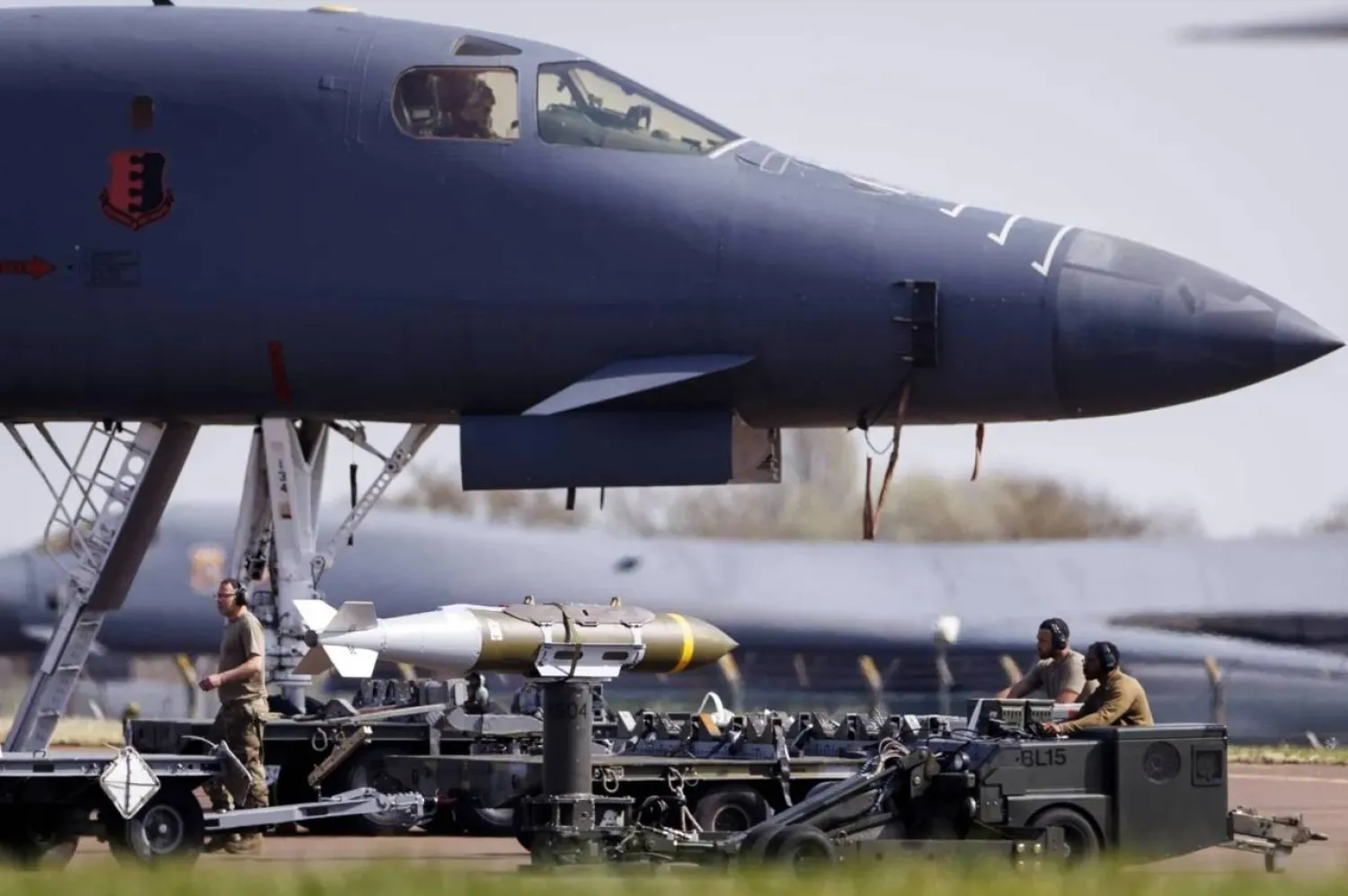
US Air Force personnel perform maintenance on bomber at UK's RAF Fairford (EPA)
TT

A 60-Day Deadline Could Pressure Trump on Ending the Iran War

US Air Force personnel perform maintenance on bomber at UK's RAF Fairford (EPA)

Washington - Robert Jimison

Over nearly eight weeks of war in Iran, Republicans in Congress have turned back repeated efforts by Democrats to halt the operation and force US President Donald Trump, who began the conflict without congressional authorization, to consult with lawmakers on the military campaign.

But some Republicans have signaled that a key statutory deadline in the coming weeks could be an inflection point when they will expect the president to either wind down the conflict or seek congressional approval to continue it.

Democrats have tried and failed several times to invoke a provision of the 1973 War Powers Resolution, a law aimed at curbing a president’s ability to wage war without congressional approval, to challenge the conflict in Iran.

The latest defeat came on Wednesday, when Senate Republicans blocked such a measure for the fifth time since the war began.

Yet the law also establishes a set of deadlines, the first of which is coming on May 1, that could increase the pressure on the Trump administration in the coming days. Here is what the law says about how long a president can continue to direct US forces in a conflict without congressional approval.

The 60-Day Mark

When the United States began joint strikes with the Israeli air force on Feb. 28, the president said he was acting under his authority as commander in chief to protect US bases in the Middle East, and to “advance vital United States national interests.”

He said the action was taken in “collective self-defense of our regional allies, including Israel.”

Many Democrats disputed that justification and have continued to argue that Trump acted illegally.

White House officials and most Republicans on Capitol Hill say he is operating within the bounds of the war powers statute, which sets a 60-day clock for a president to remove American forces from hostilities without congressional authorization to use military force.

Although the war began at the end of February, Trump formally notified Congress of the operation on March 2, starting the 60-day period that ends on May 1.

Some Republicans have already signaled they will not support any extension beyond 60 days.

Senator John Curtis, Republican of Utah, wrote in an opinion essay earlier this month that he “will not support ongoing military action beyond a 60-day window without congressional approval.”

Other Republicans, including Representative Brian Mast of Florida, who chairs the Foreign Affairs Committee, warned that the president could lose significant support if the conflict continued into May.

Moments after Republicans just barely blocked a war powers resolution in the House last week, Mast said there could be “a different vote count after 60 days,” alluding to the May 1 deadline.

A 30-Day Extension

Under the statute, once the initial 60-day deadline passes, the president’s options for continuing a military campaign without congressional approval become limited.

At that point, Trump would effectively have three choices: seek congressional authorization to continue the campaign, begin winding down US involvement or give himself an extension.

The law allows a one-time, 30-day extension of the deployment if the president certifies in writing that additional time is necessary to facilitate the safe withdrawal of US forces, but it does not grant authority to continue waging an offensive campaign.

Congress Can Authorize the War

Lawmakers also have the option at any time of granting explicit permission for Trump to continue the operation by passing an authorization for the use of military force.

Such measures have become the primary way Congress approves military campaigns short of a formal declaration of war, something that has not been done since World War II.

While Republicans have largely united in blocking Democrats’ attempts to halt the war, it is unclear whether the same unity exists when it comes to affirmatively authorizing the conflict.

Senator Lisa Murkowski, Republican of Alaska, has said she is working with a group of senators on a formal authorization for the use of military force against Iran, but has yet to introduce the resolution.

Congress has not voted in favor of using military force since 2002, when lawmakers authorized it against Iraq.

Murkowski was an early critic of the administration’s lack of transparency around the objectives, costs and timeline for the war, and said that her goal with an authorization vote would be to reassert congressional authority and require the administration to be held to firm parameters for the operation.

Why Trump Might Ignore the Deadlines

Administrations led by presidents of both parties have long argued that the Constitution gives broad authority to the commander in chief, meaning that the limits the war powers law places on the president are unconstitutional.

In 2011, President Barack Obama continued a military engagement in Libya beyond the 60-day mark, arguing that the law did not apply because “US operations do not involve sustained fighting or active exchanges of fire with hostile forces, nor do they involve US ground troops.”

Though that prompted bipartisan backlash at the time, some lawmakers anticipate that the Trump administration could make a similar argument about Iran.

During his first term, Trump similarly balked at the law in 2019 when he vetoed a bipartisan resolution both chambers had passed that sought to end American military involvement in Yemen’s civil war. He argued then that the measure was an “unnecessary, dangerous attempt to weaken my constitutional authorities.”

Still, ignoring the deadline could pose a political problem for Republicans, which so far has given the administration broad latitude to carry out the war without congressional involvement, including any formal oversight.

“Many Republicans are on record having set the 60-day mark as somehow legally important,” said Senator Chris Murphy of Connecticut, who has been among the Democrats offering resolutions aimed at limiting the president’s ability to continue the war without congressional authorization. “So I do think it will be harder for Republicans to continue to look the other way once we are out of the 60 days.”

The New York Times


UK Detains Sanctioned Oil Tanker Believed to be Linked to Russia’s Shadow Fleet

Britain's Prime Minister Keir Starmer (L) and his wife Victoria (R) attend the King's Birthday Parade "Trooping the Colour" in London on June 13, 2026. (Photo by Toby Shepheard / AFP)
TT

UK Detains Sanctioned Oil Tanker Believed to be Linked to Russia’s Shadow Fleet

Britain's Prime Minister Keir Starmer (L) and his wife Victoria (R) attend the King's Birthday Parade "Trooping the Colour" in London on June 13, 2026. (Photo by Toby Shepheard / AFP)

Britain is investigating a sanctioned tanker that is suspected of being part of the Russian “shadow fleet,” shipping oil in violation of international sanctions over Moscow’s war on Ukraine, British Prime Minister Keir Starmer said Sunday.

British armed forces boarded and detained the vessel, the Smyrtos, on Sunday in the English Channel, in what the country’s Defense Ministry called “the first UK-led operation of its kind.”

The vessel will be held and monitored off the south coast of England for investigation, according to a statement by the Defense Ministry.

The operation was carried out “in close coordination” with French authorities, who have previously intercepted a number of vessels linked to the “shadow fleet.”

Russia is believed to be using a fleet of hundreds of ships to evade sanctions over its war against Ukraine.

“This operation delivers yet another blow to Russia and reminds those fueling Putin’s war in Ukraine that they cannot hide,” The Associated Press quoted Starmer as saying.

UK authorities said that such operations were “directly bearing down on the resources sustaining Russia’s aggression in Ukraine and reducing its capacity to threaten security across Europe and beyond."


Qatari Delegation in Tehran for Middle East War Talks

FILE PHOTO: A woman walks past a banner with a picture of the late Supreme Leader Ali Khamenei, on a street in Tehran, Iran June 7, 2026. Majid Asgaripour/WANA (West Asia News Agency) via REUTERS
TT

Qatari Delegation in Tehran for Middle East War Talks

FILE PHOTO: A woman walks past a banner with a picture of the late Supreme Leader Ali Khamenei, on a street in Tehran, Iran June 7, 2026. Majid Asgaripour/WANA (West Asia News Agency) via REUTERS

A Qatari delegation arrived in Tehran on Sunday, Iranian media and a diplomat said, as part of the mediation process to end the war between Iran and the United States.

Iran's ISNA news agency reported an adviser to Qatar's foreign minister had been dispatched to Iran.

Another Iranian news agency Tasnim said the purpose of the visit was to "go over the latest developments regarding the diplomatic process.”

A diplomat with knowledge of the situation told AFP on Sunday that "Qatari negotiators flew to Tehran this morning.”

Speaking on condition of anonymity to discuss the sensitive talks, the diplomat said the delegation travelled "to help facilitate the finalization of the agreement.”

Pakistan, which has led mediation to end the months-long Middle East war, and the US have indicated an agreement to end the fighting would be signed on Sunday.

But Tehran has cast doubt on that timing, and Iranian media has reported a final decision on the framework is yet to be made.


Iran Media: Tehran Has 'Not Yet' Taken Final Decision on US Peace Deal

Iranians drive past a billboard featuring Iran's national flag at Enqelab Square in Tehran, Iran, 14 June 2026. EPA/ABEDIN TAHERKENAREH
TT

Iran Media: Tehran Has 'Not Yet' Taken Final Decision on US Peace Deal

Iranians drive past a billboard featuring Iran's national flag at Enqelab Square in Tehran, Iran, 14 June 2026. EPA/ABEDIN TAHERKENAREH

Iran's Fars news agency said on Sunday that Tehran has not made a final decision on signing the agreement under discussion with the United States to end the Middle East war.

"Iran has not yet taken or announced its final decision concerning the memorandum of understanding proposed during negotiations," reported Fars, which is close to Iranian conservative circles, citing "a well-informed source close to the Iranian negotiating team.”

The prospective agreement has faced opposition from hardline Iranian figures, who argue that it does not serve Iran's interests and would deprive Tehran of leverage over the strategic Strait of Hormuz.

US President Donald Trump and mediator Pakistan said on Saturday an initial deal to end the war in the Middle East would be signed on Sunday.

Pakistani Prime Minister Shehbaz Sharif said the two sides had agreed on a framework for a peace deal and that Islamabad was preparing for an electronic signing on Sunday, to be followed by technical-level talks next week.

Trump also said in a social media post that the deal with Iran was scheduled to be signed on Sunday and that the Strait of Hormuz, a vital artery for global oil supplies which Iran has blocked, would be immediately "open to all" after it was signed.
