


Iran Offers to End Chokehold on Strait of Hormuz and Asks US to End Blockade, Officials Say

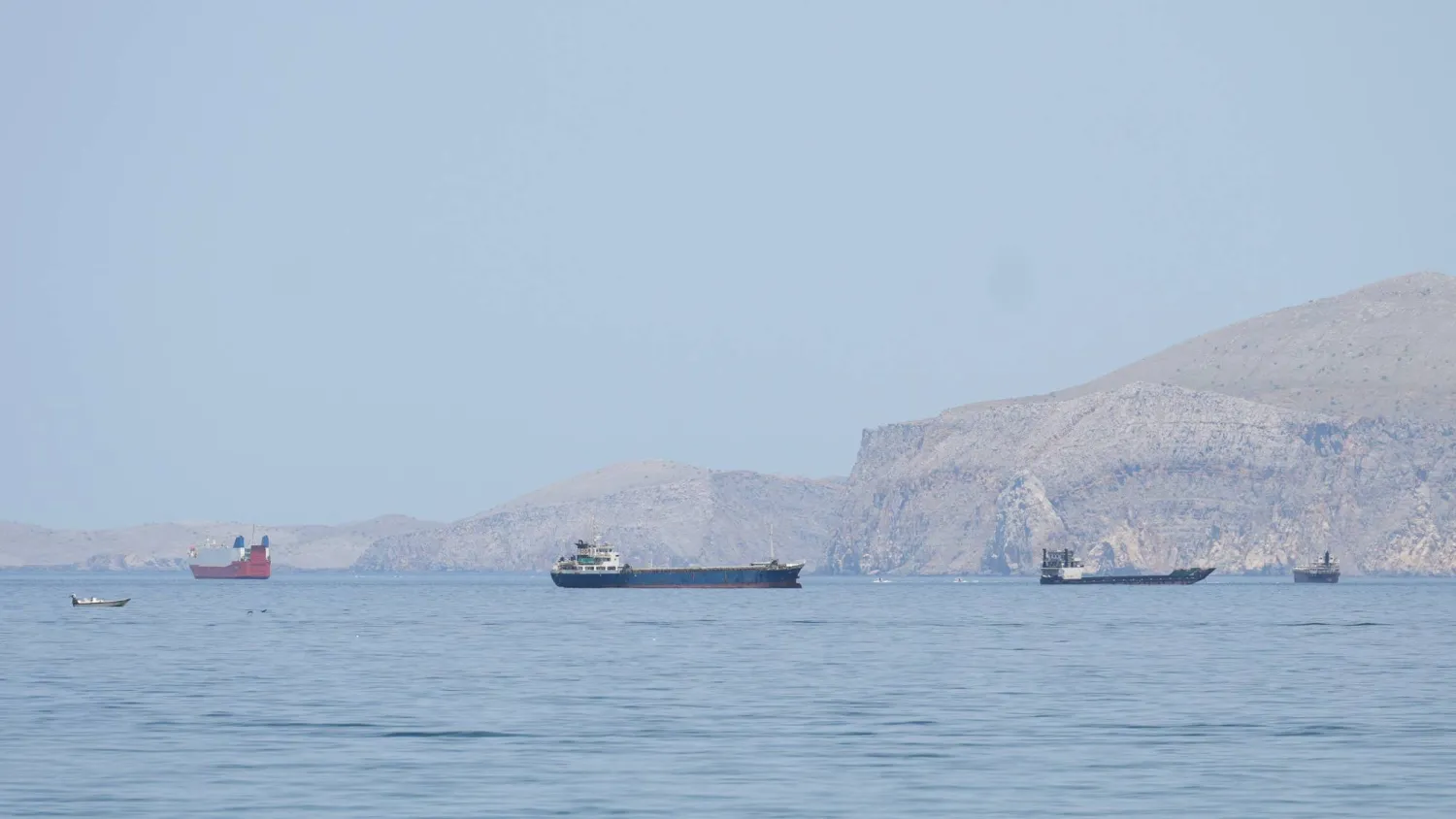
 Ships and boats in the Strait of Hormuz, Musandam, Oman, April 24, 2026. (Reuters)
Ships and boats in the Strait of Hormuz, Musandam, Oman, April 24, 2026. (Reuters)
TT

Iran Offers to End Chokehold on Strait of Hormuz and Asks US to End Blockade, Officials Say

 Ships and boats in the Strait of Hormuz, Musandam, Oman, April 24, 2026. (Reuters)
Ships and boats in the Strait of Hormuz, Musandam, Oman, April 24, 2026. (Reuters)

Iran is offering to end its chokehold on the Strait of Hormuz without addressing its nuclear program, two regional officials with knowledge of the proposal said Monday, as the country's foreign minister made a visit to Russia he said was an opportunity to consult with Moscow regarding the war against Israel and the United States.

Iran also wants the US to end its blockade of the country as part of its proposal, said the two officials, who spoke on condition of anonymity to discuss the closed-door negotiations.

The new proposal, passed to the United States by Pakistan, likely won't be supported by US President Donald Trump, who wants to end Iran’s atomic program as part of an overall deal to reopen the Strait of Hormuz and make the ceasefire permanent.

“We have all the cards. If they want to talk, they can come to us, or they can call us,” Trump said Sunday to Fox News Channel.

The Axios news outlet first reported Iran’s proposal.

Iran's foreign minister visits Russia

Iran's state-run IRNA news agency said Foreign Minister Abbas Araghchi landed in St. Petersburg on Monday morning ahead of a meeting with Russian President Vladimir Putin. His trip over the weekend has included two stops in Pakistan and a visit to Oman, which shares the strait with Iran.

Araghchi’s visit comes as a standoff between Iran and the US in the crucial Strait of Hormuz persists despite a ceasefire, keeping oil prices high.

“It is a good opportunity for us to consult with our Russian friends about the developments that have occurred in relation to the war during this period and what is happening now,” Araghchi said in a video interview posted by IRNA.

Talks had been expected in Islamabad Pakistan has been seeking to revive stalled talks between Iran and the US, and negotiations had been expected in Islamabad over the weekend. But US President Donald Trump has suggested the talks could take place by phone instead.

Araghchi said it was America’s approach that “caused the negotiations to be delayed.”

“The previous one, despite the progress that had been made, could not achieve its goals,” he said, blaming what he called Washington’s “excessive demands.”

Trump has questioned who is in charge in Iran at the moment and said confusion within its theocracy made it difficult to reach a deal.

The White House last week said it would dispatch envoys Steve Witkoff and Jared Kushner to Islamabad to follow up on historic face-to-face talks earlier this month. But Araghchi left the Pakistani capital Saturday, and shortly afterward Trump said he had called off the mission because of a lack of progress with Iran.

“If they want, we can talk but we’re not sending people,” Trump told Fox News on Sunday. He said earlier on social media: “All they have to do is call!!!”

Araghchi later returned to Islamabad, and also visited Oman's capital of Muscat before heading to Russia. He also spoke by phone with counterparts in Saudi Arabia and Qatar on Sunday.

Strait of Hormuz standoff

A standoff remains on the Strait of Hormuz, the narrow mouth of the Gulf through which a fifth of all traded oil and natural gas normally passes, as Iran has restricted movement through it and the US enforces a blockade of Iranian ports.

The June contract for Brent crude, the international standard, was trading at around $107 per barrel Monday, compared with $72 a barrel before the war began.

Oil prices have risen steadily since the war began and tankers full of crude became stranded in the Gulf, unable to safely transit through the strait and reach global distribution points.

The economic fallout is growing two months into the war as global shipments of not only oil, but also liquefied natural gas, fertilizer and other supplies are disrupted by the near-closure of the strategic strait.

An official, who is involved in mediation efforts, said Iran insisted on ending the US blockade before new talks and that Pakistan-led mediators are trying to bridge significant gaps between the countries.

Trump last week indefinitely extended the ceasefire the US and Iran agreed to on April 7 that has largely halted fighting that began with joint US-Israeli strikes on Iran on Feb. 28. But a permanent settlement remains elusive in the war that has killed thousands of people and shaken the global economy.

Even before Saturday’s developments, Iran’s Foreign Ministry said any talks would be indirect and Pakistani officials would act as go-betweens, reflecting Tehran’s wariness after rounds of indirect talks last year and earlier this year ended with Iran being attacked by the US and Israel.

Trump says Iran has offered a ‘much better’ proposal

Both sides have continued to make military threats. Iran’s joint military command Saturday warned that “if the US continues its aggressive military actions, including naval blockades, banditry, and piracy” it will face a “strong response.”

Trump last week ordered the military to “shoot and kill” small boats that could be placing mines in the waterway.

Trump told journalists Saturday that within 10 minutes of him canceling Witkoff and Kushner’s trip to Islamabad, Iran sent a “much better” proposal.

He did not elaborate but stressed that one of his conditions is that Iran “will not have a nuclear weapon.” The status of Iran’s enriched uranium has long been at the center of tensions. Tehran has 440 kilograms (970 pounds) of uranium enriched to 60% purity, a short, technical step from weapons-grade levels, according to the UN nuclear watchdog agency.

Since the war began, at least 3,375 people have been killed in Iran and at least 2,509 people in Lebanon, where the Israel-Hezbollah fighting resumed two days after the Iran war started. Another 23 people have been killed in Israel and more than a dozen in Gulf Arab states. Fifteen Israeli soldiers in Lebanon, 13 US service members in the region and six UN peacekeepers in southern Lebanon have been killed.

Another ceasefire — between Israel and the Iranian-backed Lebanese Hezbollah group — has been extended by three weeks. Hezbollah has not participated in the Washington-brokered diplomacy.



White House to Review Trump’s Security After Gunfire Near Press Dinner

 25 April 2026, US, Washington: US President Donald Trump delivered remarks during a press conference in the Brady Briefing Room at the White House, following the cancellation of the annual White House Correspondents' Association Dinner amid reports of a possible shooting. (dpa)
25 April 2026, US, Washington: US President Donald Trump delivered remarks during a press conference in the Brady Briefing Room at the White House, following the cancellation of the annual White House Correspondents' Association Dinner amid reports of a possible shooting. (dpa)
TT

White House to Review Trump’s Security After Gunfire Near Press Dinner

 25 April 2026, US, Washington: US President Donald Trump delivered remarks during a press conference in the Brady Briefing Room at the White House, following the cancellation of the annual White House Correspondents' Association Dinner amid reports of a possible shooting. (dpa)
25 April 2026, US, Washington: US President Donald Trump delivered remarks during a press conference in the Brady Briefing Room at the White House, following the cancellation of the annual White House Correspondents' Association Dinner amid reports of a possible shooting. (dpa)

White House chief of staff Susie Wiles will meet with law enforcement and homeland security early this week to review security protocols after Saturday's shooting in a Washington hotel where President Donald Trump and top officials were attending a dinner, a senior White House official told Reuters.

The third major security incident targeting Trump in less than two years comes as he prepares for a summer packed with high-profile public events, testing the Secret Service at a moment of high political ‌and global ‌tensions.

Wiles will meet with leaders of the US Secret ‌Service ⁠and the Homeland Security ⁠department to discuss "protocol and practices" for major events involving Trump, the official said.

They said Trump is standing by the Secret Service leadership following the shooting outside the Washington Hilton ballroom where the White House Correspondents' Association dinner was being held.

TRUMP'S SECURITY ALREADY TIGHTENED AFTER INCIDENTS

Acting Attorney General Todd Blanche said in interviews that Trump and other administration officials were the likely intended targets of the suspect, ⁠a California man who was expected in court on Monday ‌to face felony charges.

The 31-year-old is suspected ‌of firing a shotgun at a Secret Service agent at a checkpoint one floor ‌up from the ballroom entrance before being tackled and arrested. Trump and first ‌lady Melania Trump were rushed out of the dinner.

In July 2024, a sniper's bullet skimmed Trump's ear during a campaign rally in Pennsylvania. Two months later, Secret Service agents spotted an armed man hiding in bushes a few hundred yards from where Trump ‌was golfing in Florida. Since then, security around Trump has tightened, and bulletproof glass is used when he speaks ⁠at outdoor events.

Wiles' ⁠meeting will examine Saturday's security response and measures to keep future events safe, the official said.

Trump is expected to attend events this summer for the nation's 250th anniversary and the football World Cup.

Trump told reporters that the first lady had found Saturday's incident traumatic. Nevertheless, the couple was continuing with plans to welcome Britain's King Charles and Queen Camilla on Monday for several days of events.

After the shooting, Trump praised the security response, argued that security concerns were more justification to continue building his East Wing ballroom, and mused to reporters about the risks of being president.

Asked if he was satisfied with his protection, he said: "I'd be up here right now saying they didn't do their job," adding: "Believe me, because, you know, it's my life."


Putin Praises Iranian People for Resistance to US in Talks with Araghchi

27 April 2026, Russia, Saint Petersburg: Russian President Vladimir Putin (R) meets with Iranian Foreign Minister Abbas Araghchi in Saint Petersburg. (Kremlin/dpa)
TT

Putin Praises Iranian People for Resistance to US in Talks with Araghchi

27 April 2026, Russia, Saint Petersburg: Russian President Vladimir Putin (R) meets with Iranian Foreign Minister Abbas Araghchi in Saint Petersburg. (Kremlin/dpa)

Russian President Vladimir Putin on Monday praised the Iranian people for battling to stay independent in the face of US and Israeli pressure and said Moscow would do all it could to help Tehran.

Russia has offered to mediate to try to help restore calm to the Middle East following US and Israeli strikes, which Moscow has strongly condemned. ‌It has ‌also repeatedly offered to store Iran's enriched uranium ‌as ⁠a way of ⁠defusing tensions, a proposal spurned by the United States.

"We see how courageously and heroically the Iranian people are fighting for their independence and sovereignty," Putin told Iranian Foreign Minister Abbas Araghchi, saying he hoped they could get through what he called a "difficult period" and that peace would prevail.

"For our part, we will do everything that serves your interests and the interests ⁠of all the peoples of the region to ensure ‌that peace is achieved as ‌quickly as possible," said Putin.

Putin received Araghchi in the presidential library in Russia's former ‌imperial capital St Petersburg as sources from mediator Pakistan said work ‌had not halted to bridge gaps between the United States and Iran.

Putin said he received a message from Iran’s new Supreme Leader, Mojtaba Khamenei, last week, and asked Araghchi to convey to him that Russia intended to ‌continue its strategic partnership with Tehran.

That 20-year agreement was sealed last year. Russia is building two new ⁠nuclear units at ⁠Bushehr - the site of Iran's only nuclear power plant - and Iran has supplied Russia with Shahed drones for use against Ukraine, the production of which Moscow has since localized.

Araghchi, who said he wanted to brief Putin on the situation around his country, thanked Putin for Moscow's support.

"It has also been proven to all that Iran has friends and allies, such as the Russian Federation, who stand by Iran precisely in difficult times," he said.

Dmitry Peskov, Putin's spokesman, said that Moscow wanted to see the US and Iran continue negotiations. There should be no return to military action, he added, something he said was not in anyone's interests.


UN Maritime Agency Rejects Iran’s Demand for Hormuz Tolls

A woman walks past a billboard with a graphic design about the Strait of Hormuz on a building, amid a ceasefire between US and Iran, in Tehran, Iran, April 27, 2026. Majid Asgaripour/WANA (West Asia News Agency) via Reuters
TT

UN Maritime Agency Rejects Iran’s Demand for Hormuz Tolls

A woman walks past a billboard with a graphic design about the Strait of Hormuz on a building, amid a ceasefire between US and Iran, in Tehran, Iran, April 27, 2026. Majid Asgaripour/WANA (West Asia News Agency) via Reuters

The head of the UN's maritime agency said Monday there was "no legal basis" for imposing any fees for ships to pass through the Strait of Hormuz.

Shipping through the narrow strait has been strangled since the US and Israel attacked Iran in late February.

Iran has sealed off the passage, sharply cutting oil and gas flows and sending prices soaring, while the US has blockaded Iranian ports. Tehran has also said it wants to impose transit fees as part of any lasting peace deal.

"There's no legal basis for the introduction of any tax, any customs, or any fees for on straits for international navigation," IMO Secretary-General Arsenio Dominguez said at a press conference.

Iran's armed forces would have authority over the key shipping lane under the country's proposed law for managing the waterway, a top official said Monday.

Ebrahim Azizi, head of the national security commission in Iran's parliament, told state TV the armed forces were already in control of the strait and were seeking to prohibit the passage of "hostile vessels".

The bill also provides that financial gains from the strait would be paid in Iran's rial currency.

Speaking on the sidelines of an IMO maritime protection committee meeting, Dominguez said he was in contact with "all the countries of the region", including Iran.

He firmly rejected the idea that reopening the waterway could involve payment of any fees.

Dominguez also said a planned evacuation operation for around 20,000 seafarers currently stranded on vessels in the Gulf could only go ahead once the strait was fully secure.

The shipping lane remains a key sticking point in negotiations between Washington and Tehran, even as a fragile April 8 ceasefire continues to hold.