


Turkish Police Fire Tear Gas, Arrest Hundreds at Istanbul May Day Rallies

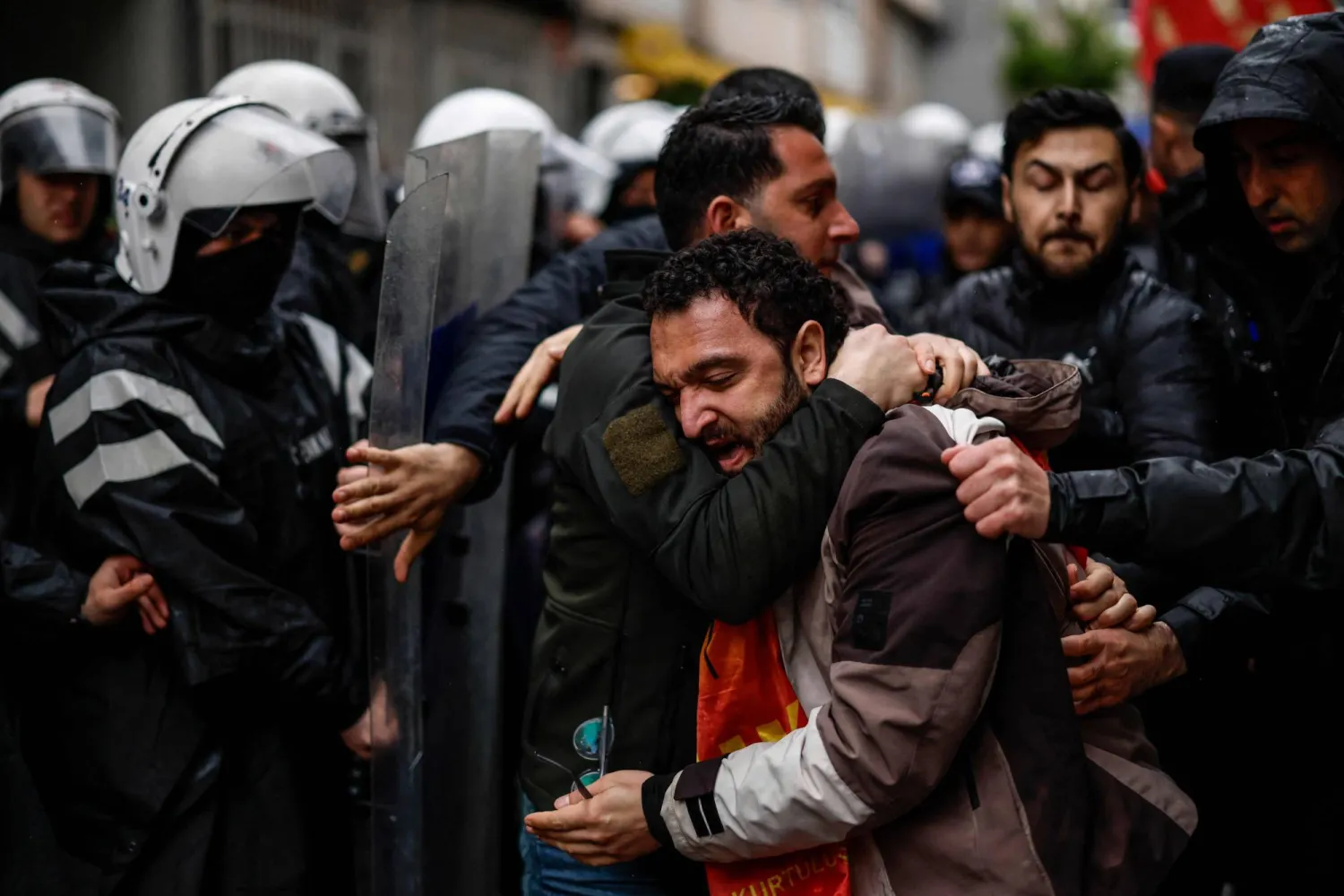
 Turkish police detain a protestor during a May Day (Labor Day) rally, marking international Workers' Day, in Besiktas, a district of Istanbul, on May 1, 2026. (AFP)
Turkish police detain a protestor during a May Day (Labor Day) rally, marking international Workers' Day, in Besiktas, a district of Istanbul, on May 1, 2026. (AFP)
TT

Turkish Police Fire Tear Gas, Arrest Hundreds at Istanbul May Day Rallies

 Turkish police detain a protestor during a May Day (Labor Day) rally, marking international Workers' Day, in Besiktas, a district of Istanbul, on May 1, 2026. (AFP)
Turkish police detain a protestor during a May Day (Labor Day) rally, marking international Workers' Day, in Besiktas, a district of Istanbul, on May 1, 2026. (AFP)

Turkish police on Friday fired tear gas and arrested hundreds of people holding May Day demonstrations in Istanbul, as thousands rallied nationwide. 

According to the CHD Lawyers' Association, police had arrested at least 550 people by mid-afternoon in Istanbul, where police fired tear gas from riot-control vehicles into the crowd, AFP journalists observed. 

"The number of people in police custody -- or whom their relatives suspect are in custody -- from whom we have not heard anything, stood at at least 550," by 4:00 pm (1300 GMT) said a CHD statement. 

The authorities did not immediately comment on the detentions in the country's economic capital. 

Images aired on the opposition channel HALK TV also showed the president of the Turkish Workers' Party, Erkan Bas, engulfed in pepper spray. 

"Those in power already speak 365 days a year, so let workers talk about the hardships they face at least one day a year," he said. 

Two groups were specially singled out in the city's European side after signaling their intention to march to Taksim Square -- the scene of several anti-government protests in the past -- which was sealed off overnight by police. 

A union official, Basaran Aksu, was arrested just after he had denounced the Taksim lockdown. 

"You can't close off a square to the workers of Türkiye. Everyone uses Taksim, for official ceremonies, for celebrations. Only the laborers, the workers, the poor find the square closed to them," he said. 

- Police lines - 

May Day, which celebrates workers and the working classes, sees a major police deployment in Türkiye every year, with a large area in the heart of Istanbul around Taksim Square sealed off. 

Last year, protests moved to the Kadikoy area of the city and more than 400 people were arrested. 

The number of arrests this year appeared to be approaching that level. 

The CHD lawyers' group, which was present at the rallies, said on a post on X that, at 1100 GMT "according to our information, the number of people in custody stands at 370". 

On Friday, large numbers of police, many in riot gear, deployed, setting up metal barricades to cut off access to central neighborhoods of Istanbul. 

In the Mecidiyekoy district, AFP reporters saw police use tear gas on the crowd, which included members of a Marxist party, the HKP, as they tried to push through while chanting "USA murderer, AKP (Türkiye's ruling party) accomplice". 

Police encircling the Besiktas neighborhood stepped in -- sometimes violently -- whenever a chant was taken up by the demonstrators. AFP saw several protesters thrown to the ground. 

Unions and civil society associations had called for the May 1 demonstrations under the slogan "Bread. Peace. Freedom". 

While inflation in Türkiye is officially pegged at 30 percent, it is closer to 40, according to independent estimates. 

In Ankara, about 100 coal miners who had staged a nine-day hunger strike to demand wage arrears were cheered as they joined the May Day march. 

The turnout, notably large and youthful, was monitored by a significant police presence, an AFP journalist said. 

Earlier this week, Turkish authorities issued arrest and search warrants against 62 people, of whom they deemed 46 -- including journalists, trade unionists and opposition figures -- "likely to carry out attacks". 


Eritrean Information Minister Welcomes New Chapter of Cooperation With Washington

Eritrean Information Minister Yemane G. Meskel (X account)
TT

Eritrean Information Minister Welcomes New Chapter of Cooperation With Washington

Eritrean Information Minister Yemane G. Meskel (X account)

Eritrean Information Minister Yemane Gebremeskel welcomed the United States' decision to lift sanctions affecting his country, describing the move as reflecting "a reservoir of constructive political goodwill" and saying it could pave the way for a new chapter in bilateral cooperation, particularly in investment and trade.

In remarks to Asharq Al-Awsat, the minister said the sanctions, which had caused significant economic damage to Eritrea, had sent an important message to the international community.

The United States recently ended the national emergency related to the crisis in Ethiopia, under which sanctions had been imposed on Eritrean entities and individuals over Eritrea's military role in the war in Ethiopia's Tigray region. The conflict ended with a peace agreement in 2022. Washington said the expiration of the emergency reflected changed circumstances underlying the measures.

The US Treasury's Office of Foreign Assets Control subsequently removed from its sanctions list entities and individuals designated under the relevant executive order. These included the People's Front for Democracy and Justice, Eritrea's ruling party, the Eritrean Defense Forces, and the Red Sea Trading Corporation, as well as Eritrean officials.

"Restoring Lost Opportunities"

In his remarks to Asharq Al-Awsat, Gebremeskel said the sanctions that have now been lifted "were not justified by any criteria in the first place and caused significant economic damage."

"Lifting them sends an important message to the international community by removing a political impediment that was not conducive to investment and broader engagement," he said.

He said the details of future cooperation would be determined through appropriate channels and platforms, with a focus on investment and trade.

Asked about the role of Massad Boulos, the US president's senior adviser for Arab and African affairs, Gebremeskel said Boulos had met Eritrean Foreign Minister Osman Saleh on the sidelines of Saleh's recent visit to Cairo.

He said the previous meetings had been "initial discussions to lay the groundwork for broader talks at appropriate levels on comprehensive bilateral cooperation, with a focus on investment and trade," expressing hope that the lifting of the sanctions would accelerate those contacts.

On the immediate implications of lifting the sanctions, he said the move opens "prospects for restoring lost opportunities and moving forward quickly." He said Eritrea has advantages across multiple sectors and is open to investment in areas of mutual benefit, supported by an established legal and administrative framework.

He stressed that "Eritrea's international partnerships have always been based on sustainable ties that enhance mutual and equal benefits, while avoiding imbalanced advantages or structural dependency, principles that have become norms governing bilateral and multilateral cooperation."

Relations With Egypt

On relations with Egypt, he said: "Cooperation with Egypt has developed rapidly over the past decade, not only because of history and geography, but also because the two countries are located in a vital strategic region, particularly along the Red Sea maritime route, and share similar views on mechanisms for cooperation among coastal states to enhance the security of this waterway."

"Eritrea, Egypt, and other like-minded countries in the Horn of Africa and Red Sea region have moved beyond slogans toward mechanisms for joint action to strengthen regional security and stability," he added.

He stressed that "the principles of the Council of Arab and African Coastal States of the Red Sea and Gulf of Aden remain a key platform for multilateral cooperation," alongside convergence in positions on resolving the conflict in Sudan and the situation in Somalia.

On Eritrea's foreign policy priorities for the next phase, he said his country's policy "has always been consistent and transparent, based on building bilateral and multilateral relations within frameworks of equal and mutually beneficial cooperation."

He rejected describing Eritrea as "isolationist," calling the characterization "a false and malicious concept promoted by its critics" that contradicts the country's strategic geographic position, economic potential, and government policies.

"Asmera will seriously seek to capitalize on new diplomatic openings to advance its core national interests," he said.


CNN, MS Now, Politico Sue Donald Trump over White House Ban

President Donald Trump speaks to reporters at Charlotte Douglas International Airport, Wednesday, Sept. 16, 2026, in Charlotte, N.C. (AP Photo/Alex Brandon)
TT

CNN, MS Now, Politico Sue Donald Trump over White House Ban

President Donald Trump speaks to reporters at Charlotte Douglas International Airport, Wednesday, Sept. 16, 2026, in Charlotte, N.C. (AP Photo/Alex Brandon)

CNN, MS NOW and Politico sued President Donald Trump on Monday for banning them from White House grounds, saying it violated their rights under the US Constitution to cover him.

In a complaint filed in the Washington, D.C., federal court, the media outlets said Trump can't ban them solely because he dislikes what he calls their "negative" coverage, and reserve coverage for media who offer praise. They also said the public deserves "current and complete information" about their government.

"This ban could not be a more direct assault on the First Amendment nor a more blatant violation of our most fundamental constitutional principles," the media outlets said.

According to AFP, leading US broadcasters suspended the TV "pool" coverage in solidarity with CNN.

"The public has a vital interest in receiving accurate, independent information about its government. No administration should restrict a news organization because it objects to its reporting," ABC, CBS, CNN, Fox and NBC said in a statement.

TV broadcasters rotate responsibility for filming the president at some events.


US Refuses Visas for Iran UN Delegation Members

Iranian President Masoud Pezeshkian delivers a speech in the United Nations General Assembly Hall in New York (File photo/UN)
TT

US Refuses Visas for Iran UN Delegation Members

Iranian President Masoud Pezeshkian delivers a speech in the United Nations General Assembly Hall in New York (File photo/UN)

The United States has refused to issue visas for members of Iranian President Masoud Pezeshkian's delegation, including his communications team, for this week's trip to the UN General Assembly, Iranian state media reported Monday.

Pezeshkian will be the highest-ranking Iranian official to enter the United States since the Middle East war began with US-Israeli strikes on Iran in February.

"In an unprecedented hostile move by the US government, (US President Donald) Trump has denied US visas to certain members of the president's high-level delegation, including members of his communications team," state news agency IRNA reported.

The Mehr news agency also carried the story, citing a spokesperson for the Iranian presidency, and added that Pezeshkian will address the UN General Assembly on Wednesday.

The US has authorized the Iranian delegation to travel for the UN General Assembly but will, like last year, put restrictions in place.

Iran's delegation will not, for instance, be allowed to purchase luxury goods or other items, the State Department said on Thursday.

Iranian Foreign Minister Abbas Araghchi, part of the delegation to the UN, left Iran on Sunday evening for a stopover in Qatar.

Iran says it has conveyed to the US, via Qatar as mediator, conditions for reopening the strategic Strait of Hormuz oil and gas shipping route, which it has choked off since the war began.

The United States, in turn, is imposing a counterblockade of Iranian ports.
