


US Navy Turns to AI Firm Domino for Options to Counter Iranian Mines

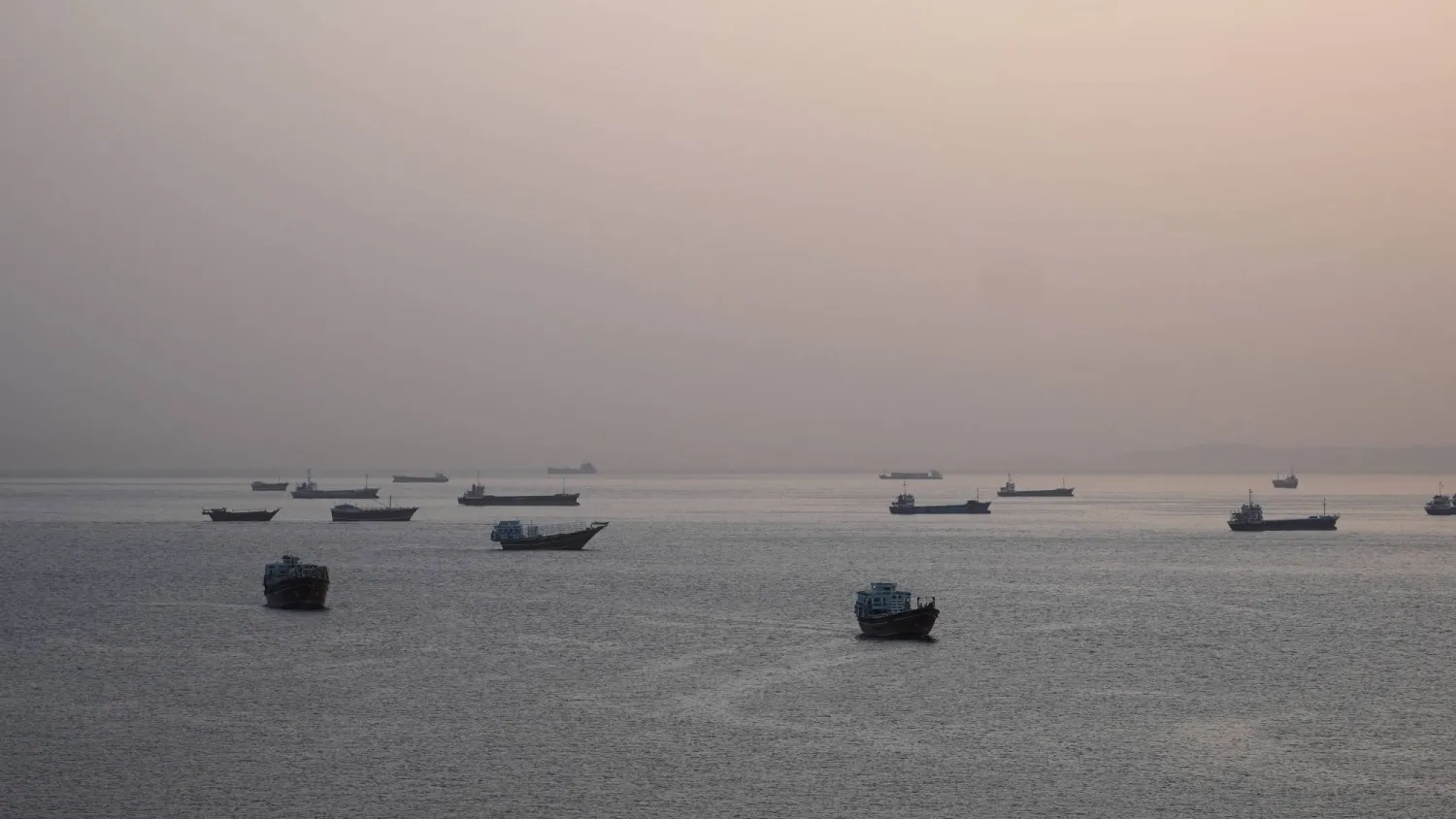
Ships and boats in the Strait of Hormuz, Musandam, Oman, May 1, 2026. REUTERS/Stringer
TT

US Navy Turns to AI Firm Domino for Options to Counter Iranian Mines

Ships and boats in the Strait of Hormuz, Musandam, Oman, May 1, 2026. REUTERS/Stringer

The US Navy is ramping up its AI capabilities to hunt for Iranian mines in the Strait of Hormuz, one of the world's most critical shipping lanes, a recently awarded contract shows.

President Donald Trump has said the US Navy is clearing Iranian mines from the strait, a vital sea route for oil shipments, whose disruption is increasingly threatening the global economy.

Sweeping for underwater explosives could take months despite a tenuous ceasefire between the US and ⁠Iran in their weeks-long ⁠war.

The up to $100 million contract for the San Francisco artificial intelligence company Domino Data Lab could quicken this process with software that can teach underwater drones to identify new types of mines in a matter of days.

"Mine-hunting used to be a job for ships," Thomas Robinson, Domino's chief operating officer, said in an interview with Reuters. "It's becoming a job for AI.

⁠The Navy is paying for the platform that lets it train, govern, and field that AI at a speed required for contested waters that block global trade and imperil sailors."

Last week, the US Navy awarded the up to $99.7 million contract to expand Domino's role as the AI backbone of the Navy's Project AMMO - Accelerated Machine Learning for Maritime Operations - a program to make underwater mine detection faster, more accurate, and less dependent on human sailors.

The software integrates data from multiple sensor types, including side-scan sonar and visual imaging systems, and allows the Navy to monitor how well various AI ⁠detection models ⁠are performing in the field, identify failures, and push corrections to improve performance.

The core of Domino's pitch - and the Navy's wager - is speed. Before the company's involvement, updating the AI models that power the Navy's unmanned underwater vehicles (UUVs) to recognize new or previously unseen mines could take up to six months. Domino says it has cut that cycle to days.

Robinson illustrated the relevance to the Middle East crisis: "If there were UUVs in the Baltic Sea trained on Russian mines, and then they needed to be deployed to the Strait of Hormuz to detect Iranian mines, with Domino's technology, the Navy could be ready in a week rather than a year."

A Navy spokesman was not immediately able to provide comment.


Trump Says Iran's Kharg is Being 'Blown to Smithereens', But Gives No Details

FILE PHOTO: A satellite image shows an oil terminal at Kharg Island, Iran, February 25, 2026. 2026 Planet Labs PBC/Handout via REUTERS
TT

Trump Says Iran's Kharg is Being 'Blown to Smithereens', But Gives No Details

FILE PHOTO: A satellite image shows an oil terminal at Kharg Island, Iran, February 25, 2026. 2026 Planet Labs PBC/Handout via REUTERS

Iran's energy hub of Kharg Island is being blown to smithereens, US President Donald Trump said on Sunday in a one-line social media post accompanied by an AI-generated video clip.

There was no other evidence that the Iranian energy hub was under attack. The White House and the US Defense Department did not immediately respond to Reuters requests for comment outside regular business hours.

There was no immediate response to Trump's post on Iranian media.

"Kharg Island being blown to smithereens!!! President DJT," Trump said on social media, but gave no further details.

Reuters confirmed that an accompanying video clip showing dramatic explosions was most likely synthetically-generated, using software that detects AI-manipulated imagery.

Attacking Kharg, which handled 90% of Iran's oil exports before the war launched by US and Israeli attacks on February 28, would severely disrupt its energy trade and put huge pressure on its economy.

Iran responded to an earlier US ‌attack on rocket launchers on ‌its island of Larak, about 660 km (410 miles) east of Kharg, with an assault ‌on two ⁠US bases in ⁠Jordan, Iranian media said.

The return to hostilities followed weeks in which the Trump administration has stepped up efforts to punish Tehran and its business partners with costly economic sanctions, shifting away from military options.

US Treasury Secretary Scott Bessent told Reuters on Sunday new secondary sanctions were likely to be unveiled weekly in the effort to pressure Iran, with an initial focus on banks.

"We're starting with the banks, and we're telling the banks it's not okay to have Iranian money and to aid the regime," Bessent said in an interview.

After imposing penalties on the United Arab Emirates branches of Egypt's Banque Misr on Friday over alleged financial links to Iran, Bessent said the next step ⁠may be cutting off an institution entirely from the dollar-based financial system.

"You're going to see a ‌lot more of these every week," Bessent told Reuters, ahead of a meeting ‌of Group of 20 finance leaders.


Bessent Expects New US Secondary Sanctions Weekly, Aiming to Increase Pressure on Iran

 US Treasury Secretary Scott Bessent speaks during an interview with The Associated Press in Asheville, NC, Sunday, Aug. 30, 2026. (AP)
US Treasury Secretary Scott Bessent speaks during an interview with The Associated Press in Asheville, NC, Sunday, Aug. 30, 2026. (AP)
TT

Bessent Expects New US Secondary Sanctions Weekly, Aiming to Increase Pressure on Iran

 US Treasury Secretary Scott Bessent speaks during an interview with The Associated Press in Asheville, NC, Sunday, Aug. 30, 2026. (AP)
US Treasury Secretary Scott Bessent speaks during an interview with The Associated Press in Asheville, NC, Sunday, Aug. 30, 2026. (AP)

The US Treasury Department is likely to unveil weekly new secondary sanctions aimed at increasing economic pressure on Iran, with an initial focus on banks, US Treasury Secretary Scott Bessent told Reuters on Sunday.

After imposing penalties on the United Arab Emirates branches of Egypt's Banque Misr on Friday over ‌alleged financial links ‌to Iran, Bessent said ‌in ⁠an interview that the ⁠next step may be cutting off an institution entirely from the dollar-based financial system.

"You're going to see a lot more of these every week," Bessent said ahead of a Group of 20 finance leaders meeting. "We're ⁠starting with the banks, and ‌we're telling the ‌banks it's not okay to have Iranian money and ‌to aid the regime."

Bessent said he ‌intends to drive the message home to G20 finance ministers and central bank governors to cut economic ties to Iran, or face secondary sanctions. ‌The Treasury launched the effort, dubbed Operation Economic Outcast, last week.

"There can ⁠be ⁠no leakage," Bessent said. "You're either with us or you're with the Iranians."

However, he said that he disagreed with some critics who have said that Iran sanctions will not be successful without targeting Chinese companies for secondary sanctions.

Most of China's Iran oil purchases have been curbed by the US blockade of Iranian ports, and the amount of Iranian oil stored in tankers is dwindling, he said, adding: "Problem solved."


Iran Retaliates after First US Strikes in a Month

A man drives next to a billboard of Iranian supreme leader Mojtaba Khamenei in a street in Tehran, Iran, 09 July 2026. EPA/ABEDIN TAHERKENAREH
TT

Iran Retaliates after First US Strikes in a Month

A man drives next to a billboard of Iranian supreme leader Mojtaba Khamenei in a street in Tehran, Iran, 09 July 2026. EPA/ABEDIN TAHERKENAREH

Iran vowed on Monday a "decisive response" to the first American strikes on its territory in a month, in a fresh flare-up in the Middle East war.

Tehran's powerful Revolutionary Guards said they had retaliated to Sunday's attack by striking two US military air bases with ballistic missiles in Washington-allied Jordan, causing "heavy damage."

Jordan's army said it had intercepted eight missiles, without stating their origin, AFP said.

The Guards also said on Monday they had shot down a US drone over the Strait of Hormuz.

The attacks came after the United States said Sunday it had attacked Iranian rocket launchers on a small island in the strategic shipping lane.

Washington said its attacks were aimed at preventing Iran from launching more sea mines into the strait, days after it announced it had completed clearing explosives from the waterway.

"US forces took limited, precise action against IRGC (Iran's Revolutionary Guards') minelaying forces posing an imminent threat in the Strait of Hormuz," the US Central Command wrote on X.

The Guards said the US strikes resulted in "casualties" and that their subsequent attack on Jordan was "in response to the US-Zionist aerial aggression."

"We are not seeking war, but we will deliver a decisive response to the aggressors," Iranian President Masoud Pezeshkian said in a statement quoted by state TV.

Pezeshkian was speaking before traveling to Kyrgyzstan for the summit of a bloc that seeks to be a counterinfluence to the West, along with Russia's Vladimir Putin and China's Xi Jinping.

The exchange of fire between the United States and Iran came shortly after their war hit the six-month mark, and at a time when hostilities had been subsiding.

In recent weeks, the administration of US President Donald Trump has prioritized "economic warfare" over military strikes on Iran.

Tehran has effectively blocked the Strait of Hormuz, a strategic sea lane through which one-fifth of the world's oil passed before the United States and Israel triggered hostilities with strikes on Iran on February 28.

"Last week, CENTCOM completed clearing sea mines from the strait's international shipping routes," said Navy Captain Tim Hawkins, a spokesman for US Central Command.

"US forces are monitoring the area closely and remain prepared to protect the free flow of commerce through this essential waterway," he said.

- Unpopular war -

Diplomatic efforts, spearheaded by mediators including Pakistan and Qatar, have tried for months to bring an end to the war.

While a ceasefire was agreed in April and a memorandum of understanding towards a final peace deal was signed in June, no agreement has been forthcoming, and Washington has since declared "economic warfare" against Tehran.

A US naval counterblockade of Iranian ports is squeezing petrol supplies in Iran during a shortfall in domestic production, as the US ramps up the pressure.

The April ceasefire put an end to the most intense fighting, but sporadic attacks, mainly around the Strait of Hormuz, have dimmed the prospects of a final peace agreement.

The last US strike on Iran prior to Sunday's came on July 29 in response to "an attempted surprise attack on US forces" in the region, the US military said. Earlier in July, CENTCOM attacked Iran for 13 consecutive nights.

Throughout the war, Iran has fought back by striking US facilities and allies in the Gulf region, hitting targets in Kuwait, Oman, Saudi Arabia and the United Arab Emirates, among others.

Its closure of the Strait of Hormuz has caused pain around the world in the form of price hikes and shortages of fertilizer and energy.

Both main crude oil contracts rose at least two percent on Monday.

The Iran war is deeply unpopular with the US public, with midterm elections looming in November that could overturn Republican control of Congress.

In a statement on Friday, US Senator Jack Reed criticized Trump over the war.

"Six months later, not a single objective has been achieved," said Reed, the top Democrat on the Senate Armed Services Committee.

"Indeed, he has weakened our position in the Middle East and the world significantly."
