


Iran Military Official Says Renewed War with US ‘Likely’

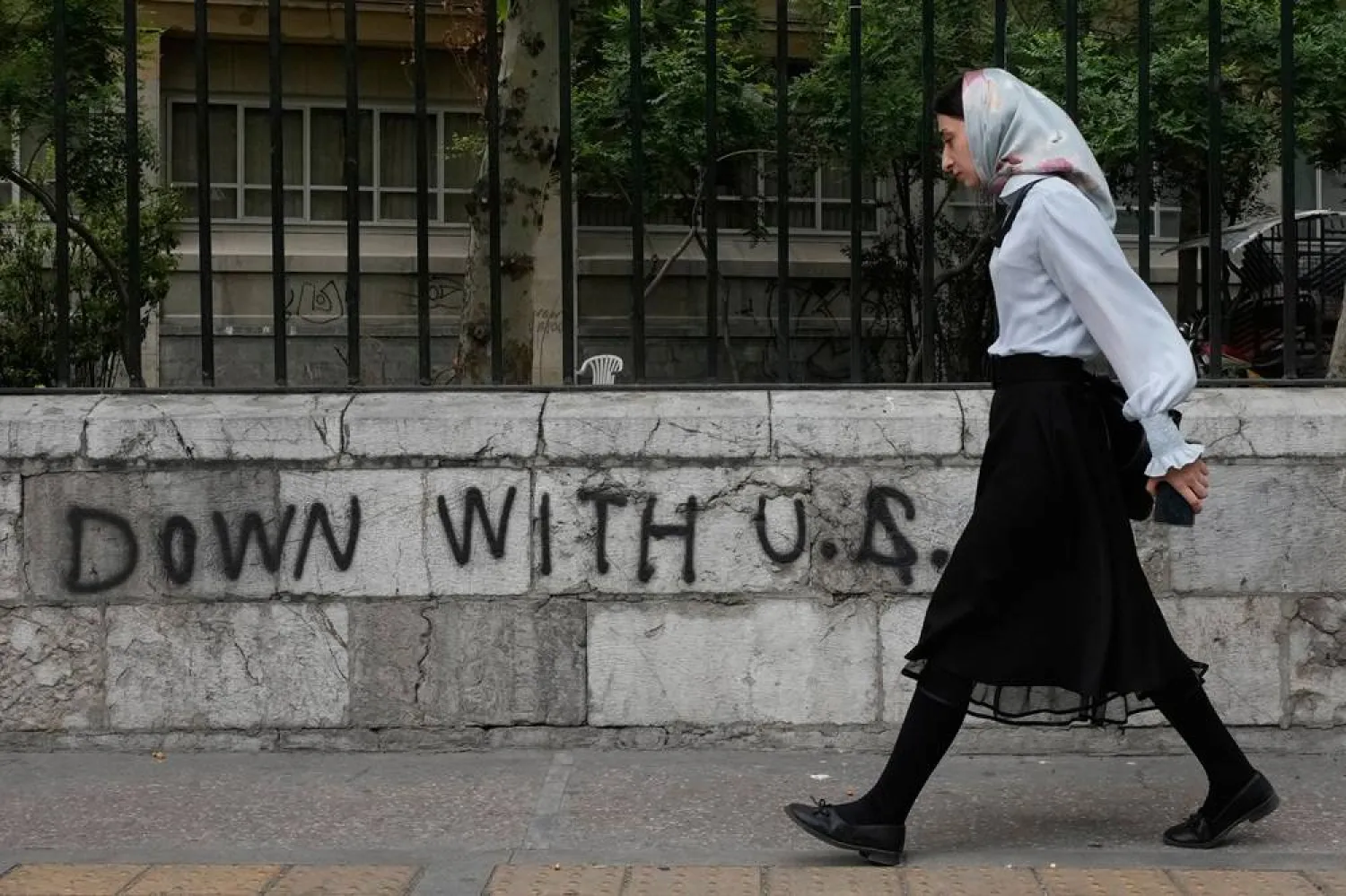
A woman walks past an anti-US graffiti painted on the wall of the Tehran University on Enqelab-e-Eslami street in downtown Tehran, Iran, Saturday, April 25, 2026. (AP)
TT

Iran Military Official Says Renewed War with US ‘Likely’

A woman walks past an anti-US graffiti painted on the wall of the Tehran University on Enqelab-e-Eslami street in downtown Tehran, Iran, Saturday, April 25, 2026. (AP)

A senior Iranian military officer said on Saturday that renewed fighting between the US and Iran was "likely", hours after President Donald Trump said he was "not satisfied" with a new Iranian negotiating proposal.

Iran delivered the draft to mediator Pakistan on Thursday evening, state media reported without detailing its contents.

The war, launched by the United States and Israel in late February, has been on hold since April 8, with one failed round of peace talks having taken place in Pakistan since then.

"At this moment I'm not satisfied with what they're offering," Trump told reporters, blaming stalled talks on "tremendous discord" within Iran's leadership.

"Do we want to go and just blast the hell out of them and finish them forever -- or do we want to try and make a deal?" he added, saying he would "prefer not" to take the first option "on a human basis".

On Saturday morning, Mohammad Jafar Asadi, a senior figure in the Iranian military's central command, said "a renewed conflict between Iran and the United States is likely", in quotes published by Iran's Fars news agency.

"Evidence has shown that the United States is not committed to any promises or agreements," he added.

- 'Stuck in purgatory' -

Iran's judiciary chief Gholamhossein Mohseni Ejei said on Friday that his country had "never shied away from negotiations", but added it would not accept an "imposition" of peace terms.

The White House has declined to provide details on the latest Iranian proposal, but news site Axios reported that US envoy Steve Witkoff had submitted amendments putting Tehran's nuclear program back on the negotiating table.

The changes reportedly include demands that Iran not move enriched uranium from bombed sites or resume activity there during talks.

News of the Iranian proposal briefly pushed oil prices down nearly five percent, though they remain about 50 percent above pre-war levels amid the ongoing closure of the Strait of Hormuz.

Iran has maintained a stranglehold on the strait since the war began, choking off major flows of oil, gas and fertilizer to the world economy, while the United States has imposed a counter-blockade on Iranian ports.

Tehran resident Amir told Paris-based AFP journalists that the stalemate "feels like we are stuck in purgatory", and he expressed little hope for the Iranian proposal.

"This is all to waste time," he said, predicting the United States and Israel "will attack again".

Despite the ceasefire in the Gulf, fighting has continued in Lebanon, where Israel has carried out deadly strikes despite a separate truce with the Iran-backed armed group Hezbollah.

Lebanon's health ministry said 13 people were killed in strikes in the south, including in the town of Habboush, where the Israeli military had issued an evacuation warning.

- 'Terminated' -

In Washington, lawmakers were wrestling with a legal dispute over whether Trump had breached a deadline to seek congressional approval for the war.

Administration officials argue that the ceasefire pauses a 60-day limit, after which congressional authorization would be required -- a claim disputed by opposition Democrats.

Trump faces growing domestic pressure, with inflation rising, no clear victory in sight and midterm elections approaching.

"There has been no exchange of fire between United States Forces and Iran since April 7, 2026," Trump said in letters to congressional leaders, adding that the hostilities "have terminated".

In Iran, the war's economic toll is deepening.

Washington has imposed new sanctions on three Iranian currency firms and warned others against paying a "toll" for safe passage through Hormuz, as demanded by Iran.

The US military says its blockade of Iranian ports has stopped $6 billion in Iranian oil exports, while inflation in Iran, already high before the war, has surged past 50 percent.

"For many people, paying rent and even buying food has become difficult, and some have nothing left at all," 28-year-old Iranian Mahyar told an AFP reporter based outside the country.

Supreme leader Mojtaba Khamenei said on Friday that "the owners of damaged businesses should avoid, as much as possible, layoffs and separation of their workforce".

He also threatened Iran's enemies with "economic and cultural" war.


Iran and US Closing in on Deal to End War

Vessels in the Strait of Hormuz, Iran, May 22, 2026. Majid Asgaripour/WANA (West Asia News Agency) via REUTERS
TT

Iran and US Closing in on Deal to End War

Vessels in the Strait of Hormuz, Iran, May 22, 2026. Majid Asgaripour/WANA (West Asia News Agency) via REUTERS

The United States and Iran could strike a deal to end the Middle East war as early as Sunday, Washington's top diplomat said, while Tehran insisted the agreement would do nothing to limit its nuclear program.

Washington and Tehran have observed a ceasefire since April 8 while mediators push for a negotiated settlement, although Iran has imposed controls on shipping and the US has blockaded Iran's ports.

On Sunday, during a visit to India, US Secretary of State Marco Rubio told reporters: "I do think perhaps there is the possibility that in the next few hours the world will get some good news."

This came after US President Donald Trump posted on social media that the deal "has been largely negotiated, subject to finalization between the United States of America, the Islamic Republic of Iran, and the various other Countries".

Rubio said the agreement would start a "process that can ultimately leave us where the president wants us to be, and that is a world that no longer has to fear or worry about an Iranian nuclear weapon".

Trump's post stressed that the Strait of Hormuz would be re-opened, a development that would bring relief to energy markets after a long Iranian blockade of a crucial waterway that in peacetime carries a fifth of world oil exports.

Iranian officials confirmed the existence of a draft agreement but stressed that -- contrary to earlier long-standing US demands -- talks on the issue of Iran's contested nuclear program have been deferred for 60 days after any deal.

- 'Lasting peace' -

According to Iran's Fars news agency, Washington has agreed to release part of Tehran's funds frozen abroad under international economic sanctions and to end its naval blockade of ships travelling to and from Iranian ports.

In exchange, "according to this draft, passage through the Strait of Hormuz would return to pre-war levels under Iranian management".

And, Fars said, "sanctions on oil, gas, petrochemicals and their derivatives would be temporarily lifted during the negotiation period so that Iran can freely sell its products".

Leaders from Saudi Arabia, the United Arab Emirates, Qatar, Egypt, Jordan and Bahrain, as well as representatives from Türkiye and Pakistan, joined a call with Trump to discuss the deal on Saturday.

Pakistan, which mediated historic face-to-face negotiations between US and Iranian delegations in April, hopes to host another round of talks "very soon", Prime Minister Shehbaz Sharif said.

He said Pakistan's powerful army chief Asim Munir, who visited Tehran on Friday and Saturday, also joined the call, which "provided a useful opportunity... to move the ongoing peace efforts forward to bring lasting peace in the region".

- Lebanese front -

Trump said a separate call with Israeli Prime Minister Benjamin Netanyahu "went very well". US strikes on Iran have been carried out together with Israel since the war began on February 28.

Iran's chief negotiator Mohammad Bagher Ghalibaf had warned earlier that Washington would face a tough response if it resumed hostilities, as Trump has often threatened.

"Our armed forces have rebuilt themselves during the ceasefire period in such a way that if Trump commits another act of folly and restarts the war, it will certainly be more crushing and bitter for the United States than on the first day of the war," Ghalibaf said.

On the war's other main front in Lebanon, state media reported that Israel struck the country's south on Saturday, where fighting has continued despite an April 17 ceasefire.

Lebanon's military said a strike targeted an army barracks and wounded a soldier, while Israel said one of its soldiers was killed on Friday near the border.

On Sunday, Lebanon's civil defense agency said its regional facility in the city of Nabatieh had been destroyed by an Israeli strike.


EU's Kallas: Russia Showing 'Reckless Nuclear Brinkmanship' in Latest Attacks on Ukraine

European Union foreign policy chief Kaja Kallas speaks with the media as she arrives for a meeting of EU foreign ministers at the European Council building in Brussels, Monday, May 11, 2026. (AP Photo/Marius Burgelman)
TT

EU's Kallas: Russia Showing 'Reckless Nuclear Brinkmanship' in Latest Attacks on Ukraine

European Union foreign policy chief Kaja Kallas speaks with the media as she arrives for a meeting of EU foreign ministers at the European Council building in Brussels, Monday, May 11, 2026. (AP Photo/Marius Burgelman)

Russia's latest attacks against Ukraine, which President Volodymyr Zelenskiy said involved an Oreshnik intermediate-range ballistic missile, showed 'reckless nuclear-brinkmanship,' the European ‌Union's foreign policy ‌chief Kaja ‌Kallas ⁠said on Sunday.

"Russia ⁠hit a dead-end on the battlefield, so it terrorizes Ukraine with ⁠deliberate strikes on ‌city ‌centers. These ‌are abhorrent acts of ‌terror meant to kill as many civilians as possible," ‌Kallas wrote on X.

"Moscow reportedly using ⁠Oreshnik ⁠intermediate-range ballistic missiles – systems designed to carry nuclear warheads – is a political scare tactic and reckless nuclear brinkmanship," Kallas said.


Taiwan, China Coast Guards in Standoff at Top of South China Sea

A person poses for photo holding a Taiwan flag at a rally to support government plans to increase defense spending in Taipei, Taiwan May 23, 2026. (Reuters)
TT

Taiwan, China Coast Guards in Standoff at Top of South China Sea

A person poses for photo holding a Taiwan flag at a rally to support government plans to increase defense spending in Taipei, Taiwan May 23, 2026. (Reuters)

The Taiwanese and Chinese coast guards were engaged in a tense standoff for the second day near the strategically located Pratas islands at the top of the South China Sea, Taiwan's Coast Guard said on Sunday.

China claims democratically governed Taiwan as its own territory, a position the government in Taipei rejects.

China has pressured Taiwan by increasing its military presence around the island, and Taipei is on high alert for further Chinese actions after President Xi Jinping discussed Taiwan with US President Donald Trump in Beijing this ‌month.

Lying roughly ‌between southern Taiwan and Hong Kong, the Taiwan-controlled Pratas are ‌seen ⁠by some security ⁠experts as vulnerable to Chinese attack due to their distance - more than 400 km (250 miles) - from Taiwan island.

Taiwan's Coast Guard said on Saturday it had spotted a Chinese Coast Guard ship heading to the Pratas and immediately sent its own ship which broadcast warnings and the two sides "engaged in an intense verbal confrontation over sovereignty via radio."

The Chinese ship broadcast that it was on a ⁠routine mission and that China had sovereignty and jurisdiction over ‌the Pratas, the Taiwan Coast Guard said.

“Please do ‌not destroy peace. You should return and strive for democracy. That is the correct ‌way to serve your country,” the Taiwan ship broadcast back, according to ‌video provided by its coast guard.

China's Taiwan Affairs Office did not respond to a request for comment.

A Taiwan Coast Guard official told Reuters the Chinese ship was 21 nautical miles to the northeast of the Pratas and the standoff was continuing as of Sunday ‌afternoon.

China's wording on having jurisdiction and sovereignty was unusual as was the length of its stay in the ⁠waters so close ⁠to the Pratas, the official added, speaking on condition of anonymity due to the sensitivity of the situation.

The coast guard said on Friday night it had also driven away for the second time this month the Chinese research ship "Tongji" in waters close to the island.

The Pratas, an atoll which is also a Taiwanese national park, is only lightly defended by Taiwan, and its coast guard has that responsibility rather than the military.

In January, Taiwan said a Chinese reconnaissance drone briefly flew over the Pratas.

On Saturday, Taiwan's National Security Council Secretary-General Joseph Wu took to his X account to detail the 100 Chinese ships he said were currently in the first island chain, referring to an area running from Japan through Taiwan and into the Philippines.
