


Taiwan Leader Says Island Has 'Right to Engage with the World'

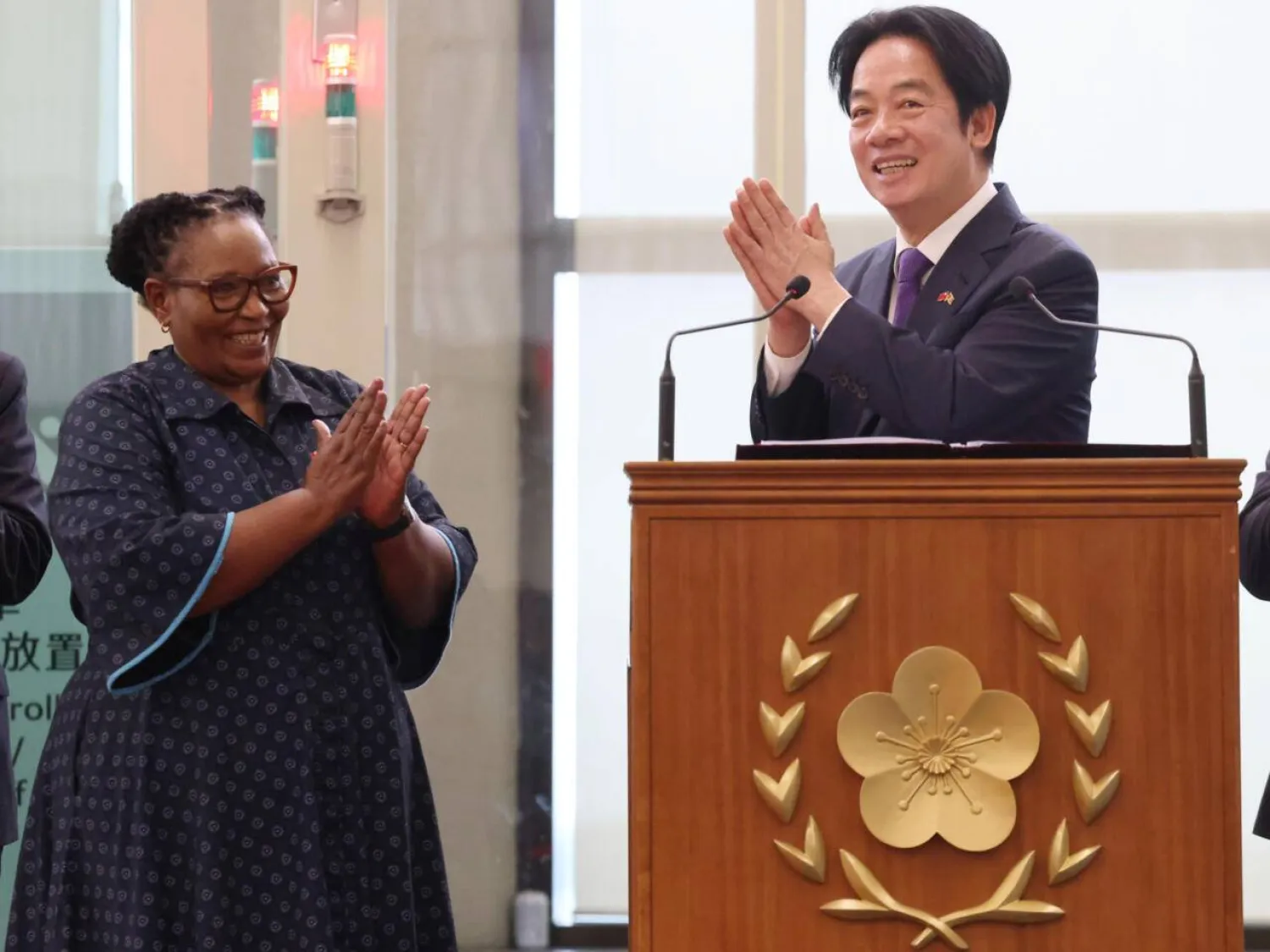
Taiwan President Lai Ching-te (R) and Eswatini Deputy Prime Minister Thulisile Dladla(L) arrive at Taiwan Taoyuan International Airport following his visit to Eswatini, in Taoyuan on May 5, 2026. I-Hwa Cheng / AFP
TT

Taiwan Leader Says Island Has 'Right to Engage with the World'

Taiwan President Lai Ching-te (R) and Eswatini Deputy Prime Minister Thulisile Dladla(L) arrive at Taiwan Taoyuan International Airport following his visit to Eswatini, in Taoyuan on May 5, 2026. I-Hwa Cheng / AFP

Taiwanese President Lai Ching-te said Tuesday the democratic island has the "right to engage with the world", after he returned from a trip to Africa that Taipei has accused Beijing of trying to derail.

Taiwan said China applied "intense pressure" to Seychelles, Mauritius and Madagascar to revoke overflight permits for Lai's original trip to Eswatini, Taipei's only ally in Africa, which had been scheduled for April 22-26, AFP said.

China claims Taiwan is part of its territory and opposes the self-governed island's participation in international organizations and exchanges with other countries.

"Taiwanese people are people of the world; Taiwanese people have the right to engage with the world," Lai told reporters at Taipei's international airport after his flight home on the Eswatini king's plane.

Lai flew on the king's aircraft to Eswatini on Saturday.

"We will not shrink back because of suppression," Lai said, flanked by Eswatini Deputy Prime Minister Thulisile Dladla who had flown to Taiwan with him and his delegation.

"Mutual visits between heads of state should be the most ordinary thing, just like when we go out to visit friends, and are a basic right of every country."

The United States slammed China's "intimidation campaign" after Lai's first trip was delayed. The remarks were rejected by China's foreign minister as "baseless accusations".

On Saturday, China's foreign ministry accused Lai of making a "stowaway-style escape farce" that made him "an international laughing stock".

- 'Sanctions' -

Eswatini, a small enclave kingdom formerly known as Swaziland, is one of 12 countries that still recognize Taiwan. China has persuaded other nations to break diplomatic ties with the self-ruled island.

Lai had planned to visit Eswatini from April 22 to 26 for the 40th anniversary of King Mswati III's accession and his 58th birthday.

Taiwan's Foreign Minister Lin Chia-lung went instead after Lai's trip was postponed.

A Taiwanese security official, who requested anonymity in order to speak to the media, said previously that China had threatened "to revoke substantial debt relief granted to (Seychelles, Mauritius and Madagascar), halt financing and impose further economic sanctions".

Lai's last official overseas trip was in November 2024, when he visited Taiwan's Pacific allies and transited through the US territory of Guam.

Trump's administration reportedly denied Lai permission to transit through New York last year as part of an official trip to Latin America. Taiwan's foreign ministry denied that he was blocked.



Ukraine Drone Attacks Kill 5 in Russia, Crimea

FILE PHOTO: Explosion at Moscow oil refinery after Ukrainian drone attacks on the city, in Moscow, Russia june 18, 2026, in this screengrab obtained from a social media video. SOCIAL MEDIA/via REUTERS
TT

Ukraine Drone Attacks Kill 5 in Russia, Crimea

FILE PHOTO: Explosion at Moscow oil refinery after Ukrainian drone attacks on the city, in Moscow, Russia june 18, 2026, in this screengrab obtained from a social media video. SOCIAL MEDIA/via REUTERS

Ukrainian drone strikes killed five people, including two children, in Russia and on the Moscow-annexed Crimean peninsula, in attacks that also triggered a fire at a major oil depot in the country's south, local officials said Thursday.

Ukraine has stepped up strikes on Russia in recent months in retaliation for Moscow's near-daily barrages of drones and missiles throughout its five-year offensive, AFP reported.

Russia's defense ministry said it downed 269 Ukrainian drones overnight over Russia and Crimea, which Moscow annexed in 2014.

In Crimea, which Ukraine is trying to cut-off from Russian logistics and supply routes, the Russia-appointed governor Sergey Aksyonov said: "Two people, including a child, were killed and two others wounded ... as a result of overnight enemy attacks.

Drone strikes also killed two people in the border Bryansk region -- a 23-year-old driver and 15-year-old girl -- and one in the Belgorod region, regional authorities said.

Kyiv insists that the Ukrainian army first and foremost targets military installations and energy infrastructure, in a bid to deprive the Kremlin's war chest of vital fossil fuel revenues.

In Russia's southern Krasnodar Krai region, debris from a drone strike triggered a fire at an oil depot, authorities said Thursday.

"Following the fall of UAV debris, a fire broke out at the Poltavskaya oil depot," Aleksandr Kharitonov, head of Krasnoarmeysk district in Krasnodar Krai, wrote on Russia's state-run Max platform.

Ukraine's air force said Russia fired 90 drones and an Iskander missile -- launched from Crimea -- at Ukraine overnight, adding that 83 of the drones had been shot down.

But Ukraine's state railway operator said a crew member was killed in a strike on a train in the southern Zaporizhzhia region.


Iran Warns Against Hormuz Crossings Without Authorization

FILE PHOTO: Vessels are seen at the Strait of Hormuz, as seen from Musandam, Oman, June 1, 2026. REUTERS/Stringer/File Photo
TT

Iran Warns Against Hormuz Crossings Without Authorization

FILE PHOTO: Vessels are seen at the Strait of Hormuz, as seen from Musandam, Oman, June 1, 2026. REUTERS/Stringer/File Photo

Iran's Revolutionary Guards on Thursday warned against any crossings of the Strait of Hormuz without authorization, saying vessels not complying "will be dealt with.”

The future of the strait, a vital route for energy shipments that was blockaded by Iran during the war, is a key sticking point in negotiations between Tehran and Washington.

Tehran has said it plans to impose what it calls maritime service fees, as opposed to tolls, while the United States argues it is an international waterway and therefore should not be charged.

"The only authorized route for passage through the Strait of Hormuz is the route announced by the Islamic Republic of Iran," said the Revolutionary Guards, the ideological arm of Iran's military.

Any crossing without authorization is "unacceptable and extremely dangerous,” they warned in a statement.

According to AFP, they also denounced what they said was a new route through the waterway announced by "certain authorities.”

The statement did not elaborate but it appeared to be a response to an announcement overnight of a temporary corridor by Oman, which also borders the strait.


US-Iran Deal May Leave Netanyahu as Biggest Casualty

FILE PHOTO: US President Donald Trump points his finger towards Israeli Prime Minister Benjamin Netanyahu as they shake hands during a press conference after meeting at Trump’s Mar-a-Lago club in Palm Beach, Florida, US, December 29, 2025. REUTERS/Jonathan Ernst/File Photo
TT

US-Iran Deal May Leave Netanyahu as Biggest Casualty

FILE PHOTO: US President Donald Trump points his finger towards Israeli Prime Minister Benjamin Netanyahu as they shake hands during a press conference after meeting at Trump’s Mar-a-Lago club in Palm Beach, Florida, US, December 29, 2025. REUTERS/Jonathan Ernst/File Photo

The biggest casualty of the US-Iran deal may not be Israel's Iran strategy, but the political brand Benjamin Netanyahu spent decades building as the Israeli leader who could uniquely bend Washington to his will on Iran, analysts, former US officials and diplomats say.

Netanyahu shaped his political identity on an audacious assertion: that he alone could keep the US and Israel in strategic lockstep on Iran. Cultivating Republican support, he cast himself as the only Israeli leader capable of influencing successive US presidents and insisted that only sustained military pressure could contain Tehran.

At the height of his power, he was described by diplomats as the "American whisperer" — the Israeli leader who could pick up the phone and ensure Washington’s strategic calculus aligned with that of Israel.

No other Israeli prime minister, they note, addressed Congress as often or built such enduring political capital across the American political system. But analysts say Washington and Tehran's interim pact to end the war that the US and Israel launched in February shows how that narrative has been reversed.

Rather than shaping Washington’s Iran policy, Netanyahu is now forced to accept it, as US President Donald Trump pursues a settlement that increasingly treats Israeli objections as constraints, Reuters reported.

At home, the reckoning is equally stark, said former US official Dennis Ross. Netanyahu is increasingly boxed in between a US president intent on ending the conflict and a domestic base resistant to concessions, particularly in Lebanon, he said.

Withdrawal risks political backlash while escalation risks confrontation with Washington. The war Netanyahu hoped would cement his legacy as the leader who confronted Iran may instead be remembered as the conflict that dismantled a central source ⁠of his power. ⁠Isolated abroad, constrained by his closest ally and vulnerable ahead of an autumn election, he now finds the political asset on which he built his career has become his greatest liability.

At the outset of the war with Iran, Netanyahu promised ultimate victory. He delivered neither the collapse of Iran’s ruling system, nor the defeat of Lebanon's Hezbollah, nor safe return for residents of northern Israel.

“The US-Iran deal is a decisive blow to Netanyahu,” said Aviv Bushinsky, a former Netanyahu adviser. “Not only did he lose the war with Iran, he has also lost Trump as a friend. He is now isolated not only internationally, but locked in a major dispute with Trump,” he said.

Netanyahu's office did not respond to a request for comment. In a press conference this month, the Israeli premier described his relationship with Trump as one between partners who "agree many times and sometimes disagree.”

There had been a systematic campaign to diminish Israel's "huge achievements" against Iran and its proxies, he said.

A White House official said Trump and Netanyahu had a strong relationship and that Israel's ⁠military forces had been "incredible partners" in a war that had "decimated the Iranian regime's military capabilities.”

A State Department official said the United States maintains an “iron-clad” commitment to Israel’s security, stressing that “this is not changing.”

The official added that Israel retains the right to defend itself, particularly against Hezbollah, “a terrorist organization that threatens its citizens and undermines the Lebanese government,” and cannot be expected to withdraw from Lebanon until that threat is addressed.

Normalization and regional integration remain a top priority for the Trump administration, added the official.

The disagreement between the US and Israeli leaders, analysts say, extends beyond personal ties to a growing divergence in goals: Trump seeks to disengage from another Middle East war, while Netanyahu views continued pressure on Iran and its ally Hezbollah as essential to Israel’s security.

Washington has negotiated directly with Tehran, folded Lebanon’s conflict between Israel and Iran-backed Hezbollah into a broader framework, and created mechanisms to manage ceasefire disputes — moves that, according to three regional diplomatic sources, have increasingly sidelined Israel from key decisions.

The country that once viewed Netanyahu as an indispensable interlocutor is now, the regional sources say, treating him as an obstacle to an agreement it is determined to protect.

Trump has publicly rebuked Israel’s military conduct in Lebanon, while Vice President JD Vance has underscored the conditional nature of the relationship, warning Israeli critics of the deal against “attacking the only powerful ally they have left in the world.”

Two Israeli officials familiar with Netanyahu’s thinking said he was not concerned that public remarks by Trump and Vance would translate into meaningful shifts in US policy toward Israel, such as delays ⁠in arms deliveries, even if Israel continues military operations ⁠in Lebanon.

Trump has signaled that he is prepared to override Israeli priorities in pursuit of US interests. In a TV interview this month, he said that if he tells Netanyahu “to do something, he does it.”

Iran will seek to widen the emerging gap between the US and Israel by portraying any Israeli military action in Lebanon as an attempt to sabotage Trump’s diplomacy, forcing the White House to choose between backing its ally or preserving the deal, said Ali Vaez of the International Crisis Group.

What makes Netanyahu’s position so precarious, US analysts say, is the loss of his safety net.

For years, he cultivated Republican backing, using it as a counterweight to offset tensions with Democratic administrations, and openly denouncing former President Barack Obama’s 2015 Iran nuclear deal from a congressional podium. But Republicans will not break with Trump for Netanyahu, they said.