


US and Iran Inch towards Short-term Deal to End Fighting

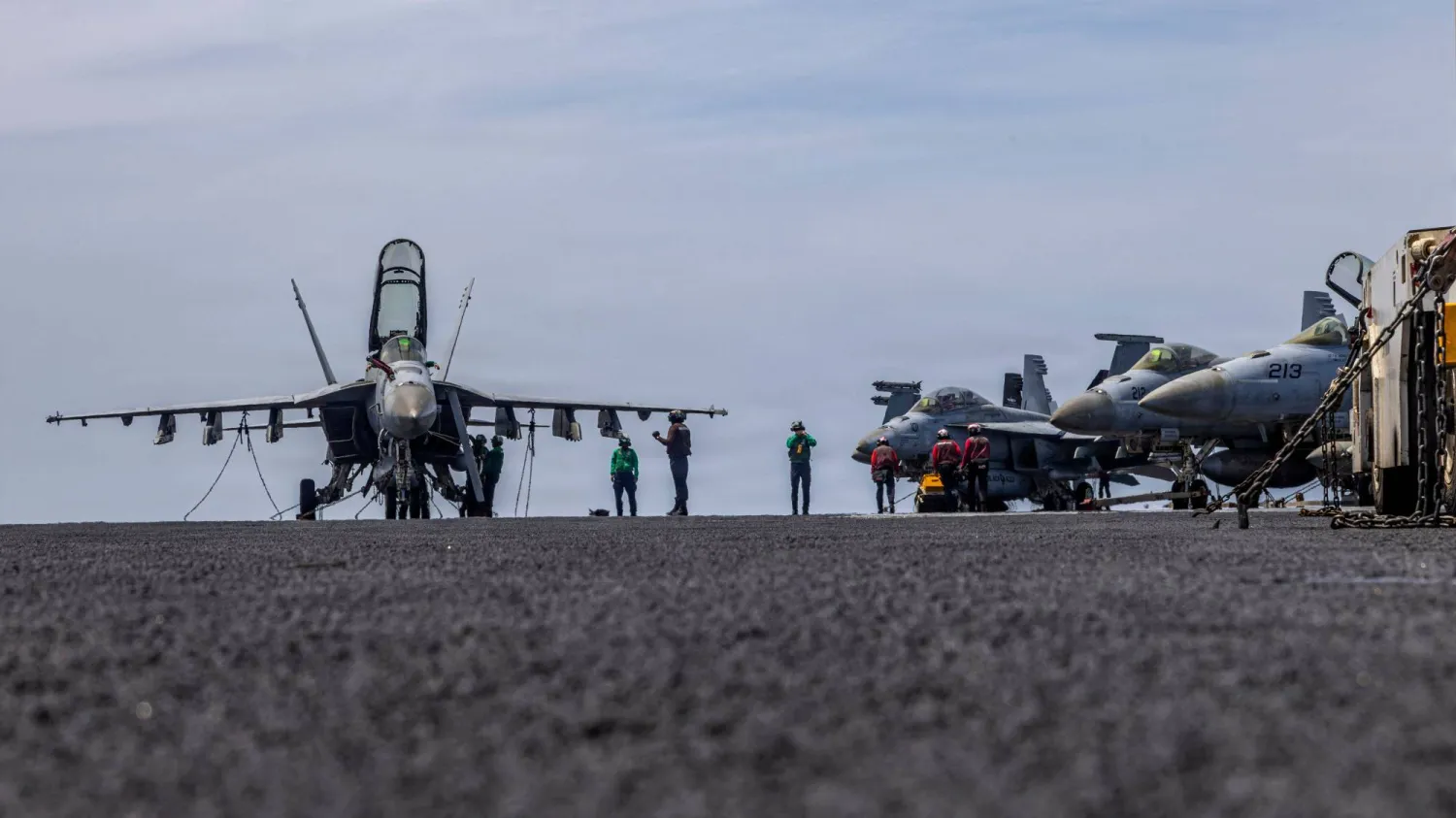
This US Navy handout photo released on May 4, 2026, by US Central Command Public Affairs shows US sailors conducting maintenance on the flight deck of the Nimitz-class aircraft carrier USS Abraham Lincoln (CVN 72) at sea on April 15, 2026. (Photo by US NAVY / AFP)
TT

US and Iran Inch towards Short-term Deal to End Fighting

This US Navy handout photo released on May 4, 2026, by US Central Command Public Affairs shows US sailors conducting maintenance on the flight deck of the Nimitz-class aircraft carrier USS Abraham Lincoln (CVN 72) at sea on April 15, 2026. (Photo by US NAVY / AFP)

The United States and Iran are edging toward a limited, temporary agreement to halt their war, sources and officials said on Thursday, with a draft framework that would stop the fighting but leave the most contentious issues unresolved.

The emerging plan centers on a short-term memorandum rather than a comprehensive peace deal, underscoring deep divisions between the two sides and signaling that any agreement at this stage would be an interim step.

Hopes that even a partial deal could lead to the reopening of the Strait of Hormuz have already moved markets, with global stocks approaching record highs on Thursday and oil prices nursing steep losses on bets that supply disruptions could ease.

Tehran and Washington have scaled back ambitions for a sweeping settlement as differences persist, particularly over Iran's nuclear program — including the fate of its highly enriched uranium stockpiles and how long Tehran would halt nuclear work.

Instead, they are working toward a temporary arrangement aimed at preventing a return to conflict and stabilizing shipping through the strait, the sources and officials said.

"Our priority is that they announce a permanent end to war and the rest of the ‌issues could be thrashed ‌out once they get back to direct talks," a senior Pakistani official involved in mediation between the two sides ‌told ⁠Reuters.

The proposed framework ⁠would unfold in three stages: formally ending the war, resolving the crisis in the Strait of Hormuz and launching a 30-day window for negotiations on a broader agreement, according to the sources and officials.

A Pakistani source and another source briefed on the mediation said a one-page memorandum to formally end the conflict was close, though gaps remain between the sides.

TRUMP OPTIMISTIC, IRAN SCEPTICAL

US President Donald Trump, who has repeatedly played up the prospect of a breakthrough since the war began on February 28 with US-Israeli strikes on Iran, struck an optimistic tone.

"They want to make a deal... it's very possible," he told reporters at the White House on Wednesday, adding later that “it’ll be over quickly.”

The proposal would formally end the conflict in which full-scale warfare was paused by a ceasefire announced on April 7. But it leaves unresolved key US demands that Iran suspend its ⁠nuclear program and reopen the Strait of Hormuz, the sources said.

Israel, which has also been fighting Iran-backed Hezbollah in ‌Lebanon, said on Thursday it had killed a Hezbollah commander in an airstrike on Beirut a day ‌earlier, the first Israeli attack on the Lebanese capital since a ceasefire there was agreed last month.

Hezbollah triggered its latest conflict with Israel by opening fire in support of Iran ‌on March 2. A halt to Israeli strikes in Lebanon is another key Iranian demand in Tehran's negotiations with Washington, and Iranian officials signaled skepticism over the ‌US proposal to end the wider war.

A foreign ministry spokesperson said Tehran would respond in due course, while lawmaker Ebrahim Rezaei described the proposal as "more of an American wish-list than a reality."

Iran's parliament speaker Mohammad Baqer Qalibaf appeared to mock reports that indicated the two sides were close, writing on social media that “Operation Trust Me Bro failed” and portraying the negotiations as US spin following its failure to reopen the strait.

DEAL HOPES DRIVE OIL DOWN, SHARES RISE

Reports of a possible agreement caused global oil prices to shed roughly 11% on Wednesday, ‌with benchmark Brent crude trading at around $98 a barrel on Thursday.

Global share prices also rose and bond yields fell on optimism about an end to a war that has disrupted energy supplies.

"The contents of the US-Iran peace ⁠proposals are thin, but there is an expectation ⁠in the market that further military action will not take place," said Takamasa Ikeda, a senior portfolio manager at GCI Asset Management.

MILITARY, REGIONAL TENSIONS

Trump on Tuesday paused a two-day-old naval mission aimed at reopening the blockaded strait, citing progress in talks.

The US military has kept up its own blockade on Iranian ships in the region. US Central Command said forces fired at an unladen Iranian-flagged oil tanker on Wednesday, disabling the vessel as it attempted to sail toward an Iranian port.

KEY DEMANDS LEFT OUT

The source briefed on the mediation said the US negotiations were being led by Trump's envoy Steve Witkoff and son-in-law Jared Kushner. If both sides agreed on the preliminary deal, that would start the clock on 30 days of detailed negotiations to reach a full agreement.

The sources said the memorandum did not mention several key demands Washington has made in the past, which Iran has rejected, such as the restrictions on Iran's missile program and an end to its support for proxy militias in the Middle East, including Hezbollah.

The sources also made no mention of Iran's existing stockpile of more than 400 kg (900 pounds) of near-weapons-grade uranium — one of Washington's central concerns.



US-Iran Deal May Leave Netanyahu as Biggest Casualty

FILE PHOTO: US President Donald Trump points his finger towards Israeli Prime Minister Benjamin Netanyahu as they shake hands during a press conference after meeting at Trump’s Mar-a-Lago club in Palm Beach, Florida, US, December 29, 2025. REUTERS/Jonathan Ernst/File Photo
TT

US-Iran Deal May Leave Netanyahu as Biggest Casualty

FILE PHOTO: US President Donald Trump points his finger towards Israeli Prime Minister Benjamin Netanyahu as they shake hands during a press conference after meeting at Trump’s Mar-a-Lago club in Palm Beach, Florida, US, December 29, 2025. REUTERS/Jonathan Ernst/File Photo

The biggest casualty of the US-Iran deal may not be Israel's Iran strategy, but the political brand Benjamin Netanyahu spent decades building as the Israeli leader who could uniquely bend Washington to his will on Iran, analysts, former US officials and diplomats say.

Netanyahu shaped his political identity on an audacious assertion: that he alone could keep the US and Israel in strategic lockstep on Iran. Cultivating Republican support, he cast himself as the only Israeli leader capable of influencing successive US presidents and insisted that only sustained military pressure could contain Tehran.

At the height of his power, he was described by diplomats as the "American whisperer" — the Israeli leader who could pick up the phone and ensure Washington’s strategic calculus aligned with that of Israel.

No other Israeli prime minister, they note, addressed Congress as often or built such enduring political capital across the American political system. But analysts say Washington and Tehran's interim pact to end the war that the US and Israel launched in February shows how that narrative has been reversed.

Rather than shaping Washington’s Iran policy, Netanyahu is now forced to accept it, as US President Donald Trump pursues a settlement that increasingly treats Israeli objections as constraints, Reuters reported.

At home, the reckoning is equally stark, said former US official Dennis Ross. Netanyahu is increasingly boxed in between a US president intent on ending the conflict and a domestic base resistant to concessions, particularly in Lebanon, he said.

Withdrawal risks political backlash while escalation risks confrontation with Washington. The war Netanyahu hoped would cement his legacy as the leader who confronted Iran may instead be remembered as the conflict that dismantled a central source ⁠of his power. ⁠Isolated abroad, constrained by his closest ally and vulnerable ahead of an autumn election, he now finds the political asset on which he built his career has become his greatest liability.

At the outset of the war with Iran, Netanyahu promised ultimate victory. He delivered neither the collapse of Iran’s ruling system, nor the defeat of Lebanon's Hezbollah, nor safe return for residents of northern Israel.

“The US-Iran deal is a decisive blow to Netanyahu,” said Aviv Bushinsky, a former Netanyahu adviser. “Not only did he lose the war with Iran, he has also lost Trump as a friend. He is now isolated not only internationally, but locked in a major dispute with Trump,” he said.

Netanyahu's office did not respond to a request for comment. In a press conference this month, the Israeli premier described his relationship with Trump as one between partners who "agree many times and sometimes disagree.”

There had been a systematic campaign to diminish Israel's "huge achievements" against Iran and its proxies, he said.

A White House official said Trump and Netanyahu had a strong relationship and that Israel's ⁠military forces had been "incredible partners" in a war that had "decimated the Iranian regime's military capabilities.”

A State Department official said the United States maintains an “iron-clad” commitment to Israel’s security, stressing that “this is not changing.”

The official added that Israel retains the right to defend itself, particularly against Hezbollah, “a terrorist organization that threatens its citizens and undermines the Lebanese government,” and cannot be expected to withdraw from Lebanon until that threat is addressed.

Normalization and regional integration remain a top priority for the Trump administration, added the official.

The disagreement between the US and Israeli leaders, analysts say, extends beyond personal ties to a growing divergence in goals: Trump seeks to disengage from another Middle East war, while Netanyahu views continued pressure on Iran and its ally Hezbollah as essential to Israel’s security.

Washington has negotiated directly with Tehran, folded Lebanon’s conflict between Israel and Iran-backed Hezbollah into a broader framework, and created mechanisms to manage ceasefire disputes — moves that, according to three regional diplomatic sources, have increasingly sidelined Israel from key decisions.

The country that once viewed Netanyahu as an indispensable interlocutor is now, the regional sources say, treating him as an obstacle to an agreement it is determined to protect.

Trump has publicly rebuked Israel’s military conduct in Lebanon, while Vice President JD Vance has underscored the conditional nature of the relationship, warning Israeli critics of the deal against “attacking the only powerful ally they have left in the world.”

Two Israeli officials familiar with Netanyahu’s thinking said he was not concerned that public remarks by Trump and Vance would translate into meaningful shifts in US policy toward Israel, such as delays ⁠in arms deliveries, even if Israel continues military operations ⁠in Lebanon.

Trump has signaled that he is prepared to override Israeli priorities in pursuit of US interests. In a TV interview this month, he said that if he tells Netanyahu “to do something, he does it.”

Iran will seek to widen the emerging gap between the US and Israel by portraying any Israeli military action in Lebanon as an attempt to sabotage Trump’s diplomacy, forcing the White House to choose between backing its ally or preserving the deal, said Ali Vaez of the International Crisis Group.

What makes Netanyahu’s position so precarious, US analysts say, is the loss of his safety net.

For years, he cultivated Republican backing, using it as a counterweight to offset tensions with Democratic administrations, and openly denouncing former President Barack Obama’s 2015 Iran nuclear deal from a congressional podium. But Republicans will not break with Trump for Netanyahu, they said.


Rubio: US Will Immediately Send Search Teams and Medical and Humanitarian Aid to Venezuela

TOPSHOT - Rescuers search for victims in a collapsed building following an earthquake in Caracas on June 24, 2026. (Photo by Manaure Quintero / AFP)
TT

Rubio: US Will Immediately Send Search Teams and Medical and Humanitarian Aid to Venezuela

TOPSHOT - Rescuers search for victims in a collapsed building following an earthquake in Caracas on June 24, 2026. (Photo by Manaure Quintero / AFP)

Powerful back-to-back earthquakes that struck Venezuela on Wednesday evening killed at least 32 people and injured at least 700, the nation's acting president said, as communities across the South American country sustained damage.

Acting President Delcy Rodríguez warned the toll was expected to rise as rescuers search collapsed buildings and emergency crews reach devastated areas after the 7.2 and 7.5 magnitude earthquakes that struck shortly after 6 p.m, The Associated Press said.

Rodríguez declared a state of emergency in an address to the nation late Wednesday and said the quakes caused damage in several states. The casualty figures released early Thursday excluded the state of La Guaira, which Rodríguez described as a “disaster zone” and the area hardest hit.

“Dozens of buildings have collapsed there, about 30 kilometers (19 miles) north of Caracas, and we are currently carrying out intensive rescue operations to save lives,” she said.

The earthquakes, among the strongest to strike Venezuela in more than a century, roiled the region, with buildings evacuated in cities and areas impacted as far as Brazil’s Amazon about 1,700 kilometers (1,050 miles) from Venezuela's capital Caracas.

The earthquakes damaged and closed Simón Bolívar International Airport near Caracas, the country’s main airport, Rodríguez said, adding that subway and natural gas services in Caracas were canceled. She urged Venezuelans to report any damages through a government app.

Rodríguez said school classes would be canceled for several days. The Ministry of Education said some school buildings would be used as shelters and donation centers.

“We urge our population to remain calm,” said Rodríguez, who asked health care professionals to report to hospitals to assist the injured. “We urge unity.”

Country hit twice by large quakes The US Geological Survey initially said the first earthquake had a magnitude of 7.1, later revising that to 7.2. Its epicenter was west of Morón on the country’s Caribbean coast about 168 kilometers (104 miles) west of Caracas. The quake had a depth of 22 kilometers (13.6 miles).

The USGS reported an even larger 7.5-magnitude earthquake just a minute later. The second quake had a depth of 10 kilometers (6.2 miles) with an epicenter 16 kilometers (10 miles) southwest of Morón.

In the coastal state of Falcon, Gov. Víctor Clark said 32 people had been hospitalized and there were 15 people trapped in the hours after the earthquake.

International assistance offered

Offers of help were made by various governments including the United States, Argentina, Bolivia, Brazil, Chile, Ecuador, El Salvador, Mexico, Panama and Uruguay.

Jeremy P. Lewin, the US undersecretary of state for foreign assistance, said the State Department had mobilized a disaster assistance team and task force to coordinate aid including search-and-rescue teams, medical and humanitarian supplies and other resources in coordination with the interim Venezuelan government.

El Salvador President Nayib Bukele, once diametrically opposed to Venezuela’s government, said in a post on X Wednesday night that he had offered aid.

“We send you all our solidarity and our prayers. Stay strong, Venezuela,” Bukele wrote.

Ecuadorian President Daniel Noboa said he had ordered the immediate delivery of humanitarian aid to help respond to the emergency.

“Ecuador will respond with the speed and commitment this moment demands because, despite our enormous differences, humanity must always guide the actions of a leader,” Noboa wrote.

Bolivian President Rodrigo Paz, who less than a week ago declared a state of emergency in his country following weeks of anti-government protests, said his country stood ready to provide any needed assistance.

The administration of Brazil President Luiz Inácio da Silva expressed solidarity and said no Brazilians reported being injured

‘We all had to leave our houses' Television broadcasts Thursday showed images of rescue workers using power tools on collapsed structures.

During the quakes, people evacuated swaying buildings in Caracas, many visibly shocked as they saw collapsed walls that left furniture visible from the street. Dust columns could be seen in two capital neighborhoods with typically busy restaurants and other businesses.

People remained on the streets for hours, some sitting on the ground hugging pets as dust gathered around them. Collapsed buildings, toppled electric poles and debris blocked streets. Parts of the capital lost power and cellphone signal.

“It started off gently and then gradually grew, and in the end, we all had to leave our houses, go outside and gather together,” Caracas resident Hector Ricci said.

Roberto Gamas, another Caracas resident, said the building he was in “really shook from side to side. Unreal. The force was incredibly strong.”

The lack of cellphone signal in parts of Venezuela deepened the distress of many families, particularly those among the more than 7.7 million people who have left the country during its protracted crisis.

Venezuela opposition leader María Corina Machado, in exile after leaving Venezuela in December, took to X to send prayers and wish strength to Venezuelans.

“May strength, serenity, and solidarity prevail among us in the face of this difficult time,” she said on X.

Impact felt throughout Venezuela Venezuela Interior Minister Diosdado Cabello said the quake could be felt in several states and asked motorists to give way to ambulances and other emergency vehicles.

“We understand that some people may be desperate, but we are acting according to protocols to activate aid and rescue efforts to help those who need it most,” Cabello said, urging people to remain outside as aftershocks could further damage structures. “Be very careful with children and the elderly. Call each other and check that no one has been harmed.”

Earthquakes impact the region Buildings in Manaus, Belem and Macapá in Brazil's Amazon were evacuated, according to reports on TV Globo. The quakes also were felt in Colombia’s Caribbean and northeast regions, but there were no reports of damages or injuries.

The US Pacific Tsunami Warning Center issued several tsumani alerts in the wake of the earthquakes that were quickly lifted.

Strong earthquakes are unusual in Venezuela. While the country sits near multiple fault lines, its position straddling the South American and Caribbean plates make earthquakes much less common than in other parts of Latin America.

Earthquakes are frequent along the Pacific coast, including in Mexico and Chile, which both sit along the seismically active tectonic belt known as the Ring of Fire, an area that the USGS said is responsible for 90% of earthquakes.


US Senate Sides with Trump in Fresh Vote on Iran War Powers

US President Donald J. Trump arrives for a Senate Republican luncheon meeting, at the US Capitol in Washington, DC, USA, 24 June 2026. EPA/GRAEME SLOAN
TT

US Senate Sides with Trump in Fresh Vote on Iran War Powers

US President Donald J. Trump arrives for a Senate Republican luncheon meeting, at the US Capitol in Washington, DC, USA, 24 June 2026. EPA/GRAEME SLOAN

The US Senate rejected a resolution on Wednesday to rein in President Donald Trump's handling of the Iran war -- an apparent U-turn following pressure from the Republican leader.

The move came just one day after the Senate voted 50-48 to pass a resolution calling for an end to the Iran war, delivering a rebuke to the White House as it seeks to negotiate a lasting deal with Tehran, AFP said.

The legislation is seen as largely symbolic and has little chance of curbing executive authority because Trump has the presidential power of veto.

Trump slammed the Tuesday vote as "poorly timed and meaningless," saying that it made his job more difficult.

The president lashed out on Wednesday at Republican lawmakers during a closed-door lunch on Capitol Hill, US media reported.

Hours later, Republican Senators Rand Paul and Bill Cassidy -- who had called for a check on the president's war on Iran -- changed their stance in the late Wednesday vote to align with Trump, CNN reported.

The Wednesday resolution, which was defeated 50-47, did not nullify or change the outcome of Tuesday's vote.

Trump took a more positive view of Wednesday's result, writing on Truth Social that "This vote puts Iran on notice!"

During his lunch with Republicans on Wednesday, Trump "was mad as a murder hornet," Senator John Kennedy told the New York Times.

Other attendees told the newspaper that Trump aired a long list of grievances and complaints.