


North Korea Will Deploy New Artillery Guns Targeting Seoul and Commission Its 1st Destroyer

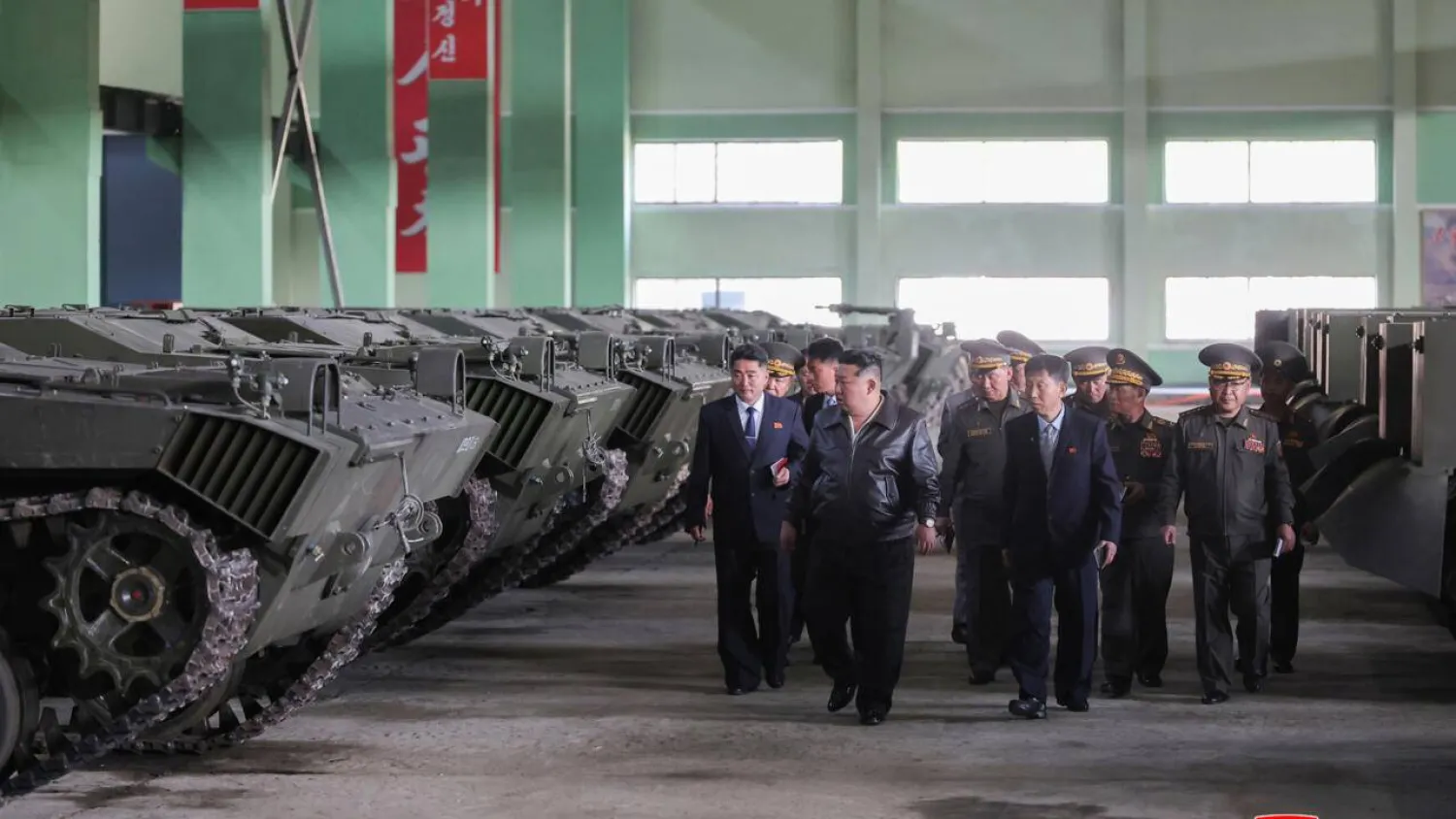
This picture taken on May 6, 2026 and released by North Korea's official Korean Central News Agency (KCNA) via KNS on May 8, 2026 shows North Korean leader Kim Jong Un (C) visiting a munitions factory to inspect the production status of military hardware at an undisclosed location in North Korea. STR / KCNA VIA KNS/AFP
TT

North Korea Will Deploy New Artillery Guns Targeting Seoul and Commission Its 1st Destroyer

This picture taken on May 6, 2026 and released by North Korea's official Korean Central News Agency (KCNA) via KNS on May 8, 2026 shows North Korean leader Kim Jong Un (C) visiting a munitions factory to inspect the production status of military hardware at an undisclosed location in North Korea. STR / KCNA VIA KNS/AFP

North Korea said Friday it will deploy new long-range artillery systems this year that are capable of striking South Korea's capital region and will commission its first naval destroyer in coming weeks.

The announcement comes days after South Korea said North Korea’s newly revised constitution drops all references to Korean unification, in line with leader Kim Jong Un’s vows to terminate ties with South Korea and establish a two-state system on the Korean Peninsula, The Associated Press reported.

Kim visited a munitions factory Wednesday to inspect the production of 155-mm self-propelled gun-howitzers to be deployed at an artillery unit in the southern border area within this year, the North’s official Korean Central News Agency reported.

KCNA cited Kim as saying the striking range of this large-caliber rifled gun is over 60 kilometers (37 miles). He said that “such a rapid extension of striking range and remarkable improvement of striking capability will provide a great change and advantage in the land operations of our army,” according to KCNA.

Kim said various operational and tactical missile systems and powerful multiple rocket launcher systems are also scheduled to be deployed along the border.

North Korea’s artillery systems draw less outside attention than its ballistic missiles whose launches are banned under UN Security Council resolutions. But the country already deploys many artillery guns near the border with South Korea, posing a serious threat to Seoul, the South Korean capital that has 10 million people and is about 40 to 50 kilometers (25 to 30 miles) from the border.

KCNA said Kim on Thursday rode on the destroyer Choe Hyon to review its maneuverability off North Korea’s west coast. Kim ordered authorities to hand over the ship to the navy in mid-June as scheduled, after appreciating all the tests for the destroyer’s operational commissioning progressed smoothly, according to KCNA.

KCNA photos showed Kim’s teenage daughter on the destroyer as well, in the latest public activity with her father. One photo showed her standing behind her father as he spoke to navy sailors, and another showed them eating a meal with the crew on the destroyer. South Korea’s spy service said last month she could be considered Kim’s heir.

The destroyer, which was unveiled with great fanfare last year, is North Korea’s largest and most advanced warship. North Korea later unveiled a second destroyer of the same class, but it was damaged during a botched launching ceremony. Kim has called for building two more destroyers.

Kim’s latest military inspections came after South Korea said Wednesday that the new North Korean constitution dropped previous commitments to peaceful unification with South Korea and redefined its territory only as the northern half the Korean Peninsula.

The changes reflected Kim’s increasingly hard-line stance toward South Korea, which he has declared his country’s permanent and most hostile enemy while diplomacy is stalled and tensions rise over his nuclear ambitions. In January 2024, Kim ordered the rewriting of the constitution to eliminate the idea of shared statehood with South Korea, a step that would break away with his predecessors’ long-cherished dreams of peacefully achieving a unified Korea on the North’s terms.

Kim’s vilification of the South has been a major setback for Seoul’s liberal government, which desires reengagement and has taken preemptive steps to ease tensions, including shutting down propaganda broadcasts along the border.

North Korea has shunned dialogue with South Korea and the US and focused on expanding its nuclear and missile arsenals since Kim’s broader, high-stakes nuclear diplomacy with President Donald Trump collapsed in 2019.



3 Australian Women Back from Syria Face Slavery and Terrorism Charges over Alleged ISIS Links

An Australian woman returning from Syrian refugee camps where they have been staying since the ISIS's demise walks past members of the media as they arrive at the airport in Melbourne on May 7, 2026. (Photo by WILLIAM WEST / AFP)
TT

3 Australian Women Back from Syria Face Slavery and Terrorism Charges over Alleged ISIS Links

An Australian woman returning from Syrian refugee camps where they have been staying since the ISIS's demise walks past members of the media as they arrive at the airport in Melbourne on May 7, 2026. (Photo by WILLIAM WEST / AFP)

Three Australian women were refused bail when they appeared in courts on Friday charged with slavery and terrorism offenses after they arrived home from Syria with another 10 others whom police allege are linked to the ISIS group.

The four women and nine children, who have spent years in Roj camp in the Syrian desert, landed on two Qatar Airways flights from Doha on Thursday despite the Australian government warning they would face charges if they returned.

Kawsar Abbas, 53, and her daughter Zeinab Ahmed, 31, were charged in a Melbourne court in relation to allegations that their family bought a female Yazidi slave for $10,000, police said in a statement.

Their lawyers said they would apply for both women to be released on bail on Monday. Neither woman spoke during their brief court appearance. Bail was formally denied.

Abbas, her husband and children traveled in 2014 to Syria, which was then the center of ISIS’s co-called caliphate, police allege.

Abbas was complicit in buying the slave, who was kept in the family home, police allege.

The mother was charged with four crimes against humanity under Australian law, and the daughter was charged with two slavery crimes. Each charge carries a potential penalty of 25 years in prison.

Both women were detained by Kurdish forces in March 2019 and have been held with other family members at Roj camp since.

The camp in northeast Syria near the Iraq border houses mostly women and children who were displaced from areas that were once controlled by the ISIS group.

Janai Safar, 32, was arrested at Sydney Airport and charged with being a member of a terrorist organization and with entering or remaining in a region controlled by a terrorist organization. Each charge carries a potential maximum sentence of 10 years in prison.

A judge refused to release her on Friday when she applied for bail in a Sydney court where she appeared via video link from a prison.

Her lawyer unsuccessfully argued that exceptional circumstances in her case warranted her release from custody. The lawyer submitted that both Safar and her 9-year-old son were likely both suffering from PTSD and the boy knew no one else in Australia.

Police allege she followed her ISIS-fighter partner to Syria in 2015 and had a child there. The partner reportedly died in 2017. Australia made it illegal to travel to the former Syrian ISIS stronghold of Raqqa without a legitimate reason from 2014 to 2017.

The Australian government has condemned the women for supporting ISIS militants by traveling to Syria and refused to help repatriate them.

Prime Minister Anthony Albanese said Friday he had sympathy for the returned children, but none for the parents who could expect no government support.

“I have absolutely zero sympathy for these people,” Albanese told reporters. “I do have sympathy for the children, who are victims of decisions that their parents have made.”

“It is appropriate that they undergo support: children who've been subject and exposed to all sorts of horrors in those camps,” Albanese added.

Police have been investigating Australians’ potential involvement in atrocities in Syria for more than a decade.

Another 21 Australian women and children remain in Roj camp. Their supporters have told reporters they intend to repatriate them within weeks.

One of those women is banned from returning to Australia by a temporary exclusion order.

Australia can use such orders to prevent high-risk citizens from returning for up to two years.

The orders were created by laws introduced to in 2019 to prevent defeated ISIS fighters from returning to Australia. There are no public reports of an order being issued before.

Such orders can’t be made against children younger than 14. But Australia has ruled out separating children from their mothers.

Australian governments have repatriated Australian women and children from Syrian detention camps on two occasions. Other Australians have returned without government assistance.


20 Hikers Missing after Volcano Erupts in East Indonesia

This screen grab made from UGC footage courtesy of X user @SEACHICKEN_1059 taken on April 11, 2026 and made available on April 13 shows Sakurajima, one of Japan's most active volcanoes, erupting in Japan's Kagoshima Prefecture. (Photo by Handout / COURTESY OF @SEACHICKEN_1059 / AFP)
TT

20 Hikers Missing after Volcano Erupts in East Indonesia

This screen grab made from UGC footage courtesy of X user @SEACHICKEN_1059 taken on April 11, 2026 and made available on April 13 shows Sakurajima, one of Japan's most active volcanoes, erupting in Japan's Kagoshima Prefecture. (Photo by Handout / COURTESY OF @SEACHICKEN_1059 / AFP)

Twenty hikers, nine of them from Singapore, were reported missing Friday after Mount Dukono on Indonesia's eastern Halmahera island erupted, spewing a smoke cloud some 10 kilometers (6.2 miles) into the air, a rescue official told AFP.

"Our team is on its way. It is not yet confirmed if there are injured people. Based on reports, there are about 20 people being searched for," local rescue official Iwan Ramdani said by telephone.

He confirmed the 20 were all hikers, even though the area had been closed to visitors since April 17 after scientists observed an increase in volcanic activity.

Lana Saria, head of the government Geology Agency, said the early-morning eruption was accompanied by a "booming sound" and a thick smoke column rising some 10 km from the summit of Mount Dukono in the North Maluku province.

"The direction of the ash distribution leans northward, so residential areas and Tobelo City need to be vigilant for... volcanic ash rain," she said in a statement.

The smoke could be dangerous for public health, Lana added, and risked disrupting transportation services.

Indonesia, a vast archipelago nation, experiences frequent seismic and volcanic activity due to its position on the Pacific "Ring of Fire" where tectonic plates collide.

Mount Dukono is currently on the third-highest alert level of Indonesia's four-tiered alert system.

Since December, the Center for Volcanology and Geological Hazard Mitigation (PVMBG) has recommended that tourists and climbers do not come within four kilometers of the volcano's Malupang Warirang Crater.


WHO Warns of More Hantavirus Cases in 'Limited' Outbreak

Test tubes labelled "Hantavirus positive" in this illustration taken May 7, 2026. REUTERS/Dado Ruvic/Illustration
TT

WHO Warns of More Hantavirus Cases in 'Limited' Outbreak

Test tubes labelled "Hantavirus positive" in this illustration taken May 7, 2026. REUTERS/Dado Ruvic/Illustration

The World Health Organization said Thursday that more hantavirus cases could emerge after the disease killed three passengers from a cruise ship, but it expected the outbreak to be limited if precautions were taken.

Another sick passenger from the MV Hondius landed in Europe earlier in the day, as the vessel headed to the Spanish Canary Islands and health officials scrambled to map the outbreak of the potentially deadly human-to-human strain, said AFP.

The fate of the Hondius sparked international alarm after three people travelling on it died, though health officials have played down fears of a wider global outbreak from the rat-borne virus, which is less contagious than Covid-19.

A Dutch couple who had travelled around South America before boarding the ship in Ushuaia, Argentina on April 1 were the first fatalities.

Argentine health authorities said Thursday they had not yet been able to establish where the outbreak began.

"With the information provided so far by the countries involved and participating national agencies, it is not possible to confirm the origin of the infection," the health ministry said after a meeting with authorities from all 24 Argentine provinces.

WHO chief Tedros Adhanom Ghebreyesus told journalists in Geneva that five confirmed and three suspected cases had been reported overall, including the three deaths.

"Given the incubation period of the Andes virus, which can be up to six weeks, it's possible that more cases may be reported," he said, referring to the rare strain detected aboard the Hondius, which can be transmitted between humans.

The Leiden University Medical Centre in the Netherlands later announced another patient had tested positive.

But the WHO's emergency alert and response director Abdi Rahman Mahamud said he believed it would be "a limited outbreak" if "public health measures are implemented and solidarity shown across all countries."

People thought or known to have contracted the virus are being treated or isolating in Britain, Germany, the Netherlands, Switzerland and South Africa.

- Rare disease -

Hantavirus is a rare respiratory disease that is usually spread from infected rodents and can cause respiratory and cardiac distress as well as haemorrhagic fevers. There are no vaccines and no known cure.

A passenger is thought to have contracted the virus before boarding the ship in Argentina and infected others on board as it sailed across the Atlantic.

Officials in Argentina said they planned to test rodents in the coastal city of Ushuaia, from where the ship had set sail on April 1.

Three evacuees were whisked away from the ship on Wednesday when it anchored off Cape Verde and a fourth landed in Amsterdam on Thursday, according to the vessel's operator, Netherlands-based Oceanwide Expeditions.

The company said there were no symptomatic individuals on board as the ship sails toward the Spanish island of Tenerife, where it is scheduled to arrive on Sunday.

- First case -

A Dutch man who had boarded in Ushuaia along with his wife died aboard the ship on April 11.

The man's body was taken off the ship on April 24 in Saint Helena, an island in the south Atlantic where 29 other passengers disembarked, the ship's operator said.

It said it was working to trace all passengers and crew who got on or off the ship since March 20.

Tedros said the WHO had informed 12 countries that their nationals disembarked from the cruise ship on Saint Helena.

The Saint Helena government said "more than 95 percent" of the population had no close contact with the ship's passengers or crew, or boarded the vessel, and are currently "at an extremely low risk of infection".

The deceased man's wife, who left the ship to accompany his body to South Africa, died in that country 15 days later after also falling ill, with hantavirus confirmed as the cause on May 4.

The couple had visited Chile and Uruguay as well as Argentina, officials in Buenos Aires said.

Chile's health ministry said the couple were not infected in that country as they travelled there at "a period that does not correspond to the incubation time".

According to the WHO, the incubation period for hantavirus can be up to six weeks.

The Dutch woman flew on a commercial plane from Saint Helena to Johannesburg while she was showing symptoms.

Officials were trying to trace people on that flight, which South African-based carrier Airlink said was carrying 82 passengers and six crew.

A German passenger died on May 2. Her body remains on the ship.