

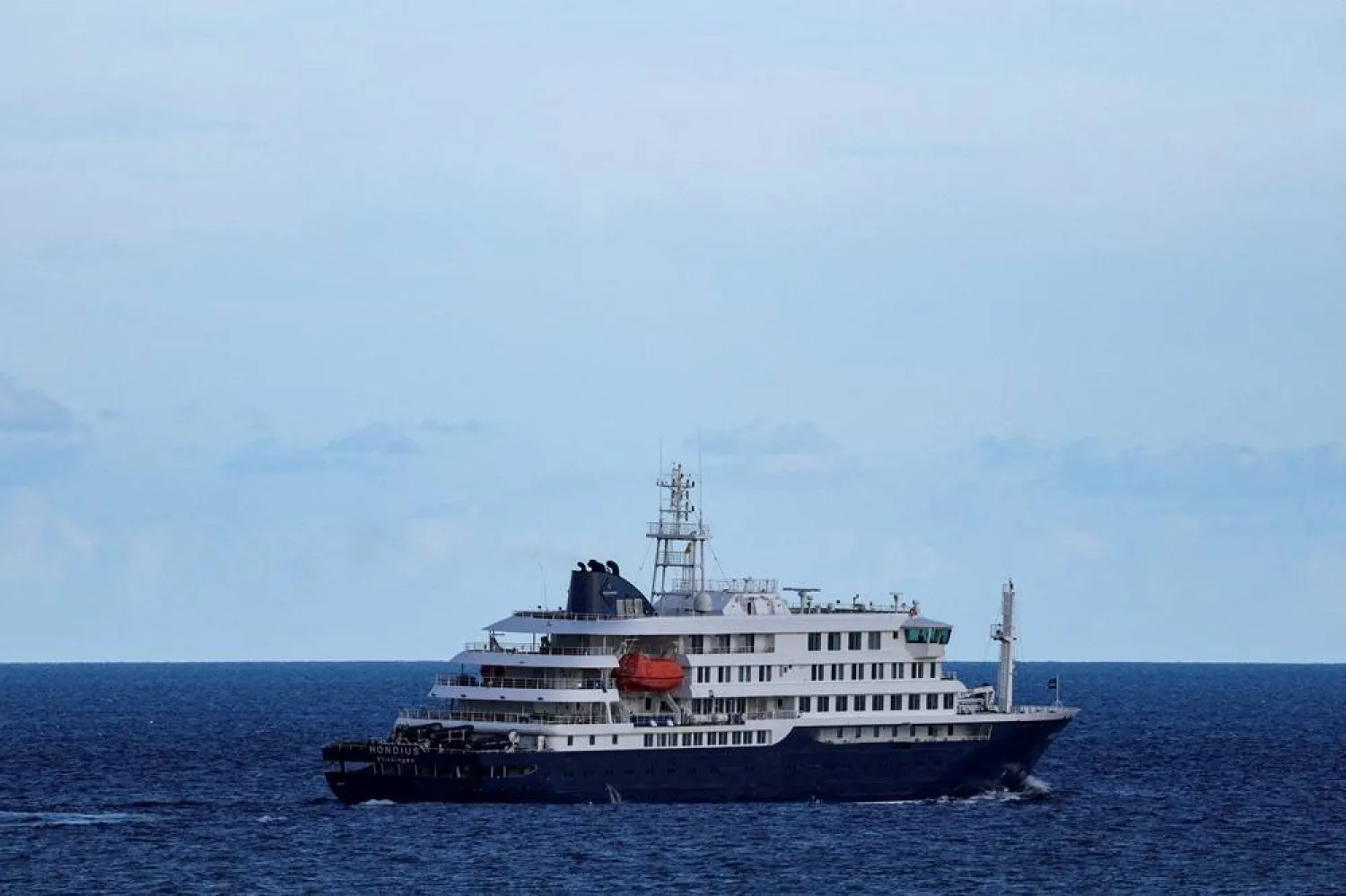

Tests in Italy, Spain Come Back Negative in Global Hunt for Hantavirus

The cruise ship MV Hondius, affected by a hantavirus outbreak, leaves the port of Granadilla de Abona, in Tenerife, Spain, May 11, 2026. (Reuters)
TT

Tests in Italy, Spain Come Back Negative in Global Hunt for Hantavirus

The cruise ship MV Hondius, affected by a hantavirus outbreak, leaves the port of Granadilla de Abona, in Tenerife, Spain, May 11, 2026. (Reuters)

Seventeen people under observation in Italy and Spain for possible hantavirus infection have tested negative, the countries' health ministries said on Wednesday as governments around the globe track the virus to stop it from spreading.

The MV Hondius cruise ship, which had confirmed hantavirus cases on board, is expected to arrive at the Dutch port of Rotterdam on Monday, shipowner Oceanwide Expeditions said, adding that the remaining 25 crew members, along with two medical staff, will follow quarantine procedures set by Dutch authorities upon arrival.

The World Health Organization said on Tuesday more cases were expected from the cluster that broke out on the ‌ship during a polar ‌expedition that departed from Argentina, but it stressed this was nothing like COVID ‌and ⁠was not a ⁠pandemic.

Hantavirus is primarily spread by rodents but can be transmitted between people in rare cases. That requires close contact. Incubation can last about six weeks, and crew, passengers and people in contact with them have been quarantined in several European countries.

QUARANTINE

Three people - a Dutch couple and a German national - have died since the start of the outbreak.

Some European health ministers were to meet on Wednesday afternoon to share information and better coordinate their response to the virus, French Health Minister Stephanie Rist told parliament.

The European Center for Disease Prevention and Control has recommended ⁠quarantine for all asymptomatic passengers from the original cruise ship for six ‌weeks, until June 21/22 depending on when they left the boat.

The ‌WHO has increased its tally of confirmed cases in the outbreak to nine, with an additional two suspected ‌cases: one person who died before being tested, and one on Tristan da Cunha, a remote South ‌Atlantic island where there were no tests available.

So far, all are considered to have been contaminated on the cruise trip or before boarding.

TESTING

In Italy, tests were conducted on an Argentine tourist hospitalized with pneumonia, a man from the southern Italian region of Calabria who was in voluntary isolation, a British tourist located in Milan and a companion travelling ‌with him. Two of them had come into contact with a Dutch woman who later died from the virus.

All tests came back negative, the Italian ⁠health ministry said in a ⁠statement.

"The risk connected with the virus remains very low in Europe and therefore also in Italy," it added.

In Spain, new PCR tests on 13 Spaniards quarantined at a military hospital in Madrid had again yielded negative results, health ministry official Javier Padilla told broadcaster TVE.

The man who had earlier tested positive had suffered some difficulties while breathing overnight, but was now stable.

In France, health minister Rist said she expected on Wednesday the outcome of tests carried out on 22 people for having been in contact with someone with the virus.

The hunt for new cases could drag on for months, since the incubation time for each case was up to about six weeks, Arnaud Fontanet, head of Epidemiology of Emerging Diseases at France's Pasteur Institute, told Reuters on Tuesday.

Still, because it does not transmit easily, his guess was that there would be no more than a few dozen more cases in total.



Iraq’s Top Judge in Damascus to Discuss ISIS Detainees, Judicial Cooperation

Iraq’s Supreme Judicial Council President Judge Faiq Zidan and his accompanying delegation at Tishreen Palace in Damascus, with Syrian Justice Minister Mazhar al-Wais in attendance. (SANA/Justice Ministry)
TT

Iraq’s Top Judge in Damascus to Discuss ISIS Detainees, Judicial Cooperation

Iraq’s Supreme Judicial Council President Judge Faiq Zidan and his accompanying delegation at Tishreen Palace in Damascus, with Syrian Justice Minister Mazhar al-Wais in attendance. (SANA/Justice Ministry)

Syrian Justice Minister Mazhar al-Wais met Faiq Zidan, head of Iraq’s Supreme Judicial Council, in Damascus on Thursday for talks aimed at deepening judicial cooperation, and the fate of Syrian detainees transferred to Iraq high on the agenda.

The Iraqi News Agency (INA) said Zidan arrived in the Syrian capital to discuss several issues of mutual concern, foremost among them ISIS detainees transferred to Iraqi prisons.

Al-Wais and Mohammad Taha al-Ahmad, adviser for Arab affairs at Syria’s Ministry of Foreign Affairs and Expatriates, received Zidan.

Judge Laith Jabr, head of Iraq’s Judicial Supervision Authority, said the visit opened broad prospects for judicial and legal cooperation between the two countries and included talks on detainees transferred from al-Hol camp.

Jabr told INA the Iraqi delegation, headed by Zidan, visited Damascus at the Syrian justice minister’s invitation to discuss a range of shared judicial issues.

He said the talks focused on Syrian detainees handed over to Iraq from al-Hol and their legal status, adding that Iraqi authorities had carried out judicial investigations and provided the detainees with all legal guarantees required under Iraqi law.

The two sides agreed to form joint judicial committees that would meet regularly to resolve issues linked to the detainees’ trials, Jabr said.

The meetings also covered stronger judicial coordination, expanded exchanges of information and expertise, and preparations for future memorandums of understanding between the two countries.

Sources following the visit said Zidan was expected to meet Syrian President Ahmed al-Sharaa and hold separate talks with the justice and foreign ministers and other Syrian officials.

The discussions were expected to cover ISIS members detained in Iraq, transitional justice, anti-corruption efforts and greater transparency.

Informed sources also said Iraq and Syria were close to signing a joint agreement to regulate the transfer and prosecution of Syrian detainees held by Iraqi authorities.

Al-Wais said Syria hoped the progress already made in economic and security relations would help drive closer judicial and legal coordination and strengthen ties between the two countries’ justice institutions.

Syria’s state news agency SANA quoted him as saying Damascus was committed to balanced and positive relations with its neighbors based on mutual respect and shared interests.

He said Syria’s historical ties and mutual interests with Iraq gave both countries stronger reason to expand bilateral cooperation.

Al-Wais said Syria was entering a new phase focused on building a state based on the rule of law and institutions, while strengthening national unity and justice.

He said the Justice Ministry was pursuing a broad judicial reform program to bolster judicial independence and integrity, improve judges’ efficiency, speed up the delivery of justice and simplify procedures for citizens.

Zidan, in turn, pointed to the historic and fraternal ties between Iraq and Syria and said Iraq’s judiciary was seeking new avenues of cooperation to improve judicial work and reinforce the rule of law in both countries.

He called for stronger coordination between justice institutions and greater exchanges of expertise, saying regional stability and justice required close judicial cooperation and partnership.

Iraqi and Syrian sources also said preparations were under way for a possible visit by Iraqi Prime Minister Ali al-Zaidi to Damascus for talks with Syrian President Ahmed al-Sharaa.

Asharq Al-Awsat reported on Sunday, citing sources in Baghdad, that Kurdistan Region President Nechirvan Barzani’s recent visit to Damascus had helped ease mutual concerns in Baghdad and Damascus over bilateral relations and several unresolved political and security issues.

The sources said Barzani carried messages between al-Zaidi and al-Sharaa and helped pave the way for a possible visit by the Iraqi prime minister to Damascus.


Iran Rejects Trump Claims of US Control over Hormuz as 'Lies'

An Iranian woman walks next to an anti-US billboard at the Enghelab square in central Tehran, Iran, 13 August 2026. Tensions between Iran and the US remain high as opposing claims persist over shipping control in the Strait of Hormuz.  EPA/ABEDIN TAHERKENAREH
An Iranian woman walks next to an anti-US billboard at the Enghelab square in central Tehran, Iran, 13 August 2026. Tensions between Iran and the US remain high as opposing claims persist over shipping control in the Strait of Hormuz. EPA/ABEDIN TAHERKENAREH
TT

Iran Rejects Trump Claims of US Control over Hormuz as 'Lies'

An Iranian woman walks next to an anti-US billboard at the Enghelab square in central Tehran, Iran, 13 August 2026. Tensions between Iran and the US remain high as opposing claims persist over shipping control in the Strait of Hormuz.  EPA/ABEDIN TAHERKENAREH
An Iranian woman walks next to an anti-US billboard at the Enghelab square in central Tehran, Iran, 13 August 2026. Tensions between Iran and the US remain high as opposing claims persist over shipping control in the Strait of Hormuz. EPA/ABEDIN TAHERKENAREH

Iran's military on Thursday rejected as "lies" remarks by US President Donald Trump claiming control of the Strait of Hormuz, saying the strategic waterway was fully under Iranian control.

"The false claims of the United States that ships are passing through the Strait of Hormuz normally ... are nothing more than lies and fabrications," said Ebrahim Zolfaghari, the spokesperson for Iran's central military command, Khatam-al Anbiya.

"The Strait of Hormuz is, as in the past, under the complete management and control of the Islamic Republic of Iran, and no commercial ship or tanker without the permission and supervision of the powerful Iranian armed forces has had and will have the possibility of safe passage through this strait," he said in a video carried by state television.

Iran has kept control of Hormuz, a vital energy conduit, since the outbreak of the war in the Middle East on February 28, requiring vessels to obtain permission and pay transit fees before using the waterway.

In a Wednesday Truth Social post, Trump claimed that the US "has total control over the Strait of Hormuz. I THINK WE WILL KEEP IT!"

"Our Naval Blockade is being called, by everyone, 'A WALL OF STEEL,' and there is nothing Iran can do about it," he added.

On Thursday, the head of Iran's Basij forces under the Revolutionary Guards also said that the strait was under Iranian control.

"Today, you see that the Strait of Hormuz is under the management and control of the Islamic republic, and our country continues on its path in complete security," said Hossein Taeb according to state television.

Iran's top diplomat Abbas Araghchi on Thursday said the US makes miscalculations in regard to the waterway.

"The US has long miscalculated due to intelligence failures. Case in point: The war on Iran. Now, an even bigger miscalculation on the Strait of Hormuz," he said on X.

Iranian parliamentarian and member of the national security commission Behnam Saeedi said the strait is closed to US and Israeli ships.

"Ships belonging to the Zionist regime will not have the right to pass through the Strait of Hormuz under any circumstances, whether in war or peacetime," he told state TV, adding that "US military ships will also be barred from passing through the Strait".

Iran and Oman have been in talks to establish a new route through the strait, but negotiations have not yet been finalized.

Tehran, however, says even if the talks produce a new route, that would not on its own open the waterway unless the US meets Iran's demands.


White House Press Secretary Karoline Leavitt Will Leave at the Month’s End

FILE - White House press secretary Karoline Leavitt watches as President Donald Trump speak to reporters while in flight on Air Force One to Joint Base Andrews, Md., Jan. 11, 2026. (AP Photo/Julia Demaree Nikhinson, File)
TT

White House Press Secretary Karoline Leavitt Will Leave at the Month’s End

FILE - White House press secretary Karoline Leavitt watches as President Donald Trump speak to reporters while in flight on Air Force One to Joint Base Andrews, Md., Jan. 11, 2026. (AP Photo/Julia Demaree Nikhinson, File)

White House press secretary Karoline Leavitt will leave the administration at the end of the month to spend more time with her family, President Donald Trump announced Wednesday.

Leavitt, 28, is the youngest person to hold the role. She was a press aide during Trump's first term and has been one of the most visible advocates of his “Make America Great Again” movement. Trump did not outline any plans for who might replace her, The Associated Press said.

Meanwhile, Trump said he slipped away from Air Force One after a trip last month in Türkiye because the Secret Service and military wanted him on a “different plane” due to a threat he insisted did not scare him.

He downplayed the extraordinary nature of the subterfuge involved in his flight, which saw him stow away in an airport catering container to sneak onto another plane while Air Force One was sent into the sky, essentially as a decoy.