


Russia Attacks Ukraine’s Danube Port, Ukraine Launches Drones Towards Moscow

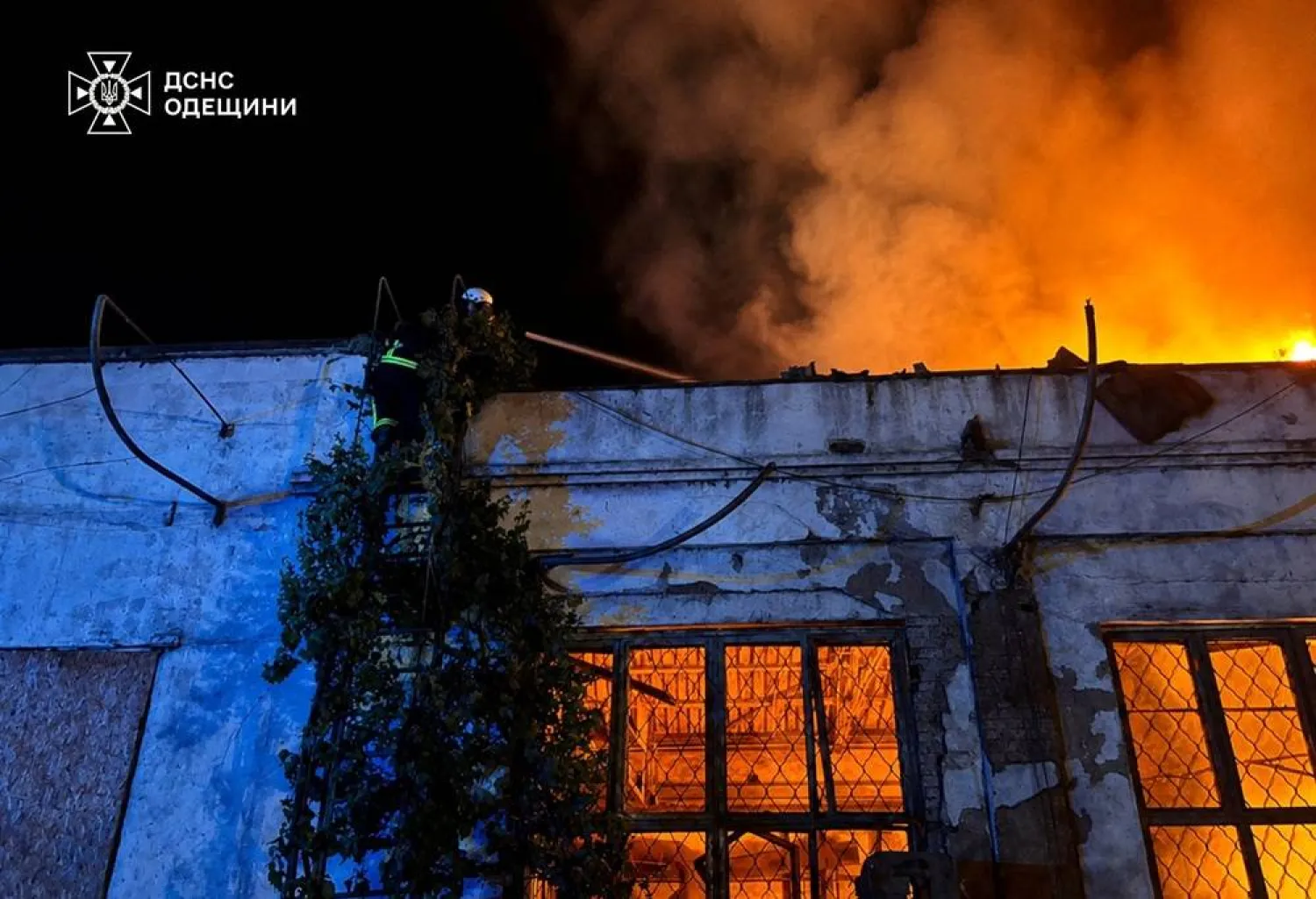
A firefighter works at a compound of a port which was hit during overnight Russian drone strikes in the town of Izmail, amid Russia's attack on Ukraine, in Odesa region, Ukraine, May 19, 2026. (Press service of the State Emergency Service of Ukraine/Handout via Reuters)
TT

Russia Attacks Ukraine’s Danube Port, Ukraine Launches Drones Towards Moscow

A firefighter works at a compound of a port which was hit during overnight Russian drone strikes in the town of Izmail, amid Russia's attack on Ukraine, in Odesa region, Ukraine, May 19, 2026. (Press service of the State Emergency Service of Ukraine/Handout via Reuters)

A Russian air attack damaged port infrastructure in Ukraine's Izmail city in the early hours of Tuesday, while Russian authorities said they had downed four drones launched by Ukraine that were headed towards Moscow.

Izmail, in the southern Odesa region and home to the largest Ukrainian port on the Danube River, is a frequently hit strategic location.

"Port infrastructure facilities in the city of Izmail were damaged," local officials said on Telegram, adding that nearly all aerial attack ‌weapons were destroyed. "Fortunately, ‌there were no casualties or significant destruction."

The Telegram post ‌showed ⁠firemen battling a ⁠fire at a building that had its windows blown out.

Elsewhere in Ukraine, two people were rescued and one person may still be trapped under rubble after a Russian drone attack on the northeastern city of Kharkiv, Mayor Ihor Terekhov said on Telegram.

There also were drone attacks in the regions of Dnipropetrovsk, Mykolaiv and Zaporizhzhia, local authorities said on Telegram.

Peace efforts to end the war that began with Russia's 2022 invasion ⁠of Ukraine have stalled. Each side has accused the other ‌of regular attacks on military, civilian and ‌energy targets. Both sides deny deliberately targeting civilians.

DRONE ATTACKS IN RUSSIA

Moscow Mayor Sergei Sobyanin ‌said on Telegram that four drones heading for the capital had been downed ‌and that emergency services had been deployed, but provided no further details.

The attack comes on the heels of a heavy Ukrainian drone attack on Moscow at the weekend, after which Russia struck the Ukrainian cities of Odesa and Dnipro with missile and drone attacks that ‌damaged residential buildings and injured dozens of people.

In the Russian Kursk region bordering Ukraine, a woman has died and two ⁠people were injured ⁠as a result of a Ukrainian attack on Monday evening, the Kursk operational headquarters said on Telegram.

Russia's southern Rostov region and Yaroslavl, northeast of Moscow, have also come under drone attacks along with a number of other areas in central Russia, regional authorities said on Telegram.

In Yaroslavl, where Russia has oil refining infrastructure, 'an industrial object' was damaged following the drone attack and emergency services were working to extinguish the fire, Governor Mikhail Yevrayev said. He did not name the asset.

Ukraine has sought to deprive Russia of energy revenues. Ukrainian President Volodymyr Zelenskiy wrote on X overnight that over the past few months Russian refining capacity has dropped by 10% and oil wells have been shut.

"(Russian President Vladimir) Putin has, of course, built a war chest - but certainly not enough to fight indefinitely," Zelenskiy said.



Iran Warns of Domestic Gas Shortages from War This Winter

 People walk through the rain near Tehran's traditional main bazaar in Tehran, Iran, Saturday, Nov. 7, 2026. (AP)
People walk through the rain near Tehran's traditional main bazaar in Tehran, Iran, Saturday, Nov. 7, 2026. (AP)
TT

Iran Warns of Domestic Gas Shortages from War This Winter

 People walk through the rain near Tehran's traditional main bazaar in Tehran, Iran, Saturday, Nov. 7, 2026. (AP)
People walk through the rain near Tehran's traditional main bazaar in Tehran, Iran, Saturday, Nov. 7, 2026. (AP)

Iran's government has ‌warned of worsening internal gas shortages this winter as a result of damage to processing facilities in the war with the United States that could lead to cuts in supply.

"If the level of consumption is high it is possible that gas cuts will occur all over the country including in Tehran," government spokesperson Fatemeh Mohajerani said in a news conference in Tehran on Tuesday.

Iran, a major oil producer, controls part of the world's biggest natural gas ‌field but has ‌sometimes faced difficulty meeting domestic demand ‌because ⁠of outdated equipment, worsened by ⁠international sanctions. It is now subject to a US blockade of its ports.

The country faced some gas shortages and power cuts even before the conflict that began with a US and Israeli air campaign on February 28, a situation which has now worsened.

Mohajerani forecast a ⁠shortfall of 430 million cubic meters in gas ‌supply this year, compared ‌to about 300 million cubic meters in previous years.

National Iranian Gas ‌Company managing director Saeed Tavakoli said this month there ‌had been damage to four processing plants during the first phase of the conflict early this year, which initially reduced capacity by 230 million cubic meters, of which around 100 million ‌had so far been restored.

Last week the company warned that 11 of Iran's 31 ⁠provinces could ⁠face supply difficulties this winter, naming Mazandaran on the Caspian coast, and Golestan and North Khorasan along Iran's border with Turkmenistan, as most vulnerable.

Political leaders have urged Iranians to use less gas. Parliament Speaker Mohammad Baqer Qalibaf on Sunday called on Iranians to cut their gas use by 10% ahead of the winter.

Iran's First Vice President Mohammad Reza Aref was cited by state news agency IRNA on Monday as saying gas prices could rise as a result of the reduced supply if consumption was excessive.


Iran Slams US’s ‘Repugnant’ $20Mn Reward for Nuclear Info

Iran's Foreign Minister Abbas Araghchi looks on after a session of the United Nations Conference on Disarmament, on the sideline of a second round of US-Iranian nuclear negotiations in Geneva, on Feb. 17, 2026. (AFP/Getty Images)
TT

Iran Slams US’s ‘Repugnant’ $20Mn Reward for Nuclear Info

Iran's Foreign Minister Abbas Araghchi looks on after a session of the United Nations Conference on Disarmament, on the sideline of a second round of US-Iranian nuclear negotiations in Geneva, on Feb. 17, 2026. (AFP/Getty Images)

Iran hit out at the United States' $20 million reward for information on its nuclear program on Wednesday, calling it "repugnant and regrettable".

Foreign Minister Abbas Araghchi urged the United Nations' atomic energy agency and the Security Council to condemn the reward, which was announced last week.

Last Friday, the US military said up to $20 million and "possible relocation" were available for information about the program's "facilities, equipment, and associated personnel".

"Iran calls upon the UN Secretary-General, the Security Council, and the Director General of the IAEA to condemn this repugnant announcement explicitly and unequivocally," Araghchi wrote in a letter addressed to all three.

He repeated Iran's insistence that its nuclear program is peaceful.

US President Donald Trump has repeatedly said Iran's nuclear program was effectively obliterated by the brief US strikes on key Iranian nuclear facilities during the 12-day war between Iran and Israel in June 2025.

Since that war, Iran has blocked International Atomic Energy Agency inspectors from visiting bombed facilities at Fordow, Natanz and Isfahan.

War broke out between Iran and the United States on February 28 when US-Israeli strikes killed the country’s supreme leader Ali Khamenei.

During the war's most intense phase, US-Israeli strikes hit Iranian nuclear sites again, but the scale of the damage remains unclear.

Diplomatic efforts, led by Qatar and Pakistan, have been underway to negotiate an end to the war.

Tehran has insisted Washington accepts a raft of demands including unfreezing assets and lifting sanctions in return for reopening the Strait of Hormuz, the vital energy conduit it has blockaded since the start of the conflict.

Araghchi previously said that talks over Iran's nuclear program would come at a later stage.

Iran's nuclear program has been at the center of tensions for years. In 2018, during Trump's first term, the US withdrew from an agreement struck under Barack Obama that aimed to stop it developing nuclear weapons in return for sanctions relief.


German Military Bans Chinese-Made Drones

 Chinese-manufactured EHANG-E216 passenger drone taxi flies over the Colombo Port city during its first test flight in Colombo on November 11, 2026. (AFP)
Chinese-manufactured EHANG-E216 passenger drone taxi flies over the Colombo Port city during its first test flight in Colombo on November 11, 2026. (AFP)
TT

German Military Bans Chinese-Made Drones

 Chinese-manufactured EHANG-E216 passenger drone taxi flies over the Colombo Port city during its first test flight in Colombo on November 11, 2026. (AFP)
Chinese-manufactured EHANG-E216 passenger drone taxi flies over the Colombo Port city during its first test flight in Colombo on November 11, 2026. (AFP)

The German military has banned the use of Chinese-made drones, including for training, and is replacing them with European models, the defense ministry said on Wednesday.

Citing the need for data and IT security, the ministry said that "Chinese-made models will no longer be used ... and existing systems will be replaced by products from domestic or, where applicable, European sources".

News magazine Der Spiegel first reported on the decision, based on worries the drones could transmit data on military exercises, training grounds or weapons systems to Chinese intelligence services.

The ministry said the armed forces, the Bundeswehr, had used "inexpensive, off-the-shelf drones for training purposes", buying them "with minimal bureaucratic effort".

"To strengthen the Bundeswehr's self-sufficiency and technological sovereignty, Chinese-made models will no longer be used for target or training purposes," its statement said.