


Lights Out for Cuban Students as Blockade Bites

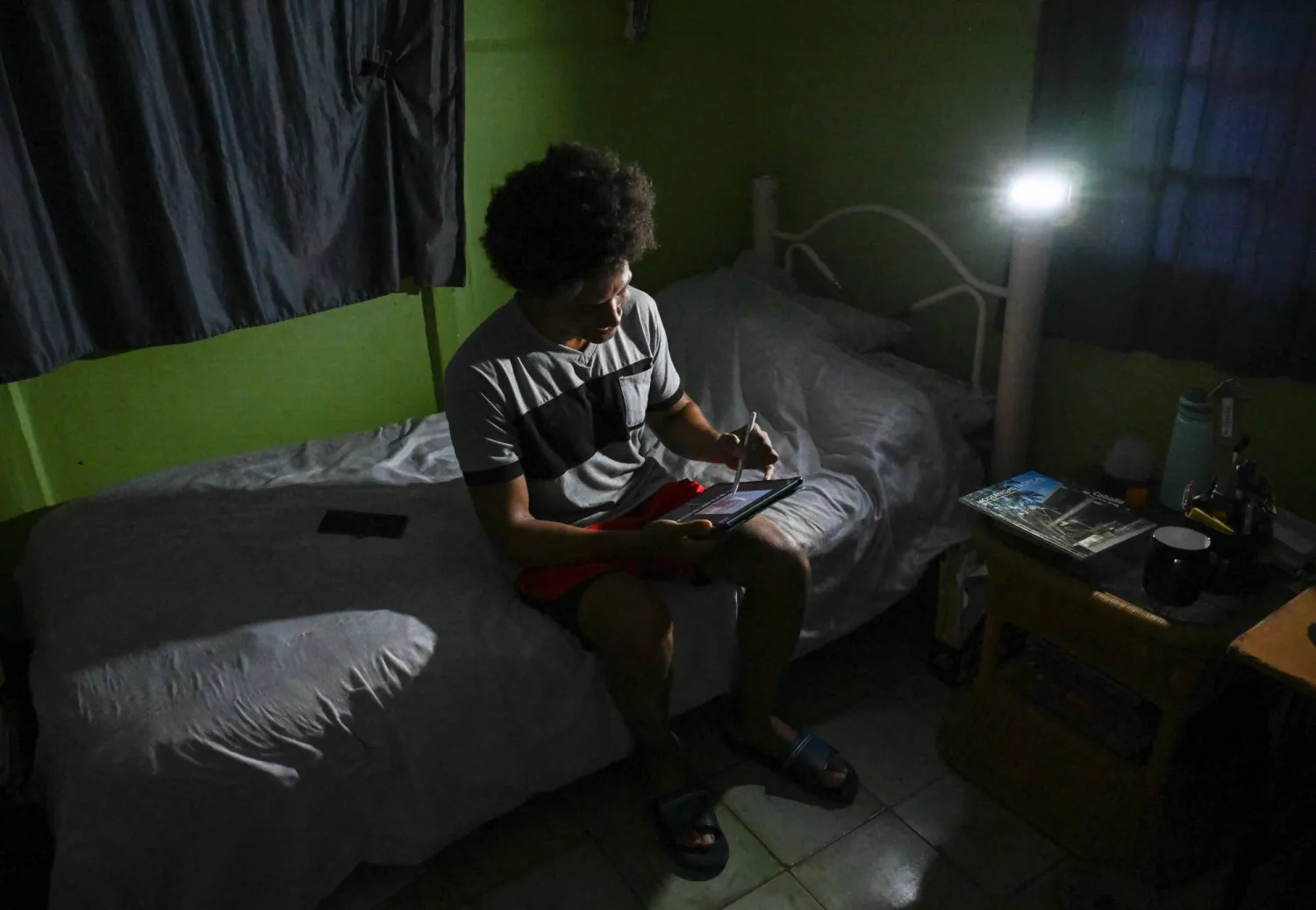
Alfredo Rodriguez, industrial designer and ISDI professor, studies during a power cut in Punta Brava, Havana on May 11, 2026. (AFP)
TT

Lights Out for Cuban Students as Blockade Bites

Alfredo Rodriguez, industrial designer and ISDI professor, studies during a power cut in Punta Brava, Havana on May 11, 2026. (AFP)

It's the middle of the night in Havana, but Alejandro Benitez is just getting down to work.

The power is back on for the first time in 15 hours and Benitez, a fourth-year architecture student, needs to get his assignment in fast before the electricity cuts out again.

Desperate times call for desperate measures in crisis-hit Cuba, where a US fuel blockade -- part of a pressure campaign which Havana fears will culminate in a military intervention -- has aggravated an energy crisis, leaving people without power for up to 20 hours a day.

In February, the government moved university classes online, part of a raft of measures aimed at conserving electricity.

But distance learning has proven challenging in a country with patchy internet and dwindling power supplies.

Students struggle in fields like architecture, which require regular feedback and direction from instructors.

"Having direct contact with the teacher is really important," said 28-year-old Benitez, who has to ask all of his questions via WhatsApp or Telegram.

With only one oil tanker mooring in Cuba in the last four months, the situation is rapidly deteriorating.

The government announced that it had run out of diesel and fuel oil needed to power the generators that supplement the output of its seven dilapidated power plants.

And as public transport grinds to a halt, so too have students' social lives.

Benitez, who cooks over an open charcoal fire, hasn't left his neighborhood of Punta Brava since February.
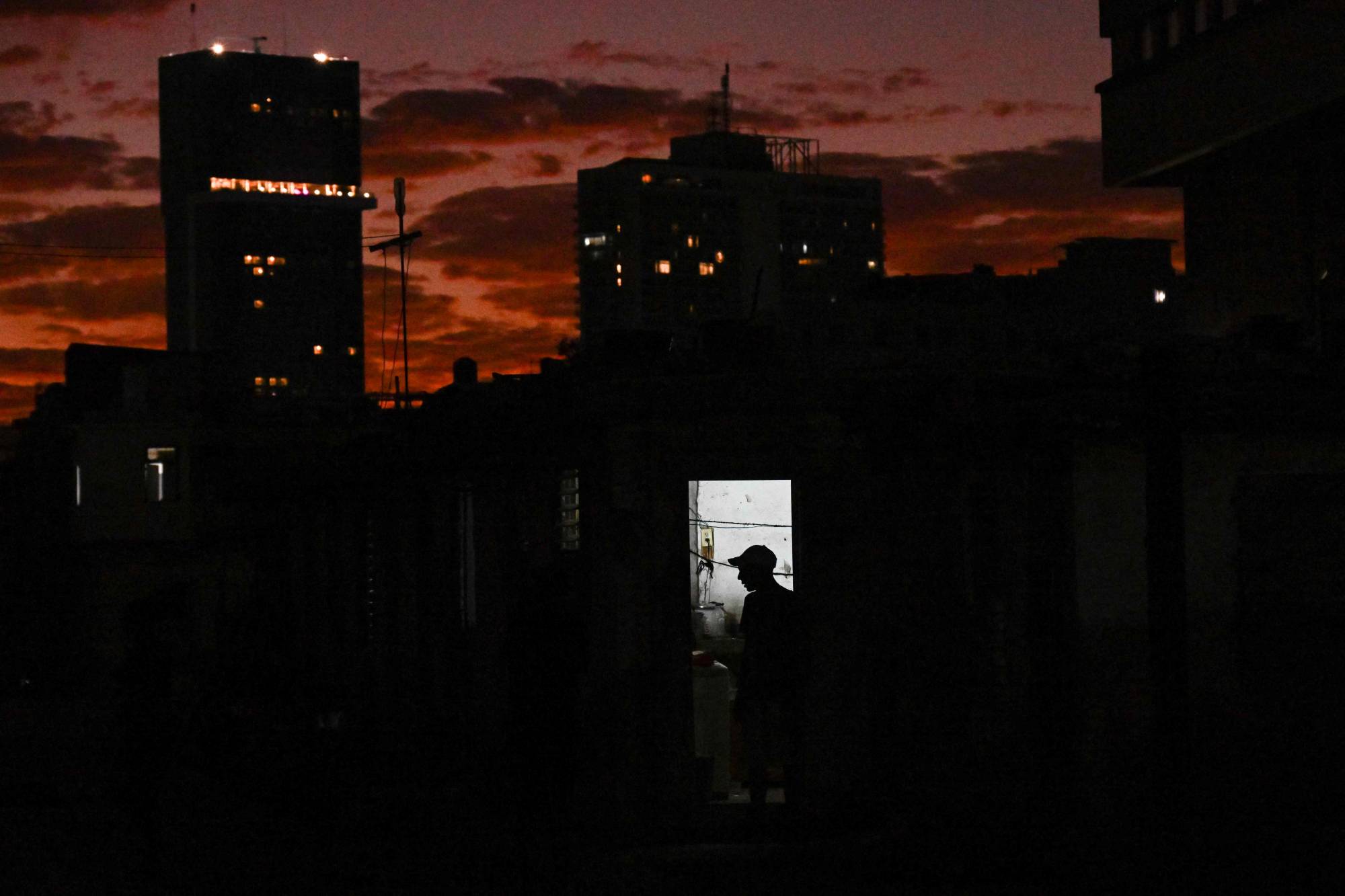
The silhouette of a man is seen at his home during a blackout in Havana on February 21, 2026. (AFP)

- Self-starters required -

Shalia Garcia, a 19-year-old second-year industrial design student, is also struggling to adapt.

Some courses which are central to her degree have been suspended or pared back.

Teachers send around agendas, course material and submission dates for assignments.

Then the responsibility is on the students in a system that requires them to be self-starters.

"This type of teaching puts the onus on the student, which I find hard to manage," Garcia said.

Even the most zealous pupils face multiple hurdles.

The discounted mobile data packages available to students do not have the capacity to download large folders, and it can take time for teachers to respond to questions.

Teachers, too, say they feel hamstrung by the lack of face time with students.

Benitez's partner, Alfredo Rodriguez, a 34-year-old industrial design professor, told AFP there were entire sections of the syllabus that his students "simply have not seen" because they need to be taught in person.

He also has to regularly extend students' deadlines.

"We cannot make the same demands when we know that some students have no electricity or internet connection," he explained.

Garcia's mother, a doctor, worries that her daughter's education is suffering as a result.

"I'm very concerned but I have no choice but to face the situation," Luisa Odalys Destrade said with a sigh.

Benitez, for his part, feels his future is being held hostage by Havana's standoff with Washington.

"What sort of architect will I become?" he wondered.


Türkiye Arrests 110 on Suspicion of ISIS Ties

The arrests came during simultaneous raids across three provinces, centered in Istanbul. (AFP file)
TT

Türkiye Arrests 110 on Suspicion of ISIS Ties

The arrests came during simultaneous raids across three provinces, centered in Istanbul. (AFP file)

Turkish counter-terror police on Tuesday arrested 110 people on suspicion of activities in support of the ISIS group in an operation largely targeting Istanbul, the Anadolu state news agency said.

The suspects are accused of organizing classes in illegal associations, educating young children with ISIS ideology, collecting money for the group and seeking to recruit new ISIS members, in an operation coordinated by the Istanbul chief prosecutor's office.

The arrests came during simultaneous raids across three provinces, centered in Istanbul, with police seizing four rifles and 90 cartridges along with documents and digital materials.

Last week, police arrested another 324 people in raids targeting ISIS suspects across 47 provinces, the interior ministry said.

On April 7, a gunman was killed and two others were wounded in a shootout outside the Israeli consulate in Istanbul.

Interior Minister Mustafa Ciftci said one of them was linked to an "organization that exploits religion", which Turkish media reported was ISIS.

At the end of December, ISIS militants opened fire on police in the northwestern town of Yalova, killing three officers and wounding nine others.

Six ISIS militants were also killed in the hours-long gun battle that followed, with Türkiye rounding up more than 600 suspected members of the group in the following weeks.


WHO Chief Says ‘Deeply Concerned’ by ‘Scale and Speed’ of DR Congo Ebola Outbreak

A motorcycle taxi driver waits for clients in front of the entrance of CBCA Virunga General Hospital, in Goma on May 17, 2026. (AFP)
TT

WHO Chief Says ‘Deeply Concerned’ by ‘Scale and Speed’ of DR Congo Ebola Outbreak

A motorcycle taxi driver waits for clients in front of the entrance of CBCA Virunga General Hospital, in Goma on May 17, 2026. (AFP)

The World Health Organization chief said Tuesday he was "deeply concerned" by an Ebola outbreak raging in the Democratic Republic of Congo which has spilled into Uganda, believed to have killed 131 people. 

"Early on Sunday, I declared a public health emergency of international concern over an epidemic of Ebola disease in the Democratic Republic of the Congo and Uganda," Tedros Adhanom Ghebreyesus told the World Health Assembly in Geneva. 

"I did not do this lightly... I'm deeply concerned about the scale and speed of the epidemic," he said. 

The Africa Centers for Disease Control and Prevention (Africa CDC) declared the outbreak a Continental Public Health Emergency, in a statement late Monday.

The Democratic Republic of Congo has recorded 131 deaths from 513 suspected cases of Ebola, and there has been one death in neighboring Uganda.

Declaring a continental emergency empowers the Africa CDC, based in Ethiopia, to mobilize extra resources including emergency response teams and surveillance operations.

"Africa CDC expresses deep concern about the high risk of regional spread due to intense cross-border population movements, mobility related to mining activities, insecurity in affected areas, weak infection prevention and control measures... and the proximity of affected areas to Rwanda and South Sudan," it said.

The agency said it was working closely with the WHO to strengthen coordination, as developed in response to recent mpox and cholera outbreaks.

"This outbreak is occurring in one of the continent's most complex operational environments, marked by insecurity, population mobility, fragile health systems, and the limited availability of medical countermeasures for Bundibugyo strain Ebola virus disease," said Africa CDC head Jean Kaseya.


US Court Accuses Former Venezuelan Industry Minister of Money Laundering for Maduro

FILE PHOTO: Venezuelan President Nicolas Maduro embraces Alex Saab, who was facing US bribery charges, after he was released by the US government, at the Miraflores Palace, in Caracas, Venezuela, December 20, 2023. REUTERS/Leonardo Fernandez Viloria/File Photo
TT

US Court Accuses Former Venezuelan Industry Minister of Money Laundering for Maduro

FILE PHOTO: Venezuelan President Nicolas Maduro embraces Alex Saab, who was facing US bribery charges, after he was released by the US government, at the Miraflores Palace, in Caracas, Venezuela, December 20, 2023. REUTERS/Leonardo Fernandez Viloria/File Photo

Venezuela's former minister of industry appeared in a US court Monday to face money laundering charges under accusations of being a front man for deposed president Nicolas Maduro.

Alex Saab, a 54-year-old Colombia-born businessman and close ally of Maduro's, appeared in US federal court in Miami where he was indicted on charges he oversaw a network that exploited a subsidized food aid program for Venezuela known as CLAP.

"Alex Saab allegedly used American banks to launder hundreds of millions of dollars stolen from a Venezuelan food program meant for the poor and proceeds from the illegal sale of Venezuelan oil," US Assistant Attorney General A. Tysen Duva said in a statement.

Saab, who was expelled from Venezuela on Saturday, had originally become involved with politics in the South American country during the final years of leftist firebrand Hugo Chavez's 1999-2013 presidency, said AFP.

Under Maduro, he was accused of acting as front man and money launderer, and in return was granted Venezuelan citizenship and a diplomatic passport.

First hit by US sanctions in 2019, Saab had been arrested in Cape Verde in 2020 and extradited to the United States the following year, but he was released in 2023 as part of a negotiated prisoner exchange with Venezuela.

Maduro appointed Saab to be his minister of industry in 2024, but shortly after US forces Maduro in a deadly Caracas raid earlier this year, interim president Delcy Rodriguez dismissed him from all his posts.
