
Xi, Putin Highlight Their Friendship and Cooperation on Energy and Other Issues in Beijing Visit

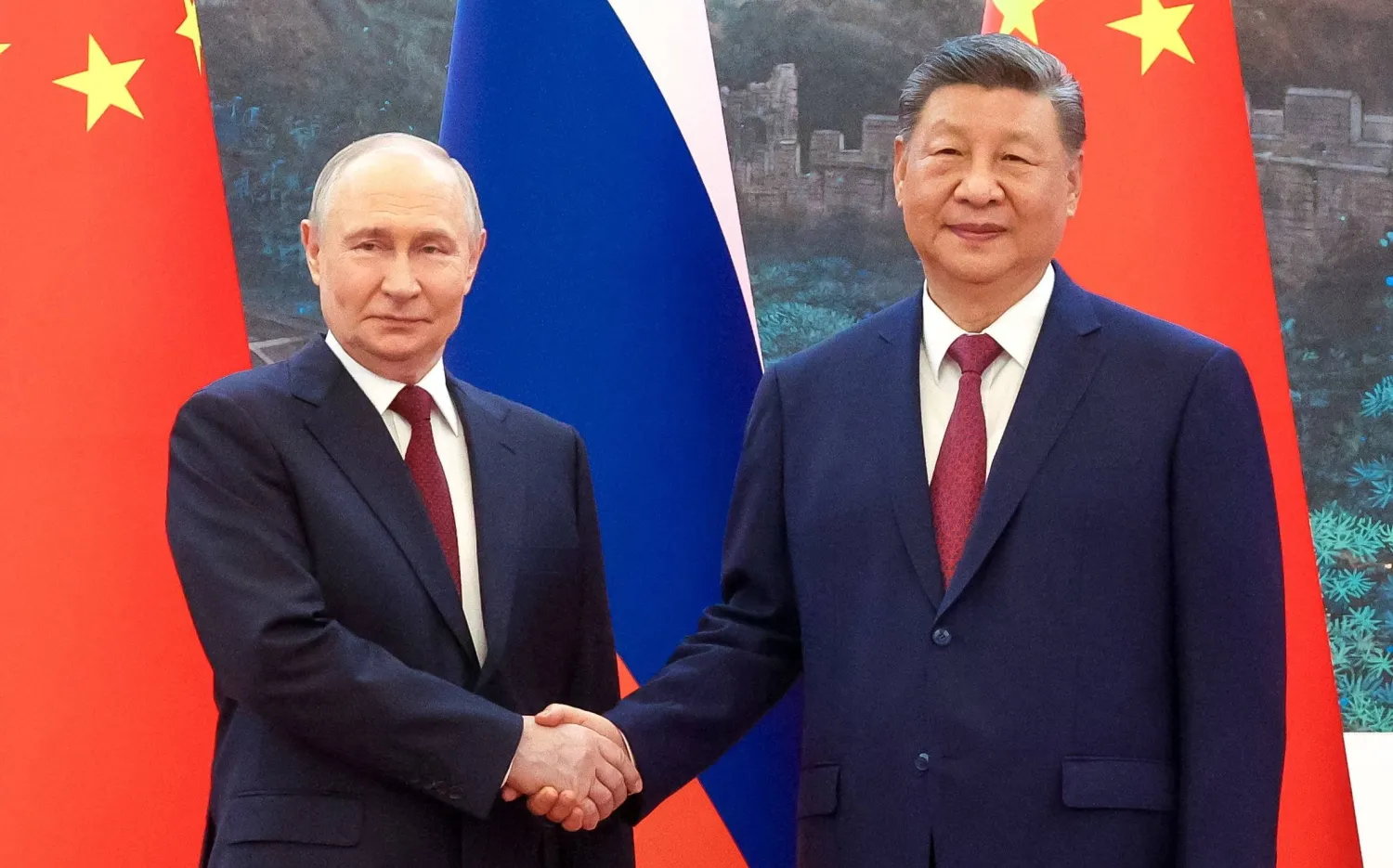
 Russian President Vladimir Putin and Chinese President Xi Jinping pose for a picture during a meeting at the Great Hall of the People in Beijing, China May 20, 2026. (Sputnik/Maxim Stulov/Pool via Reuters)
Russian President Vladimir Putin and Chinese President Xi Jinping pose for a picture during a meeting at the Great Hall of the People in Beijing, China May 20, 2026. (Sputnik/Maxim Stulov/Pool via Reuters)
TT

Xi, Putin Highlight Their Friendship and Cooperation on Energy and Other Issues in Beijing Visit

 Russian President Vladimir Putin and Chinese President Xi Jinping pose for a picture during a meeting at the Great Hall of the People in Beijing, China May 20, 2026. (Sputnik/Maxim Stulov/Pool via Reuters)
Russian President Vladimir Putin and Chinese President Xi Jinping pose for a picture during a meeting at the Great Hall of the People in Beijing, China May 20, 2026. (Sputnik/Maxim Stulov/Pool via Reuters)

Russian President Vladimir Putin praised his close ties with Chinese leader Xi Jinping and said their countries are partners in trade and international affairs as they opened bilateral talks Wednesday on his trip to Beijing. 

Xi welcomed Putin with a ceremony at the Great Hall of the People only days after meeting with US President Donald Trump. The quick succession of Trump’s and Putin’s visits highlighted Beijing’s growing role as an international superpower, experts say. 

Putin greeted Xi warmly as they met for bilateral talks at the Great Hall of the People. 

“My dear friend,” Putin said. “We are truly delighted to see you. We keep in constant touch, both personally and through our aides in the government.” 

Xi also stressed the “political mutual trust and strategic cooperation” between the countries, according to Chinese state media. The two leaders have praised each other profusely in the past, with Xi at one point describing Putin as his “best and most intimate friend.” 

Energy purchases top meeting’s agenda  

Xi and Putin were set to focus on energy and security as well as their overall ties. The two sides agreed to extend a friendship treaty first signed in 2001, Chinese state media reported. 

China became Russia’s top trading partner after Moscow’s full-scale invasion of Ukraine in 2022. Beijing has said it is neutral in the conflict while maintaining trade ties with the Kremlin despite economic and financial sanctions by the US and Europe. 

China is the top customer for Russian oil and gas supplies, and Moscow expects the war in Iran to increase the demand. 

In his meeting with Xi, Putin stressed their countries’ economic ties. 

“The driving force behind economic cooperation is Russian-Chinese collaboration in the energy sector,” Putin said. “Amid the crisis in the Middle East, Russia continues to maintain its role as a reliable supplier of resources, while China remains a responsible consumer of these resources.” 

Xi stressed the need of “complete cessation of hostilities” in the Middle East, according to Chinese state media. 

“An early end to the conflict will help reduce disruptions to energy supply stability, the smooth flow of industrial and supply chains, and international trade order,” Xi said. 

A Russian presidential aide said earlier Russia’s oil exports to China grew by 35% in the first quarter of 2026 and that Russia is one of the biggest exporters of natural gas to China. 

United front on international affairs  

Putin also stressed China and Russia’s cooperation in foreign policy as “one of the key stabilizing factors on the international stage.” 

“In the current tense situation on the international stage, our close cooperation is particularly in demand,” he said. 

In February 2022, just weeks before Russia’s invasion of Ukraine, China and Russia announced a “no limits” partnership during a trip by Putin to Beijing. 

Beijing says it is neutral in the conflict, though in practice it supports Moscow through frequent state visits, growing trade and joint military drills. China has also ignored demands from the West to stop providing high-tech components for Russia’s weapons industries. 

Cooperation agreements 

The two leaders are scheduled to sign cooperation agreements during Putin’s two-day visit. 

But regardless of specific deals, the primary purpose of the visit is to reaffirm the countries’ ties as well as project Beijing’s image as an influential superpower, experts say. 

“The optics matter,” said Steve Tsang, director of the SOAS China Institute at the University of London. 

“The message is clearly one that China maintains friendship and strategic partnership with whichever power it likes, and the US is just one of them.” 

Putin and Xi both need to use their close ties in order to prop up their images at home, said Willy Lam, a senior China fellow at the Jamestown Foundation. 

Putin “needs to tell his countrymen and the world that Russia has China’s support in terms of buying its oil and gas and other tangible and intangible financial support,” Lam said. 

Meanwhile, for Xi, having both Trump and Putin visit in such close succession is a major source of credit with the country’s top Communist leadership. 

Putin noted earlier this month that Moscow and Beijing have reached “a very substantial step forward in our cooperation in the oil and gas sector.” 

“Practically all the key issues have been agreed upon,” he said. “If we succeed in finalizing these details and bringing them to a conclusion during this visit, I will be extremely pleased.” 

Putin also praised their bilateral relationship as a crucial, balancing force in international relations. 

“Interaction between such nations as China and Russia undoubtedly serves as a factor of deterrence and stability,” he said. 

Moscow welcomes China’s dialogue with the US as another stabilizing element for the global economy, Putin added. 

“We stand only to benefit from this, from the stability and constructive engagement between the US and China,” he said. 


Iran Maritime Body Says Hormuz Completely Closed 'Until Further Notice'

Vessels are anchored in the Strait of Hormuz, as seen from Musandam, Oman, June 10, 2026. REUTERS/Stringer
TT

Iran Maritime Body Says Hormuz Completely Closed 'Until Further Notice'

Vessels are anchored in the Strait of Hormuz, as seen from Musandam, Oman, June 10, 2026. REUTERS/Stringer

Iran's new body overseeing the Strait of Hormuz on Thursday confirmed a complete closure order for the strategic waterway until further notice, after the Revolutionary Guards announced the move overnight.

"Due to the tensions caused by the aggression of the American forces in the region and the announcement made last night by the Iranian armed forces, the Strait of Hormuz will be closed until further notice," PGSA said in a post on X .

"Applicants who have been granted a transit permit are asked to be patient and wait for instructions from the PGSA."


A Mass Funeral is Held for 22 Pakistani Soldiers Who Died in a Helicopter Crash in Kashmir

Smoke billows after an army MI-17 helicopter crashed due to a technical fault, in Muzaffarabad, capital of Pakistan-administered Kashmir, Wednesday, June 10, 2026. (AP Photo/M.D. Mughal)
TT

A Mass Funeral is Held for 22 Pakistani Soldiers Who Died in a Helicopter Crash in Kashmir

Smoke billows after an army MI-17 helicopter crashed due to a technical fault, in Muzaffarabad, capital of Pakistan-administered Kashmir, Wednesday, June 10, 2026. (AP Photo/M.D. Mughal)

Rescuers recovered the remains of all 22 soldiers aboard a military helicopter that crashed in Pakistan-administered Kashmir the previous day, officials said Thursday, confirming there were no survivors, as senior government and military officials attended a mass funeral for the victims.

The helicopter crashed Wednesday in Muzaffarabad, the regional capital, apparently because of a technical fault, according to Pakistan’s military. An investigation is underway to determine the exact cause.

An Associated Press reporter counted 22 coffins draped in Pakistan’s national flag at a funeral ceremony.

Witnesses and regional officials said the remains of the soldiers were recovered from the badly burned wreckage. The dead included a colonel and two army majors, according to two security officials who spoke on condition of anonymity because they were not authorized to speak publicly.

Among those attending the funerals was regional Prime Minister Faisal Mumtaz Rathore.

According to the officials, the soldiers had been traveling to carry out security duties after a call for a march on Muzaffarabad by the Joint Awami Action Committee, a recently banned alliance of various groups.

Authorities have not indicated any connection between the planned protest and the crash.

Pakistan has deployed additional security forces across the region, where tensions have been high since the weekend after members of an outlawed group attacked police and security personnel, killing four officers.

Military helicopter crashes are not uncommon in Pakistan.

In September, an army helicopter on a routine flight crashed in northern Pakistan, killing two pilots and three technicians.


Taiwan Says Chinese Ships Entered Waters of Disputed South China Sea Island

A Taiwan Coast Guard boat patrols, as seen from a boat with Chinese tourists, to observe Taiwan's Kinmen Islands, off Xiamen, in China's southeastern Fujian province on May 25, 2026. (Photo by Hector RETAMAL / AFP)
TT

Taiwan Says Chinese Ships Entered Waters of Disputed South China Sea Island

A Taiwan Coast Guard boat patrols, as seen from a boat with Chinese tourists, to observe Taiwan's Kinmen Islands, off Xiamen, in China's southeastern Fujian province on May 25, 2026. (Photo by Hector RETAMAL / AFP)

Taiwan said Chinese ships entered the "prohibited" waters off a disputed island in the South China Sea for the first time on Thursday, condemning escalating "harassment" by Beijing.

The two Chinese vessels "openly intruded" into the waters around the Taiwan-controlled Taiping Island and stayed for 15 minutes before the Taiwanese coast guard expelled them, the force said in a statement.

The island, also known as Itu Aba, is the largest in the Spratly archipelago claimed by Taiwan, China, the Philippines and Vietnam, said AFP.

The Taiwanese coast guard expressed its "strongest condemnation of this incident", saying it "once again maliciously escalates grey-zone harassment in an attempt to create a false impression of jurisdiction".

China claims Taiwan is part of its territory and in recent years has ramped up military pressure on the island democracy.

Beijing also claims most of the South China Sea.

Taiping's "prohibited" waters extend four kilometers (2.5 miles) from shore, Taiwan's coast guard said.

"China is systematically harassing Taiwan," the Ocean Affairs Council, which is responsible for the coast guard, said on X.

The latest in a series of Chinese activities in waters around Taiwan and islands under its control follows an operation to Taiwan's east, which Beijing said was in response to talks between Japan and the Philippines to draw a maritime boundary there.

The Ocean Affairs Council said Thursday's incident "also proves that what China did in the waters east of Taiwan should be dealt with as a challenge to international order; Japan-Philippines talks were just an excuse."

China called the Japan-Philippines talks "illegal" and has claimed exclusive control over the affected waters.

Taiwan has branded the Chinese operation in recent days as "provocative" and "expansionism in disguise".

Taipei has also accused the Chinese ships of "harassment" after they requested information from three passing commercial cargo ships, including their port of destination.

Meanwhile, Taiwan's coast guard said Saturday that a Chinese survey vessel had joined a coast guard ship in waters around Pratas Island in the northern part of the South China Sea.

It was "the first observed instance of Chinese coast guard and survey vessels acting in coordination to provoke Taiwan", the coast guard said.

Taiwan controls Pratas but Beijing also claims the island, along with most of the strategic waterway.