

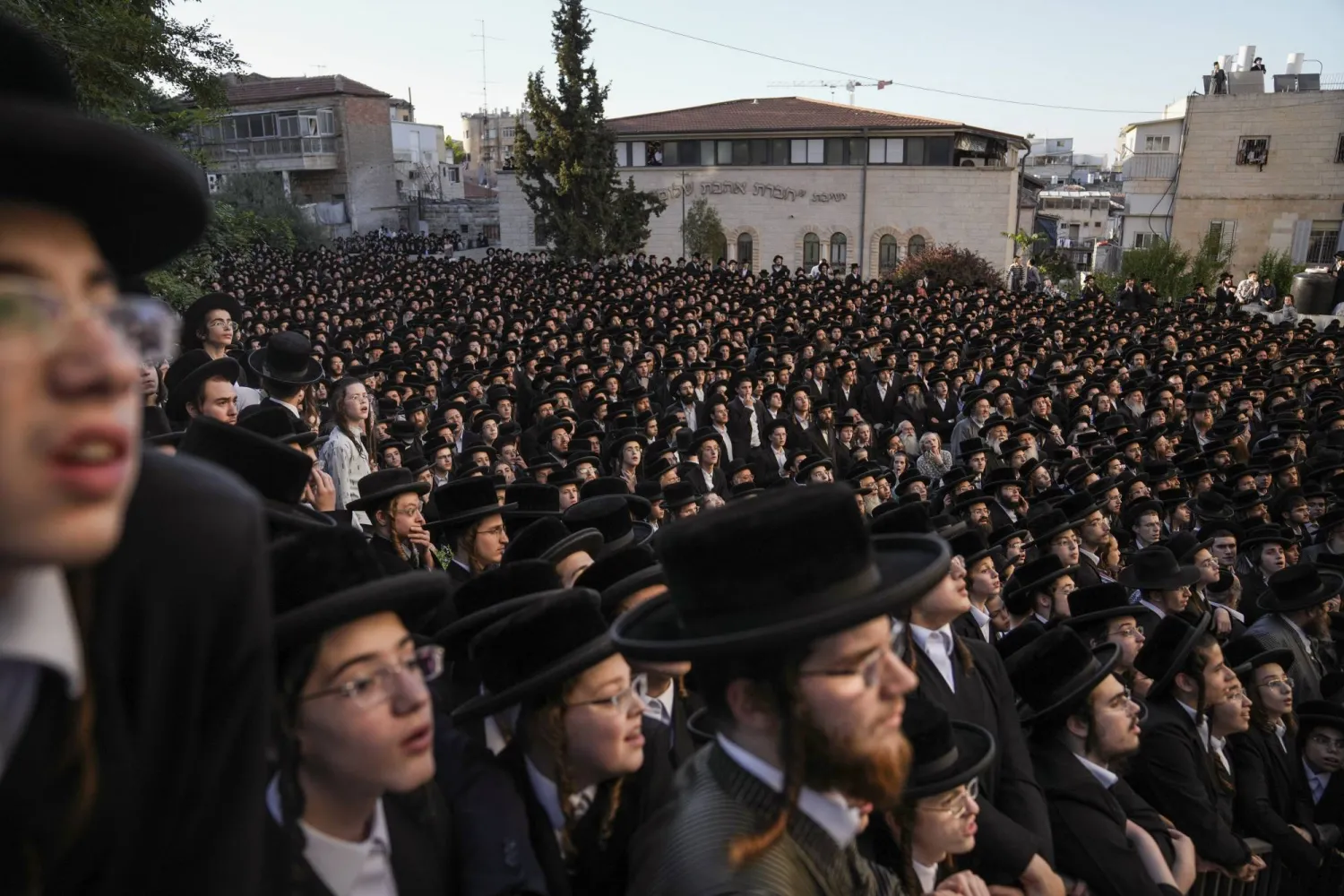

Netanyahu's Coalition Alliances with Religious Parties Put His Reelection at Risk

Ultra-Orthodox Jewish men attend a rally against Army recruitment in Jerusalem, June 30, 2024. (AP Photo/Mahmoud Illean)
TT

Netanyahu's Coalition Alliances with Religious Parties Put His Reelection at Risk

Ultra-Orthodox Jewish men attend a rally against Army recruitment in Jerusalem, June 30, 2024. (AP Photo/Mahmoud Illean)

Israeli Prime Minister Benjamin Netanyahu has remained in power for most of the past 17 years due in part to a tight alliance with ultra-Orthodox religious parties.

But that alliance is tearing apart his governing coalition and proving to be another major liability for the long-serving Israeli leader as the country heads to elections later this year. The Oct. 7, 2023, attack — and the inconclusive wars that have followed — are also weighing on him.

After 2 1/2 years of active fighting in multiple countries, much of it involving reservists, many Israelis are tired of a longstanding system that has allowed ultra-Orthodox men to skip military service. That anger has spread to Netanyahu’s own base, The Associated Press said.

The ultra-Orthodox are meanwhile furious at his failure to legalize their exemptions. They withdrew their support for the coalition two weeks ago, leading to an initial vote to dissolve parliament, known as the Knesset, on Wednesday.

That set in motion a process that could move elections up from October to September.

Here’s a closer look.

The clock is ticking Netanyahu is still trying to pass a bill that would legalize the exemptions and fulfill a promise to his religious partners, but that appears to be a long shot given the strident opposition of many within his own coalition.

Deputy Foreign Minister Sharren Haskel, who served for three years in a combat unit and is a vocal supporter of Netanyahu, said she was among at least seven members of the coalition who will not support the draft bill, rendering it impassable.

“The ultra-Orthodox are trying to extort us. It’s immoral. It’s not fair,” said Haskel, who wore her military uniform at the dissolution vote on Wednesday to highlight her opposition and highlight her own service.

Two major ultra-Orthodox parties deserted Netanyahu earlier this month after he told them he did not expect to be able to pass the exemptions bill. That left his coalition without a parliamentary majority, and is one of the main reasons for the bill to dissolve the Knesset.

“He made a promise to his most loyal allies in the coalition, and he could not deliver, he kept postponing,” said Shmuel Rosner, a senior fellow at the Jewish People Policy Institute, a Jerusalem think tank.

Yitzhak Pindrus, a lawmaker from one of the factions, told The Associated Press on Tuesday that it has no plans to return to the coalition.

“We need the draft bill,” he said.

The ultra-Orthodox can make or break Netanyahu's coalition Israel's political landscape is highly fragmented, and no one party has ever won a majority in the 120-member Knesset.

Instead, parties must build alliances to cobble together a majority, which often involves bargaining that gives smaller parties outsized influence.

The ultra-Orthodox currently have 18 seats in the Knesset, a similar number to previous years, but have long been indispensable to Netanyahu. In exchange for his support for government subsidies and the draft exemptions, they have stood by him through regional crises and longstanding corruption allegations.

Netanyahu has long relied on “automatic support” from the ultra-Orthodox, said Gilad Malach, an expert on the ultra-Orthodox at the Israel Democracy Institute, a research group in Jerusalem.

That support helped Netanyahu remain in power through the worst attack in Israel’s history.

The coalition, which also includes ultra-nationalist parties, “was much more stable than I ever imagined,” said Rosner. “Maybe it's because they realized in a new election, they're going to get defeated, and that's why they stuck together.”

Imploding the coalition from within If Netanyahu somehow passes some form of the draft exemption bill, it could dramatically alter the electoral map. It would push large sectors of the population, who have previously supported Netanyahu but are buckling under hundreds of days of reserve duty, to vote for rival parties that promise equal service, Malach said.

Netanyahu appears to stand little chance of remaining prime minister after October's elections without ultra-Orthodox support. And he is probably their only hope of a bill that would avoid mandatory enlistment coming up for discussion in the next government.

But sticking with the ultra-Orthodox risks harming Netanyahu's standing with the broader public, leaving him in a bind as the country heads toward elections.

Why the ultra-Orthodox reject military service Most Jewish men are required to serve nearly three years of military service, followed by years of reserve duty. Jewish women serve two mandatory years.

Each year, roughly 13,000 ultra-Orthodox men reach the conscription age of 18, but less than 10% enlist, according to a parliamentary committee.

Faced with a severe shortages of soldiers, the military is looking to extend the period of mandatory service.

The ultra-Orthodox, who make up roughly 13% of Israeli society and are the fastest growing sector, have traditionally received exemptions if they are studying full-time in religious seminaries. The exemptions date back to the birth of the state in 1948, when a small number of students sought to revive the Jewish scholarship system after it was decimated by the Holocaust.

Those exemptions — and the government stipends many seminary students receive up to the age of 26 — have infuriated many Israelis. Israel is currently maintaining a simultaneous military presence in Gaza, Lebanon, and Syria, in addition to fighting a war with Iran, which has stretched its robust military to the breaking point.

The Supreme Court said the exemptions were illegal in 2017, but repeated extensions and government delay tactics have left them in place.

Among Israel’s Jewish majority, mandatory military service is largely seen as a melting pot and rite of passage. Many in the insular ultra-Orthodox community fear that military service would expose young people to secular influences.



Trump to Make First Flight on Qatar-Gifted Jet This Week

(FILES) In this February 15, 2025 a Qatari Boeing 747 sits on the tarmac of Palm Beach International airport after US President Donald Trump toured the aircraft on February 15, 2025. (Photo by ROBERTO SCHMIDT / AFP)
TT

Trump to Make First Flight on Qatar-Gifted Jet This Week

(FILES) In this February 15, 2025 a Qatari Boeing 747 sits on the tarmac of Palm Beach International airport after US President Donald Trump toured the aircraft on February 15, 2025. (Photo by ROBERTO SCHMIDT / AFP)

US President Donald Trump will make his first flight on a new Air Force One plane gifted by Qatar later this week, the White House said Monday.

Trump will take the jet on Wednesday to North Dakota for an event marking the 250th anniversary of US independence, a White House official told AFP.

As he unveiled the plane earlier this month, Trump praised the Gulf emirate for being “so nice and providing” the modified Boeing 747, which previously served Qatar's head of state.

Trump has been obsessed since his first term with replacing the aging jets that serve as Air Force One, and he hand-picked the new plane's red, white and blue livery.

But critics have raised a host of ethical, constitutional and security concerns about the gifting of an aircraft worth hundreds of millions of dollars by a foreign power like Qatar.

The US Constitution prohibits presidents and other officeholders from receiving “any present, Emolument, Office, or Title, of any kind whatever, from any King, Prince, or foreign State” unless approved by Congress.

Trump's administration has said the plane is a direct gift to the US Department of Defense -- while stoking further concern by saying the plane would eventually be donated to Trump's presidential library.

The Qatari-gifted plane is meant to be a stopgap until US planemaker Boeing delivers two new 747-8 aircraft to serve as the presidential jet in a program plagued by delays and cost overruns.


Türkiye Must Be ‘Included’ in Europe Security Structures, Says Erdogan

Turkish President Recep Tayyip Erdogan speaks during the opening ceremony of Antalya Diplomacy Forum in Antalya, Türkiye, April 17, 2026. (Reuters)
TT

Türkiye Must Be ‘Included’ in Europe Security Structures, Says Erdogan

Turkish President Recep Tayyip Erdogan speaks during the opening ceremony of Antalya Diplomacy Forum in Antalya, Türkiye, April 17, 2026. (Reuters)

Türkiye must be included in all of Europe's defense structures and defence trade restrictions between NATO members must be removed, President Recep Tayyip Erdogan said Monday ahead of a key NATO summit.

His remarks come as Europe revamps its defenses to counter Russia and the risk of a US pullback from NATO, which is to hold a summit in the Turkish capital Ankara on July 7-8.

"Türkiye's indispensable contributions to European security are sometimes overlooked," Erdogan told parliamentary delegates from all 32 NATO member states in Istanbul. He said Türkiye wanted "to participate in all defense and security initiatives" on the continent.

At issue is Türkiye's access to the European Union's 150-billion-euro ($176-billion) Security Action for Europe (SAFE) initiative, intended to strengthen European defense capabilities.

"We expect your support, lawmakers, for Türkiye's inclusion in the defense and security initiatives announced by the European Union," Erdogan told them.

Within SAFE, firms from non-EU countries such as Türkiye, Britain and the United States can only supply up to 35 percent of the component costs of weaponry funded by the scheme.

If Türkiye wants its companies to be able to tap a bigger part of the funds Ankara needs to sign a security partnership with the EU and then negotiate special access with Brussels -- a process that would require approval from all 27 EU members. Greece has threatened to block such a move.

"Under SAFE, any third country can participate in a defense project up to a level of 35 percent. Any negotiations with a view to potentially increasing or lifting this 35 per cent cap ... would require a bilateral agreement," said Thomas Regnier, a European Commission spokesperson.

"For now, this is not an agreement we have concluded with Türkiye."

- 'Remove the obstacles' -

Erdogan also urged NATO to remove all barriers blocking defense industry trade between alliance members.

"If we want to overcome the challenges we face, we need to remove obstacles to defense industry trade while ensuring a balanced and fair burden-sharing among allies," he said.

Türkiye has the second-biggest army of the alliance after the United States and a burgeoning defense industry which has gone from strength to strength fueled by bilateral defense deals.

But its defense industry has been hit by US sanctions imposed over Ankara's purchase of an S-400 Russian surface-to-air missile defense system. Washington also booted Türkiye out of its F-35 program, in a move that has soured relations between the NATO allies.

Although Washington has expressed a desire to draw a line under the dispute, lifting the sanctions requires Congressional approval. Observers say there is little chance the showdown would be resolved before the summit.

US President Donald Trump has however pledged to give Erdogan something that would make him "very happy" when he flies in next week for the NATO gathering.

Analysts said it was likely to be a delivery of several dozen US-made F110 engines Türkiye needs for its fifth-generation KAAN fighter jets that are under development. Delivery of the engines had been blocked since the imposition of the US sanctions.


Trump Says Iran Requested Meeting to be Held in Doha Tuesday

US and Iran flags are seen in this illustration taken June 18, 2025. REUTERS/Dado Ruvic/Illustration/File Photo
TT

Trump Says Iran Requested Meeting to be Held in Doha Tuesday

US and Iran flags are seen in this illustration taken June 18, 2025. REUTERS/Dado Ruvic/Illustration/File Photo

US President Donald Trump said that Iran has requested a meeting that will be held in the Gulf state of Qatar on Tuesday, despite an earlier denial from Tehran that talks were planned.

"IRAN HAS REQUESTED A MEETING. IT WILL TAKE PLACE TOMORROW IN DOHA!" Trump posted on his Truth Social platform on Monday.

Shortly afterwards, White House spokesperson Karoline Leavitt said US negotiators Jared Kushner and Steve Witkoff would be "flying to Doha for high level meetings this week".

Iran's foreign ministry earlier on Monday denied reports that Iranian and American technical teams will meet this week to discuss the implementation of the deal to end the Middle East war.

Uncertainty over the talks followed renewed tit-for-tat attacks between the United States and Iran in recent days despite an April ceasefire and a memorandum of understanding, brokered by Pakistan and Qatar, aimed at permanently ending the war.

A diplomat with knowledge of the talks confirmed to AFP on Monday that officials from the US and Iran are to meet in Doha to discuss the accord.

"Technical teams working on the implementation of the MoU are scheduled to meet in Doha in the coming days," the diplomat said on condition of anonymity to discuss the sensitive talks.

The diplomat added "communications channels created to de-escalate any incidents are in place," following strikes between the US and Iran.