

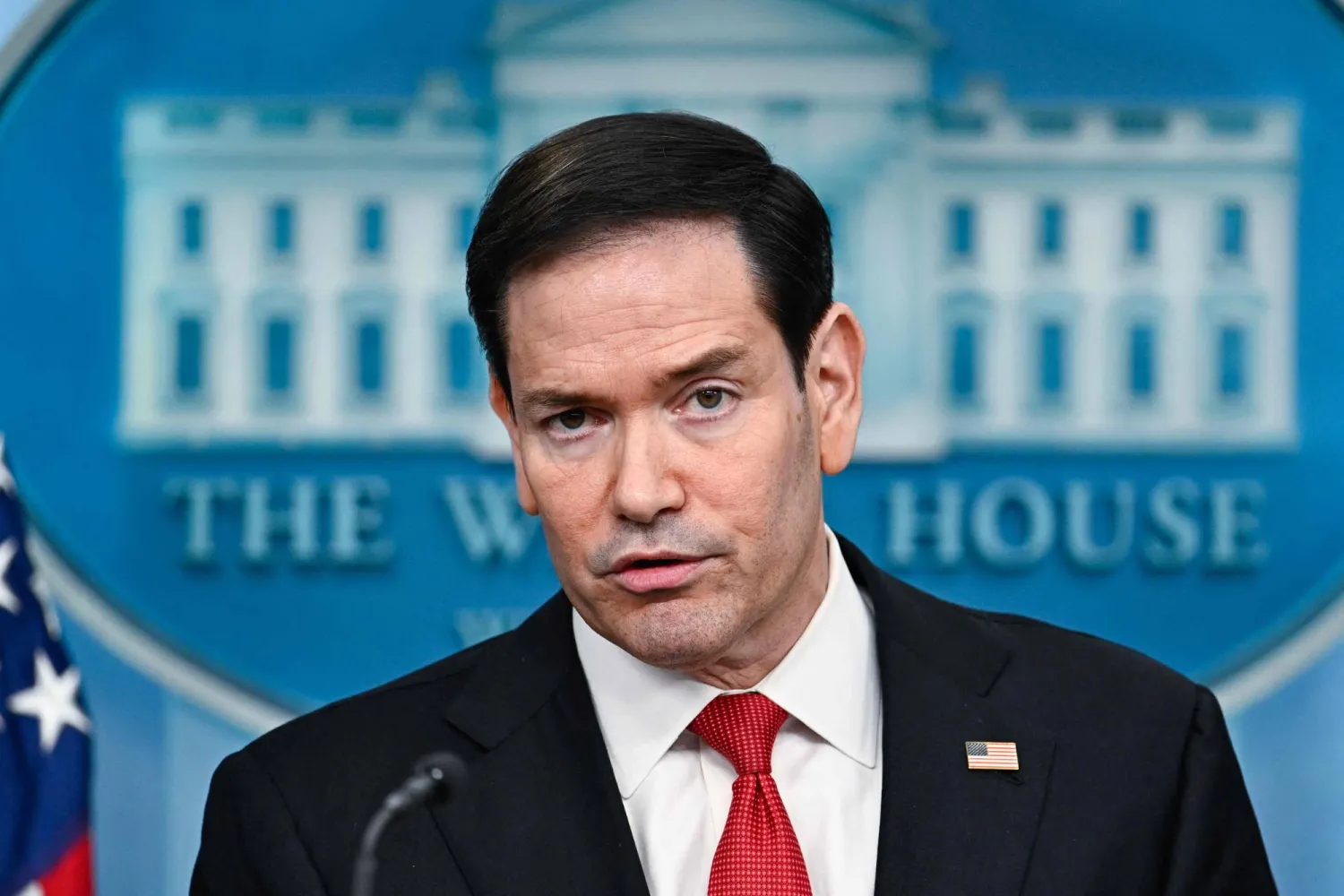

Rubio Doubtful of Diplomacy with Cuba as Trump Raises New Threat of Military Action

(FILES) US Secretary of State Marco Rubio speaks during a press briefing in the Brady Briefing Room of the White House in Washington, DC, on May 5, 2026. (Photo by Kent NISHIMURA / AFP)
TT

Rubio Doubtful of Diplomacy with Cuba as Trump Raises New Threat of Military Action

(FILES) US Secretary of State Marco Rubio speaks during a press briefing in the Brady Briefing Room of the White House in Washington, DC, on May 5, 2026. (Photo by Kent NISHIMURA / AFP)

President Donald Trump and America's top diplomat on Thursday again raised the specter of US military intervention in Cuba, a renewed threat that takes on greater weight a day after the administration announced criminal charges against the island's former leader, Raúl Castro.

Trump said previous US presidents have considered intervening in Cuba for decades but that “it looks like I’ll be the one that does it.”

“Other presidents have looked at this for 50, 60 years, doing something,” Trump told reporters when asked about Cuba during an environmental event in the Oval Office. “And, it looks like I’ll be the one that does it. So, I would be happy to do it.”

Secretary of State Marco Rubio told reporters separately that Cuba has been a national security threat for years because of its ties to US adversaries and that Trump is intent on addressing it, The Associated Press said.

Rubio says the US prefers a negotiated agreement with Cuba

Rubio, the son of Cuban immigrants who has long taken a hard-line against Cuba’s socialist leadership, said the Trump administration wants to resolve differences with Cuba peacefully but is doubtful the US can reach a diplomatic resolution with the island's current government.

Trump's “preference is always a negotiated agreement that’s peaceful. That’s always our preference. That remains our preference with Cuba,” Rubio said in Miami before boarding a plane to attend a NATO meeting in Sweden and then visit India.

“I’m just being honest with you, you know, the likelihood of that happening, given who we’re dealing with right now, is not high,” he said.

Top Trump aides — including Rubio, CIA chief John Ratcliffe and other senior national security officials — have met with Cuban officials in recent months to explore possible improvements in relations. But the US side has come away unimpressed from those talks, leading to even more sanctions imposed on the Cuban government in the past week.

Over the years, Cuba has gotten used to “buying time and waiting us out,” Rubio said. “They’re not going to be able to wait us out or buy time. We’re very serious, we’re very focused.”

When asked whether the US would use force in Cuba to change the island's political system, Rubio repeated that a diplomatic settlement was preferred but noted that “the president always has the option to do whatever it takes to support and protect the national interest.”

He pushed back on a reporter’s suggestion that it sounded like “nation-building,” insisting it was about addressing a national security risk.

New threats follow US announcement of charges against Castro Federal prosecutors on Wednesday unveiled an indictment that accuses Castro of ordering the shootdown in 1996 of civilian planes flown by Miami-based exiles. The charges, which were secretly filed by a grand jury in April, included murder and destruction of an airplane.

Cuban President Miguel Díaz-Canel has condemned the indictment as a political stunt that sought only to “justify the folly of a military aggression against Cuba.”

The Castro indictment has led many to believe that the Trump administration is following the same playbook it did when it captured then-Venezuelan President Nicolás Maduro in a military operation in early January. Maduro, who has been imprisoned in the US since his seizure, faces federal drug trafficking charges and has pleaded not guilty.

The US military touted the arrival of the USS Nimitz aircraft carrier and accompanying ships to the Caribbean Sea on the same day the charges against Castro were announced. US Southern Command said the ships are taking part in maritime exercises with partners in Latin America that began in March.

Rubio would not discuss how the US might move to implement the indictment against Castro, who turns 95 next month.

Trump has been threatening military action in Cuba ever since ousting Maduro and then ordering an energy blockade that choked off fuel shipments to Cuba. That has led to severe blackouts, food shortages and an economic collapse across the island.

The Trump administration this month also has slapped new sanctions on Cuba, the largest of which is against Grupo de Administración Empresarial S.A., a business conglomerate operated by the Cuban Revolutionary Armed Forces.

On Thursday, Rubio announced that the sister of the GAESA's executive president, who was living in the US, has had her green card revoked and been arrested, and is now in US Immigration and Customs Enforcement custody.

“Past Administrations have permitted the families of Cuban military elites, Iranian terrorists and other reprehensible organizations to enjoy lavish lifestyles in our country funded by stolen blood-money, while the people they repress at home suffer in increasingly dire circumstances. No longer,” Rubio said in a statement.

Trump has ratcheted up talk of regime change in Cuba after pledging to conduct a “friendly takeover” of the country if its leadership did not open its economy to American investment and kick out US adversaries.

On Thursday, Rubio said Cuba poses a serious national security threat to America because of its security and intelligence ties with China and Russia and friendly relations with US foes in Latin America.

China opposes US sanctions and pressure on Cuba, a Chinese Foreign Ministry spokesperson, Guo Jiakun, said Thursday.

“China firmly supports Cuba in safeguarding its national sovereignty and national dignity and opposes external interference,” Guo added.



Australia Charges Man with Trying to Pass Ukraine Military Intel to Russia

Ukrainian soldiers on a Swedish CV90 infantry fighting vehicle at their positions near Bakhmut, Donetsk region, Ukraine, Sunday, June 25, 2023. Roman Chop, AP
TT

Australia Charges Man with Trying to Pass Ukraine Military Intel to Russia

Ukrainian soldiers on a Swedish CV90 infantry fighting vehicle at their positions near Bakhmut, Donetsk region, Ukraine, Sunday, June 25, 2023. Roman Chop, AP

Australian police charged a man with foreign interference on Friday for allegedly seeking to pass intelligence about Ukrainian military activities to Russia.

The 27-year-old Russian-Australian citizen underwent "military style" training in Russia and later joined the Ukrainian armed forces, Australian Federal Police Commissioner Krissy Barrett told a news conference.

Police allege he travelled to Russia for the training in October 2024 before returning to Australia, where he "maintained contact" with individuals he believed were linked to Moscow's intelligence services.

He travelled in 2025 to Ukraine, where he enlisted in the country's armed forces and "gained access to information relating to their military personnel, units and locations", police allege.

Barrett said he then "provided, or attempted to provide, information obtained in Ukraine to individuals he believed were acting on behalf of Russian intelligence services".

"It is alleged this conduct created a risk to the safety and security of Ukrainian military personnel," she said.

"We don't want Australia to become a safe haven for people who are undertaking foreign interference on behalf of other countries," Barrett said.

- 'Zero tolerance' -

Police said there was no indication he had received military training in Australia.

The man has not been identified and was unemployed, Barrett said.

A number of search warrants have been executed and it is a "possibility" there could be further arrests related to the case, she said.

The investigation was conducted by federal police and the Australian Security Intelligence Organization spy agency.

"This case should put regimes perpetrating foreign interference on notice: we have zero tolerance," ASIO Deputy Director-General Claire McGuinness said.

The man was scheduled to face charges at a court hearing in Brisbane on Friday.

It marks the eighth charging of an individual with crimes related to spying and foreign interference in Australia.

The crime of intentional foreign interference carries a maximum penalty of 20 years' imprisonment in Australia.

Australia's spy chief Mike Burgess singled out Russia last year as an "aggressive espionage threat" to the country.

In 2024, Australian police charged a married Russian-born couple with spying for Moscow, accusing them of accessing national security-related material from the military.

The 40-year-old woman, Kira Korolev, and her 62-year-old husband Igor -- both holders of Russian passports -- had lived in Australia for more than 10 years and had obtained citizenship, the authorities said.


8 Killed in Charter Plane Crash Near Remote Site in Alaska

FILE - The National Transportation Safety Board logo and signage are seen at a news conference at NTSB headquarters in Washington, Dec. 18, 2017. (AP Photo/Andrew Harnik, File)
TT

8 Killed in Charter Plane Crash Near Remote Site in Alaska

FILE - The National Transportation Safety Board logo and signage are seen at a news conference at NTSB headquarters in Washington, Dec. 18, 2017. (AP Photo/Andrew Harnik, File)

Eight people died after a charter aircraft crashed at a remote military radar site in western Alaska on Thursday, the US ⁠military's Alaskan Command ⁠said.

A Cessna 441 operated by Anchorage-based air charter company Security Aviation crashed west of Cape ⁠Newenham LRRS Airport in Alaska around 12:15 p.m. (2015 GMT), a Federal Aviation Administration spokesperson said.

The aircraft had departed from Anchorage International Airport and was bound for Cape Newenham, the spokesperson added.

“This is a devastating loss for our military family and the communities we serve,” US Air Force Lt. Gen. Robert Davis, commander of Alaskan Command, the Alaskan North American Aerospace Defense Command Region and Eleventh Air Force, said in a statement.

The statement did not provide details on the specific work the individuals were doing. It referred to the plane involved as a “civilian-contracted aircraft.”

The Cape Newenham ⁠facility ⁠is part of a network of remote radar sites that track aircraft in Alaska's airspace and along its borders.

Davis described those on board as “dedicated professionals carrying out a vital mission in a demanding environment. Our absolute priority right now is providing unwavering support to their families, friends and teammates during this devastating time. We are profoundly grateful for the swift and tireless response of our search and recovery professionals.”

Clint Johnson, the National Transportation Safety Board’s Alaska region chief, said earlier Thursday evening that two pilots and six passengers were on board.


UN Holds Second Informal Poll for Next Leader

Diplomats are reluctant to predict the outcome of the race because of the sway of the five permanent members of the Security Council. Leonardo MUNOZ / AFP/File
TT

UN Holds Second Informal Poll for Next Leader

Diplomats are reluctant to predict the outcome of the race because of the sway of the five permanent members of the Security Council. Leonardo MUNOZ / AFP/File

The UN's most powerful body, the Security Council, meets Friday to hold another straw poll to gauge the popularity of a growing field of contenders to lead the embattled organization.

Costa Rica's Rebeca Grynspan was the front-runner after last month's first informal vote, in which the council's 15 members, including the five with veto power, pass judgment in secret on the candidates, said AFP.

Argentina's Rafael Grossi -- the current head of the UN nuclear watchdog -- is also a candidate along with Chile's Michelle Bachelet, Ecuador's Maria Fernanda Espinosa, Guyana's Carolyn Rodrigues-Birkett, Uganda's Olara Otunnu and Senegal's Macky Sall.

After the first round concluded, Ecuador's Ivonne A-Baki threw her hat into the race to succeed Antonio Guterres, who will complete his second five-year term on December 31, 2026.

"While the first straw poll set the scene for the Secretary-General race, the second may give us some direction about where it is headed," said the International Crisis Group's Daniel Forti.

"Diplomats expect fluctuations in the vote distribution compared to the July poll. Most will be watching to see whether the early front-runners consolidate their support or slip in the standings.

"It is unlikely that any candidate will emerge from (Friday's) poll with a decisive lead."

Forti said the veto-wielding nations -- Britain, China, France, Russia and the United States -- might wait until later to express their preferences, while new contenders could emerge.

Russia's ambassador to the UN, Vassily Nebenzia, said Thursday he could not rule out that possibility.

"If, for example -- I'm speculating now -- if there is a deadlock on any of the candidates we are seeing today, if nobody... flies, then I think that we may see other candidates as well," Nebenzia said.

- 'End of the road'? -

Even if a candidate earns the required nine votes from the 15 available in the Security Council, they must also avoid a veto by the five major powers, which are deeply divided.

Once a candidate clears those bars, their name will go to the General Assembly of all UN members for confirmation.

The Security Council straw poll was devised in the early 1980s in an attempt to break a deadlock between two candidates shut down by vetoes.

The informal mechanism has persisted, in various forms, despite criticism from countries opposed to the opaque process.

"There is a good chance that some nominees realize after (Friday's) vote that their campaigns have reached the end of the road," Forti added.

Each member state must anonymously assign each candidate one of three labels: "encourage,discourage," or "no opinion."

That would give those with no support the opportunity to withdraw -- though they are not obliged.

In the first rounds of the process expected to take several weeks, all ballots are the same color.

But after an unspecified number of votes, the ballots of the five permanent members will become a different color from those of the elected members, making it possible to identify potential vetoes, without knowing which country blackballed any given candidate.

It is tradition that the UN's top job should rotate between different regions.

Under that premise, the role should go to a candidate from Latin America this time. There are many candidates from the region, though Sall and Otunnu hail from Africa.