


Ebola Risk Now at Highest Level in DR Congo, Says WHO

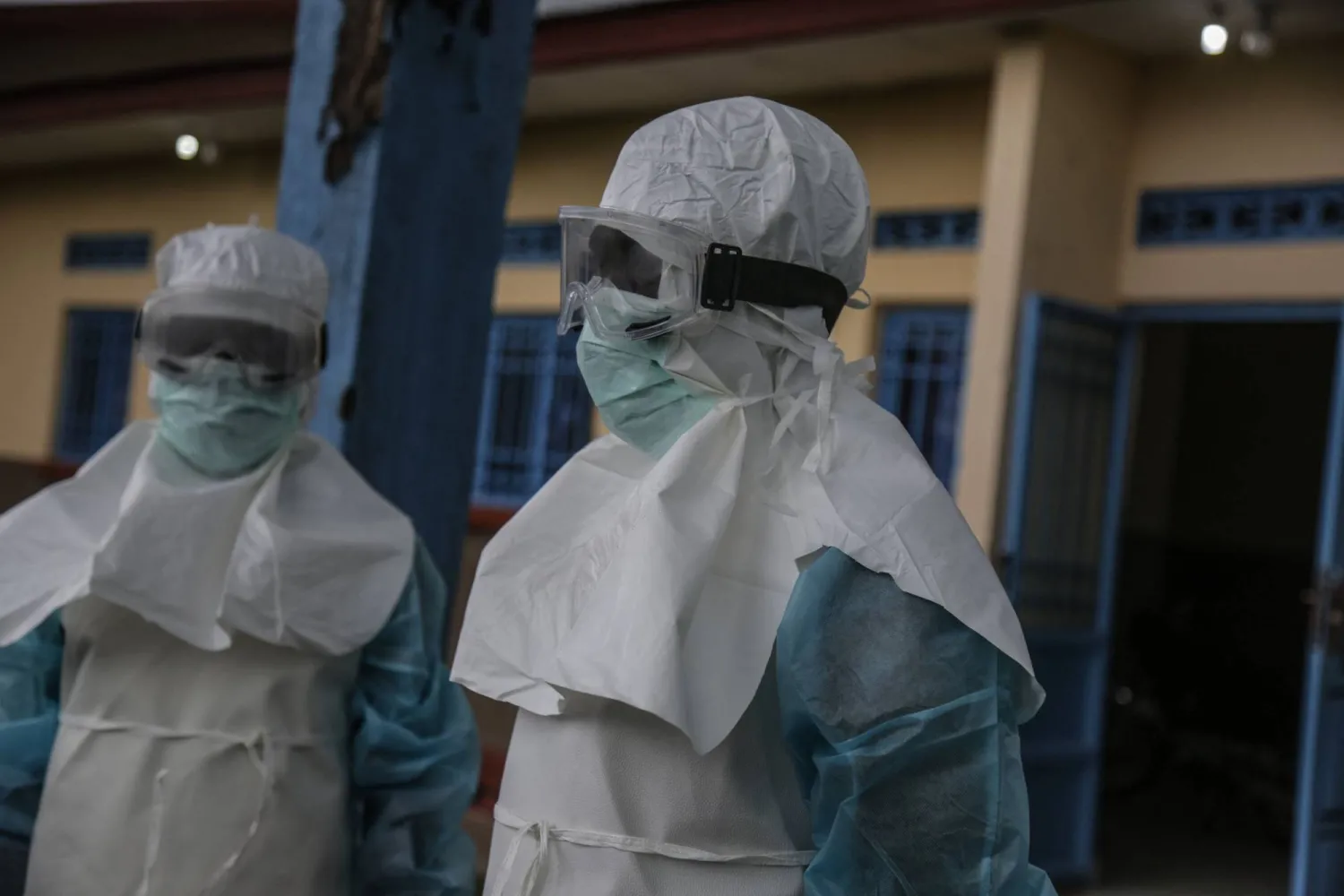
Medical staff wearing personal protective equipment (PPE) are seen at the hospital in Rwampara on May 21, 2026. (AFP)
TT

Ebola Risk Now at Highest Level in DR Congo, Says WHO

Medical staff wearing personal protective equipment (PPE) are seen at the hospital in Rwampara on May 21, 2026. (AFP)

The risk from the deadly Ebola outbreak has been raised to the highest level for the Democratic Republic of Congo, the World Health Organization said Friday, as the toll continues to rise.

The WHO upgraded its risk assessment level from high to very high for the DR Congo, while keeping the regional risk level at high and the global risk level at low.

WHO chief Tedros Adhanom Ghebreyesus said the situation was "deeply worrisome".

He said there were now nearly 750 suspected cases in the DR Congo and 177 suspected deaths, as health workers scramble to track down contacts of everyone thought to be infected with the virus.

"The Ebola outbreak in the Democratic Republic of the Congo is spreading rapidly," he told a press conference.

"So far, 82 cases have been confirmed in DRC, with seven confirmed deaths.

"But we know the epidemic in DRC is much larger. There are now almost 750 suspected cases and 177 suspected deaths."

He said the situation in Uganda was "stable", with two cases confirmed in people who travelled from DRC and one death.

Measures taken in Uganda, including "intense contact tracing" and calling off the Martyrs' Day commemorations, "appear to have been effective in preventing the further spread of the virus", Tedros added.

While a US national who was working in the DRC has tested positive and been transferred to Germany for care, Tedros said another US national deemed to be a high-risk contact had been transferred to the Czech Republic.

Besides national staff already in the DRC, he said 22 international staff had been deployed to the field, "including some of our most experienced people".

Tedros said that violence and insecurity was impeding the response to the outbreak in the DRC.

- Treatment trials planned -

Ebola is a deadly viral disease spread through direct contact with bodily fluids. It can cause severe bleeding and organ failure.

There are no approved vaccines or therapeutics for the Bundibugyo strain of Ebola behind the current outbreak.

There have only been two previous outbreaks of Bundibugyo, in Uganda in 2007 and DRC in 2012.

WHO chief scientist Sylvie Briand said the UN agency was making an inventory of all existing tools which might be useful in combating the outbreak and then prioritizing them, with safety and efficacy the main criteria.

The WHO research and development branch has convened its technical advisory group on treatments, which recommended the prioritization of two monoclonal antibodies for clinical trials.

It also recommended evaluating the antiviral obeldesivir in clinical trials as post-exposure prophylaxis for people who are high-risk contacts.

Briand said it looked "promising" as something that might be able to prevent infected contacts from going on to develop disease from that infection.

The WHO is also in talks with partners on developing eventual vaccines that work against Bundibugyo.



Macron: French Navy Intercepted Another Russian 'Shadow Fleet' Tanker

France's President Emmanuel Macron addresss the press at the end of the meeting of state leaders of the European Group of Five (E5) and the NATO Secretary General, on June 24, 2026 at the Chancellery in Berlin, Germany. (Photo by Ludovic MARIN / AFP)
TT

Macron: French Navy Intercepted Another Russian 'Shadow Fleet' Tanker

France's President Emmanuel Macron addresss the press at the end of the meeting of state leaders of the European Group of Five (E5) and the NATO Secretary General, on June 24, 2026 at the Chancellery in Berlin, Germany. (Photo by Ludovic MARIN / AFP)

French President Emmanuel Macron said on Thursday that his country's navy had intercepted an oil tanker as it transited near the coast of Sicily, in what he called his country's latest action against the 'shadow fleet' Russia uses to ship oil and gas and ⁠to skirt Western ⁠sanctions.

"This new action against the shadow fleet, conducted days after a similar operation by Britain, shows Europeans' determination," Macron said in ⁠a post on Instagram, adding that the interception took place on Tuesday.

"We will not let the shadow fleet evade sanctions and finance the Russian war effort," Reuters quoted Macron as saying.

Macron posted a video showing Marines descending from helicopters onto the ⁠Deliver.

⁠France has intercepted at least five tankers it says are part of Russia's shadow fleet, old vessels that Russia has relied on to ship oil and gas and to skirt Western sanctions.

Moscow has called such actions illegal.


Ukraine Drone Attacks Kill 5 in Russia, Crimea

FILE PHOTO: Explosion at Moscow oil refinery after Ukrainian drone attacks on the city, in Moscow, Russia june 18, 2026, in this screengrab obtained from a social media video. SOCIAL MEDIA/via REUTERS
TT

Ukraine Drone Attacks Kill 5 in Russia, Crimea

FILE PHOTO: Explosion at Moscow oil refinery after Ukrainian drone attacks on the city, in Moscow, Russia june 18, 2026, in this screengrab obtained from a social media video. SOCIAL MEDIA/via REUTERS

Ukrainian drone strikes killed five people, including two children, in Russia and on the Moscow-annexed Crimean peninsula, in attacks that also triggered a fire at a major oil depot in the country's south, local officials said Thursday.

Ukraine has stepped up strikes on Russia in recent months in retaliation for Moscow's near-daily barrages of drones and missiles throughout its five-year offensive, AFP reported.

Russia's defense ministry said it downed 269 Ukrainian drones overnight over Russia and Crimea, which Moscow annexed in 2014.

In Crimea, which Ukraine is trying to cut-off from Russian logistics and supply routes, the Russia-appointed governor Sergey Aksyonov said: "Two people, including a child, were killed and two others wounded ... as a result of overnight enemy attacks.

Drone strikes also killed two people in the border Bryansk region -- a 23-year-old driver and 15-year-old girl -- and one in the Belgorod region, regional authorities said.

Kyiv insists that the Ukrainian army first and foremost targets military installations and energy infrastructure, in a bid to deprive the Kremlin's war chest of vital fossil fuel revenues.

In Russia's southern Krasnodar Krai region, debris from a drone strike triggered a fire at an oil depot, authorities said Thursday.

"Following the fall of UAV debris, a fire broke out at the Poltavskaya oil depot," Aleksandr Kharitonov, head of Krasnoarmeysk district in Krasnodar Krai, wrote on Russia's state-run Max platform.

Ukraine's air force said Russia fired 90 drones and an Iskander missile -- launched from Crimea -- at Ukraine overnight, adding that 83 of the drones had been shot down.

But Ukraine's state railway operator said a crew member was killed in a strike on a train in the southern Zaporizhzhia region.


Iran Warns Against Hormuz Crossings Without Authorization

FILE PHOTO: Vessels are seen at the Strait of Hormuz, as seen from Musandam, Oman, June 1, 2026. REUTERS/Stringer/File Photo
TT

Iran Warns Against Hormuz Crossings Without Authorization

FILE PHOTO: Vessels are seen at the Strait of Hormuz, as seen from Musandam, Oman, June 1, 2026. REUTERS/Stringer/File Photo

Iran's Revolutionary Guards on Thursday warned against any crossings of the Strait of Hormuz without authorization, saying vessels not complying "will be dealt with.”

The future of the strait, a vital route for energy shipments that was blockaded by Iran during the war, is a key sticking point in negotiations between Tehran and Washington.

Tehran has said it plans to impose what it calls maritime service fees, as opposed to tolls, while the United States argues it is an international waterway and therefore should not be charged.

"The only authorized route for passage through the Strait of Hormuz is the route announced by the Islamic Republic of Iran," said the Revolutionary Guards, the ideological arm of Iran's military.

Any crossing without authorization is "unacceptable and extremely dangerous,” they warned in a statement.

According to AFP, they also denounced what they said was a new route through the waterway announced by "certain authorities.”

The statement did not elaborate but it appeared to be a response to an announcement overnight of a temporary corridor by Oman, which also borders the strait.