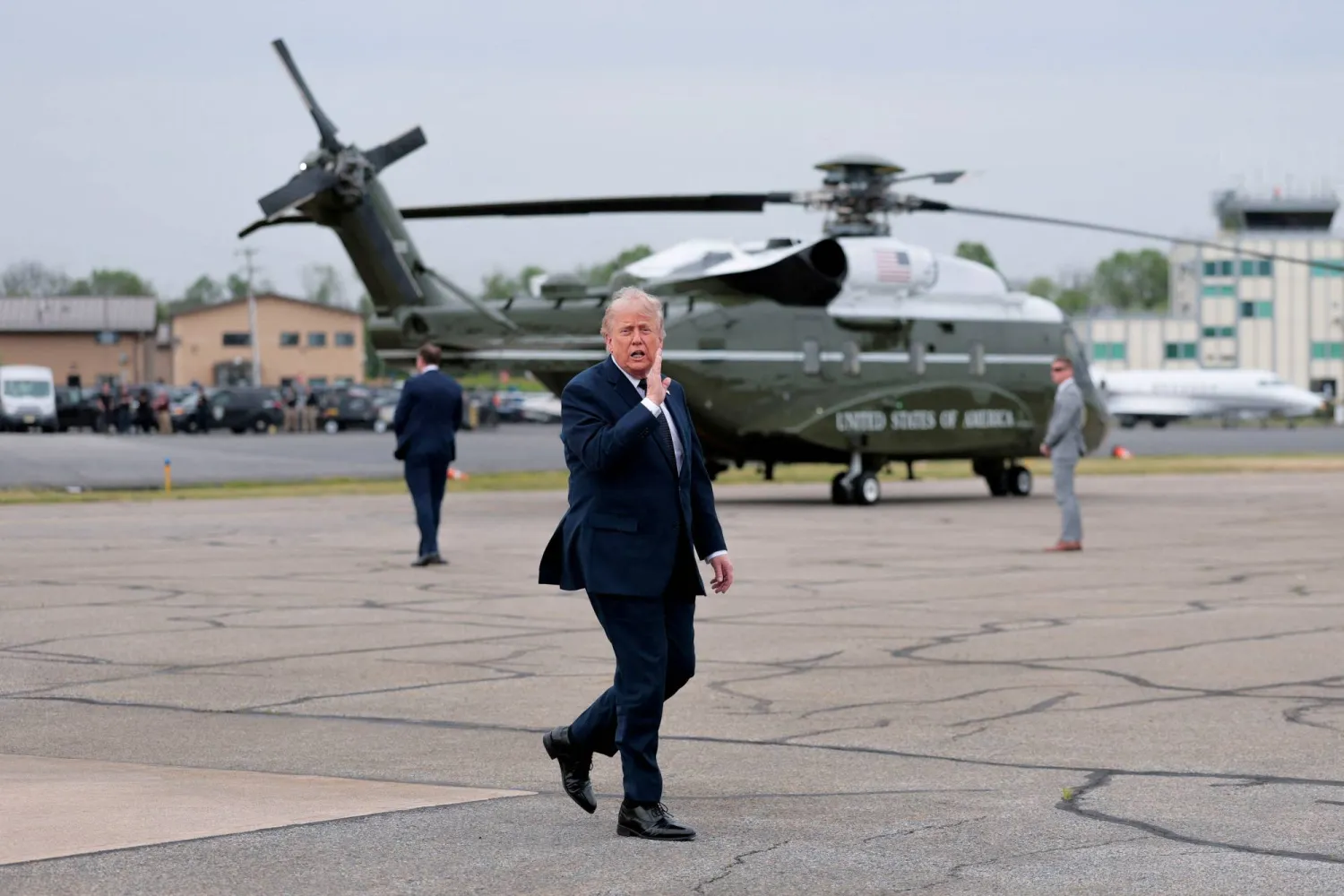
US President Donald Trump said on Monday that a threat linked to Iran had prompted the removal of American B-1 bombers from a British airbase.
The planes had been stationed at RAF Fairford, the preferred European base for US bombers, and had recently been used in US strikes on Iran. Last week, five British men were arrested near the base — which Iran's Revolutionary Guards previously said was a legitimate target — on suspicion of preparing terrorist acts.
"We had an idea that there might be a threat, and why would I leave them there? It costs very little money to move them," Trump told reporters on Monday. "So we had a threat, and if we're going to be threatened, we just move them, and that sort of alleviates that. And we actually know the people that made the threat."
When asked if they were linked to Iran, Trump responded: "They would be linked to Iran."
Earlier on Monday, Vice President JD Vance said the US moved the bombers out of an abundance of caution.
"We do feel with some confidence that the Iranians are, you know, they're trying to do what the Iranian state has done for 49 years, which is engaged in acts of terrorism against the United States (and others), so we are being extremely cautious, and that's all I'd say about that," Vance told reporters.
However, US Secretary of State Marco Rubio said there was no direct link between the sudden removal of the bombers and the suspected Iranian plot. He said the Pentagon is "constantly reallocating resources where they need to be."
A NATO military source had said on Monday: "It is still believed that Iran poses an acute threat to US assets in the UK."
While much about the incident remains unexplained, British Prime Minister Andy Burnham said any plot was likely backed by Iran.
Iran has said accusations that it was involved in any plot are baseless, and Foreign Minister Abbas Araghchi wrote on X: "I can confirm Iran's belief that releasing supposed terrorists working for foreign states really says it all. You're barking up the wrong tree."
KEY AIR BASE FOR US STRIKES
Rubio said on Monday the US had confidence in the security of all its bases.
Fairford, located 90 miles (145 km) west of London, is one of the most important European bases for the US, being one of only a few suitable for heavy bombers such as the B-1 aircraft. It has played a key role in previous US campaigns in the Middle East, although its bombers are not stationed there permanently.
During the current conflict, the US had permission to use Fairford only to strike Iranian missile sites that were attacking ships in the Strait of Hormuz, or so-called defensive strikes. London had refused permission for the US to use British bases for offensive strikes on Iran.
That approach has strained ties between the US and Britain, typically one of Washington's closest allies.
A Pentagon official confirmed on Sunday that all US bombers that had been deployed to Fairford had headed to their home stations in the US.
The Pentagon said the US bomber force remained ready to deliver precision global strike capabilities "anywhere, anytime".
The New York Times, citing two US officials, said the US had rushed over the weekend to move the bombers after commanders received new threats about an Iran-backed plot. It said some of the planes had left while aerial refueling aircraft were still being scrambled.
A US official declined to comment. The British government also declined to comment, although a spokesman for Burnham said the base was safe.
Christoph Bergs, research analyst at defense think tank the Royal United Services Institute, said the redeployment would in the short term reduce US capacity "to quickly surge sorties against Iran, reducing the threat level somewhat".
But he noted that use of Fairford was already limited given London's stipulation on defensive strikes. The aircraft could now potentially be sent to either Diego Garcia or bases in the Gulf, to reduce the need for more air-to-air refueling to cover the additional distance, but that would depend on capacity availability, negotiations with allies and security, he added.
TRUMP SAID PLOT WAS FOR 'BIG DAMAGE'
In the early hours of September 27, five British men in their 20s were arrested after being seen running into fields from three white vans parked near the base. Police said no explosive devices were found but a quantity of petrol was present.
The men have since been released on bail. A sixth man, a dual UK-Iranian national arrested on suspicion of preparing terrorist acts four days later, has also been released on bail.
Trump said at the time of the first arrests that the plot had planned "big damage" and that it might have been connected to Iran. Trump later said he would not have released the suspects on bail.
A senior NATO military official said the removal of the bombers would have no impact on the alliance: "NATO's defensive agility towards any aggression remains unchanged and unmatched thanks to the unity, strength, and combined capabilities of 32 nations."
The Wall Street Journal first reported the removal of the US bombers.