Philippine Construction Collapse Toll Hits Four, over Dozen Missing

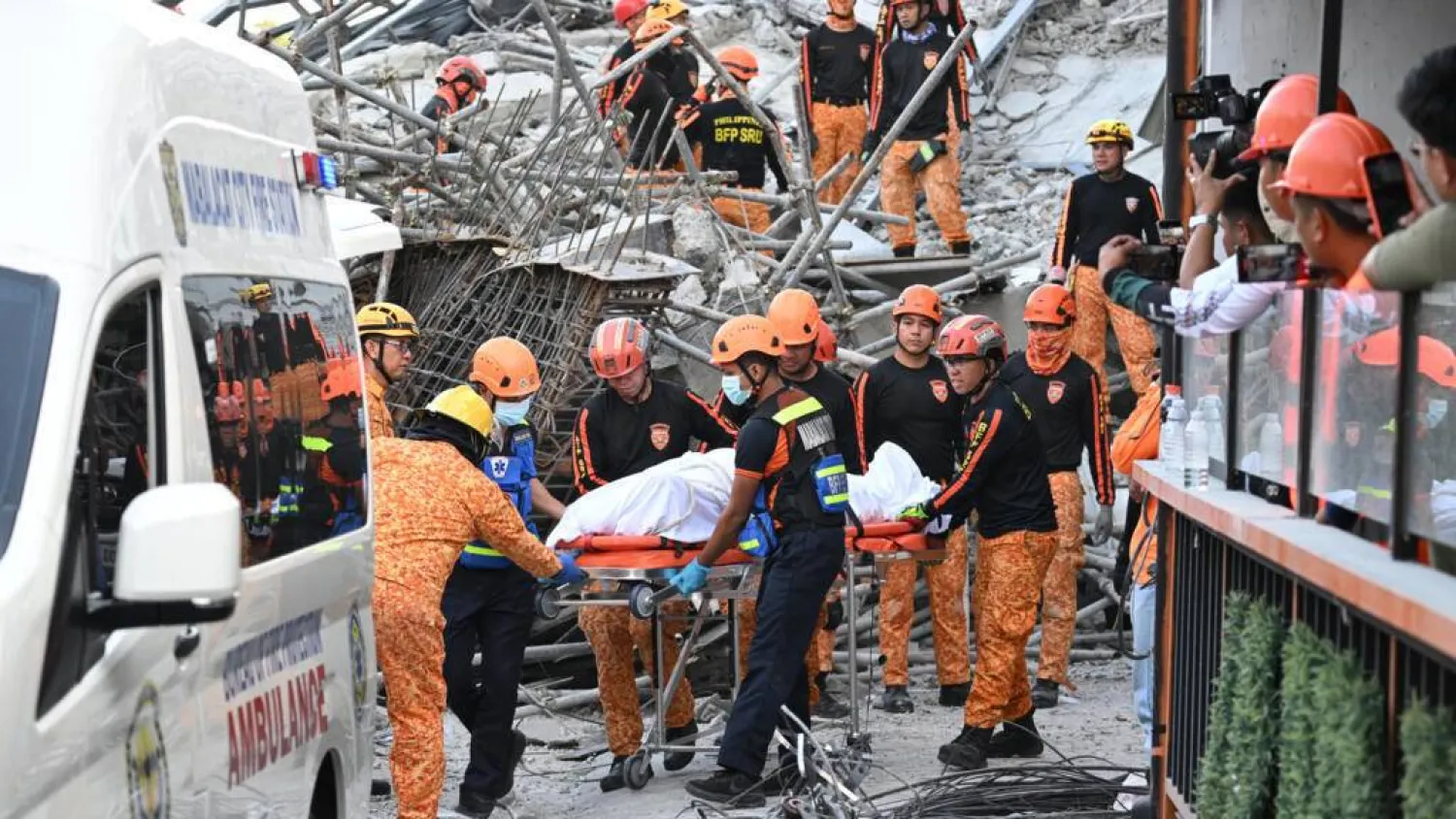
The death toll in a Philippine construction site collapse has risen to three. Ted ALJIBE / AFP
TT

Philippine Construction Collapse Toll Hits Four, over Dozen Missing

The death toll in a Philippine construction site collapse has risen to three. Ted ALJIBE / AFP

The death toll rose to four Monday in the collapse of a building under construction near the Philippine capital, with more than a dozen people still believed missing, authorities said.

Two workers pinned beneath the wreckage were found alive after the nine-storey structure gave way Sunday, hitting a nearby hotel and killing a Malaysian guest.

But the two workers trapped at the site in Angeles, which is north of the capital Manila, died despite rescue efforts.

"The first of the two was pulled out alive, but unfortunately, his body gave out and he did not survive. Doctors could not resuscitate him," regional fire bureau spokeswoman Maria Leah Sajili told AFP.

"The other one suffered a cardiac arrest around 3:00 am (1900 GMT Sunday). Doctors could not attend to him as he was still pinned down," she added.

Crews pulled another corpse from the rubble on Monday, but it was not immediately clear if the unidentified body belonged to a person listed among the missing, rescuers said in an updated toll.

Due to the uncertainty, authorities said approximately 17 other people were still considered missing, mostly construction workers who were sleeping at the building site when disaster struck.

Lea Casilao, girlfriend of a missing construction worker, told AFP she had taken a bus from her northern Manila home to Angeles with rice and canned goods for her mate on Sunday, unaware of the pre-dawn accident on the same day.

"It's very difficult, it is breaking my heart to wait for something uncertain," 47-year-old Casilao said, crying as she recounted how she slept alone at a local government building overnight Sunday.

- Lacking safety gear -

Stephanie Batar and her mother Noby told AFP they only learnt about the accident on social media from their home in nearby Bulacan province early Monday and have been unable to contact her 64-year-old father who had been hired only weeks earlier at the job site on a six-month contract.

"I couldn't breathe. I couldn't stand. It's very painful and we did not know what to do," the daughter said.

The cause of the collapse is not known.

Regional labor department director Geraldine Panlilio said she had briefly shut the project down in September 2024 over violations of occupational safety standards.

"Our labor inspectors had monitored poor working conditions, a violation that would put our workers at risk," she said in an interview over Manila radio station DZMM.

The construction workers "lacked safety gear" like hardhats, boots, safety belts and lifelines, and worked under poor lighting and with no visible safety signages, she added.

Construction resumed a month later after the building contractor complied with requirements, Panlilio said.

Officials said up to 70 people were employed at the construction site, though most had gone home for the weekend.

Alfredo Albis, 55, told AFP he was asleep at a barracks for workers about five meters (16 feet) from the structure when it gave way.

"I have two cousins who are still trapped there. They were working here to earn for their families and (they) are missing," he said, adding "there's a possibility that my relatives are dead".

Sajili, the fire bureau spokeswoman, said that "rescue in (a) building collapse is very challenging since any sudden shift triggered by the movements of our rescuers can cause areas to move and people under can get crushed".

If no more survivors are found after a search with thermal scanners, mechanical diggers and other heavy equipment will be brought in to clear debris and recover bodies, she said, but gave no timeline.



Netanyahu’s Somalia Map Revives Fears of Partition

From the Somali capital, Mogadishu (Reuters)
TT

Netanyahu’s Somalia Map Revives Fears of Partition

From the Somali capital, Mogadishu (Reuters)

A map unveiled by Israeli Prime Minister Benjamin Netanyahu has sparked outrage in Somalia, which accused him of undermining its sovereignty and territorial integrity by depicting Puntland and Somaliland as separate states.

The map has reignited fears of partition in a country already grappling with deep divisions. Puntland remains at odds with the federal government, while Israel recognized the breakaway region of Somaliland several months ago.

Somalia rejects the map

Somalia's federal government "categorically rejected" what it called a "misleading map" displayed during Netanyahu's news conference on Sunday, saying it portrayed the country as fragmented.

It condemned the move as "a flagrant violation of Somalia's sovereignty, territorial integrity and internationally recognized borders."

In a statement issued by the Information Ministry on Wednesday evening, the government reaffirmed its unwavering commitment to national sovereignty and the unity of its territory and people.

It stressed that Somaliland and Puntland remain "integral and inseparable parts of the unified, sovereign Somali state."

The government warned that any attempt by foreign officials or outside parties to redraw Somalia's political map, misrepresent its borders or undermine its territorial unity would constitute a direct violation of international law and diplomatic norms.

It urged the international community and its partners to respect Somalia's independence and territorial integrity, pledging to uphold its constitutional duty to defend the country's sovereignty and national unity.

Netanyahu displayed the map, titled "Geopolitical Alliances in the Middle East," during an Israeli national security briefing on Oct. 18. It placed Puntland and Somaliland in geopolitical categories linked to Israel.

For Mogadishu, the controversy goes beyond the map itself.

Abdulwali Jama Barre, an African affairs expert and co-founder of the Somali Academy of Leadership and Global Affairs, said the government's response underscored its determination to preserve Somalia's unity and reject any treatment of its regions as independent states.

But Barre drew a distinction between the map's depiction and formal recognition of independence.

"Showing Somali territories under separate geopolitical classifications does not, in itself, mean the map formally declared them independent states," he told Asharq Al-Awsat.

"However, the Somali government viewed the depiction as fragmenting the country's political map and undermining its internationally recognized borders."

Barre said the dispute carried particular weight given Somaliland's contested political status, its ties with Israel and fears in Mogadishu that foreign involvement could weaken Somalia's unity.

The deeper concern, he said, is that foreign powers could increasingly treat Somali regions as entities separate from the federal state.

That risk would grow if symbolic gestures were followed by concrete steps or new formal arrangements amid the country's existing political disputes, he added.

Deep divisions

Somaliland's strategic location adds another dimension to the dispute.

The breakaway region stretches along 740 kilometers of the Gulf of Aden coastline, occupying a key position at the junction of the Indian Ocean and the Red Sea in the Horn of Africa. It is also home to the strategically important Port of Berbera.

Since breaking away from Somalia in 1991, Somaliland had failed to secure international recognition until Israel recognized it, a decision Mogadishu firmly rejects, with Arab countries backing its position.

The map controversy comes as tensions between Somalia's federal government and Puntland remain unresolved.

In May, Puntland President Said Abdullahi Deni declared that he no longer recognized Hassan Sheikh Mohamud as Somalia's legitimate president, accusing him of illegally abusing his presidential powers.

Deni called for an urgent gathering of Somalia's political parties to agree on an inclusive electoral process.

The dispute is part of a broader rift between Puntland and Mogadishu. Over the past year, the regional administration has repeatedly challenged Mohamud's positions and refused dialogue with him.

Deni has also joined the opposition Somali Future Council, which is demanding the government's departure.

At the time, Somalia's federal Interior Minister Ali Yusuf Ali, known as Hosh, sharply criticized Deni, calling him "an obstacle to the state, the country's unity and its development."

Barre warned that such internal divisions must be addressed through constitutional and political dialogue to prevent disputes between Mogadishu and regional administrations, particularly Puntland, from becoming an arena for foreign competition.

He urged Mogadishu to pursue diplomatic action on several fronts, beginning with a formal protest to Israel and a request for clarification about the map and the circumstances in which it was presented.

Somalia should also raise the matter with the United Nations, African Union, Arab League and Organization of Islamic Cooperation, seeking assurances of respect for its sovereignty and territorial integrity, he said.

At home, Barre stressed the need for renewed dialogue between the federal government and regional administrations, especially Puntland, to resolve their differences within an agreed constitutional framework.


Trump: Iran is Trying to Drive Up Oil Prices Before Midterm Elections

21 October 2026, US, Washington: US President Donald Trump speaks to the press at the White House before departing for South Carolina. Photo: Matt Kaminsky/ZUMA Press Wire/dpa
TT

Trump: Iran is Trying to Drive Up Oil Prices Before Midterm Elections

21 October 2026, US, Washington: US President Donald Trump speaks to the press at the White House before departing for South Carolina. Photo: Matt Kaminsky/ZUMA Press Wire/dpa

US President Donald Trump said on Thursday that Iran was doing all it could ⁠to drive up ⁠the price of oil before ⁠the US midterm elections.

"They are even making up fake hits, mines, and everything else," he said ⁠in ⁠a Truth Social post.

Iran's state television reported on Thursday that seven oil tankers were either struck by attacks or hit naval mines in the Strait of Hormuz overnight, possibly the largest single-day number of vessels damaged in the waterway since the Iran war started on Feb. 28.

Quoting a statement by the Revolutionary Guard's navy, the Iranian report said four of the tankers were transferring oil when they were targeted and caught fire. Three more were damaged and immobilized after hitting naval mines. The report didn't provide details about possible casualties or the tankers' flags.

Oil prices climbed about 2% to a five-month high on Thursday.

Brent futures rose $2.42, or 2.2%, to $111.24 a barrel at 10:45 a.m. EDT (1445 GMT), while US West Texas Intermediate (WTI) crude rose $1.14, or 1.2%, to $98.29.

That drove Brent into technically overbought territory for a third time in a week and set for its highest close since May 18.


French Justice Minister: 217 People Jailed Over Riots

France's Justice Minister Gerald Darmanin leaves after attending the weekly cabinet meeting at the Elysee Palace in Paris on October 22, 2026. (Photo by Ludovic MARIN / AFP)
TT

French Justice Minister: 217 People Jailed Over Riots

France's Justice Minister Gerald Darmanin leaves after attending the weekly cabinet meeting at the Elysee Palace in Paris on October 22, 2026. (Photo by Ludovic MARIN / AFP)

French courts have jailed 217 people after convicting them in fast-track trials linked to last weekend's rioting, the justice minister said Thursday, hailing the judiciary's "extremely firm" response.

Speaking outside the Fleury-Merogis prison on the outskirts of Paris, Gerald Darmanin said 2,700 people had been detained since Saturday.

More than 1,000 of them had appeared in court, he said, of whom "217 people have been imprisoned... and this figure is continuing to rise a lot."

Darmanin told reporters that of the 217 sent to jail "half had no criminal record", adding that "in general these are men aged between 18 to 25."

"This shows that prosecutors and judges are imprisoning people who, until now, were not known to the judiciary and are first offenders. It shows that the decisions of the judiciary are being applied in an extremely firm way," AFP quoted him as saying.

Darmanin has vowed to oversee expedited trials to rapidly clear the backlog of cases and to serve as a deterrent. New protests over grievances including the rising cost of living are planned this weekend.

But he has faced criticism from some lawyers who have accused the judiciary of lurching into repression.

France, like many European countries, faces problems with prison overcrowding but Darmanin said the solution was not "to imprison fewer people, but to create more space in prison."

As of September 1, there were 90,020 inmates in French prisons, well above the capacity of 63,348 places and a new record, according to ministry statistics.