


Xi Hails ‘Unbreakable’ Pakistan Ties, Praises Role in Iran Peace Efforts

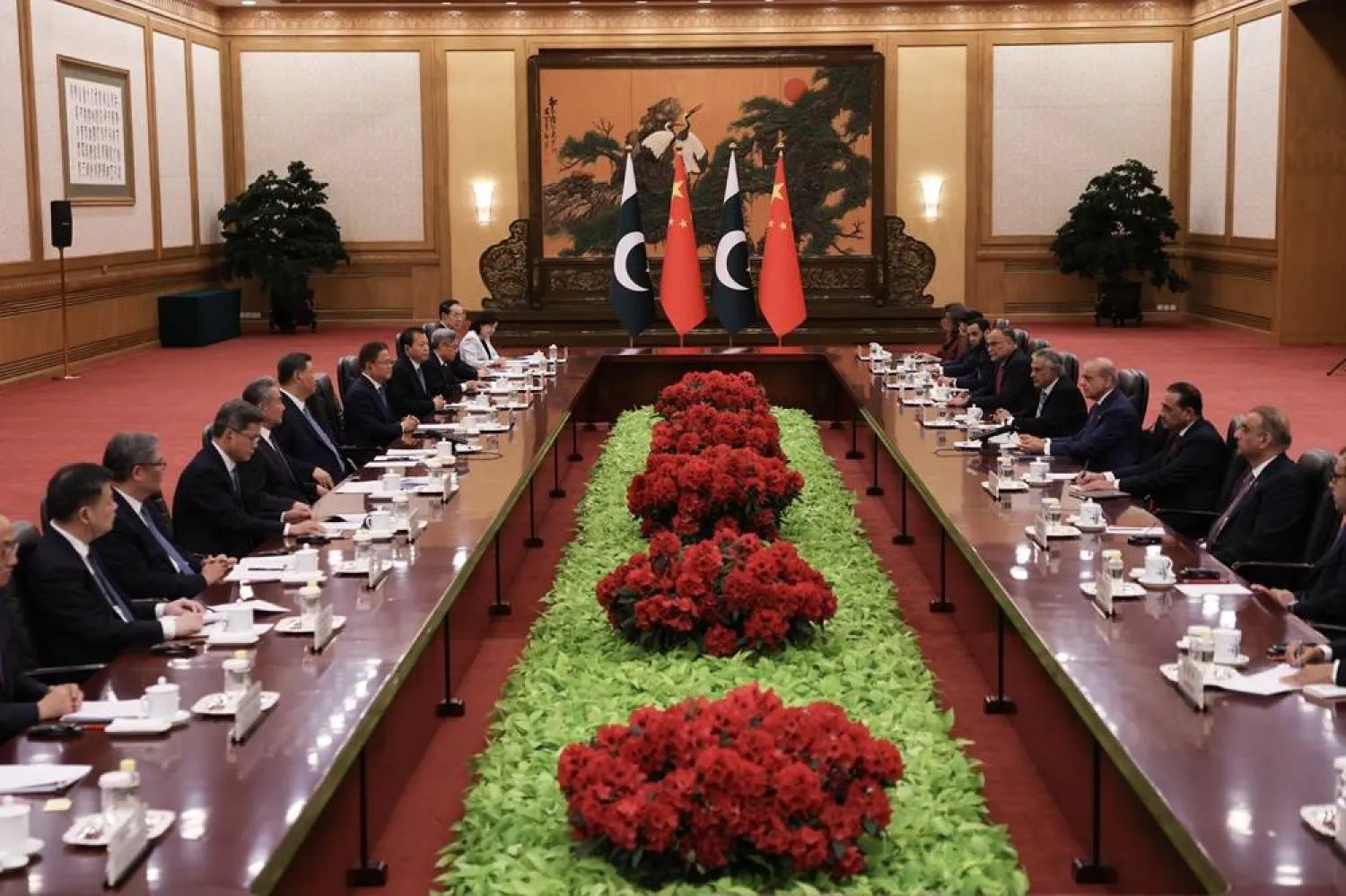
Chinese President Xi Jinping (6-L) and Pakistan's Prime Minister Shehbaz Sharif (4-R) attend a meeting at the Great Hall of the People in Beijing, China, 25 May 2026. (Pool/EPA)
TT

Xi Hails ‘Unbreakable’ Pakistan Ties, Praises Role in Iran Peace Efforts

Chinese President Xi Jinping (6-L) and Pakistan's Prime Minister Shehbaz Sharif (4-R) attend a meeting at the Great Hall of the People in Beijing, China, 25 May 2026. (Pool/EPA)

China's President Xi Jinping hailed Beijing's "unbreakable" friendship with Pakistan on Monday as he met visiting Prime Minister Shehbaz Sharif, seeking to deepen their "all-weather" partnership. 

Pakistan is among an exclusive group of countries China regards as an "all-weather strategic partner," with ties featuring close economic, trade and security cooperation. But repeated extremist attacks on Chinese nationals and projects in the South Asian country have emerged as ‌an irritant, while ‌Islamabad's warming ties with Washington have added complexity ‌to ⁠its ties with ⁠Beijing. 

Greeting Sharif at Beijing's Great Hall of the People, Xi called the Pakistani leader an "old friend" and said the two countries had "understood, trusted and supported each other" over decades, forging an "unbreakable traditional friendship." 

"No matter how the international situation changes, China always prioritises the development of China-Pakistan relations in its neighbourhood diplomacy," Xi said. 

LET'S WORK TOGETHER 

Beijing was ⁠willing to work with Islamabad to build a ‌more close-knit China-Pakistan community with a ‌shared future and achieve more in their "all-weather" cooperation, Xi added. 

Sharif, in turn, ‌called China and Pakistan two "iron brother" countries with a relationship that ‌is "next to none". 

He was accompanied at Monday's meeting by Pakistan's Army chief, Asim Munir, who was recently in Tehran for meetings with the Iranian leadership. 

Following a rickety ceasefire in the Iran conflict, achieved in April, Pakistan ‌hosted mediation talks in Islamabad between Washington and Tehran, relaying proposals and missives between the warring countries ⁠even when ⁠tensions escalated. 

Weeks into Islamabad's diplomatic efforts, Washington has reported progress in negotiations with Tehran. 

"I know that you have just returned from Iran and made positive efforts for the current peace. We still appreciate the constructive role played by Pakistan," Xi said. 

For Pakistan, engaging China in its mediation efforts is important given Beijing and Tehran's close ties. 

China and Pakistan issued a five-point initiative in March as their foreign ministers met in Beijing, calling for peace talks and restoration of normal navigation in the Strait of Hormuz, the vital waterway through which roughly a fifth of the world's oil and liquefied natural gas normally passes. 


The Iranian Leaders Killed in Israeli-US War

Alireza Tangsiri is the latest top Iranian security official to be killed in the conflict. SEPAH NEWS/AFP
TT

The Iranian Leaders Killed in Israeli-US War

Alireza Tangsiri is the latest top Iranian security official to be killed in the conflict. SEPAH NEWS/AFP

Over the course of the US-Israeli war on Iran, waves of airstrikes killed an entire echelon of the Iranian republic's political and military elite, starting with supreme leader Ali Khamenei.

President Donald Trump had claimed in March that the campaign had achieved "regime change", but Iran showed resilience in rapidly replacing killed leaders and keeping up the war against the US and Israel.

With Washington and Tehran agreeing on a deal announced Monday to halt the conflict, here is a recap of some of the key figures killed in the war:

- Supreme leader Ali Khamenei -

Khamenei, Iran's number one since 1989, was killed in the first hour of the war on February 28 in a strike on a meeting of senior officials in Tehran that also left his daughter-in-law, daughter and at least one grandchild dead, according to reports.

His low-profile son Mojtaba survived -- although reportedly with injuries -- and took over as supreme leader. He has yet to make a public appearance.

Ali Khamenei has yet to be buried, with state media reporting on Saturday that his funeral will take place on July 9 in his hometown, the northeastern city of Mashhad, following three days of funeral ceremonies in Tehran and another in the holy city of Qom.

- Security chief Ali Larijani -

The killing of Larijani, who despite not being a cleric was a pillar of the system for decades, was likely the biggest loss to the Iranian republic after the death of Ali Khamenei.

Larijani was killed on March 17 in an Israeli strike, reportedly in the Tehran region and which also killed family members.

The previous week, he had defiantly walked in public in Tehran at a pro-government rally.

- Revolutionary Guards chief Mohammad Pakpour -

Pakpour, previously head of the Guards' ground forces, took over as commander-in-chief in June 2025 after his predecessor Hossein Salami was killed in Israel's 12-day war against Iran.

He was killed on the first day of the war and has been replaced by former interior and defense minister Ahmad Vahidi.

- Guards naval chief Alireza Tangsiri -

A veteran of the 1980-1988 Iran-Iraq war, Tangsiri was one of the longest-serving senior figures in the Revolutionary Guards as the head of its navy since 2018 and one of its highest-profile faces within the Iranian republic.

Israel's defense minister described him as the "man who was directly responsible for the terrorist operation of mining and blocking the Strait of Hormuz".

- Adviser Ali Shamkhani -

Shamkhani, a mainstay of the Iranian republic's armed forces since the 1980s, was killed in an airstrike on the first day of the war.

He was given a public funeral in Tehran's Tajrish Square.

He had been severely wounded, and initially reported dead, in a strike during Israel's June war against Iran but later re-emerged.

- Intelligence Minister Esmail Khatib -

A cleric, Khatib was killed by an Israeli strike in Tehran early on March 18.

As Iran's intelligence minister since 2021, he was accused by rights groups of playing a key role in the suppression of protests.

- Defense Minister Aziz Nasirzadeh -

A veteran of the Iran-Iraq war in the 1980s, Nasirzadeh had served as defense minister since 2024.

He was also killed in a strike on the first day of the war.

- Basij commander Gholamreza Soleimani -

Soleimani headed the Basij, a volunteer paramilitary group that is a branch of the Revolutionary Guards and notorious among rights groups for suppressing protests.

He was killed in an airstrike on March 17.

- Guards spokesman Ali Mohammad Naini -

Naini was killed in March in what the Guards described as a "cowardly" attack by the United States and Israel.

Just before his death was confirmed, the Fars news agency issued a statement quoting Naini as saying Iran's missile production deserved a "perfect score" and was continuing despite the war.

- Head of military office Mohammad Shirazi -

Killed on the opening day of the war, Shirazi had the crucial job of coordinating between the various branches of the Iranian security forces at the office of supreme leader.

- Armed forces chief Abdolrahim Mousavi -

Mousavi, killed on the first day of the war, had only taken up his post -- a senior position that coordinates between the Guards and the regular army -- in June 2025 following the death of his predecessor Mohammad Bagheri in the 12-day war.


Deadly Strikes on Ukraine Leave Kyiv Cathedral in Flames

Smoke and fire rises from the Dormition Cathedral in the Orthodox in Kyiv. Genya SAVILOV / AFP
TT

Deadly Strikes on Ukraine Leave Kyiv Cathedral in Flames

Smoke and fire rises from the Dormition Cathedral in the Orthodox in Kyiv. Genya SAVILOV / AFP

Russia fired a barrage of missiles at several major Ukrainian cities, setting Kyiv's historic Dormition Cathedral on fire and killing nine, while Ukraine strikes claimed three lives south of Moscow.

The wave of attacks came as news of a US-Iran deal started to open a path to peace in the Middle East war, highlighting the lack of progress toward an end to over four years of fighting in Ukraine.

Five rescue workers were killed during firefighting operations in northeast Ukraine, while at least five others were wounded after Russian strikes hit the city of Kharkiv, Interior Minister Igor Klymenko said Monday.

The violence killed another four people in the capital, where fire broke out on the grounds of the UNESCO world heritage site Kyiv-Pechersk Lavra and the roof of the Dormition Cathedral was on fire.

Residents were seen running through the streets seeking shelter as projectiles were intercepted in the sky and glowing debris fell across the city, AFP journalists in the capital witnessed.

More than a dozen fire trucks surrounded the cathedral with firefighters working tirelessly to extinguish the blaze from the inside and from aerial platforms, an AFP journalist saw.

A gaping hole could be seen on one side of the church, with flames visible from the roof which has been partially destroyed.

- 'Repeated Russian strikes' -

Russian attacks damaged several buildings in the complex in January, the Ministry of Culture reported at the time.

The Kyiv Pechersk Lavra, a monastery with emblematic golden domes, had made headlines in recent years after the expulsion of its monks, who were accused of having ties with Moscow.

The Orthodox Church of Ukraine officially broke away from Russia in 2022 and two years later the Ukrainian government went so far as to ban the Ukraine branch of the Orthodox Church linked to Moscow.

Institutionally, the Russian Orthodox Church has stood full-square behind President Vladimir Putin since he launched Russia's offensive on Ukraine in 2022.

Head of the local military administration, Tymur Tkachenko, condemned the "direct strike" on the site.

Kyiv's Metropolitan Epiphanius also denounced the attack as a "crime against humanity, history and Christianity."

At least 23 people have been reported to have been injured in the capital and 140,000 residents in the northern districts left without electricity.

The major city of Kharkiv, in the northeast, also came under missile attack.

"Five State Emergency Service rescuers were killed during firefighting operations as a result of a repeated Russian strike," Interior Minister Igor Klymenko said on Telegram. At least nine people were also injured.

The head of the military administration in the Dnipropetrovsk region, Oleksandr Hanzha, said that the city of Dnipro had also been targeted, with one person wounded.

The head of the Sumy region, Oleg Grygorov, said three people had been wounded in the northeastern district, including a child.

A Ukrainian drone strike killed three people and wounded three others in the Russian city of Tula, around 200 kilometers (120 miles) south of Moscow, the regional governor Dmitry Milyaev said on Monday.

- Peace talks -

Ukrainian President Volodymyr Zelensky and Russian leader Vladimir Putin both called their US counterpart Donald Trump on Sunday to discuss the conflict in Ukraine.

Zelensky said on X that he had "discussed things that could help bring about peace now," while his adviser Dmytro Lytvyn told the press he was pleased with a "quite substantive conversation about everything" between the leaders.

The Kremlin, for its part, said that the conversation between Putin and Trump focused on peace negotiations with the United States and Iran.

Russia's invasion of Ukraine has turned into Europe's worst conflict since World War II, with thousands of civilians and hundreds of thousands of troops killed.

Amid near-daily pummeling of its cities by Russian drones and missiles, Ukraine has in recent weeks stepped up its own aerial attacks, which it says mostly target Russia's oil infrastructure to sap its profits that fund the war.

Kremlin adviser Yury Ushakov told the press that "US presidential special representatives Steve Witkoff and Jared Kushner, who are currently closely involved in Iranian affairs, will return to Russia soon".


What to Know about a Possible Deal to End the Iran War

 A woman waves an Iranian flags as she chants slogans against Iran and US talks at the revolution square in Tehran, Iran, Sunday, June 14, 2026. (AP)
A woman waves an Iranian flags as she chants slogans against Iran and US talks at the revolution square in Tehran, Iran, Sunday, June 14, 2026. (AP)
TT

What to Know about a Possible Deal to End the Iran War

 A woman waves an Iranian flags as she chants slogans against Iran and US talks at the revolution square in Tehran, Iran, Sunday, June 14, 2026. (AP)
A woman waves an Iranian flags as she chants slogans against Iran and US talks at the revolution square in Tehran, Iran, Sunday, June 14, 2026. (AP)

The United States and Iran have reached an interim deal aimed at ending the war and reopening the Strait of Hormuz.

There are plans for a signing of the deal on Friday in Switzerland. However, previous announcements fell through, and what the deal contained remained in dispute Monday.

Iran exchanged fire with the US and Israel last week, threatening to push the region back into a full-scale war. The war launched by the US and Israel on Feb. 28 has rattled the region and virtually shut down oil and natural gas shipments from the Gulf. A fragile ceasefire has been in place since April 7.

Here's what to know:

A 60-day period would address Iran's nuclear program

Iranian Foreign Minister Abbas Araghchi said Friday the terms of dealing with Iran’s nuclear program would be finalized in the 60 days after the initial agreement is signed and that the parties could decide to extend that period.

The US and Israel fear Iran’s nuclear program could lead to an atomic weapon — a main reason their leaders cited for going to war. Tehran has insisted its nuclear program is peaceful, though it has enough highly enriched uranium to build several atomic bombs, should it choose to do so.

A senior US administration official, who briefed reporters on condition of anonymity under ground rules set by the White House, said Friday that the emerging agreement would begin the process of destroying or removing Tehran’s highly enriched uranium. That's something disputed by Iran, which has insisted it would hold onto its stockpile.

The official said the 60-day period after both sides sign the deal would be used to work out technical details for removing the uranium. The official did not say who the US envisions taking charge of removing the uranium, which is believed to be entombed under three nuclear sites battered by US strikes last year.

The deal may include addressing reopening the Strait of Hormuz

The US official said the emerging agreement includes provisions for reopening the strait.

Araghchi said Iran wants a deal that allows Tehran to charge ships “for services rendered” when they transit the strait. Iran charged vessels for passage during the war, which the US and other nations have said violates international law. The strait long has been considered an international water though it sits in the territorial waters of Iran and Oman.

Transit through the strait, a vital shipping lane for oil and natural gas, has disrupted global energy supplies, driven up fuel prices and made food and other basics like fertilizer more expensive well beyond the region.

The agreement would include Iranian sanctions relief

Three regional officials said the emerging deal was expected to include the phased lifting of sanctions on Iran and the release of frozen Iranian assets. The officials spoke on condition of anonymity because of the sensitivity of the negotiations.

What will happen to Lebanon remains unclear

Pakistani Prime Minister Shehbaz Sharif said after the deal had been announced that “both sides have declared the immediate and permanent termination of military operations on all fronts, including in Lebanon.” It remains unclear whether Israel, which relies on the US but has launched in wars against its enemies since Hamas’ Oct. 7, 2023, attack on Israel, agreed to that term.

Iran has insisted that any deal must include a ceasefire in Lebanon, where Israel has been fighting the Iranian-backed Hezbollah group.

Israeli Defense Minister Israel Katz warned Friday that Israel could still act independently toward Iran and that the country would not pull out of the zones it is occupying in Lebanon, Syria and Gaza, nor would it withdraw from the northern refugee camps of the Israeli-occupied West Bank.
