


Russian Call for Diplomats to Leave Kyiv Draws Western Backlash

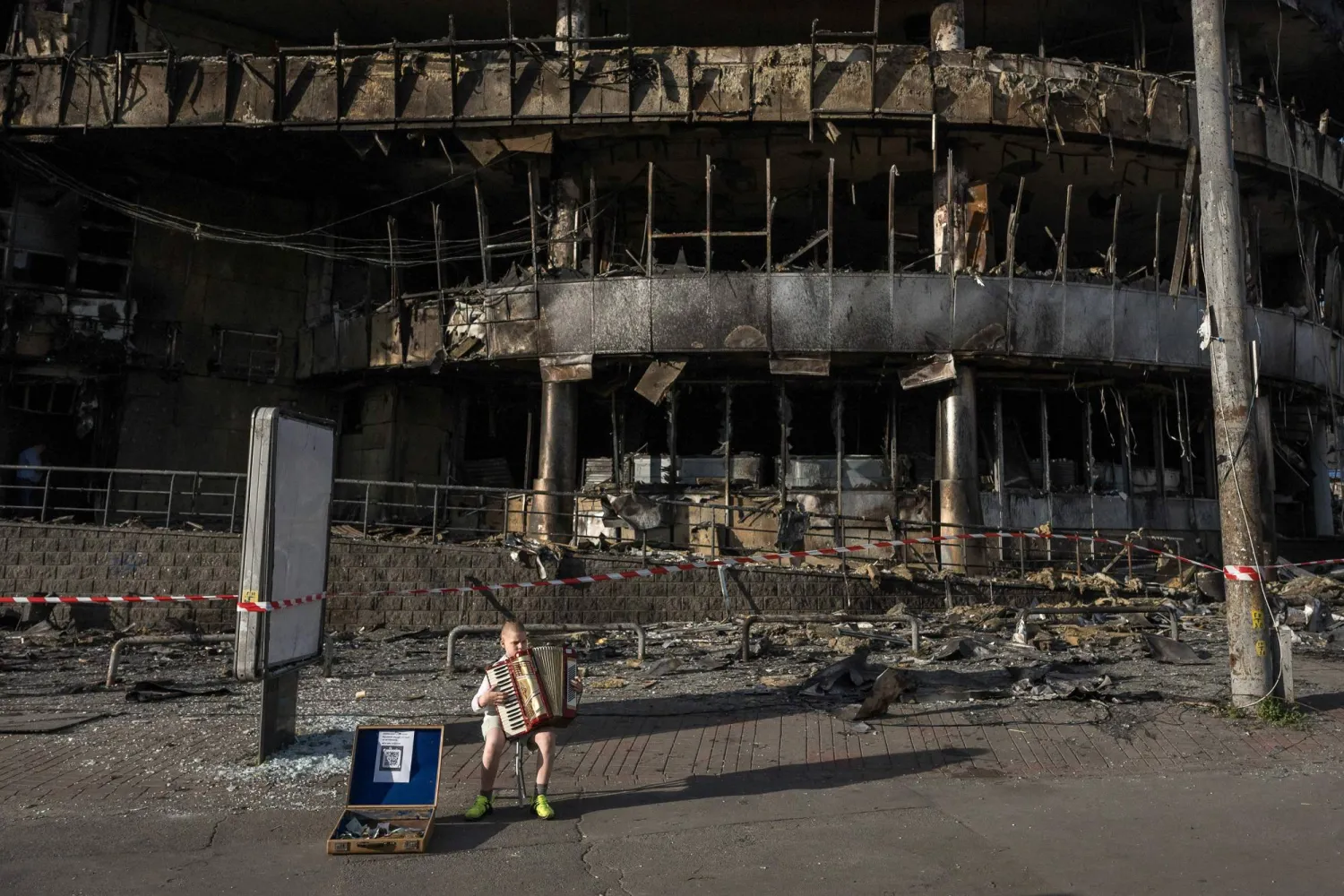
A boy plays the accordion in front of a shopping center damaged by Russian strikes in Kyiv on May 25, 2026, amid the Russian invasion of Ukraine. (AFP)
TT

Russian Call for Diplomats to Leave Kyiv Draws Western Backlash

A boy plays the accordion in front of a shopping center damaged by Russian strikes in Kyiv on May 25, 2026, amid the Russian invasion of Ukraine. (AFP)

Russia's call for diplomats and foreigners to leave Kyiv over the threat of fresh strikes drew a sharp backlash from Western countries on Tuesday, some of whom accused Moscow of escalating the more than four-year war. 

Russia announced Monday it had started a campaign of "systematic" strikes on Kyiv, after battering Ukraine with hundreds of drones and a hypersonic missile over the weekend. 

It said the strikes would target the Ukrainian capital's "decision-making centers" and urged foreign citizens and diplomats "to leave the city as soon as possible", as well as for Kyiv residents to avoid public buildings. 

Ukraine called the threats "blackmail" and encouraged its allies to ignore the warning, while several Western diplomatic missions announced they had no plans to evacuate their staff. 

Almost 50 countries condemned what they said were threats by Russia against embassies in Ukraine in a joint statement at the United Nations on Tuesday. 

"We also condemn recent threats by Russia to diplomatic institutions and embassies in Kyiv. This is something which we cannot accept," the joint statement delivered by Ukrainian UN representative Andriy Melnyk said. 

The statement was signed by European countries, Japan, South Korea and others. 

The European Union also lashed out at Russia's threat, saying it had no plans to move its staff, while Germany and Norway summoned Russia's ambassador over the move. 

A spokesperson for France's foreign ministry said Monday that evacuating diplomatic staff from Kyiv was "out of the question." 

Russia's threat came after weeks of escalating strikes between the two sides, and as US-led talks aimed at ending the conflict remained largely frozen over the Iran war. 

Russia last week accused Ukraine of hitting a vocational school in the Russian-occupied Lugansk region, killing 21 people, while a massive attack on Ukraine's capital the week before killed 24, according to Ukrainian authorities. 

Both sides deny targeting civilians. 

UN Secretary-General Antonio Guterres said on Tuesday he was "deeply concerned" by Russia's announcement. 

"We condemned the attack on the school – as we condemn all attacks on ‌civilians and civilian infrastructure, wherever they occur," he said.  

"Now ⁠more ⁠than ever, it is imperative to avoid any escalation of a conflict that has already exacted a devastating toll on civilians, and that risks making the search for peace even more distant, prolonging the suffering of people," Guterres added. 

US Secretary of State Marco Rubio said Tuesday that Washington remained ready to mediate in the conflict. 

"Every time you see these big strikes from one side or the other, it's a reminder of why this is a terrible war that's now gone on longer than the Second World War, and it needs to come to an end," Rubio told reporters during an official visit to India. 

He was referring to the length of WWII for Moscow, which entered the war in June 1941 when Nazi Germany invaded the USSR, with the conflict ending in May 1945 with Germany's surrender. 

- Drone threats - 

Both Russia and Ukraine exchanged strikes on Tuesday. 

A Ukrainian drone attack killed one person in Russia's Belgorod border region, local authorities said, while Russian strikes on Ukraine left several wounded, according to Ukrainian officials. 

Drones have also routinely crossed the airspace of the three Baltic nations, incidents that have forced citizens to seek shelter and prompted NATO to scramble jets. 

The drones are thought to be of Ukrainian origin but are sometimes deflected into the Baltics by electronic jamming, according to European and Ukrainian officials. 

Russia has accused the Baltics of offering their airspace as a springboard for attacks on Russia, an accusation that NATO and Ukraine deny. 

EU chief Ursula von der Leyen said Tuesday that Russia bore ultimate responsibility for the incidents. 

"People in the Baltic countries have been experiencing what many believed belonged to another era," von der Leyen said, standing alongside the presidents of Lithuania, Latvia and Estonia. 

"Air raid alerts, families sheltering, schools closing, transport interrupted. This is the reality on Europe's eastern border in 2026," she said. 

"These are not isolated incidents. This is a deliberate strategy from Russia, trying to destabilize our democratic societies." 

Since Russia launched its full-scale offensive in 2022, hundreds of thousands of people have died, millions have been forced to flee their homes and parts of eastern and southern Ukraine have been decimated by fighting. 

Russia currently occupies around a fifth of Ukraine: the entirety of the Crimean peninsula, which it annexed in 2014, most of the eastern regions of Donetsk and Lugansk -- collectively referred to as the Donbas -- and large parts of the southern Zaporizhzhia and Kherson regions. 

The conflict has spiraled into Europe's deadliest since World War II. 


US Launches ‘Economic Onslaught’ Against Iran’s Financial Connections

WASHINGTON, DC - AUGUST 24: US Treasury Secretary Scott Bessent announces a new set of sanctions against Iran in the Cash Room at the Treasury Department on August 24, 2026 in Washington, DC. Chip Somodevilla/Getty Images/AFP
TT

US Launches ‘Economic Onslaught’ Against Iran’s Financial Connections

WASHINGTON, DC - AUGUST 24: US Treasury Secretary Scott Bessent announces a new set of sanctions against Iran in the Cash Room at the Treasury Department on August 24, 2026 in Washington, DC. Chip Somodevilla/Getty Images/AFP

US Treasury Secretary Scott Bessent unveiled Monday what he described as an "economic D-Day" that aims to give a final warning to countries to sever their business ties with Iran or risk having key companies and entities cut off from the dollar-based financial system.

"We are launching an economic onslaught against Iran’s financial connections around ⁠the globe. Our ⁠objective is to sever every economic lifeline that sustains this tyrannical regime until Tehran stands alone," Bessent said.

He added that it’s “no longer acceptable to operate in the gray spaces” of the conflict.

He did not name what countries could face potential secondary sanctions from the United States.

“Let there be no ambiguity as to the position of the United States,” Bessent told a news conference. “An economic engagement of any kind with this murderous regime will expose those responsible to the full reach of American power.”

The US Treasury Department has mapped the networks, facilitators, and financial channels that Iran uses to smuggle oil and evade sanctions and said that Washington would be working with US partners to target any source of Iran's "illicit revenue."

The department said it has issued determinations against five sectors -- digital assets, technology, gold, ⁠aviation and shipping -- that the Iranian government is using to prop up its economy. The Treasury has also imposed sanctions on nearly 60 entities, individuals and vessels.

US President Donald Trump's war with Iran, which has pushed energy prices higher worldwide, is about to hit its six-month mark. While heavy fighting has ‌subsided, diplomatic efforts to end the war have stalled and oil and raw material shipping through the Strait of Hormuz ⁠remains blocked, ⁠keeping energy prices elevated.


Trump Says Iran 'Collapsing' Ahead of Sanctions Announcement

Motorcyclists pass a billboard depicting US President Donald Trump with hands around his neck beneath the words "Revenge is inevitable" in Tehran, Iran, Monday, Aug. 24, 2026. (AP Photo/Vahid Salemi)
TT

Trump Says Iran 'Collapsing' Ahead of Sanctions Announcement

Motorcyclists pass a billboard depicting US President Donald Trump with hands around his neck beneath the words "Revenge is inevitable" in Tehran, Iran, Monday, Aug. 24, 2026. (AP Photo/Vahid Salemi)

President Donald Trump said Monday that Iran is "collapsing" hours before the US government was set to announce details of what it says will be crushing sanctions against Tehran.

"IRAN IS COMPLETELY COLLAPSING!!!" Trump posted in his trademark all-caps style on his social media platform Truth Social.

“President Trump decimated Iran’s economy to a point where the rial has never been weaker and inflation has rarely been higher,” US Treasury Secretary Scott Bessent wrote Sunday in an opinion piece in the Financial Times.

“The regime’s final refuge now lies in the self-deception of fearful nations that still believe accommodating aggression can secure a durable peace.”


Health of Norway's King Deteriorated but he is Stable Now

(FILES) Norway's King Harald gives a speech at the gala dinner at the Castle in Oslo on April 8, 2025 during the state visit of Iceland's President Halla Tomasdottir and her husband Bjorn Skulason. (Photo by Fredrik Varfjell / NTB / AFP)
TT

Health of Norway's King Deteriorated but he is Stable Now

(FILES) Norway's King Harald gives a speech at the gala dinner at the Castle in Oslo on April 8, 2025 during the state visit of Iceland's President Halla Tomasdottir and her husband Bjorn Skulason. (Photo by Fredrik Varfjell / NTB / AFP)

Crown Prince Haakon visited his father King Harald of Norway on Monday at the hospital, after the king's health deteriorated over the weekend, public broadcaster NRK reported.

The 89-year-old monarch, who has been on sick leave for several weeks, was admitted to the National Hospital a week ago. He is now receiving antibiotics for a bacterial blood infection and has responded to treatment, the royal palace said late Sunday, adding that his condition is stable.

Haakon, has been serving as regent during that time, The Associated Press quoted the palace as saying.

The king has hemolytic anemia and was being treated with cortisone, leading to fluid accumulation in the body that required hospital treatment, the palace said last week.

Norway's prime minister sent his wishes for the king and said that “all of Norway is following and thinking about the king,” NRK reported.

“My strong wish is that he continues to receive good treatment from the good healthcare system we have,” Prime Minister Jonas Gahr Støre said.

Harald, who has been monarch since 1991, has been in and out of the hospital several times in recent years.

In February, he was admitted to a hospital in Spain’s Canary Islands during a winter vacation for treatment for a skin infection.

Two years ago, the king fell ill during a private vacation with the queen in Malaysia and received a temporary pacemaker there. Harald returned aboard a medical airplane to Norway, where he was fitted with a permanent pacemaker.
