


Aid Supplies Reach Heart of Congo’s Ebola Outbreak

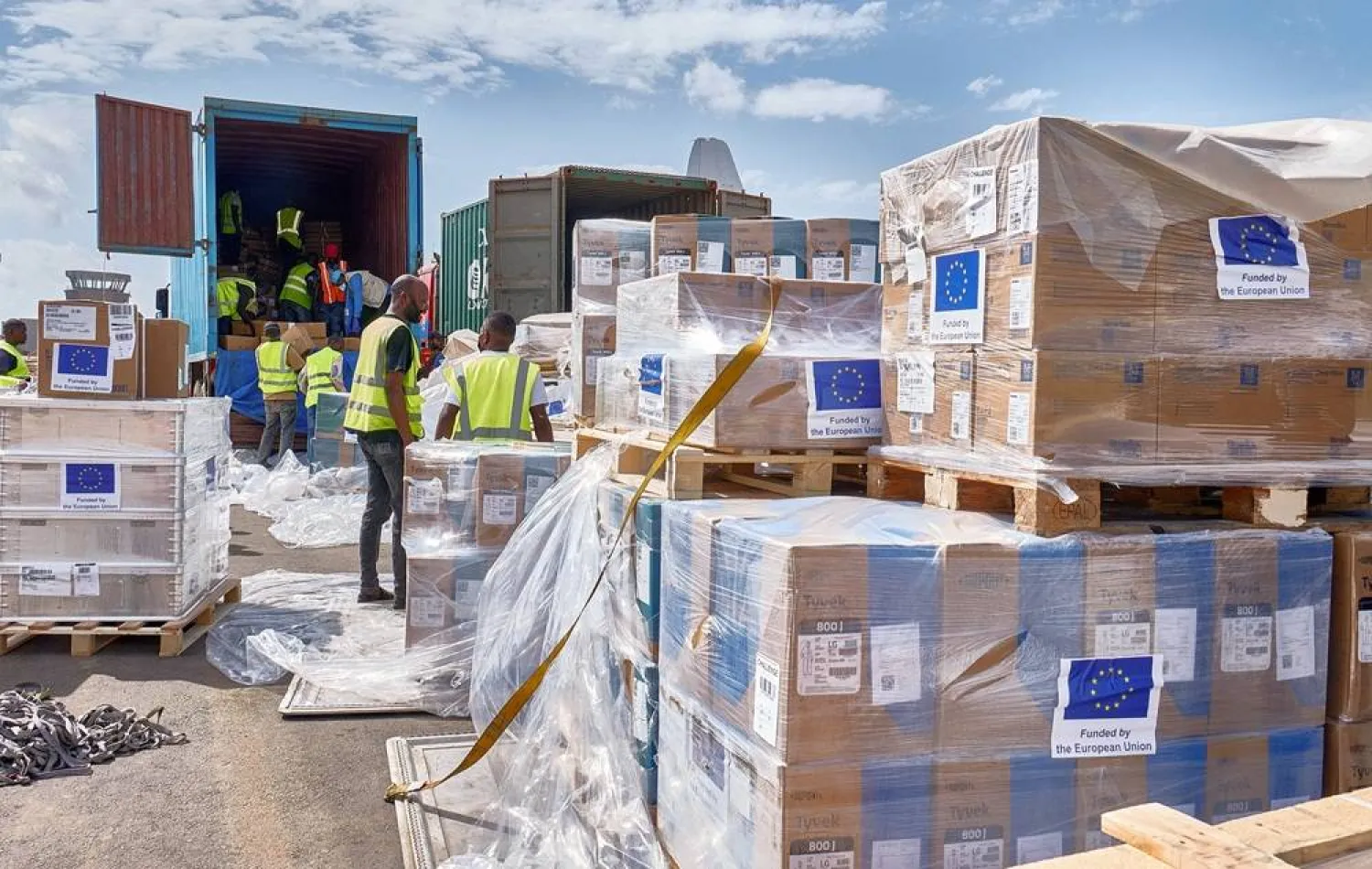
UNICEF staff and airport workers load trucks with aid from the European Civil Protection and Humanitarian Aid Operations (ECHO) for the Ebola outbreak caused by the Bundibugyo strain, at Bunia National Airport in Bunia, Ituri province, Democratic Republic of Congo, May 28, 2026. (Reuters)
TT

Aid Supplies Reach Heart of Congo’s Ebola Outbreak

UNICEF staff and airport workers load trucks with aid from the European Civil Protection and Humanitarian Aid Operations (ECHO) for the Ebola outbreak caused by the Bundibugyo strain, at Bunia National Airport in Bunia, Ituri province, Democratic Republic of Congo, May 28, 2026. (Reuters)

Aid workers rushed supplies Thursday to the center of Congo's outbreak of a rare type of Ebola virus while beleaguered medical personnel struggled with a lack of equipment, a distrustful population and armed groups in a volatile region.

A white cargo plane with aid donated by the European Union delivered masks, gloves, boots and medications, which all are in short supply, to the northeastern town of Bunia at the heart of the outbreak in Congo's Ituri province. UN-branded forklifts lifted several cases into trucks.

Health workers with scant supplies have been struggling to contain an outbreak of the Bundibugyo virus, a kind of Ebola that has no approved treatment or vaccine. In some areas, doctors have resorted to wearing expired medical masks while treating suspected patients.

Dangers faced by health workers have been heightened by anger among residents over the stringent medical protocols for dealing with the bodies of victims, which clash with local burial rites. Residents have launched at least three attacks against health centers in Ituri province.

Congolese Health Minister Samuel Roger Kamba said that during outbreaks people in remote communities can feel overwhelmed by an incoming flood of information and people.

“We’ve seen in every epidemic that there’s always resistance,” Kamba said. "Communities always ask themselves, ‘What’s going on?’ And in epidemics like this one, it is really risk communication and community engagement that ultimately change perceptions.”

Aid donated by the EU is expected to arrive in batches over the next eight days, said Jérôme Kouachi, head of emergency operations at UNICEF in Congo.

World Health Organization Director-General Tedros Adhanom Ghebreyesus was on his way to Congo to witness the efforts. The WHO has declared the outbreak a public health emergency of international concern, in the hope of ramping up aid.

The United States on Thursday said it is increasing aid to Congo and Uganda by $80 million, bringing its commitment to more than $112 million since the outbreak.

The additional money would pay for personal protective equipment for health care workers, Ebola test kits, support for health screening at airports and contact tracing, the US State Department said.

Dr. Jean Kaseya, the Africa Centres for Disease Control director-general, said the organization on Monday believed it had secured funding pledges of nearly $500 million toward Africa’s emergency response, but as of Thursday afternoon the amount had dwindled to $290 million as partners withdrew or reduced pledges.

He also said the Africa CDC hoped to have treatments and a vaccine for the Bundibugyo virus by the end of the year and there were some vaccine candidates already in the works.

The Congolese government has confirmed more than 1,000 suspected cases, with at least 220 deaths, since it declared an outbreak on May 15. But the virus had been spreading undetected for weeks and the WHO suspects it is much larger than what has been reported.

The virus also has reached neighboring Uganda, which has confirmed seven cases and one death.

On Wednesday, the Congolese government said the first survivor to recover from the virus had left a health center.

“We are trying to catch up,” Congo Foreign Minister Thérèse Kayikwamba Wagner said earlier this week. “It is a race against the clock.”

The ground response has been hampered by multiple challenges including customs' red tape, insufficient storage facilities, bad roads and weak telecommunications, humanitarian agencies said in a report Thursday.

Tedros on Wednesday called for a ceasefire in a region where armed groups have staged violent attacks for decades.

“We cannot build community trust or isolate the sick while bombs are falling,” he said.

Tucked in the northeastern part of Congo close to the Ugandan border, Ituri province has been reeling from attacks by the Allied Democratic Force, a rebel group allied with the ISIS group, and a coalition of ethnic militias. In early May, the ADF killed at least 40 people and burned several homes in Ituri.

The illness also has been reported in the Congolese provinces of North Kivu and South Kivu, south of Ituri, where the Rwanda-backed M23 rebel group controls many key cities including Goma and Bukavu. The rebels have reported two cases.

The region’s main airport in Goma, which doubles as a staging ground for humanitarian efforts into the region, has been closed since January 2025, when M23 seized the city.

The conflict has precipitated one of the world’s largest humanitarian crises, with at least 7 million people displaced in eastern Congo.



Poland President Says Wants Zelensky Stripped of Award

Polish President Karol Nawrocki (C) attends the ceremony marking the 86th anniversary of the outbreak of World War II in Wielun, central Poland, 01 September 2025. EPA/Marian Zubrzycki POLAND OUT
TT

Poland President Says Wants Zelensky Stripped of Award

Polish President Karol Nawrocki (C) attends the ceremony marking the 86th anniversary of the outbreak of World War II in Wielun, central Poland, 01 September 2025. EPA/Marian Zubrzycki POLAND OUT

Poland's president said Friday he wanted Volodymyr Zelensky to be stripped of his country's highest civilian award, after the Ukrainian leader named a military unit after a historical faction accused of killing scores of Poles in World War II.

Karol Nawrocki told the media he was "outraged" and had proposed "the withdrawal of the Order of the White Eagle from President Zelensky".


China Opposes any Country Using Freedom of Navigation to Undermine Its Sovereignty

FILE PHOTO: A cargo ship with containers docks at a terminal of the Yantian port in Shenzhen, Guangdong province, China October 30, 2025. REUTERS/Tingshu Wang/File Photo
TT

China Opposes any Country Using Freedom of Navigation to Undermine Its Sovereignty

FILE PHOTO: A cargo ship with containers docks at a terminal of the Yantian port in Shenzhen, Guangdong province, China October 30, 2025. REUTERS/Tingshu Wang/File Photo

China said on Friday it firmly opposes any attempt by any country to undermine its sovereignty and security "under ‌the pretext ‌of freedom ‌of navigation", ⁠in response to ⁠a Canadian warship passing through the Taiwan Strait.

Canadian media reported that the frigate HMCS Charlottetown made ⁠the transit last ‌week ‌without being accompanied by ‌any allied countries' ships, reported Reuters.

Chinese ‌foreign ministry spokesperson Mao Ning added that China respects all countries' ‌rights to navigation under international law.

The Canadian Department ⁠of ⁠National Defense and Taiwan's defense ministry did not immediately respond to requests for comment.


Report: China is Building Launch Pads near Its Nuclear Missile Silos

A satellite image shows what security analysts say is a fortified weapons storage installation, revealing revetments around the building, a perimeter wall and guard towers, in the Xinjiang Uyghur Autonomous Region, China, March 19, 2026. Vantor/Handout via REUTERS
TT

Report: China is Building Launch Pads near Its Nuclear Missile Silos

A satellite image shows what security analysts say is a fortified weapons storage installation, revealing revetments around the building, a perimeter wall and guard towers, in the Xinjiang Uyghur Autonomous Region, China, March 19, 2026. Vantor/Handout via REUTERS

In a remote Chinese desert, a vast military complex is taking shape that some security scholars say appears built to ensure no American first strike on China’s nuclear arsenal could reliably knock out Beijing’s ability to hit back.

China’s nuclear missiles can already reach any city in the United States. Now, satellite images reviewed by Reuters show Beijing is building a sprawling web of launch pads, bunkers and communications nodes near the isolated nuclear silos that hold the Chinese military’s longest-range missiles.

The images reveal more than 80 pads for possible use by China’s expanding fleet of mobile missile launchers and air-defense batteries. They also show facilities that may serve electronic warfare, satellite communications and command operations, according to three security analysts, who assessed the imagery for Reuters. (View the story on Reuters.com: )

The scale of the construction, which hasn’t been previously reported, points to a sweeping expansion of hardened infrastructure designed to protect and operate China’s land-based nuclear forces. Taken together, the network signals a significant upgrade in Beijing’s efforts to ensure second-strike capability, underscoring intensifying nuclear competition with the United States as tensions rise over issues such as Taiwan’s sovereignty.

“We can see this infrastructure is being built on a grand scale, covering thousands of square kilometers of desert beyond the silo fields," said Alexander Neill, an adjunct fellow at Hawaii’s Pacific Forum think tank. Depending on the precise capabilities, he said, “we're looking at a very considerable enhancement and diversification of China's strategic nuclear deterrent.” The ability to protect its desert silos is key to China’s stated goal of forging a minimal but credible nuclear deterrent — a policy grounded in the capacity to retaliate if it is struck first. While the People’s Liberation Army (PLA) can fire nuclear weapons from submarines and aircraft, ‌the silo fields in ‌the northwestern Xinjiang region and Gansu province are the core of its nuclear forces. China’s nuclear build-up is among the most scrutinized facets of President ‌Xi Jinping’s ⁠military modernization because ⁠of what some foreign diplomats describe as Beijing’s lack of transparency and failed efforts by the United States to engage the Chinese leadership on its evolving nuclear capabilities and intentions.

A cornerstone of China’s doctrine is its “no first use” policy, meaning its forces wouldn’t initiate a nuclear exchange. But some senior Western diplomats and analysts say China would possibly resort to nuclear coercion to limit outside involvement in a conflict over Taiwan. Xi this month warned US President Donald Trump that mishandling of their countries’ disagreements over Taiwan, which China claims as its territory, could lead them to a “dangerous place.” Taiwan’s government rejects China’s sovereignty claim.

China’s defense ministry didn’t respond to questions about its nuclear program and the developments revealed in the satellite imagery. The Pentagon said it wouldn’t comment on intelligence-related matters.

OCTAGONS IN THE DESERT

The new desert infrastructure is centered on two octagon-shaped installations built over the past six years in eastern Xinjiang. Both are southwest of the Hami nuclear silo fields – one is about 140 kilometers away, the other some 230 kilometers.

Satellite images show the octagon structures contain housing for personnel and large military vehicles. They are flanked by armored bunkers ⁠and fortified weapons-storage areas, as well as airfields and railheads that link the octagons to the Hami silos.

Exercises involving large military vehicles occurred around the ‌northern octagon this month and during April, the images show. Also evident in recent images are large tents and what two analysts said ‌appear to be camouflaged launch sites cut into the desert, some with air-defense missile batteries.

The existence of the octagons has been documented previously. But Reuters is the first to report the extent of the launch-pad network linked ‌to the octagons; recent military activity around one of the facilities; and analysts’ assessments that the pads could field mobile missile launchers and electronic-warfare operations.

Five security scholars interviewed by Reuters agreed the infrastructure broadly ‌could support China’s nuclear program, as well as other military purposes. But they cautioned that key details remain unknown — including the weapons China might deploy at the launch pads and whether the octagon structures house truck-mounted ballistic missiles or facilities for fitting nuclear warheads.

The PLA displayed nuclear-capable weapons during a parade in Beijing last September to mark the 80th anniversary of the end of the Second World War. These included silo-based and truck-mounted intercontinental ballistic missiles (ICBMs). US officials and arms-control analysts say China is expanding and improving its nuclear weapons capabilities faster than any other nation. The latest Pentagon report on China’s military modernization says the country’s warhead production has slowed but it is on track to field 1,000 warheads ‌by 2030. The December report estimated China is likely to have loaded 100 ICBMs across its three main silo fields.

China has also been strengthening its early-warning system, underpinned by its Huoyan-1 satellites, according to US officials. The system can detect an incoming ICBM within 90 seconds of launch ⁠and alert a command center within three to four ⁠minutes, according to the Pentagon — sufficient time for China to fire its own silo-based weapons before they are hit.

‘AN EXTRAORDINARY EFFORT’

Significantly, each octagon sits at the core of a network of dirt roads and conduits that stretch far into the desert. These routes connect to the concrete pads, which are nestled among rocky outcrops and dry creekbeds.

The pads could be used to deploy mobile air-defense missiles, electronic warfare nodes or, from some of the larger ones, road-mobile ICBM launchers, three security scholars said.

Hans Kristensen, director of the Federation of American Scientists’ Nuclear Information Project, said while it was difficult to conclude how the various installations would be used, “it is hard to rule anything out” given the scale of the infrastructure in such a hostile environment.

The conduits that link the pads to the octagon structures may contain fiber-optic cables for communications, Kristensen and Neill said.

At the northernmost octagon, a possible space or microwave communications facility is also under construction, three analysts said, pointing to satellite dishes and two large towers.

“Taken together, I think there is a real possibility that the octagonal structures and the strange towers are linked to C3 - command, control, and communications - as well as maintenance and storage activities related to China's nuclear operations at the Hami ICBM silo site,” said Tong Zhao, a senior fellow in nuclear policy at the Carnegie Endowment for International Peace.

A third octagon-shaped installation south of the Lop Nur nuclear test facilities is less developed. It appears to be used as a target range: Images show pock-marked earth, damaged buildings and what analysts at Vantor, a commercial provider of satellite imagery, said are mock-ups of Western jet fighters.

The extent of the defensive network near its silos potentially sets China apart from the other major nuclear powers. The US and Russia — whose warhead stockpiles and deployed weapons far exceed Beijing’s — rely on a combination of sheer numbers of silos, their relative isolation and hardened construction to deter a first strike, rather than extensive missile defense, Kristensen said.

The scale of what is emerging in China’s northwestern desert has left even seasoned analysts startled.