

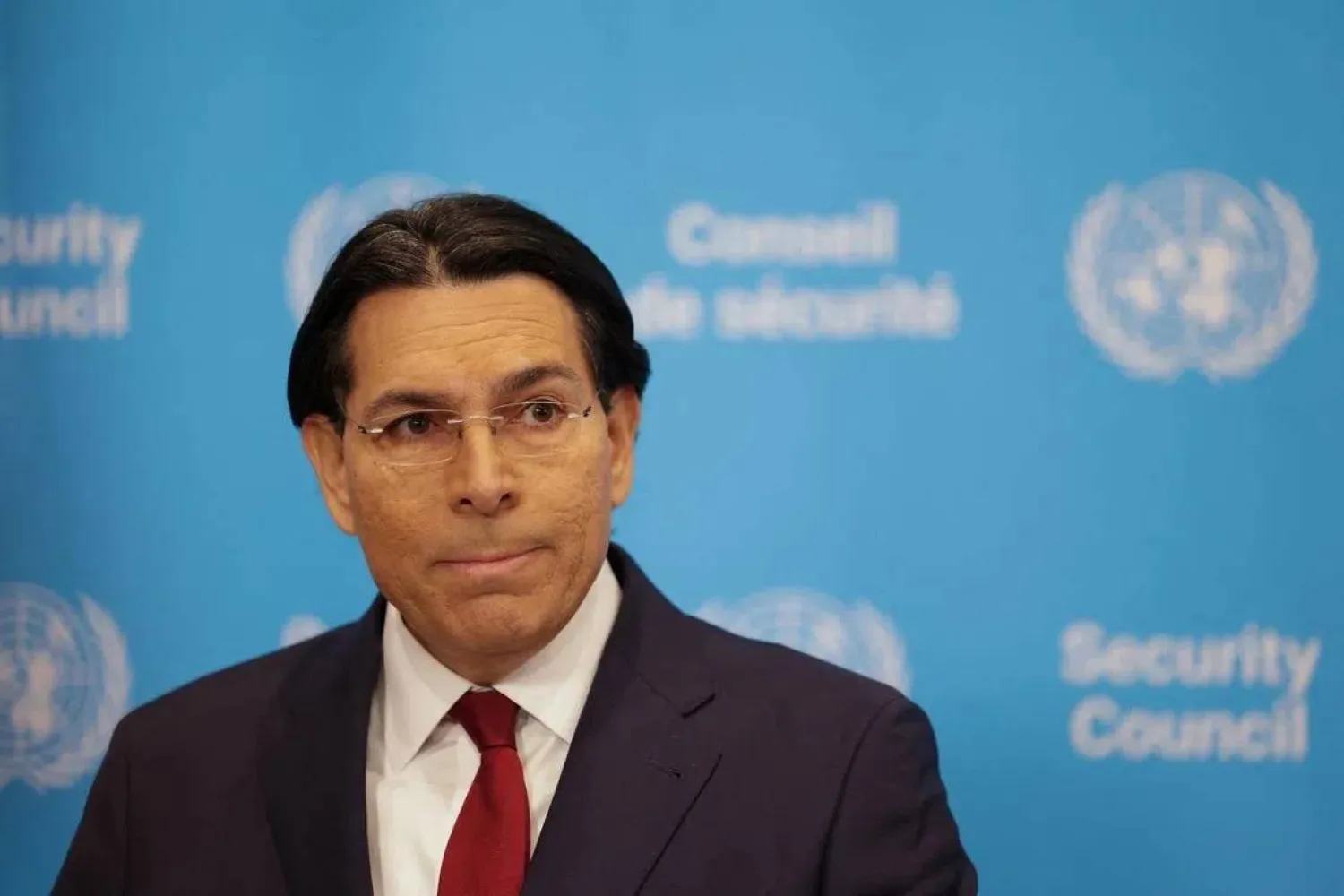

UN Places Israel on Sexual Violence Blacklist

Israel's ambassador ‌to the United Nations Danny Danon. (Reuters file)
TT

UN Places Israel on Sexual Violence Blacklist

Israel's ambassador ‌to the United Nations Danny Danon. (Reuters file)

The United Nations on Friday added Israel and Russia to a UN blacklist of countries suspected of committing sexual violence in conflict zones, a move that prompted Israel's foreign ministry to say it would sever all ties with UN Secretary-General Antonio Guterres. 

Guterres' annual report to the UN Security Council on conflict-related sexual violence goes a step further than last year, when he put Israel and Russia "on notice" that they could be added to the list of parties "credibly suspected of committing or being responsible for patterns of rape or other forms of sexual violence." 

The latest report does that and contains harrowing descriptions of abuses at the hands of Israeli and Russian armed and security forces. 

Israel's arch enemy Hamas, whose October 7, 2023, attack on southern Israel triggered the war in Gaza, was already on the blacklist and in a post on X on Thursday, Israel's UN Ambassador Danny Danon ‌said ranking Israel ‌with the group marked a "new low". 

"This is a political decision! Disconnected from the ‌facts and ⁠reality!" Danon said ⁠in another post by the Israeli mission to the UN which said he was informed about it during a phone call with Guterres. 

Russia's UN mission did not immediately respond to a request for comment. 

Being added to the list does not automatically carry specific punitive measures, such as sanctions, although public naming and shaming can cause significant reputational damage for the states involved, and those repeatedly listed are barred from UN peacekeeping operations. 

Danon said Israel had responded in detail to each allegation and had invited UN representatives to visit and examine the situation, but that they had chosen not to do so. 

"Given that Antonio Guterres has chosen to violate ⁠every standard of honesty, integrity and professionalism, Israel has decided to sever all ties with ‌the Secretary-General’s Office and will wait until a new UN Secretary-General is appointed,” the ‌ministry posted on X. 

A new UN secretary-general is due to be appointed later this year. 

Asked about Danon's comments at a regular ‌briefing on Thursday, UN spokesperson Stephane Dujarric said: "I can tell you from the Secretary-General's point of view, his door remains open ‌to Israeli representatives, as to the other 192 member states and the two observer states." 

RAPES AND GANG RAPES 

This year's report said that in 2025, "the United Nations verified multiple incidents of conflict-related sexual violence, including as a form of torture, inflicted against 14 men, seven women, nine boys and one girl from the Gaza Strip and the West Bank." 

It said 13 of the cases occurred in 2025, and 18 ‌in 2023 and 2024. 

"Violations consisted of rape, including with objects, gang rape, attempted rape, physical violence to the genitals, instances of targeted shooting of the genitals, touching of breasts and ⁠genitals, strip and cavity searches ⁠conducted without apparent security justification, forced nudity and threats of rape," it said. 

"Rape and gang rape, in some cases repeated, were perpetrated against nine victims, the majority from Gaza," it said, adding that perpetrators included Israeli armed and security forces and occurred primarily during detention and interrogation and across several sites, including military camps and also at checkpoints and during Israeli military operations in the Occupied Palestinian Territory. 

It said survivors included journalists and human rights defenders and that in some cases, the violations were filmed or photographed, including one case of rape. 

The report added that sexual violence against female detainees included mostly threats of rape, forced nudity, unwanted touching, and humiliating or degrading strip searches without justification, while men and boys were targeted with rape, attempted rape and violence to the genitals. 

This resulted in five male victims suffering severe rectal bleeding or swelling for multiple days or weeks, it said. 

The report said the UN human rights monitoring mission in Ukraine had verified 310 cases of conflict-related sexual violence perpetrated by Russian armed and security forces. 

It said the cases, including rape, gang rape, genital mutilation, electric shocks and beatings to the genitals, affected 280 men, 26 women and four girls. 


Hotel Blaze in India's West Bengal Kills 9 and Injures 6

FILED - 16 November 2024, India, New Delhi: An Indian ambulance is parked on the side of the road. Photo: Dirk Godder/dpa
TT

Hotel Blaze in India's West Bengal Kills 9 and Injures 6

FILED - 16 November 2024, India, New Delhi: An Indian ambulance is parked on the side of the road. Photo: Dirk Godder/dpa

A fire broke out at a hotel in Kolkata in the early hours Wednesday, killing at least nine people and injuring six in the capital of India’s West Bengal state, police said.

The blaze erupted around 1:45 a.m. at a hotel in central Kolkata close to the West Bengal Fire Department headquarters, the Press Trust of India news agency reported.

Five fire engines were deployed to bring the blaze under control, while police and disaster management teams carried out rescue operations, the report said. The injured were taken to a nearby hospital for treatment.

Firefighters struggled to reach people trapped on the upper floors as thick smoke engulfed the building, a police officer told the news agency.

The fire was brought under control, The Associated Press quoted the officer as saying.

Authorities said their immediate focus was on rescuing anyone still trapped inside and investigating the cause of the fire, which was not immediately known.

Nine people have been confirmed dead but the toll could rise, police told PTI.

Deadly fires, often linked to electrical faults or gas cylinder explosions, are common in India where investigators have frequently pointed to safety lapses and inadequate enforcement of fire regulations as contributing to recurring loss of life.

On Monday, a blaze at a hotel in West Bengal’s temple town of Tarapith left at least seven people dead and several others critically injured.


Ebola Cases in Congo Exceed 5,000

People wearing protective clothing prepare for the burial of a man at Nyamurongo Cemetery in Bunia, Democratic Republic of the Congo, 18 August 2026. EPA/DIEUDONNE DIROLE
TT

Ebola Cases in Congo Exceed 5,000

People wearing protective clothing prepare for the burial of a man at Nyamurongo Cemetery in Bunia, Democratic Republic of the Congo, 18 August 2026. EPA/DIEUDONNE DIROLE

The number of confirmed Ebola cases in the Democratic Republic of Congo now exceeds 5,000, government data showed late on Tuesday, as health officials warn that response efforts are failing to contain the deadly disease.

Congo's 17th Ebola epidemic turned into the biggest in the country's history ⁠in terms of ⁠number of cases in late July and over the weekend the death toll hit 2,378, the public health institute said, surpassing the previous worst outbreak ⁠in 2018-2020.

The institute has so far logged 5,021 cases, according to its latest situation report, making it the second-worst outbreak globally, behind only the 2014 to 2016 epidemic in West Africa in both infections and deaths.

The ongoing outbreak is caused by the Bundibugyo species of Ebola, ⁠which ⁠has no approved vaccines or treatments.

It has gained momentum since it was declared on May 15, as weak health infrastructure, community resistance, instability and protests by response workers hinder efforts to identify and respond to cases.


Mystery Shrouds Leadership of Iran’s Intelligence Agencies

Questions mount over the identity of Iran’s deputy intelligence minister months after Esmail Khatib’s death (Iranian Presidency)
TT

Mystery Shrouds Leadership of Iran’s Intelligence Agencies

Questions mount over the identity of Iran’s deputy intelligence minister months after Esmail Khatib’s death (Iranian Presidency)

Six months into Supreme Leader Mojtaba Khamenei’s rule, Iran has reshuffled its military and security leadership after a war that killed two cabinet ministers and a string of senior Revolutionary Guards commanders.

Yet two of the country’s most sensitive posts remain shrouded in secrecy: who is running the Intelligence Ministry, and who now commands the Guards’ powerful intelligence arm.

Defense Minister Aziz Nasirzadeh was killed on Feb. 28 in the opening strikes targeting the leadership, including the office of former Supreme Leader Ali Khamenei in Tehran’s heavily fortified Pasteur district.

On March 2, Iranian President Masoud Pezeshkian appointed Majid Ben Reza as deputy defense minister. He is expected to be formally nominated to parliament to take over the ministry.

Pezeshkian announced the death of Intelligence Minister Esmail Khatib on March 18. Since then, Iranian authorities have not disclosed who is serving as acting minister.

The government-affiliated news outlet reported last week that the deputy intelligence minister had sent separate congratulatory messages to Supreme National Security Council Secretary Mohsen Rezaei and newly appointed military commanders, pledging the ministry’s cooperation with the new leadership on priorities set by the supreme leader for the armed forces.

Deadline to name two ministers

Pezeshkian is under pressure from close reformist allies over the delay in naming a new intelligence minister, one of five cabinet posts that require the supreme leader’s approval.

In practice, the intelligence minister is usually chosen with the supreme leader’s direct involvement.

The minister also sits on the 12-member Supreme National Security Council, giving the officeholder a direct role in Iran’s main security decision-making body.

Abbas Goudarzi, a lawmaker and spokesman for parliament’s presiding board, said this week that Mojtaba Khamenei had given the government a deadline to submit nominees for the intelligence and defense ministries.

“Under the authorization obtained from the supreme leader, the government has one and a half months from Aug. 20 to submit its proposed ministers for intelligence and defense to the Iranian parliament,” Goudarzi said.

But naming a new intelligence minister may first require a change in the law.

Current legislation requires the minister to have attained the religious rank of ijtihad, a senior scholarly qualification that sharply narrows the pool of candidates to clerics who meet the requirement.

“The idea was raised that ijtihad should not be a requirement for the intelligence minister,” Goudarzi said. “Since the current law conflicts with this proposal, the law must be amended. It was therefore decided that the government would submit a bill to parliament on the matter.”

Legacy of security breaches

Khatib served as intelligence minister under former President Ebrahim Raisi and kept the job when Pezeshkian formed his government two years ago, despite mounting criticism of the security services over a series of breaches attributed to Israel’s Mossad.

Those criticisms intensified after Israeli intelligence reached military commanders and officials involved in the nuclear program who were killed during the war.

The next minister will inherit an agency battered by a string of security breaches and assassinations targeting military, nuclear and security officials, as well as the legacy left by successive ministers who ran the institution.

Fresh questions over the security surrounding senior intelligence officials were raised by Khatib’s son.

In an interview published by the state-run IRNA news agency on Aug. 10, he said his father had faced four assassination attempts before he was killed, including two during the June 2025 war.

He said Khatib was later killed at the home of his second wife despite tight security surrounding his movements.

Cultural Heritage Minister Reza Salehi Amiri is among the names being considered for the intelligence portfolio.

Salehi Amiri, previously known as Reza Fallah, worked at the Intelligence Ministry during the 1980s and 1990s and was one of the agency’s leading interrogators before gradually moving into political and government posts.

He later held positions at strategic research centers affiliated with the Iranian presidency and the Expediency Council.

Under President Hassan Rouhani, he served for a year as deputy minister of sports and youth before becoming a presidential adviser and head of the National Library and Archives.

He also served for a year as culture minister at the start of Rouhani’s second term before returning to government after Pezeshkian became president.

Vacuum in Revolutionary Guards intelligence

The picture is even murkier inside the Revolutionary Guards’ intelligence organization and its protection unit after several senior commanders were killed in the war.

On April 6, the Revolutionary Guards confirmed that Brigadier General Majid Khademi, head of its intelligence organization, had been killed in an Israeli-US attack, hours after Israeli Defense Minister Israel Katz first announced his death.

Khademi had previously headed the Guards’ protection organization before becoming intelligence chief on June 19, 2025, succeeding Mohammad Kazemi.

Before that, he oversaw the unit responsible for protecting political figures and sensitive sites, including key state institutions and nuclear facilities.

Kazemi was killed in Israeli strikes on June 15, 2025, three days after dozens of Revolutionary Guards commanders were killed in the opening strikes of the 12-day war.

That attack also killed Mohammad Reza Nasir Bagban, known by the alias Mohsen Bagheri, head of the Quds Force intelligence unit, and Brigadier General Hassan Mohaghegh, one of the Guards’ most prominent intelligence commanders and a figure with close ties to current Supreme Leader Mojtaba Khamenei.

Tehran has yet to disclose who now leads the Revolutionary Guards’ intelligence organization, its deputy command, or the Quds Force intelligence unit.

Hossein Taeb, however, who spent 13 years at the helm of Guards intelligence, has returned to a senior security role as commander of the Basij, tasked with expanding the “popular intelligence network.”
