


As Ebola Scourges Congo, Experts Warn of Link to Eating Wild Animals

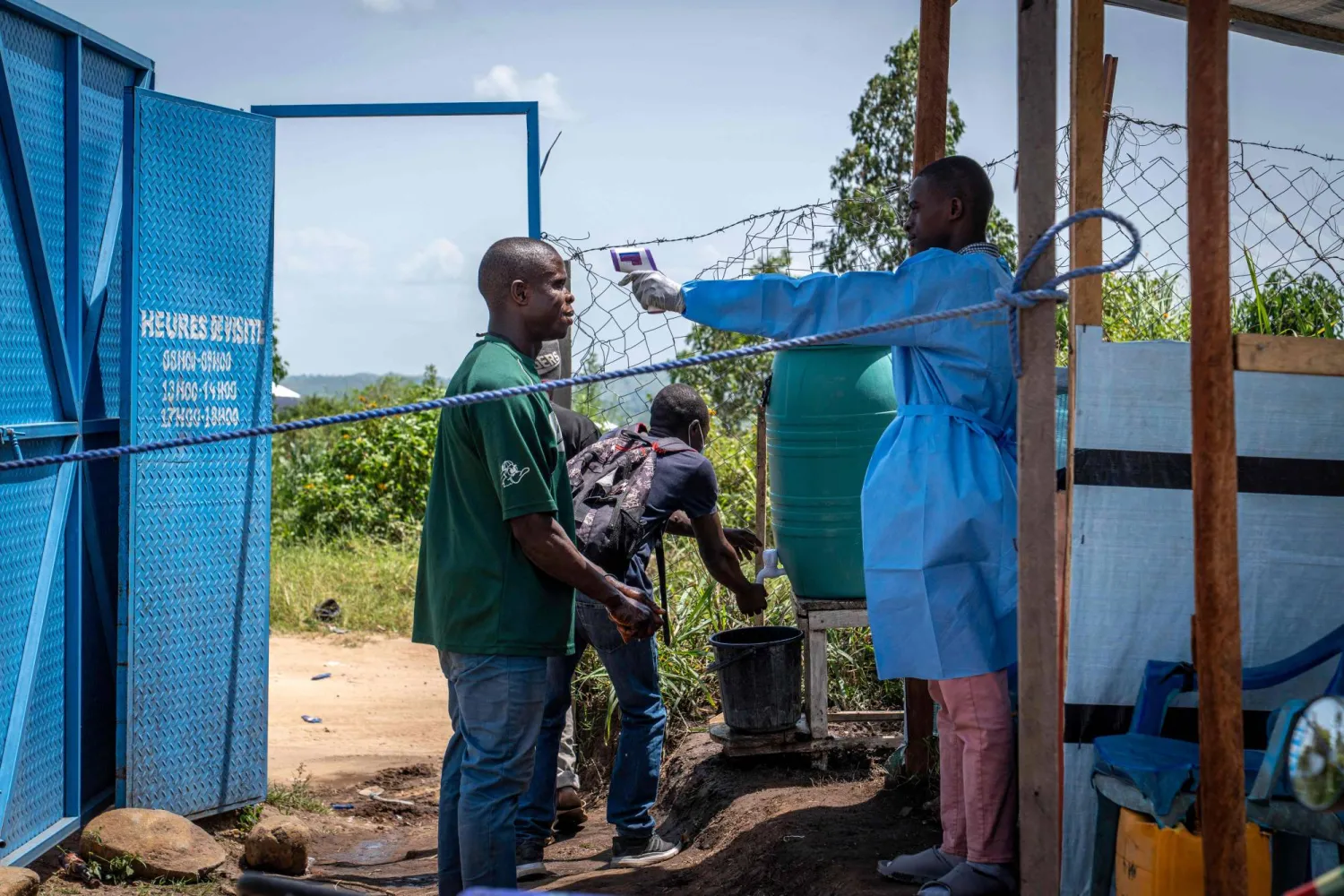
A healthcare worker takes a visitor's temperature at Rwampara Hospital in Ituri, in the eastern Democratic Republic of the Congo, on May 26, 2026. (Photo by Glody MURHABAZI / AFP)
TT

As Ebola Scourges Congo, Experts Warn of Link to Eating Wild Animals

A healthcare worker takes a visitor's temperature at Rwampara Hospital in Ituri, in the eastern Democratic Republic of the Congo, on May 26, 2026. (Photo by Glody MURHABAZI / AFP)

The vendors of wild meat at the sprawling Masina Market in the Congolese capital don’t always display their goods openly. Customers must ask for whatever they're looking for, whether it is a giant swamp rodent or the severed parts of an antelope.

Others occasionally sell in the open, like the women who preside over impossibly large baskets of squirming caterpillars at the market in Kinshasa.

For many in Congo and elsewhere in Central and West Africa wild meat is a craving and a key part of the cultural milieux. Even a disease as punishing as Ebola, currently ravaging a remote part of eastern Congo, has failed to stem demand for wild meat from the Congo Basin, an expansive forested ecosystem sometimes called Earth’s second lung.

The Congo Basin is rich in all kinds of wildlife, from great apes to serpents — both of which are hunted for their meat. One consequence for locals is exposure to zoonotic diseases such as Ebola, The Associated Press said.

Although Ebola is generally not spread by food, cases in Africa have been associated with hunting, butchering and processing meat from infected animals, the US Centers for Disease Control and Prevention has said.

“Once there is human, animal and environment interface. We have these kinds of outbreaks on a frequent level,” said Dr. Tolbert Geewleh Nyenswah of the Africa Centers for Disease Control and Prevention. “And this is why one health approach in dealing with virus outbreaks is important, because we still interact with the bats, and our hunters are still killing monkeys, and we are close to the environment.”

The link between wild meat and Ebola

The Congolese government has confirmed more than 1,000 suspected cases, with at least 220 deaths, since it declared an outbreak of Ebola on May 15. It appears the virus spread undetected for weeks, and the World Health Organization suspects it is much larger than what has been reported.

Ebola, named for a tributary of the Congo River, was first discovered in 1976 in simultaneous outbreaks in Congo and present-day South Sudan. Outbreaks are believed to start with the virus spilling over into humans from an infected animal such as a fruit bat. These cross-species infections often happen when people handle and eat wild meat, experts say.

But since Ebola outbreaks happen only sporadically in communities that regularly eat wild meat, some people “don't believe the linkage” and others are “totally ignorant” of the health threat from eating wild meat, said Dr. Misaki Wayengera, a microbiologist who advises Uganda's Ministry of Health on epidemics.

“It is very difficult to change some of these core practices,” he said.

Locals have paid a heavy price for occasional outbreaks of Ebola, whose bloody symptoms can terrorize entire villages and cause many to believe they are under an evil spell.

The Ebola virus is responsible for 17 outbreaks in Congo and many others elsewhere in the region. The deadliest outbreak, in West Africa between 2014 and 2016, infected an estimated 28,000 people and killed more than 11,300.

According to the Food and Agriculture Organization — which studied the Ebola risk stemming from the eating and handling of wild meat after West Africa’s epidemic — animal-to-human spillovers of Ebola are rare, but "their consequences are nonetheless disastrous.”

Once Ebola has infected one person, the virus then spreads through close contact with sick or deceased patients’ bodily fluids, such as sweat, blood, feces, or vomit. Health workers without sufficient protective gear are seen as highly vulnerable.

The current outbreak in eastern Congo is caused by the Bundibugyo virus, a rare type of Ebola that has no approved medicines or vaccines.

The outbreak is occurring in a part of Congo that also faces armed violence by rebel groups and the displacement of large numbers of people fleeing the violence.

A need for education While Congolese authorities have prohibited hunting endangered wildlife, including great apes sent to the brink of extinction by poachers, there is no blanket ban on the wildlife trade and illegal hunting persists for totemic creatures like the bonobo.

Many in and around the Congo Basin have wild meat as their primary source of animal protein. The yearly extraction rate of wild meat from the Congo Basin is estimated at 4.5 million tons, according to the Center for International Forestry Research.

Viande de brousse, as wild meat is known in French, is a popular food, even served in trendy restaurants. That's intensified pressure on the dwindling resources of the Congo Basin. Despite the ongoing biodiversity losses, the Congo Basin remains the world's largest carbon sink, surpassing the Amazon in its ability to capture and store carbon.

Public health campaigners need to step up education campaigns on how Ebola starts and is spread among communities that face recurring outbreaks, said Gladys Kalema-Zikusoka, founder of the Uganda-based Conservation Through Public Health group.

People need to be told that “eating meat from an unknown source, or a dead animal, is a no-no,” Kalema-Zikusoka said. “It’s a very cultural thing.”

Some fruit bats are believed to be natural hosts of the viruses that cause Ebola, according to the WHO. Yet bats are known to be a delicacy in many parts of Central and West Africa. The soup of a roasted fruit bat is highly sought after, as are the parts of a wide range of monkeys.

In Kinshasa’s Masina Market one recent morning, before the latest Ebola outbreak, traders said they sold antelope, rodent and snake meat sourced from the Congo Basin.

They said they long ago stopped selling the meat of monkeys, possible reservoirs of the Ebola virus.

One vendor, Guyva Mputu, was selling python, whose frozen flesh started to steam in the humid weather.

Another, Charles Ntanga, wielded a flywhisk to swat flies that settled on the rancid carcass of a giant rodent, with a kilogram going for about $17. Ntanga said he gets clients from all walks of life.

“We sell wild meat," he said. “We make our lives through this business.”


Top US and Cuban Military Officers Meet at Guantanamo Bay

This photo posted on the X account of the US Southern Command (SOUTHCOM) on May 29, 2026, shows SOUTHCOM Commander General Francis L. Donovan (C), the Chief of the General Staff and First Deputy Minister of Cuba's Revolutionary Armed Forces (MINFAR) General Roberto Legra Sotolongo (2nd/L) and other Cuban military officials, during their meeting at the perimeter of the US Naval Station in Guantanamo Bay, Cuba, on May 29, 2026. (Handout / US Southern Command / AFP)
TT

Top US and Cuban Military Officers Meet at Guantanamo Bay

This photo posted on the X account of the US Southern Command (SOUTHCOM) on May 29, 2026, shows SOUTHCOM Commander General Francis L. Donovan (C), the Chief of the General Staff and First Deputy Minister of Cuba's Revolutionary Armed Forces (MINFAR) General Roberto Legra Sotolongo (2nd/L) and other Cuban military officials, during their meeting at the perimeter of the US Naval Station in Guantanamo Bay, Cuba, on May 29, 2026. (Handout / US Southern Command / AFP)

Senior US and Cuban military officers met on Friday at Guantanamo Bay, the US base on the communist island, as relations between the two countries deteriorate over President Donald Trump's threatened takeover.

US General Francis Donovan met with Cuban General Roberto Legra Sotolongo "for a brief exchange on operational security matters," US Southern Command said in a statement issued along with a photograph of the meeting.

"Gen. Donovan also led a perimeter security assessment of the naval base and discussed force protection, safety of service members and their families, and operational readiness with base officials."

Cuba's Ministry of Revolutionary Armed Forces stressed that "both delegations consider the meeting to have been positive" and they agreed "to maintain communication between the two military commands," according to a statement released on Facebook.

The uniformed men met at the US base at the southeastern tip of the island.

- Deteriorating relations -

Relations between Havana and Washington have continued to worsen since January, when the United States imposed a de facto oil blockade on the island by operating a military raid to remove leftist Nicolas Maduro from power in Venezuela.

Without Caracas as a lifeline, Cuba has struggled to keep electricity on, or food and medicine in stock.

Cuba's other allies in Russia, China and Iran are also facing US pressure to back off, through a fresh round of sanctions against Cuban companies and leaders. US officials also brought an indictment against former president Raul Castro, in a case that dates back to 1996.

Now Cuba is facing the brink of collapse.

Secretary of State Marco Rubio, who is Cuban American, has said the US is seeing a diplomatic solution to the standoff.

Reports last week suggested that Havana was considering drone strikes on the base in the event of an American attack.

Donovan led a perimeter security assessment of the US facility and discussed safety of service members and operational readiness, the statement said.

Guantanamo Bay, 430 miles (700 kilometers) southeast of Miami, on the southeastern coast of Cuba, is notorious as the site of abuse against terror suspects detained after the September 11, 2001 attacks.

Trump has also planned to use the base as a holding center for undocumented migrants.

"Naval Station Guantanamo Bay is a vital operational and logistical hub that supports US military efforts to counter threats that undermine security, stability and democracy in our hemisphere," US Southern Command said.


Raise Defense Spending or Else, Hegseth Tells NATO, Europe

Swedish Air Force Saab Gripen fighter jets fly over Helsingborg, Sweden, on May 21, 2026, during the Meeting of NATO Ministers of Foreign Affairs taking place on May 21-22. (Photo by Jonathan NACKSTRAND / AFP)
TT

Raise Defense Spending or Else, Hegseth Tells NATO, Europe

Swedish Air Force Saab Gripen fighter jets fly over Helsingborg, Sweden, on May 21, 2026, during the Meeting of NATO Ministers of Foreign Affairs taking place on May 21-22. (Photo by Jonathan NACKSTRAND / AFP)

US Defense Secretary Pete Hegseth took another swipe at Washington's NATO and European partners on Saturday, saying those that do not hike defense spending sufficiently "will face a clear shift in how we do business".

NATO members pledged last year to ramp up defense-related spending to five percent of GDP but, despite increased efforts, many states say they may not be able to reach that target, said AFP.

"For too long, polite pleas from our European allies to spend more on their own defense fell on deaf ears," the Pentagon chief said at a defense summit in Singapore.

"They are finally playing catch-up," Hegseth said in a speech at the annual Shangri-La Dialogue conference.

"Allies who refuse to step up and carry their own weight for our collective defense will face a clear shift in how we do business."

Secretary of State Marco Rubio said this month NATO was facing US troop cuts in Europe as Washington focused on other threats and European nations ramped up their defenses.

In Asia, Hegseth reiterated that the region's security had "rested disproportionately on American military power, while many of our allies and partners allowed their own defense capabilities to atrophy".

Many countries in the Asia-Pacific region were indeed stepping up, Hegseth said, using South Korea as a particular example.

"South Korea has invested consistently in its own defense, because it does not have the luxury of treating war like an academic exercise.

"They live on the front lines, and so they build real combat power."

This "reflects simply a clear-eyed understanding of the threat environment", he said.

Hegseth also praised the spending policies of other countries including Australia, the Philippines and Japan.

"You don't have a strong alliance unless everyone has skin in the game. No freeloading," Hegseth said.

Hegseth agreed when asked by a New Zealand delegate whether he considered the Pacific island nation's plan to increase defense spending from one to two percent to be "freeloading".

"If I'm being honest, two percent is not enough, and so two percent is freeloading.

"I don't have anything against New Zealand, (but) I want partners to step up," Hegseth said.


Trump ‘In Excellent Health’ but Should Lose Weight, Says Presidential Physician

US President Donald Trump reacts during a Cabinet meeting in the Cabinet Room of the White House in Washington, DC, USA, 27 May 2026. (EPA)
TT

Trump ‘In Excellent Health’ but Should Lose Weight, Says Presidential Physician

US President Donald Trump reacts during a Cabinet meeting in the Cabinet Room of the White House in Washington, DC, USA, 27 May 2026. (EPA)

Donald Trump's doctor said he was in "excellent health" but advised him to lose weight, the White House said Friday, after the US president's annual medical check-up weeks before his 80th birthday.

Republican Trump, the oldest president ever inaugurated, has repeatedly boasted about his mental and physical vigor compared to his Democratic predecessor Joe Biden.

But Trump's medical and dental check-up on Tuesday at the Walter Reed Military Hospital near Washington followed questions about his apparent sleepiness in meetings and bruising on his hand.

"President Trump remains in excellent health, demonstrating strong cardiac, pulmonary, neurological, and overall physical function," said Trump's doctor, US Navy Captain Sean Barbabella, in a memo published by the White House.

The three-page memo provides an overview of Trump's physical examination and diagnostic testing, in which Barbabella concludes that the leader is "fully fit to carry out all duties of the Commander-in-Chief and Head of State."

"Preventative counseling was provided, including guidance on diet, recommendation to take a low-dose aspirin, increased physical activity, and continued weight loss," it said.

According to the memo, Trump -- who stands at six foot three inches (191 cm) tall -- weighs 238 pounds (108 kilograms), 14 pounds (6.4 kilograms) higher than his last full annual medical in April last year.

Trump's cardiac age is estimated to be "approximately 14 years younger than his chronological age."

Trump scored "30 out of 30" in the cognitive assessment.

The president has spoken dozens of times about "acing" a cognitive test that he claims his predecessors have not taken.

- 'Frequent handshaking' -

Trump, who turns 80 on June 14, is on three medications, two of which are designated for cholesterol control and the third being aspirin for "cardiac prevention."

Since returning to office, the Republican has often appeared with bruising on his right hand, usually covered with make-up.

"Examination of the dorsal hands revealed ecchymosis (bruising), consistent with minor soft tissue irritation related to frequent handshaking in the setting of aspirin use for cardiovascular prevention," the memo said regarding Trump's bruised hands.

During a number of White House events, the president has also been seen apparently closing his eyes for several seconds, although he has repeatedly denied dozing off.

Last summer, the White House disclosed that he had been evaluated for swelling in his legs and diagnosed with chronic venous insufficiency -- a common condition in which faulty vein valves allow blood to pool, causing swelling, cramping and skin changes.

The revelation came after Trump was seen with swollen ankles on a number of occasions.

The memo also noted "scarring of the right ear consistent with prior gunshot injury."

Trump was the target of an assassination attempt during a rally in Butler, Pennsylvania in 2024. A gunman fired several shots, killing a rally goer and lightly wounding the president in the ear.

- 'Perfect' health -

Trump, for his part, said Tuesday's medical went "PERFECTLY" in a post on his Truth Social platform shortly after the appointment.

The White House later posted a picture of him on social media with the caption: "PERFECT BILL OF HEALTH!"

Following the president's check-up, US media reported that the White House had broken with precedent by not releasing the report, before it did so three days later.

The White House normally releases a summary of presidential physicals within hours or days, but the extent of the detail it gives is entirely at its own discretion.

Trump has long been accused of a lack of transparency about his health and the chronology of his various check-ups during his second term has only added to the confusion.

He referred to Tuesday's appointment as a "six-month physical," despite the White House billing it as an annual dental and medical examination in an announcement earlier this month.

Tuesday's medical examination was Trump's third since returning to office last year.

Trump's last scheduled annual check-up was in April last year. But it was followed by an unannounced hospital visit that October, which the White House then also described as an annual physical.
