


At Least 22 Killed in Heavy Russian Attack on Ukrainian Cities

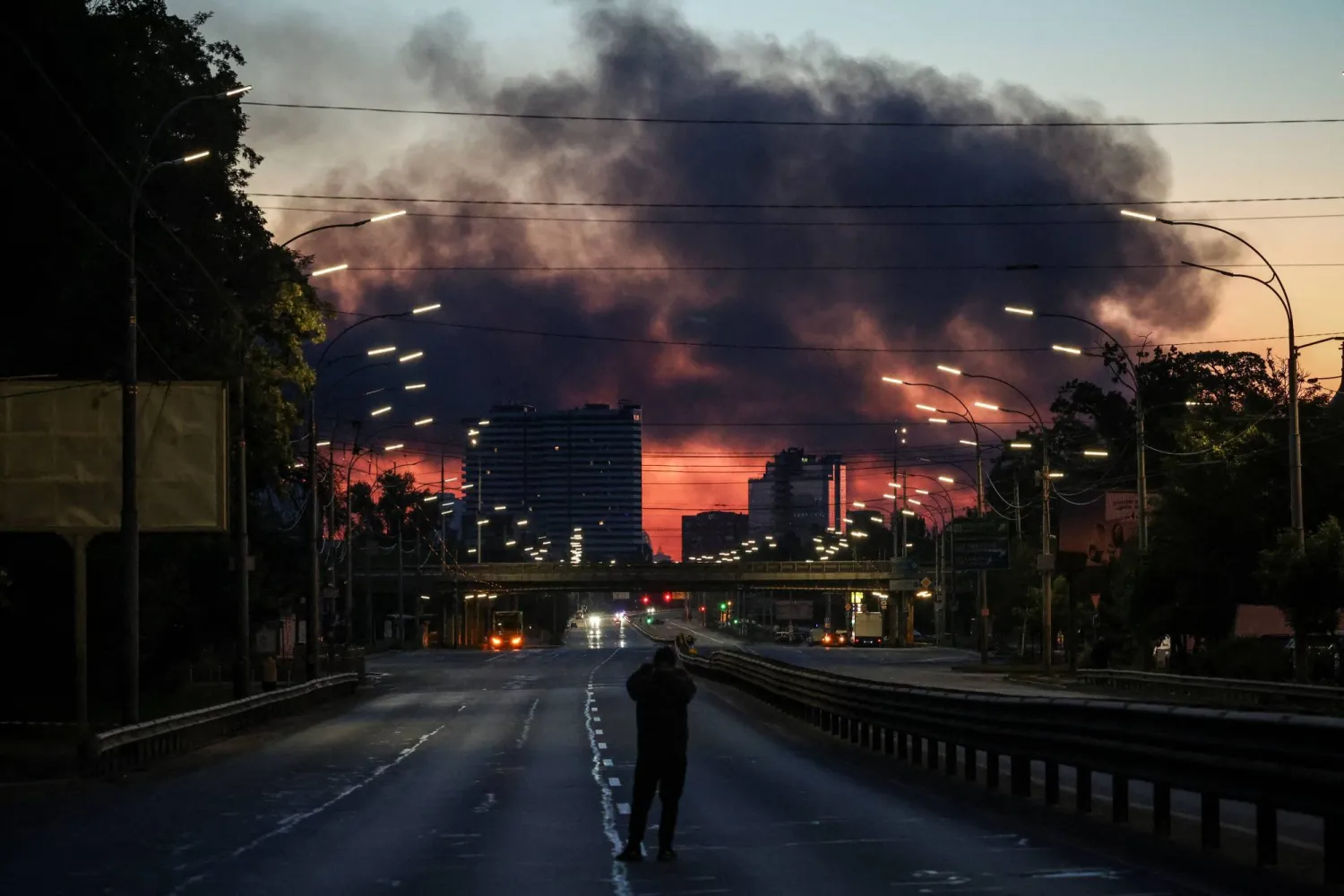
A man takes a picture of a street as smoke rises in the background after an overnight Russian missile and drone strike, amid Russia's attack on Ukraine, in Kyiv, Ukraine June 2, 2026. REUTERS/Alina Smutko
TT

At Least 22 Killed in Heavy Russian Attack on Ukrainian Cities

A man takes a picture of a street as smoke rises in the background after an overnight Russian missile and drone strike, amid Russia's attack on Ukraine, in Kyiv, Ukraine June 2, 2026. REUTERS/Alina Smutko

Russia pounded Ukraine with hundreds of drones and dozens of missiles early on Tuesday in a heavy attack that authorities said killed 22 people and wounded more than 100. 

The strikes on cities including Kyiv and Dnipro followed Russian warnings of "systematic" attacks on the capital after a drone attack on a dormitory in Ukraine's Russian-held region of Luhansk last month. Kyiv denies targeting the dormitory. 

It was the third heavy assault on Kyiv in under a month, but Russia has been relentlessly attacking Ukrainian cities, including Kyiv, since it invaded its smaller neighbor in 2022. 

US-brokered talks on the war in Ukraine have stalled with Washington focusing on Iran, while Russian advances on the battlefield have slowed this year and Kyiv has stepped up strikes on Russian oil refineries. 

ZELENSKIY CALLS FOR AIR DEFENSE SUPPLIES 

Ukrainian President Volodymyr Zelenskiy said Russia had fired 73 missiles and more than 600 drones in the overnight attack and urged Washington to send additional Patriot missile interceptors to replenish Kyiv's dwindling supplies. 

"This was a large-scale attack ‌and an absolutely clear statement ‌from Russia: if Ukraine is not protected from ballistic and other missile strikes, these attacks ‌will continue," ⁠Zelenskiy said on ⁠Telegram. 

The Kremlin said the war had entered "a new paradigm" after what it called "inhumane acts of terror" by Ukraine's military against civilians, echoing accusations Kyiv has made against Russian forces. Moscow warned last week of systematic strikes and urged foreigners to leave Kyiv. 

Zelenskiy sent a letter last week to US President Donald Trump and Congress, asking for air defense systems. As of Monday, officials said he had not received a response. 

Foreign Minister Andrii Sybiha urged partners to take "concrete steps" to help Ukraine and increase pressure on Russia, appealing for tougher sanctions and more military support. 

"Moscow is losing on the battlefield. No number of missiles can change this. What we can change is Russia's ability to continue terror," he said on X. 

The US has ⁠been Ukraine's main foreign supplier of weapons, but Kyiv has also been purchasing Patriot missiles through ‌a NATO initiative, financed by its European allies. 

'SOME KIND OF APOCALYPSE' 

Moscow's war in Ukraine ‌has killed tens of thousands of people, forced much of the population out of their homes and devastated cities, towns and villages. Russia controls about one-fifth ‌of Ukraine. 

Ukraine has also hit civilian targets during attacks on Russia or Russian-occupied areas, though on a much smaller scale. Both sides ‌deny targeting civilians. 

Photographs on Tuesday showed large explosions and smoke billowing over high-rise buildings in Kyiv, where officials said six people were killed and over 80 wounded. 

"We couldn't understand what was happening - some kind of apocalypse?" Olha Mudra, her face and clothes covered in dust, said at the site of one strike, accompanied by her six-year-old daughter Natalia. 

Sixteen people were killed overnight, including two young boys, in the southeastern city of Dnipro, local officials said. Russia attacked the ‌city again later on Tuesday, and at least two more people were injured. 

In Kyiv, at least nine high-rise buildings, a kindergarten, a clinic, offices and administrative buildings were damaged, and the attack ⁠temporarily cut power to 140,000 residents, ⁠power company DTEK said. 

More than 40,000 took shelter in the Kyiv subway system - the biggest number in recent years. Some carried pets, belongings and mattresses. 

HYPERSONIC MISSILES 

Ukraine's Air Force said the attack included 33 hard-to-shoot-down ballistic missiles and eight Zircon hypersonic missiles, which appeared to be the largest number of such missiles used at once during the war. 

The Zircon has a range of 1,000 km (625 miles) and travels at nine times the speed of sound, Moscow says. Ukrainian Air Force units shot down or neutralized 40 missiles and 602 drones, but no Zircon was listed among them. 

Russia's defense ministry said it had carried out a "massive strike" on defense industry facilities using high-precision long-range weapons, and that its strikes had hit 10 military production facilities in Kyiv. 

In Ukraine's northeastern region of Kharkiv, a child was among 14 people injured in the attacks, officials said. 

NATO member Poland said it had scrambled military jets to secure its airspace after the Russian strikes on Ukraine. 

Russian regions also came under attack. The Ilsky oil refinery, in the southern Krasnodar region, caught fire after a drone attack, local authorities said on Telegram. Ukraine's military confirmed the strike. 

In Belgorod region bordering Ukraine, a boy of 11 was injured after a Ukrainian drone hit a home, local authorities said. 

Russia downed 148 Ukrainian drones overnight, Russian news agencies said, citing the defense ministry. 

Reuters could not independently verify all the reports. 


US House Passes Bill to Crack Down on University Boycotts of Israel

Police stand between counter-protesters and a protest encampment in support of Palestinians, during the conflict between Israel and the Palestinian group Hamas, at McGill University’s campus in Montreal, Quebec, Canada May 2, 2024. (Reuters)
TT

US House Passes Bill to Crack Down on University Boycotts of Israel

Police stand between counter-protesters and a protest encampment in support of Palestinians, during the conflict between Israel and the Palestinian group Hamas, at McGill University’s campus in Montreal, Quebec, Canada May 2, 2024. (Reuters)

The ‌US House of Representatives passed legislation on Thursday to block federal aid for universities that boycott Israel, the latest Republican-backed pro-Israel measure amid growing Democratic criticism of the Israeli government over the war in Gaza.

The Republican-majority chamber voted 237-169 in favor of the "Protect Economic and Academic Freedom Act," which would have to pass the Senate in order to become law.

The war in Gaza has devastated much of the Palestinian enclave since Hamas-led fighters killed 1,200 people ‌during an attack on ‌October 7, 2023, according to Israeli ‌tallies. ⁠Israeli attacks since then ⁠have killed more than 73,000 Palestinians, according to the Gaza health ministry.

The conflict sparked protests and calls for boycotts at many US campuses. In response, Republican President Donald Trump targeted colleges and universities with probes and federal funding suspension threats. The administration and many Republicans in Congress ⁠allege that the protesters were antisemitic and ‌supported extremism.

Protesters deny this, saying ‌advocacy for Palestinian rights and objections to the devastation in ‌Gaza should not be equated with antisemitism or support ‌for extremism.

Thursday's House vote was mostly along party lines, with just two Republicans voting nay and 33 Democrats voting in favor.

US Representative Jerrold Nadler, a New York Democrat, said in a statement ‌before the vote that he opposed the global Boycott, Divestment and Sanctions (BDS) movement but ⁠would vote no ⁠because he supported Americans' right to free expression.

"It is the only way to ensure speech I do agree with is equally protected," Nadler said.

The BDS movement seeks to isolate Israel over its treatment of Palestinians.

The bill's sponsors said it was not intended to hinder academic speech or debate, but to prevent the targeting of Israel and Judaism.

"It simply says that if your university takes federal taxpayer dollars, it can't discriminate against academic partnerships or investments with one country," US Representative Josh Gottheimer, a New Jersey Democrat, said in a speech urging support.


Netanyahu Says Toppling Iran’s Regime ‘within Reach’

 Men drive past a banner showing a portrait of the Iranian Supreme Leader Mojtaba Khamenei, in downtown Tehran, Iran, Monday, Aug. 31, 2026. (AP)
Men drive past a banner showing a portrait of the Iranian Supreme Leader Mojtaba Khamenei, in downtown Tehran, Iran, Monday, Aug. 31, 2026. (AP)
TT

Netanyahu Says Toppling Iran’s Regime ‘within Reach’

 Men drive past a banner showing a portrait of the Iranian Supreme Leader Mojtaba Khamenei, in downtown Tehran, Iran, Monday, Aug. 31, 2026. (AP)
Men drive past a banner showing a portrait of the Iranian Supreme Leader Mojtaba Khamenei, in downtown Tehran, Iran, Monday, Aug. 31, 2026. (AP)

Israeli Prime Minister Benjamin Netanyahu on Thursday voiced confidence that Iran's regime could soon fall, saying it was weaker than ever as the United States resumed attacks.

"This regime is currently teetering. It is weaker than ever. It is fighting for its survival," Netanyahu said at an event with Israeli military leaders.

"I am convinced that we can remove this threat once and for all -- that is, to overthrow this regime. That is the central task that still lies ahead of us, but it is close. It is not impossible. It is within reach," he said.

Netanyahu, after decades of describing Iran's cleric-run state as an existential threat, in late February launched a joint attack on Iran with the United States, although President Donald Trump abruptly called a ceasefire in April.

The United States has imposed more economic pressure and resumed strikes this week, leading Iran to fire back at the Gulf, Jordan and in Iraq's autonomous Kurdistan region -- but not Israel.

"If they're not attacking us, it is not by chance. They attack everyone, but not us," Netanyahu said.

"They know our power -- the strength of our arms -- and our determination."

Netanyahu's remarks come ahead of October 27 general elections in which some polls show him trailing and as opposition leaders accuse him of failing on Iran.


War Criminal Mladic’s Body Returns to Serbia with Military Honors

A convoy of vehicles, escorted by police, carrying the coffin of deceased Bosnian Serb General Ratko Mladic leaves Belgrade Airport, in Belgrade, Serbia, 03 September 2026. (EPA)
TT

War Criminal Mladic’s Body Returns to Serbia with Military Honors

A convoy of vehicles, escorted by police, carrying the coffin of deceased Bosnian Serb General Ratko Mladic leaves Belgrade Airport, in Belgrade, Serbia, 03 September 2026. (EPA)

Bosnian Serb war criminal Ratko Mladic's body arrived in Serbia Thursday, where it was received with military honors.

The casket, draped in the Serbian flag, was carried from the plane by six soldiers after arriving from The Hague, accompanied by Mladic's son Darko and Serbia's Justice Minister Nenad Vujic.

The body was then driven from the airport under police escort, reportedly to a Belgrade military hospital.

Mladic died last week while serving a life sentence for genocide, war crimes and crimes against humanity during the 1992-1995 Bosnian war.

Pro-government media broadcast images of dozens of people, mostly young men, gathered on footbridges over the motorway, displaying banners honoring Mladic and lighting flares as the convoy passed.

The same outlets reported details of the funeral, including a public service at a church scheduled for Monday, but no details have been officially confirmed.

Serbian President Aleksandar Vucic said earlier Thursday that the state would provide "every kind of logistical and transport support" and he expected tens of thousands to gather for the funeral.

The court ordered a full inquiry into the circumstances surrounding Mladic's death, which had to be completed before his family could take possession of the body.

- EU concern -

EU Enlargement Commissioner Marta Kos on Monday criticized plans to bury Mladic with state honors.

"Regarding Ratko Mladic, the glorification of war criminals is contrary to fundamental European values and has no place in the European Union or in countries that aspire to become members," Kos said in Slovenia.

Mladic, who had suffered several strokes in recent months, was convicted of atrocities committed during Bosnia's war, which killed around 100,000 people and forced 2.2 million from their homes.

His role in the killings earned him the nickname the "Butcher of Bosnia", particularly for his role in the Srebrenica massacre, Europe's worst atrocity since World War II.

Mladic was the military face of a brutal leadership alongside former Bosnian Serb political leader Radovan Karadzic and ex-Yugoslav president Slobodan Milosevic.

After receiving the body, the military hospital said it would carry out a post-mortem examination "at the request of Mladic's family and the justice minister".

Dr. Ivan Lekovic, deputy head of the hospital, said: "All findings, including the post-mortem results and those of all analyses and examinations, will be provided to the family and the relevant institutions as soon as possible."

Serbia's Justice Minister Nenad Vujic said last week that Mladic "will receive all the military and state honors to which he is entitled".

Vucic said only that the funeral would be "dignified and in accordance with the family's wishes".
