


Ultra-Orthodox Protesters Block Roads and Trains Across Israel Over Military Draft

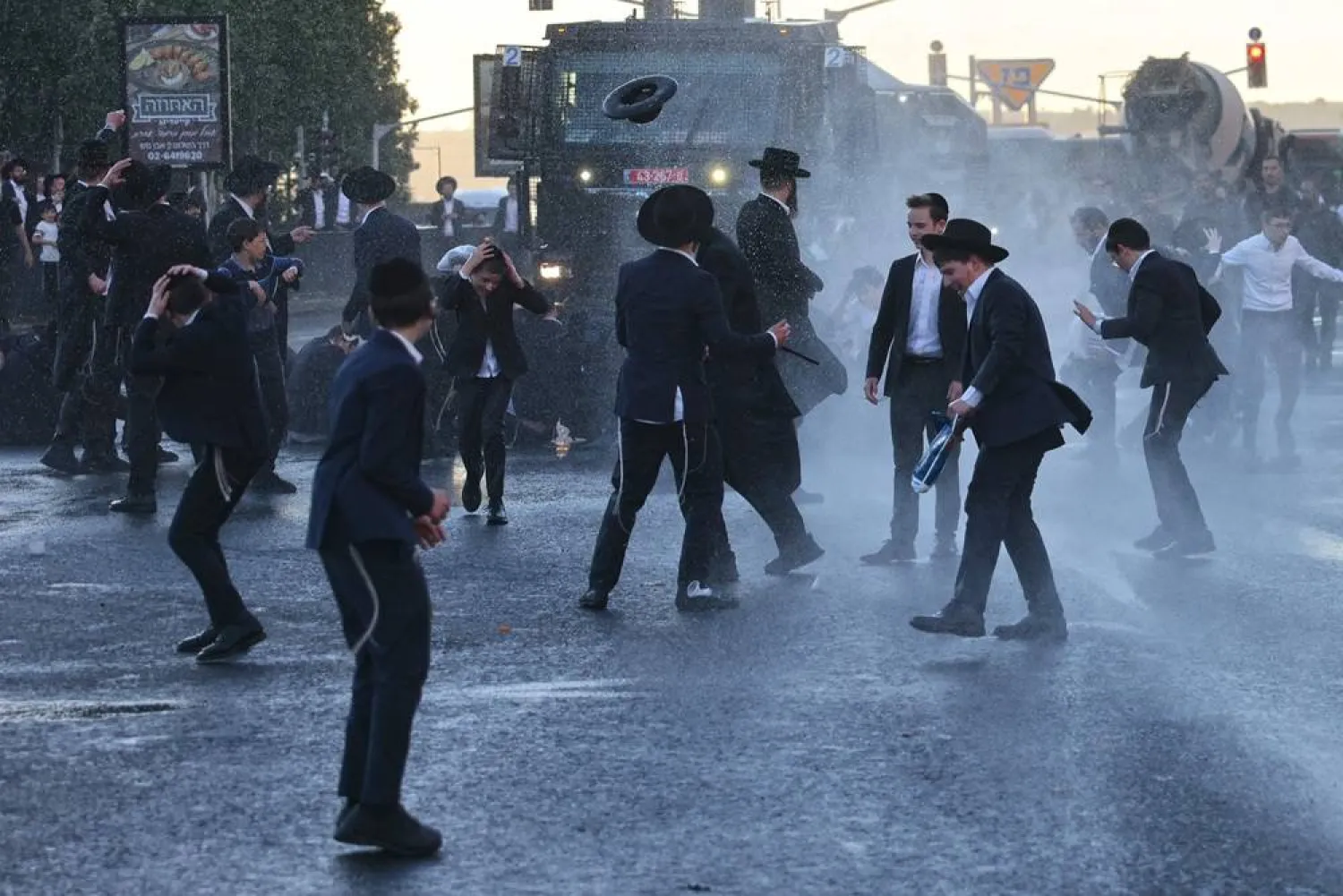
Israeli police use a water cannon to disperse ultra-Orthodox Jews protesting against conscription by blocking the entrance to Jerusalem, on June 1, 2026. (AFP)
TT

Ultra-Orthodox Protesters Block Roads and Trains Across Israel Over Military Draft

Israeli police use a water cannon to disperse ultra-Orthodox Jews protesting against conscription by blocking the entrance to Jerusalem, on June 1, 2026. (AFP)

Tens of thousands of ultra-Orthodox demonstrated across Israel on Monday, blocking roads and trains and setting cars on fire to protest mandatory enlistment in Israel’s military.

Israel’s police said demonstrators blocked major intersections and attacked a soldier who disembarked from a bus near a protest. Police struggled to control the crowds with water cannons and horses.

The protest largely crippled the country’s center, with highways closed and public transportation halted by the massive crowds in both Jerusalem and the Tel Aviv metro area.

Military service is compulsory for most Jewish men and women in Israel. The politically powerful ultra-Orthodox parties have won exemptions for their followers to forgo military service and instead study in religious seminaries, but those exemptions are under threat.

Many Israelis are tired of the longstanding system that has allowed ultra-Orthodox men to skip military service at a time when the military is stretched to its breaking point and many have served multiple tours of reserve duty.

The issue is tearing apart Prime Minister Benjamin Netanyahu’s governing coalition, possibly moving elections up by several weeks this fall after the ultra-Orthodox parties withdrew their support for Netanyahu.

Each year, roughly 13,000 ultra-Orthodox men reach the conscription age of 18, but less than 10% enlist, according to a parliamentary committee.

Faced with severe shortages of soldiers, the military is looking to extend the period of mandatory service. Most Jewish men are required to serve nearly three years of military service, followed by years of reserve duty. Jewish women serve two mandatory years.

“This public is determined, they see this as a war for their lives," said Israel Tropper, a demonstrator in Jerusalem. “From their perspective, going into the Israeli army means giving up religion ... we don’t want to give up our religion, so from our perspective it’s a war for our lives.”

He added that there is no way to force tens of thousands of people vehemently opposed to the idea to serve in the military.

Some protesters held signs condemning Israel saying: “We would rather die as Jews than live as Zionists” and “We refuse to serve an army for the sake of the Zionist religion.”

The ultra-Orthodox, who make up roughly 13% of Israeli society and are the fastest growing sector, have traditionally received exemptions if they are studying full-time in religious seminaries. The exemptions date back to the birth of the state in 1948, when a small number of students sought to revive the Jewish scholarship system after it was decimated by the Holocaust.

Those exemptions — and the government stipends many seminary students receive up to the age of 26 — have infuriated many Israelis.

Israel is currently maintaining a simultaneous military presence in Gaza, Lebanon and Syria, in addition to fighting a war with Iran, which has stretched its robust military to the breaking point.

The Supreme Court said the exemptions were illegal in 2017, but repeated extensions and government delay tactics have left them in place.

Among Israel’s Jewish majority, mandatory military service is largely seen as a melting pot and rite of passage. Many in the insular ultra-Orthodox community fear that military service would expose young people to secular influences.



Russia Wants AI, Digital Cooperation with China, Putin Tells Xi

FILE - Russian President Vladimir Putin, left, gestures while speaking to Chinese President Xi Jinping during the Shanghai Cooperation Organization (SCO) summit in Samarkand, Uzbekistan, Sept. 16, 2022. (Sergei Bobylev, Sputnik, Kremlin Pool Photo via AP, File)
TT

Russia Wants AI, Digital Cooperation with China, Putin Tells Xi

FILE - Russian President Vladimir Putin, left, gestures while speaking to Chinese President Xi Jinping during the Shanghai Cooperation Organization (SCO) summit in Samarkand, Uzbekistan, Sept. 16, 2022. (Sergei Bobylev, Sputnik, Kremlin Pool Photo via AP, File)

Moscow aims to cooperate with Beijing in the field of artificial intelligence and digital innovation, Russian President Vladimir Putin told China's Xi Jinping on Monday as the leaders met in Kyrgyzstan.

They arrived in the central Asian country for a two-day summit of the Shanghai Cooperation Organisation (SCO), a regional bloc that seeks to serve as a counter-balance to the West.

Russia, with its troops bogged down in Ukraine, has deepened ties with its main oil customer China, which has never condemned Moscow for its four-and-a-half-year invasion.

"Cooperation is successfully developing on all fronts," Putin told Xi ahead of their talks.

They last met in May in Beijing.

"Digital innovations, including in artificial intelligence technologies, are also opening up new opportunities for the economic development of our countries," Putin said.

The Kremlin has in the past months sought to tighten its control over the online sphere, imposing intermittent mass internet shutdowns and restrictions on popular messaging apps.

Moscow is pushing Russians to embrace the state-backed Max messenger platform -- an unencrypted super-app similar to China's WeChat that critics say raises privacy and snooping concerns.

It has repeatedly threatened foreign-owned sites with bans, part of what rights advocates say is a broader attempt by authorities to control and monitor internet use.


Pentagon Signs 7-year Deals to Increase Missile Production

FILE - The Pentagon is seen from the air, July 15, 2026, in Washington. (AP Photo/Alex Brandon, File)
TT

Pentagon Signs 7-year Deals to Increase Missile Production

FILE - The Pentagon is seen from the air, July 15, 2026, in Washington. (AP Photo/Alex Brandon, File)

The Pentagon said on Monday it secured seven-year agreements with General Dynamics Ordnance and Tactical Systems (GD-OTS) and Lockheed Martin to increase missile production.

The agreements are designed to "increase production quantities and accelerate delivery schedules for critical missile subcomponents supporting the Terminal High Altitude Area Defense (THAAD) and Patriot Advanced Capability-3 Missile Segment Enhancement (PAC-3 MSE) interceptor programs," the Pentagon said.


Israel Signs Three-billion-euro Arms Export Deal with Greece

Greece to buy a defense system from Israel (Reuters)
TT

Israel Signs Three-billion-euro Arms Export Deal with Greece

Greece to buy a defense system from Israel (Reuters)

Israel's defense ministry announced Monday it had signed a deal with Athens worth approximately three billion euros (almost $3.5 billion) to set up the "Achilles Shield" aerial defense system for Greece. 

"Under the deal, Israel will build Greece a comprehensive, multi-layered air defense array, drawing entirely on Israeli-made systems and on the extensive operational experience Israel's defense establishment has gained during the war," the ministry said in a statement. 

"This is the largest defense export deal in the history of Israel-Greece relations, and one of the largest in the history of the State of Israel," it added. 

The deal was signed by the Israeli defense ministry's director general, Major General (Res.) Amir Baram, and his Greek counterpart, Ioannis Bouras, in Tel Aviv. 

A Greek defense ministry source had told AFP in late July about an upcoming purchase of Israeli-made anti-missile, anti-aircraft and anti-drone systems, part of a broader defense investment for the Achilles Shield of 4.2 billion euro ($4.8 billion). 

In a statement, the Greek Defense Ministry said the multi-billion euro purchase was part of "the greatest reform of its armed forces in its history". 

Greek Defense Minister Nikos Dendias was quoted in the statement as saying that recent technological developments "have long rendered existing defense doctrines completely obsolete". 

"Greece is the first country in the European Union to adopt" a multi-layered air defense system such as the Israeli one, he added. 

According to the Israeli Defense Ministry, the export deal includes the David's Sling, Barak MX and SPYDER interception systems, air surveillance radars, and "a new national command and control system". 

All the equipment is manufactured by Israeli defense contractors Rafael and Israel Aerospace Industries and its subsidiary ELTA Systems. 

A supplementary 26 million euro deal was also signed to provide Greece with Rafael's defense systems against drones, the ministry said. 

"Israel and Greece share common strategic interests and face shared regional challenges," said Defense Minister Israel Katz, quoted in the statement. 

"At a time when actors with hegemonic ambitions are seeking to expand their influence and undermine stability in the region, Israel and Greece will continue to deepen their defense and strategic cooperation," he said, in a likely reference to Türkiye. 

Greece is now one of only four European NATO members to spend at least three percent of GDP on its military, amid decades of tensions with neighboring Türkiye. 

Israel has also increasingly locked horns with Türkiye, having struck a disused military base in northwest Syria, claiming it wanted to avert Turkish troops deploying to the facility. 

In 2023, Israel signed a deal with Germany to provide the Arrow 3 anti-ballistic missile defense system, which was expanded in December for a total value of $6.5 billion, the country's largest-ever military export contract.