


US Sanctions Iran’s Largest Crypto Exchange over IRGC Links

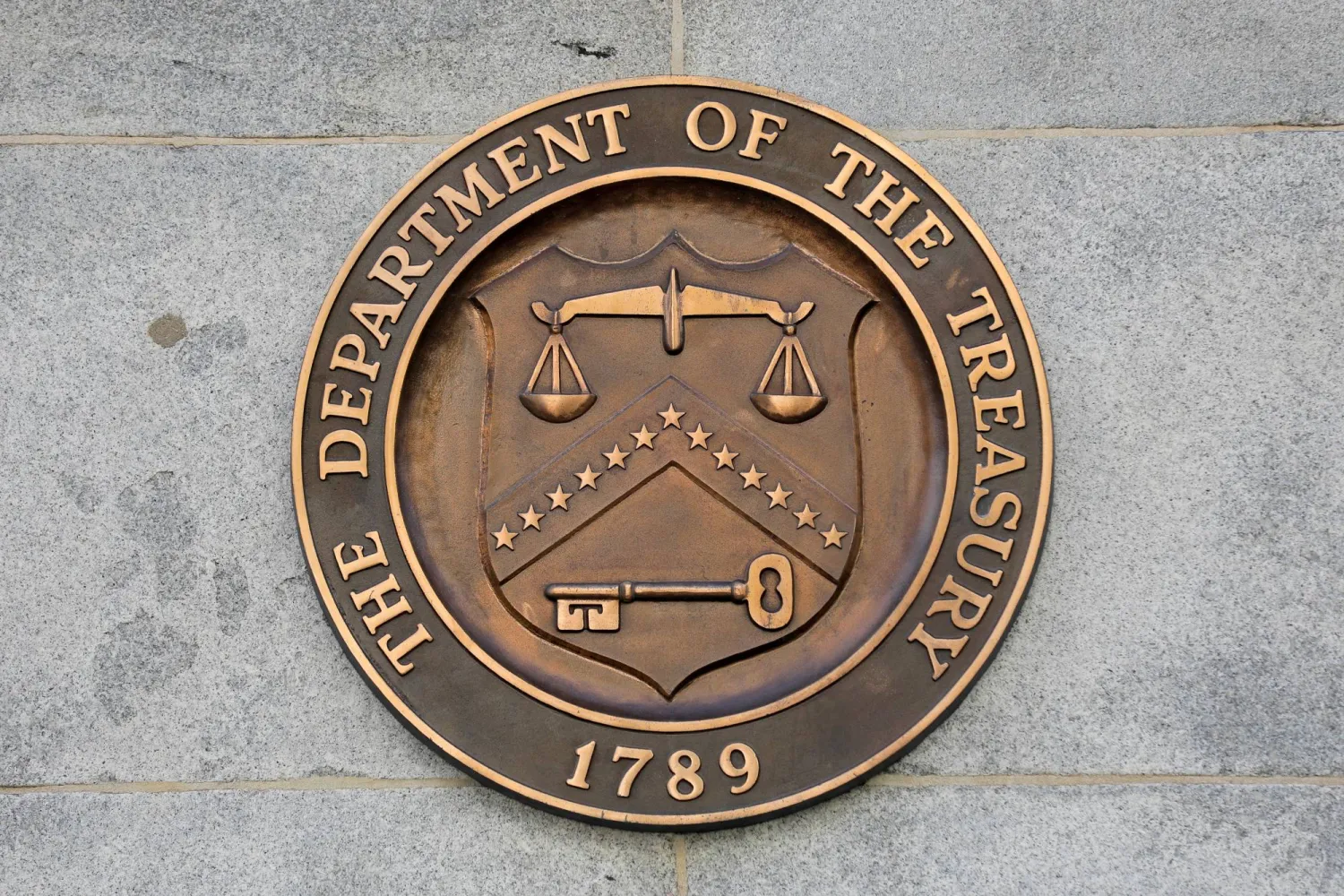
Signage is seen at the United States Department of the Treasury headquarters in Washington, DC, US, August 29, 2020. (Reuters)
TT

US Sanctions Iran’s Largest Crypto Exchange over IRGC Links

Signage is seen at the United States Department of the Treasury headquarters in Washington, DC, US, August 29, 2020. (Reuters)

The United States announced sanctions on Iran’s biggest cryptocurrency exchange on Tuesday, accusing it of enabling the Iranian government and blacklisted state institutions to circumvent Western sanctions.

The new sanctions follow a Reuters investigation published on May 1 which showed how Nobitex had become a central node in a parallel financial system used to process hundreds of millions of dollars for Iran’s central bank and the Revolutionary Guard Corps.

The report also revealed how Nobitex continued operating even after ‌the government-imposed ‌internet shutdown, processing millions of dollars of transactions.

“While Iran’s economy ‌is ⁠in free fall, ⁠the regime has chosen to co-opt digital asset technologies for its own corrupt agenda, including evading sanctions and transferring wealth out of the country,” Treasury Secretary Scott Bessent said in a statement.

The Reuters investigation showed how Nobitex is controlled by two brothers from one of Iran’s most powerful families, with close ties to the new supreme leader.

The two are members of the Kharrazi family, one of the ⁠most influential dynasties in the country. Corporate records show ‌that when the exchange started, the brothers were ‌listed under a surname rarely used by members of the family.

The US Treasury announced ‌Tuesday that the two brothers, Mohammad Ali Aghamir Mohammad Ali and ‌Mohammad Aghamir Mohammad Ali, had also been individually sanctioned, along with the exchange’s chief executive officer, Amir Hossein Rad.

Nobitex had provided “significant support” to the Iranian government and facilitated a “significant number” of digital transactions linked to the IRGC and Iran’s central bank, the US Treasury said in ‌the statement.

“Following the commencement of US combat operations in Iran, Nobitex played a role in protecting and moving assets and ⁠funds out ⁠of Iran to shield regime wealth despite internet blackouts.”

Nobitex could not be reached for comment on the sanctions, which were announced after normal business hours in Iran.

In a statement to customers Wednesday on its Telegram account, the exchange said it had anticipated possible sanctions-related issues for years given "the unique challenges faced by Iranian businesses operating internationally."

"Accordingly, the necessary technical and operational preparations to deal with such circumstances have long been part of our planning," the statement said.

In an emailed statement to Reuters in April, Nobitex said it had no direct government connections and denied assisting the state.

It said that any illicit funds moving through Nobitex did so without management approval or awareness. The company also said that the two brothers had never used an alternative identity or changed their identity.



Iran Offers $30,000 Bounty for Killing, Capturing US Soldiers

A man waves an Iranian flag before a political billboard at Valiasr Square in central Tehran on August 8, 2026. (AFP)
TT

Iran Offers $30,000 Bounty for Killing, Capturing US Soldiers

A man waves an Iranian flag before a political billboard at Valiasr Square in central Tehran on August 8, 2026. (AFP)

Iran's military announced on Sunday that it was offering a bounty equivalent to $30,000 for killing or capturing US soldiers, with the reward doubled if carried out by a woman.

Army chief Amir Hatami said the plan had been drawn up following "the large number of requests" to participate in the financial support, according to the IRNA state news agency.

There has been no known deployment of US ground forces in Iran during the Middle East war, with the exception of a rescue mission in April for a downed American pilot.

Hatami did not provide any details on where or when the killing or capturing of US soldiers was expected to take place.

"Anyone who kills or captures and hands over an invading American military personnel will receive a reward equivalent to $30,000 or 5 billion tomans from Iran's Army," Hatami said, using an informal unit equivalent to 10,000 Iranian rials.

"Courageous Iranian women who carry out such an action will receive double the reward," he added.

The war between Tehran and Washington began on February 28 after the United States, joined by Israel, attacked Iran. It was followed by an April ceasefire after nearly 40 days of fighting, and a June framework for peace talks that later collapsed.

Iran and the United States have since traded fire sporadically, with fighting mainly centered in southern Iran and around the Strait of Hormuz.


Iranian Parliament Advances Bill to Curb Foreign Influence

 A woman is silhouetted against the sun as she checks her cellphone at Revolution square in downtown Tehran, Iran, Saturday, Aug. 15, 2026. (AP)
A woman is silhouetted against the sun as she checks her cellphone at Revolution square in downtown Tehran, Iran, Saturday, Aug. 15, 2026. (AP)
TT

Iranian Parliament Advances Bill to Curb Foreign Influence

 A woman is silhouetted against the sun as she checks her cellphone at Revolution square in downtown Tehran, Iran, Saturday, Aug. 15, 2026. (AP)
A woman is silhouetted against the sun as she checks her cellphone at Revolution square in downtown Tehran, Iran, Saturday, Aug. 15, 2026. (AP)

Iran's parliament approved on Sunday the general principles of a bill that would criminalize interviews and other communications with media deemed hostile to the country, including US or Israeli media and outlets financed by either country, Iran's Shargh newspaper reported.

Osman Salari, a member of parliament's judicial and legal commission, said the individual provisions of the bill, which is aimed at countering foreign intelligence influence, have yet to be debated and approved.

Reports about ‌the bill's ‌details should not yet be considered final, Salari ‌told ⁠the Mizan news ⁠agency.

Under the proposed bill, interviews or participation in discussions with such media would be banned and violations would carry six months to two years in prison.

Interviews with other foreign media would require notification to the intelligence ministry, while contact with foreign embassies, offices of foreign organizations or other non-Iranian institutions without ⁠notification and written permission from the foreign ministry ‌would be punishable by a fine ‌and deprivation of certain social rights.

The proposed legislation would also ‌harden penalties for economic crimes committed under the direction or ‌supervision of foreigners, ban providing information to foreigners without intelligence ministry approval and restrict scientific cooperation with foreign institutions outside an approved list.

It would punish policy or legislative proposals made under the direction of ‌foreign intelligence services if they harm Iran's security or independence, with prison terms of up ⁠to 30 years. ⁠Cases would be heard by Revolutionary Courts.

The bill will be considered article by article in parliament. Once parliament approves the final text, it will have to be reviewed by the Guardian Council before becoming law.

The move is not the first time Iran has criminalized cooperation with foreign entities. A law passed in 2025 after a 12-day war with Israel imposed tougher penalties for alleged cooperation with hostile states.

Iranian photojournalist Yalda Moaiery was sentenced this month to 15 years under that law over allegations that included giving interviews to media deemed hostile and providing photographs to US and Israel-linked organizations.


PM Tusk: Poland to Send Emergency Aircraft to Budapest after Coach Crash

Polish Prime Minister Donald Tusk speaks during the Polish Armed Forces Day in Gdynia, northern Poland, 15 August 2026. EPA/Andrzej Jackowski POLAND OUT
TT

PM Tusk: Poland to Send Emergency Aircraft to Budapest after Coach Crash

Polish Prime Minister Donald Tusk speaks during the Polish Armed Forces Day in Gdynia, northern Poland, 15 August 2026. EPA/Andrzej Jackowski POLAND OUT

Poland will send an emergency aircraft to Budapest following a coach crash that killed 12 people and left at least 10 critically injured, Prime Minister Donald Tusk said Sunday.

"I have made the decision to send a special Polish aircraft to Hungary with representatives from the Ministry of Foreign Affairs and medical services," Tusk said on social media. "All the injured will receive the necessary medical and consular assistance," he added.