

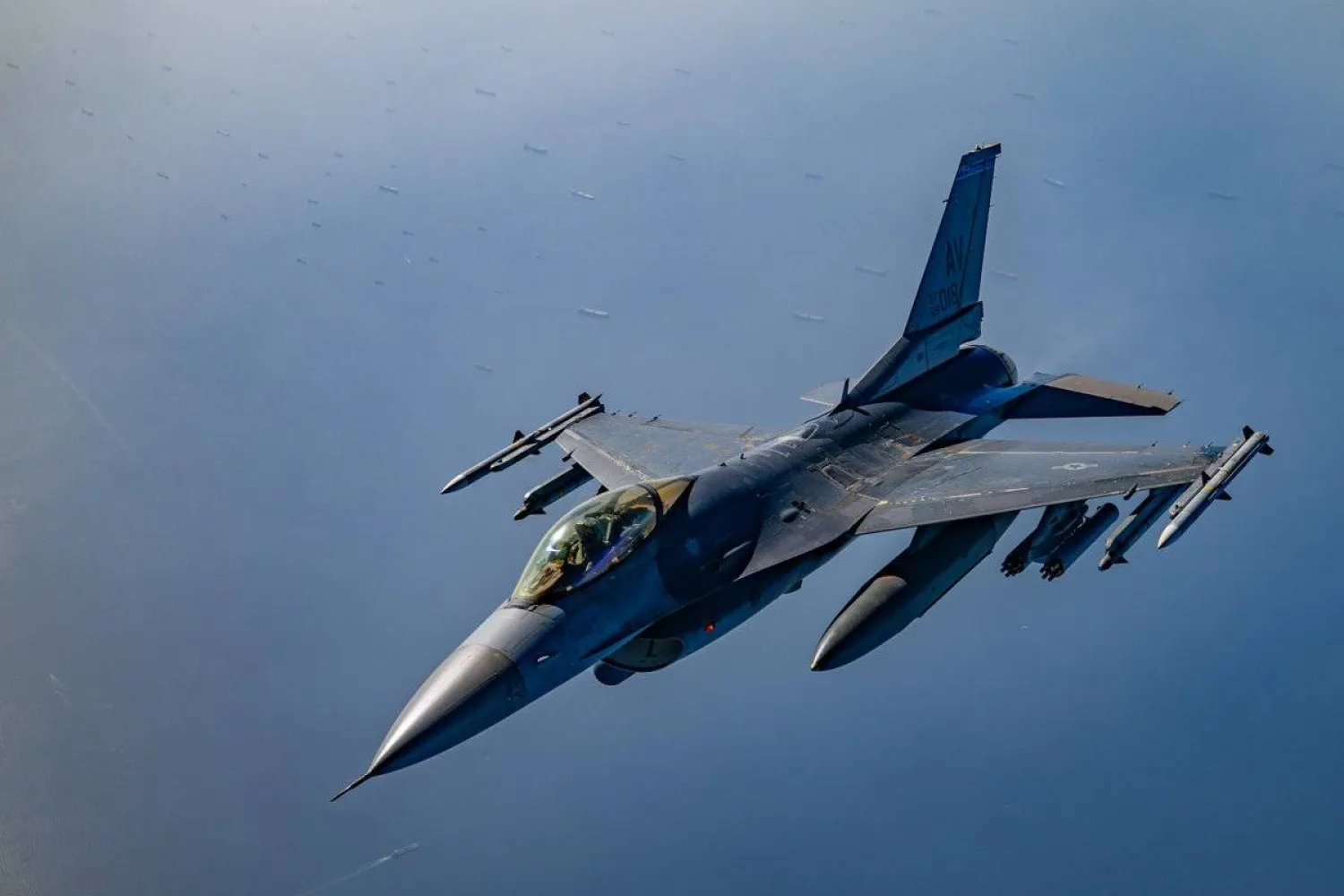

US Says Shot Down Iran Drones in Fresh Escalation

A US F-16 fighter jet on patrol near the Strait of Hormuz last month (CENTCOM)
TT

US Says Shot Down Iran Drones in Fresh Escalation

A US F-16 fighter jet on patrol near the Strait of Hormuz last month (CENTCOM)

The United States said it shot down a pair of Iranian drones threatening the Strait of Hormuz, the latest escalation of violence as the war crept into its 100th day on Sunday with no end in sight.

Weeks of indirect talks marked by tit-for-tat threats and sporadic exchanges of fire have failed to secure a deal to end the conflict or reopen the vital waterway, a chokepoint for Gulf oil and gas shipments, said AFP.

US Central Command (CENTCOM) said it destroyed two Iranian drones "that threatened international maritime traffic in the Strait of Hormuz", hours after announcing it struck four other drones and coastal surveillance radar sites.

Tehran responded with a salvo of missiles at US allies Bahrain and Kuwait on Saturday, drawing a furious response from the Gulf states and piling pressure on a shaky ceasefire agreed on April 8.

CENTCOM said Iran launched seven ballistic missiles towards Bahrain and Kuwait, with six intercepted and one falling short. Iran's Revolutionary Guards said they had targeted "enemy bases in the area" with missiles.

Bahrain, which hosts the headquarters of the US Fifth Fleet, denounced the latest attacks as "blatant aggression", while Kuwait said they "represent a dangerous escalation".

In Bahrain's capital Manama, an AFP journalist heard three explosions as air raid sirens sounded.

In Kuwait, another AFP journalist heard repeated blasts near the international airport, where a Wednesday strike blamed on Iran killed one person.

"We woke up to a huge explosion," said Reem, a mother of two. "My children were terrified, and I couldn't calm them down."

- 'Flagrant violations' -

Iran's foreign ministry denounced the latest US strikes as "flagrant" violations while condemning Washington's "hostile and provocative behavior".

Efforts to turn the truce into a lasting settlement have repeatedly stalled, while the conflict has rattled global markets and increased pressure on US President Donald Trump at home ahead of midterm elections.

"The negotiations are at a deadlock, and Trump must break this deadlock," Mohsen Rezaei, military adviser to Iran's supreme leader, told CNN as he called for the release of some $24 billion in frozen Iranian assets.

Washington instead may seek to use the funds to pay for damage wrought by Iranian strikes on Gulf allies.

The US "Treasury will utilize all tools available to allow Iranian assets to be made available to our Gulf allies to support rebuilding and repairs for any future damage caused by Iran", a source familiar with Treasury Secretary Scott Bessent's thinking said.

Lebanon -- drawn into the Middle East war when Iran-backed militant group Hezbollah attacked Israel on March 2 -- called on Friday for Iran to stop interfering in its affairs.

Beirut's army chief Rodolphe Haykal left on Saturday for Pakistan, which has emerged as a central mediator between the United States and Iran.

Pakistan's Interior Minister Mohsin Naqvi landed in Tehran the same day to meet Iran's Foreign Minister Abbas Araghchi.

Iran, in its peace negotiations with Washington, has insisted the fighting in Lebanon and the war in the Gulf are inextricably linked.

On Saturday, Lebanon said an Israeli strike in the country's south killed three of its soldiers. Israel's military said it was "reviewing the incident" and insisted its campaign in Lebanon was targeting Hezbollah, not government forces.

The health ministry said two women were killed and 22 people wounded in an Israeli strike on Saksakiyeh in the south.

The Israeli military, meanwhile, on Saturday announced the death of two of its soldiers.

The ceasefire announced in April did not stop the fighting in Lebanon, and a new conditional truce deal announced this week was flatly rejected by Hezbollah.

- Football flare-up -

The latest unrest came amid a diplomatic row over the United States' refusal to grant visas to some staff of Iran's World Cup football team.

Iranian state television confirmed the team's players and technical staff had received visas, but reported that 15 administrative and managerial members of the delegation had been refused.

An unnamed US administration official said: "We will not allow the Iranian team to abuse this system to sneak terrorists into the United States under false pretenses."

Iran's embassy in Türkiye demanded FIFA "hold the US accountable for violations of its rules and for the discriminatory treatment" of the Iranian team.

Iran's Football Federation, whose chief Mehdi Taj was reportedly among those denied a visa, described the decision as "political interference in sport in its worst form".

Adding to the tensions, Iran's ambassador to Mexico said Saturday the squad had been notified that under conditions of their visas, the team must enter and leave the US on the same day as their matches.



Pentagon Raises Threat of Israeli Spying to 'Critical', Says US Media

The Pentagon (AP)
The Pentagon (AP)
TT

Pentagon Raises Threat of Israeli Spying to 'Critical', Says US Media

The Pentagon (AP)
The Pentagon (AP)

The Pentagon has raised its counterintelligence threat level for Israel to its highest level, US media reported on Saturday.

The Pentagon's Defense Intelligence Agency (DIA) said Israel's "ability to conduct human espionage and technical collection is at a 'critical level'," NBC News said, citing US officials.

The move came after concerns that Israel had been attempting to spy on top US officials to get information on "the Trump administration's internal deliberations and decision-making on the conflicts in the Middle East," the American network said.

The New York Times cited reports of Israeli efforts to eavesdrop on senior officials, including President Donald Trump's top negotiator, Steve Witkoff, and the Pentagon's top policy official, Elbridge Colby.

The United States and Israel launched joint strikes on Iran on February 28, triggering the war.

Since then, Trump and Israeli Prime Minister Benjamin Netanyahu's relationship appears to be under strain, AFP says.

Trump unleashed a profanity-laced tirade over the phone at Netanyahu over Israel's threats to bomb the Lebanese capital Beirut, fearing it would undermine talks with Tehran, the Axios news outlet and ABC News reported earlier in the week.


Greece Arrests Palestinian Suspected of Hamas Links

20 November 2024, Greece, Athens: A Greek police officer stands guard during a security deployment. (dpa)
TT

Greece Arrests Palestinian Suspected of Hamas Links

20 November 2024, Greece, Athens: A Greek police officer stands guard during a security deployment. (dpa)

Greece has arrested a Palestinian man suspected of links to the Hamas movement for "planning terrorist acts", police said late Saturday.

The 37-year-old was arrested Saturday on the island of Crete where he was working in a hotel, media reports said.

"According to the information available so far, he was linked to individuals recently arrested in Cyprus for terrorism-related offences," the police said in a statement, adding that he had allegedly "received training" by Hamas.

Greek media reported that the man may have been targeting an Israeli cruise ship expected to arrive in Crete on Tuesday.

State TV ERT said man had rented a flat in central Athens where police found laboratory equipment and chemicals that could be used to make a bomb.

Investigations are ongoing, the police said.


Armenia Votes in Test of Pm’s Pivot Away from Russia

 A man votes in Armenia's parliamentary election at a polling station in Yerevan on June 7, 2026. (AFP)
A man votes in Armenia's parliamentary election at a polling station in Yerevan on June 7, 2026. (AFP)
TT

Armenia Votes in Test of Pm’s Pivot Away from Russia

 A man votes in Armenia's parliamentary election at a polling station in Yerevan on June 7, 2026. (AFP)
A man votes in Armenia's parliamentary election at a polling station in Yerevan on June 7, 2026. (AFP)

Armenia voted Sunday in a parliamentary election set to test Prime Minister Nikol Pashinyan's tilt to the West, as the country faces threats and allegations of interference from former imperial ruler Russia.

Armenia and Russia are technically allies, but Moscow has compared the former Soviet republic's EU ambitions to the same path it claims triggered its 2022 invasion of Ukraine.

The election comes after years of upheaval since Pashinyan was propelled to power in a 2018 street revolution.

The small Caucasus country is still reeling from long-time foe Azerbaijan's military takeover of the Karabakh region.

The conflict came to an end in 2023, when the Azerbaijan army seized control of the enclave, and most of the Armenian population fled.

Pashinyan has framed the vote as a choice between a lasting peace with Azerbaijan, or a return to war.

The 51-year-old has also sought to loosen Armenia's dependence on Moscow, after it failed to help during the Karabakh conflict.

He has frozen participation in a Russia-led security bloc while deepening ties with the European Union and United States, and set Armenia on a path toward possible EU membership.

While US President Donald Trump offered his "TOTAL Endorsement for Re-Election" to "great friend and Leader" Pashinyan, Moscow has bristled at the possible loss of yet another ally in its backyard.

"We will accept any choice made by the people" in the election, Pashinyan told journalists at a polling station in Yerevan after casting his ballot.

He said Armenia would pursue a balanced foreign policy after the vote, insisting "there is no question of choosing" between Russia and the West.

In a pointed remark, Russian President Vladimir Putin said in May: "We all see what is happening with Ukraine now... How did it all begin? With Ukraine's attempt to join the EU."

The Kremlin has been accused of seeking to sway the vote.

Analysts have noted misinformation on the web, hacker activity and Kremlin-friendly narratives portraying Western cooperation as dangerous.

In the weeks before the vote, Russia banned the import of several products from Armenia -- seen as a move to heap economic pressure on the country.

And Armenian officials have warned "enemies of freedom" are funding propaganda efforts.

- 'Reckless rush' -

Pashinyan has insisted he does not want a rupture with Moscow.

But the campaign is a battle over Armenia's geopolitical future.

Pashinyan and his chief opponents have all accused each other of risking a fresh conflict.

Pashinyan told voters Armenia could face a "catastrophic war" with Azerbaijan within months if his Civil Contract party -- leading in opinion polls -- fails to secure a strong majority.

His opponents say that rhetoric is fearmongering.

Samvel Karapetyan, a billionaire Russian-Armenian businessman whose Strong Armenia party is polling second, has rejected claims he would drag Armenia back into Russia's orbit, but warned against Pashinyan's "reckless rush" to the West.

"Russia has been and will remain our strategic partner and principal economic partner," he said.

Karapetyan has been under house arrest since last year on charges of plotting a coup -- allegations he rejects as politically motivated.

Europe has made little secret of who it wants to win.

In a high-profile visit in May, French President Emmanuel Macron threw his support behind Pashinyan, embracing the Armenian leader as a dear friend.

At an evening reception, Macron took to the microphone and Pashinyan to the drums for a rendition of "La Boheme", the 1965 classic by the late Charles Aznavour, a singer beloved in both countries.

- 'Voted for peace' -

It remains unclear whether Pashinyan's party can secure the two-thirds parliamentary majority needed to pass constitutional amendments, demanded by Azerbaijan as a condition for a final peace treaty.

Pashinyan's democratic record is also on the ballot paper.

Eight years after he swept to power on a promise to dismantle Armenia's oligarchic system, he faces increasing accusations of democratic backsliding.

Still for many Armenians, the opposition remains associated with Russian influence and oligarchs.

"I voted for peace. Only Pashinyan can bring peace," one voter, 63-year-old craftsman Hakob Hakobyan, told AFP.

Another voter, Khachatur Movsisyan, a 59-year-old mechanical engineer, said he had backed an opposition party "because the country, and all of us, need change -- in foreign policy, domestic policy and in negotiations with Azerbaijan."