

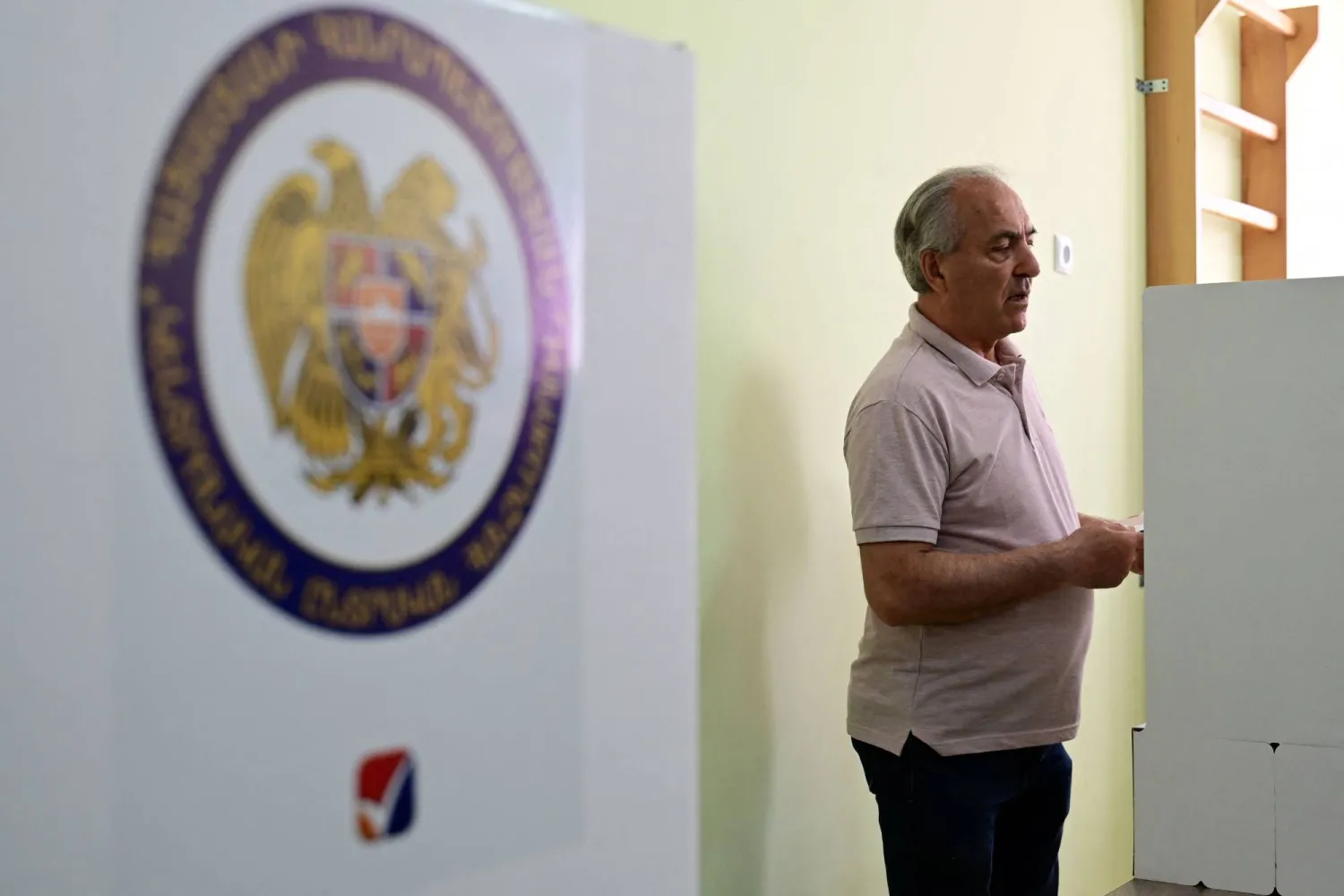

Armenia Votes in Test of Pm’s Pivot Away from Russia

 A man votes in Armenia's parliamentary election at a polling station in Yerevan on June 7, 2026. (AFP)
A man votes in Armenia's parliamentary election at a polling station in Yerevan on June 7, 2026. (AFP)
TT

Armenia Votes in Test of Pm’s Pivot Away from Russia

 A man votes in Armenia's parliamentary election at a polling station in Yerevan on June 7, 2026. (AFP)
A man votes in Armenia's parliamentary election at a polling station in Yerevan on June 7, 2026. (AFP)

Armenia voted Sunday in a parliamentary election set to test Prime Minister Nikol Pashinyan's tilt to the West, as the country faces threats and allegations of interference from former imperial ruler Russia.

Armenia and Russia are technically allies, but Moscow has compared the former Soviet republic's EU ambitions to the same path it claims triggered its 2022 invasion of Ukraine.

The election comes after years of upheaval since Pashinyan was propelled to power in a 2018 street revolution.

The small Caucasus country is still reeling from long-time foe Azerbaijan's military takeover of the Karabakh region.

The conflict came to an end in 2023, when the Azerbaijan army seized control of the enclave, and most of the Armenian population fled.

Pashinyan has framed the vote as a choice between a lasting peace with Azerbaijan, or a return to war.

The 51-year-old has also sought to loosen Armenia's dependence on Moscow, after it failed to help during the Karabakh conflict.

He has frozen participation in a Russia-led security bloc while deepening ties with the European Union and United States, and set Armenia on a path toward possible EU membership.

While US President Donald Trump offered his "TOTAL Endorsement for Re-Election" to "great friend and Leader" Pashinyan, Moscow has bristled at the possible loss of yet another ally in its backyard.

"We will accept any choice made by the people" in the election, Pashinyan told journalists at a polling station in Yerevan after casting his ballot.

He said Armenia would pursue a balanced foreign policy after the vote, insisting "there is no question of choosing" between Russia and the West.

In a pointed remark, Russian President Vladimir Putin said in May: "We all see what is happening with Ukraine now... How did it all begin? With Ukraine's attempt to join the EU."

The Kremlin has been accused of seeking to sway the vote.

Analysts have noted misinformation on the web, hacker activity and Kremlin-friendly narratives portraying Western cooperation as dangerous.

In the weeks before the vote, Russia banned the import of several products from Armenia -- seen as a move to heap economic pressure on the country.

And Armenian officials have warned "enemies of freedom" are funding propaganda efforts.

- 'Reckless rush' -

Pashinyan has insisted he does not want a rupture with Moscow.

But the campaign is a battle over Armenia's geopolitical future.

Pashinyan and his chief opponents have all accused each other of risking a fresh conflict.

Pashinyan told voters Armenia could face a "catastrophic war" with Azerbaijan within months if his Civil Contract party -- leading in opinion polls -- fails to secure a strong majority.

His opponents say that rhetoric is fearmongering.

Samvel Karapetyan, a billionaire Russian-Armenian businessman whose Strong Armenia party is polling second, has rejected claims he would drag Armenia back into Russia's orbit, but warned against Pashinyan's "reckless rush" to the West.

"Russia has been and will remain our strategic partner and principal economic partner," he said.

Karapetyan has been under house arrest since last year on charges of plotting a coup -- allegations he rejects as politically motivated.

Europe has made little secret of who it wants to win.

In a high-profile visit in May, French President Emmanuel Macron threw his support behind Pashinyan, embracing the Armenian leader as a dear friend.

At an evening reception, Macron took to the microphone and Pashinyan to the drums for a rendition of "La Boheme", the 1965 classic by the late Charles Aznavour, a singer beloved in both countries.

- 'Voted for peace' -

It remains unclear whether Pashinyan's party can secure the two-thirds parliamentary majority needed to pass constitutional amendments, demanded by Azerbaijan as a condition for a final peace treaty.

Pashinyan's democratic record is also on the ballot paper.

Eight years after he swept to power on a promise to dismantle Armenia's oligarchic system, he faces increasing accusations of democratic backsliding.

Still for many Armenians, the opposition remains associated with Russian influence and oligarchs.

"I voted for peace. Only Pashinyan can bring peace," one voter, 63-year-old craftsman Hakob Hakobyan, told AFP.

Another voter, Khachatur Movsisyan, a 59-year-old mechanical engineer, said he had backed an opposition party "because the country, and all of us, need change -- in foreign policy, domestic policy and in negotiations with Azerbaijan."



Russian Drone Strikes Kill Two in Ukraine

 Police experts work at the site of an apartment building destroyed by a Russian drone strike, amid Russia's attack on Ukraine, in Zaporizhzhia, Ukraine June 4, 2026. (Reuters)
Police experts work at the site of an apartment building destroyed by a Russian drone strike, amid Russia's attack on Ukraine, in Zaporizhzhia, Ukraine June 4, 2026. (Reuters)
TT

Russian Drone Strikes Kill Two in Ukraine

 Police experts work at the site of an apartment building destroyed by a Russian drone strike, amid Russia's attack on Ukraine, in Zaporizhzhia, Ukraine June 4, 2026. (Reuters)
Police experts work at the site of an apartment building destroyed by a Russian drone strike, amid Russia's attack on Ukraine, in Zaporizhzhia, Ukraine June 4, 2026. (Reuters)

Russian drone strikes killed two people in Ukraine, officials said Sunday, as world leaders gathered in London to discuss piling pressure on Moscow over its four-year war.

Ukrainian President Volodymyr Zelensky will meet the leaders of France, Germany and Britain on Sunday for talks on the way forward as Russia suffers military setbacks in the invasion of its neighbor.

A Russian drone strike killed a 56-year-old man working as a minibus driver in Ukraine's southern Zaporizhzhia region, the State Emergency Service of Ukraine wrote on Telegram on Sunday.

A 59-year-old man was killed in a separate attack in the central Dnipropetrovsk region, when Russian drones and aerial bombs rained down over two districts, regional military chief Oleksandr Ganzha posted on Telegram on Sunday.

The attacks wounded a 35-year-old man and damaged infrastructure, Ganzha said.

Ukraine recaptured more territory than it lost to Russian forces in May for the second straight month, AFP analysis of data from the Institute for the Study of War (ISW) showed earlier this month.

Russia's offensive has meanwhile led to rising prices, tax hikes, two-decade-high borrowing costs, business shutdowns and labor shortages, putting the economy in its trickiest spot since the full-scale invasion of Ukraine in February 2022.

Zelensky proposed a face-to-face meeting with Vladimir Putin in an open letter to the Russian leader on Thursday, saying he was also ready for a "full ceasefire".

Putin, speaking at Russia's flagship economic forum on Friday, rejected suggestions the Russian economy had collapsed, saying "we have descended to the same level at which Eurozone countries have been experiencing growth for the past few years."


With China’s Xi in North Korea, Kim to Project Confidence, Defiance

North Korean leader Kim Jong Un and Chinese President Xi Jinping shake hands on the day of their bilateral summit in Beijing, China, September 4, 2025, in this picture released by North Korea's official Korean Central News Agency. (KCNA via Reuters)
TT

With China’s Xi in North Korea, Kim to Project Confidence, Defiance

North Korean leader Kim Jong Un and Chinese President Xi Jinping shake hands on the day of their bilateral summit in Beijing, China, September 4, 2025, in this picture released by North Korea's official Korean Central News Agency. (KCNA via Reuters)

North Korean leader Kim Jong Un welcomes Chinese President Xi Jinping to Pyongyang on Monday, feeling in a position of strength with a firm ally in Russia, a nuclear arsenal and little apparent appetite to engage with Washington.

For Xi, leader of the world's second-biggest economy, the two-day visit to China's neighbor, his first in seven years, is part of an effort to draw Pyongyang back into its orbit.

Xi hosted Kim, among other leaders, at a massive military parade in Beijing last year, and the two countries have since resumed some passenger rail and air services.

This week's summit is likely to present a contrast to Xi's first visit to the isolated state in 2019 - months after a meeting between Kim and US President Donald Trump fell apart over denuclearizing North Korea and sanctions relief.

XI'S VISIT 'A BIG DEAL' FOR NORTH AFTER 'COMEBACK'

Since then, Kim has forged closer military and trade ties with Moscow, bolstered by his dispatch of troops to fight for Russia in the ‌Ukraine war, continued ‌to build up his nuclear capabilities in defiance of UN sanctions and locked down the North Korean ‌border ⁠to stop the ⁠flow of escapees.

North Korea has sought to flex its strength on the eve of Xi's arrival, announcing plans on Saturday for a 10,000-ton naval destroyer and reaffirming its status as a nuclear-armed state on Sunday.

"Having Xi visit Pyongyang is a big deal and the culmination of a good couple of 'comeback' years for Kim," said Andrew Gilholm, an analyst at consultancy Control Risks.

In 2019 Kim gave Xi a lavish reception that included thousands of people holding up placards that formed a picture of Xi's face and the Chinese flag, and a performance of the song "I Love Thee, China".

But relations between the two have been strained at times, particularly over North Korea's nuclear program. Beijing has publicly opposed Pyongyang's nuclear tests and called for it ⁠to give up its nuclear weapons.

North Korea has been cautious about becoming over-reliant on China, with which ‌it shares an 1,400-km (880-mile) border. Support from Russia is likely providing some balance.

"North Korea ‌is certainly gaining economically from what they're able to provide militarily to Russia," said John Delury, a senior fellow of the Asia Society. "That actually puts ‌North Korea in a position where they may feel more confident to increase the volume of trade and investment with China."

PUSH FOR ‌TOURISM, RED LINE ON NUCLEAR PROGRAM

Any substantive outcome of the meeting is likely to be about economic cooperation, a regional diplomat said, as North Korea starts a five-year development plan that includes expanding tourism into a solid industry and building more housing.

North Korea shut its borders to foreign tourists in early 2020 as it imposed some of the world's strictest COVID-19 controls, cutting off a modest but important source of hard currency.

Before the pandemic, Chinese tourists were ‌the backbone of North Korea's tourism industry, accounting for 90% of foreign tourists by some estimates. The first known leisure tourists allowed back after COVID were about 100 from Russia's Far East in February ⁠2024, according to Russian provincial ⁠authorities and a Western tour guide.

North Korea has managed to make economic progress, Singapore's foreign minister said after visit last month. He said Pyongyang appeared to have little interest in engaging with the United States or South Korea.

North Korea has rejected reunification with South Korea, which had long been a goal of both nations, divided since the 1950-1953 Korean War. South Korean President Lee Jae Myung, however, remains keen on dialogue and has asked Xi to assist his efforts.

"Improving inter-Korean relations through the mediation of President Xi Jinping, we are hoping that President Xi would play that kind of role," said Moon Chung-in, a professor at Yonsei University in Seoul who was national security adviser to a previous South Korean president.

Kim has drawn some red lines, including on his nuclear program. In addition to Sunday's announcement, he called on Thursday for an "exponential" expansion of the country's atomic arsenal.

Yang Moo-jin, president of the University of North Korean Studies in Seoul, said Kim was likely to continue expanding fissile-material production, increase and deploy nuclear weapons and emphasize the legitimacy of strengthening Pyongyang's nuclear deterrent.

"Kim is emboldened," said Christopher Green, a Korea specialist at Leiden University in the Netherlands.

"He feels able to publicly pursue a marked expansion of North Korea’s nuclear arsenal with a confidence that comes from knowing that as long as he doesn’t foment outright instability in the region, Beijing will not try to stop him."


Pentagon Raises Threat of Israeli Spying to 'Critical', According to US Media

The Pentagon (AP)
The Pentagon (AP)
TT

Pentagon Raises Threat of Israeli Spying to 'Critical', According to US Media

The Pentagon (AP)
The Pentagon (AP)

The Pentagon has raised its counterintelligence threat level for Israel to its highest level, US media reported on Saturday.

The Pentagon's Defense Intelligence Agency (DIA) said Israel's "ability to conduct human espionage and technical collection is at a 'critical level'," NBC News said, citing US officials.

The move came after concerns that Israel had been attempting to spy on top US officials to get information on "the Trump administration's internal deliberations and decision-making on the conflicts in the Middle East," the American network said.

The New York Times cited reports of Israeli efforts to eavesdrop on senior officials, including President Donald Trump's top negotiator, Steve Witkoff, and the Pentagon's top policy official, Elbridge Colby.

The United States and Israel launched joint strikes on Iran on February 28, triggering the war.

Since then, Trump and Israeli Prime Minister Benjamin Netanyahu's relationship appears to be under strain, AFP says.

Trump unleashed a profanity-laced tirade over the phone at Netanyahu over Israel's threats to bomb the Lebanese capital Beirut, fearing it would undermine talks with Tehran, the Axios news outlet and ABC News reported earlier in the week.