

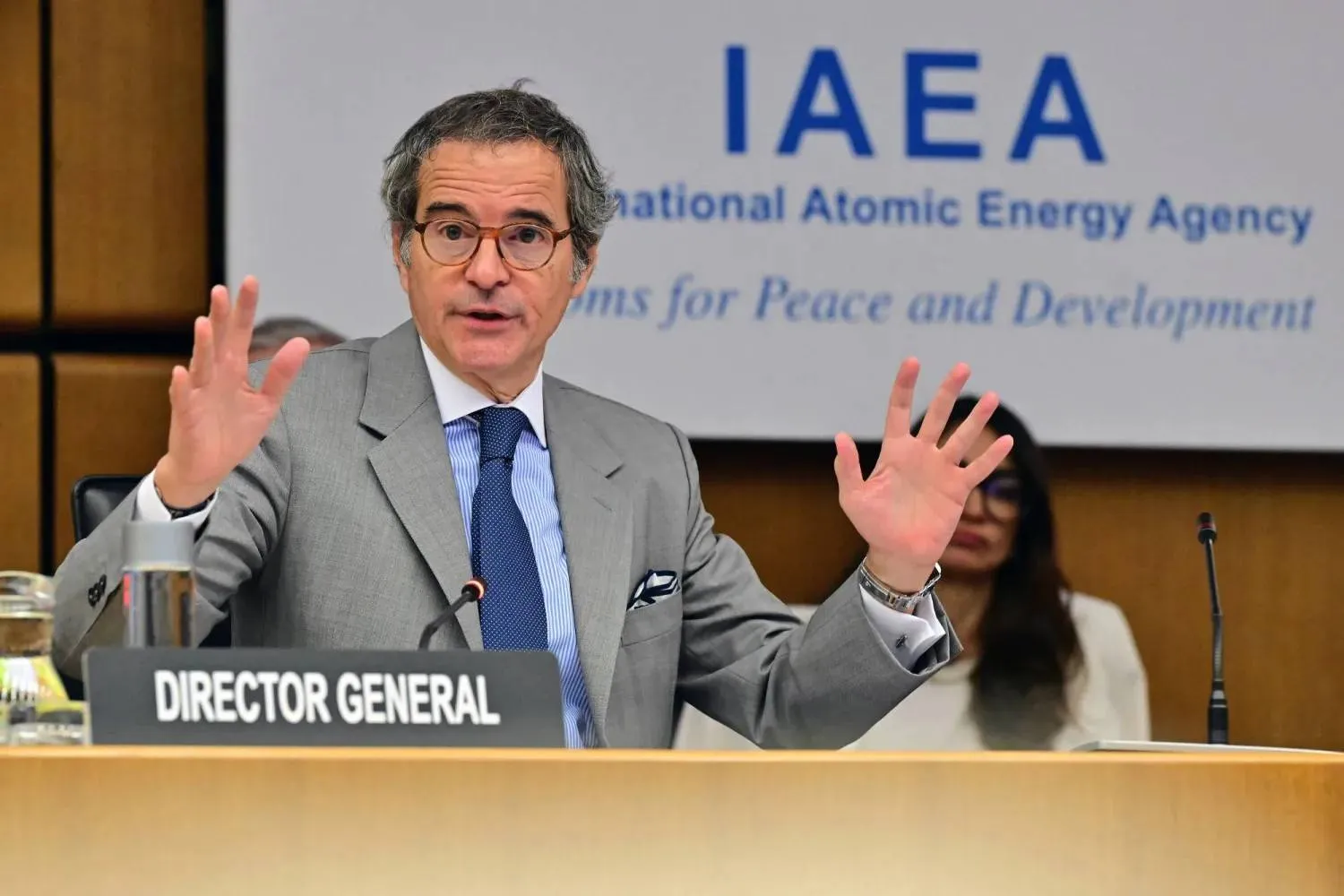

IAEA Calls on Iran to Allow Inspections to Resume

IAEA Director General Rafael Mariano Grossi delivers a statement at the opening of the Board of Governors meeting (IAEA) 
TT

IAEA Calls on Iran to Allow Inspections to Resume

IAEA Director General Rafael Mariano Grossi delivers a statement at the opening of the Board of Governors meeting (IAEA) 

UN nuclear watchdog chief Rafael Grossi called on Iran on Monday to “re-engage” with the agency ‌so inspections can resume at sites the US and Israel bombed a year ago, as Washington led a push for a resolution to that effect at the agency's board.

Iran still has not informed the International Atomic Energy Agency of what happened to those bombed nuclear sites or the nuclear material, including uranium enriched to near bomb grade, that was stored there.

While the bombings destroyed or badly damaged uranium-enrichment facilities, much of the highly enriched uranium, including some enriched to up to 60%, a short step ⁠from the roughly 90% of weapons grade, is thought to have survived.

“It's very important that we re-engage,” Grossi told the IAEA's 35-nation Board of Governors on the first day of a quarterly meeting.

“I call on Iran to engage the Agency constructively in order to facilitate the full and effective implementation of safeguards in Iran,” he added in a separate, written statement to the board, using a term that encompasses inspections.

The IAEA has conducted inspections at sites that were not bombed, but it halted those on safety grounds in February because of renewed military strikes, and has since only inspected Iran's operating power plant at Bushehr.

“I have sporadic contacts with the foreign minister and others, but basically the channel of communication is broken,” Grossi told a press conference after he addressed the board.

Later on Monday, the ‌US, ⁠Britain, France and Germany submitted a draft resolution to the board for it to vote on later this week. The text, seen by Reuters, orders Iran to provide “complete information” on the enriched uranium and grant the IAEA all the access it needs to verify it “without delay.”

While diplomats said the resolution was likely to pass by a clear margin, as a similar one did in November, it risked complicating talks between the US and Iran aimed at extending their ceasefire and paving ⁠the way for wider talks on issues including Iran's nuclear program.

Grossi’s calls came as the US is lobbying other countries on the UN nuclear watchdog's Board ‌of Governors to back a draft resolution demanding that Iran tell the agency what happened to its bombed nuclear sites and the enriched uranium stored there.

The US-drafted text, seen by Reuters on Sunday and circulated ahead of this week's quarterly meeting of the 35-nation board, says Iran must “provide the Agency with precise information on nuclear material accountancy and safeguarded nuclear facilities in Iran” and grant “all access it requires to verify this information.”

Both steps are described as “essential and urgent” and must be taken “without delay.”

The text stops short of referring Iran to the UN Security Council, a move some diplomats had said was under consideration. But it risks complicating talks between Washington and Tehran. Iran has typically retaliated against resolutions against it at the International Atomic Energy Agency, escalating its nuclear activities or scaling back cooperation.

Trump has said he wants Iran's highly enriched uranium removed, particularly what remains of the 440.9 kg enriched to up ⁠to 60% purity - a short step from roughly 90% weapons grade - that the IAEA estimates Iran had when Israel first attacked. That amount would be enough, if further enriched, for 10 nuclear weapons, according to an IAEA yardstick.

Russia's ambassador to the IAEA ⁠told reporters on Friday a resolution would only antagonize Iran.

“It was exactly the United States who undermined this cooperation,” he said, referring to the fact the IAEA had access to Iran's sites until the bombing started.

Russia and China have opposed all recent resolutions against Iran.

“Responsibility for an internationally wrongful act rests with the perpetrator and cannot be transferred to the victim. The Board must not be instrumentalized to relieve those who carried out these attacks of their responsibility,” Iran's mission to ⁠the IAEA said on X, referring to the draft resolution and the US strikes.

“The Board should be cautious on the path forward. Coercion and confrontation do ⁠not lead to cooperation. It undermines prospects of a diplomatic solution,” it added.


Iran Begins a Procession Through Tehran for Supreme Leader Ali Khamenei's Funeral

Iranians take part in a mass prayer for late Iranian supreme leader Ali Khamenei during a farewell ceremony ahead of his funeral at the grand Mosallah mosque in Tehran, Iran, 05 July 2026. EPA/ABEDIN TAHERKENAREH
TT

Iran Begins a Procession Through Tehran for Supreme Leader Ali Khamenei's Funeral

Iranians take part in a mass prayer for late Iranian supreme leader Ali Khamenei during a farewell ceremony ahead of his funeral at the grand Mosallah mosque in Tehran, Iran, 05 July 2026. EPA/ABEDIN TAHERKENAREH

Iran began a procession Monday through its capital, Tehran, for the funeral of the late Supreme Leader Ali Khamenei.

Khamenei's flag-draped coffin, and those of his family killed Feb. 28 in an airstrike at the start of the war launched by Israel and the United States, sat on board a truck. Authorities decorated the truck's side to resemble the ornamental grating that surrounds the shrine of an imam, The Associated Press said.

The coffins will be taken through the streets of Tehran on their way to Mehrabad International Airport over a 12-hour journey, said Revolutionary Guard Gen. Hasan Hasanzsdeh, who is overseeing the procession.

Iran's theocracy plans to see large crowds attend the ceremony across the city to show popular support for the government. Already, thousands have gathered at squares in Tehran, waving flags and banners in Khamenei's honor.

Authorities have shut down streets, airspace and daily life for the mourning, which began Saturday and will end Thursday as the 86-year-old Khamenei is buried at the Imam Reza shrine in Mashhad, his birthplace.

The US is meanwhile pressing ahead with negotiations with Iran aimed at fully reopening the Strait of Hormuz, rolling back its disputed nuclear program and reaching a permanent end to the war. Talks appear to be on hold until after the burial.

As the funeral has gone on, however, there's increasingly been threats from mourners to avenge Khamenei's death. Mourners and the signs they carry have called for the killing of both US President Donald Trump and Israeli Prime Minister Benjamin Netanyahu. Such signs were seen again Monday along the procession's route.

US federal authorities have been tracking Iranian threats against Trump and other administration officials for years, stemming from Trump's ordering the 2020 killing of Gen. Qassem Soleimani, who had led the elite Quds Force. Iran has repeatedly denied plotting to kill Trump, though hard-line propaganda footage long has suggested Trump was in Tehran’s crosshairs.

Trump meanwhile promised to destroy Iran’s civilization during the war, among other threats.

“Today that we are here for the funeral for our leader, it’s a very tough day," mourner Fatima Hassan said Monday morning. "We are not here to say goodbye to him, we are here for revenge. And we will take revenge.”


Six Killed in India's Mumbai as Rains Wreak Havoc, Disrupt Travel

04 July 2026, India, Mumbai: A driver pushes his auto rickshaw (L) on a flooded street after a heavy rain in Mumbai. Photo: Ashish Vaishnav/SOPA Images via ZUMA Press Wire/dpa
TT

Six Killed in India's Mumbai as Rains Wreak Havoc, Disrupt Travel

04 July 2026, India, Mumbai: A driver pushes his auto rickshaw (L) on a flooded street after a heavy rain in Mumbai. Photo: Ashish Vaishnav/SOPA Images via ZUMA Press Wire/dpa

At least six people including five children were killed when a group of buildings collapsed in the eastern suburbs of India's Mumbai on Sunday, the latest casualties of heavy rains that have disrupted travel and shut down schools in the city, Reuters reported.

Here are some details:

Two to three multi-story houses in a slum collapsed in the Mankhurd area of Mumbai, which left five young children ⁠and one woman dead, ⁠civic authorities said.

Rains also triggered landslides on the expressway connecting Mumbai with Pune, forcing its closure and disrupting traffic between the two cities.

Television images showed broken slabs of construction rubble on ⁠the road, while rainwater fell from the roof of a tunnel.

Besides road transport, flights were disrupted and long-distance train services, including those running between Mumbai and Pune, were also cancelled.

Local media showed residents trudging through waterlogged lanes, as schools and colleges were shut for Monday.

Heavy rains have also led trees to collapse on Mumbai roads, ⁠killing ⁠at least three people since late last month, local media say.

The city, the financial capital of India, received more than 100mm (3.9 inches) of rainfall, with some regions receiving as much as 161mm (6.3 inches) of rain.

India's weather office has predicted "a spell of very light to light" rain for Monday at many places in the national capital region.


Australia Signs Defense Alliance with Fiji to Outmaneuver China

Australian Prime Minister Anthony Albanese (L) shakes hands with Fiji's Prime Minister Sitiveni Rabuka (R) before a bilateral meeting at the Grand Pacific Hotel in Suva on July 6, 2026. (Photo by Leon LORD / AFP)
TT

Australia Signs Defense Alliance with Fiji to Outmaneuver China

Australian Prime Minister Anthony Albanese (L) shakes hands with Fiji's Prime Minister Sitiveni Rabuka (R) before a bilateral meeting at the Grand Pacific Hotel in Suva on July 6, 2026. (Photo by Leon LORD / AFP)

Australia and Fiji signed a major defense treaty on Monday, bolstering ties as Canberra seeks to outmaneuver China in the South Pacific.

The Ocean of Peace pact elevates Fiji to one of Australia's few treaty allies and binds each nation to come to the other's "mutual defense".

China sent waves through the region in 2022 when it signed a secretive security pact with the Solomon Islands, stoking fears it could one day lead to a permanent military presence.

Australia has greatly upped its diplomatic efforts in response, securing deals with the likes of Papua New Guinea, Vanuatu and Tuvalu.

Prime Minister Anthony Albanese signed the pact with his Fijian counterpart Sitiveni Rabuka during a trip to capital Suva.

The pair also signed a second comprehensive treaty covering everything from climate action to economic cooperation.

"When it comes to security issues the Pacific family need to look after our own security," Albanese told reporters.

"The significance of these agreements cannot be underestimated."

Fiji joins the United States, New Zealand and Papua New Guinea as Australia's fourth treaty-bound ally.

Under the deal, the two nations agree to consult each other over any "security-related development" that threatens their sovereignty, AFP reported.

Rabuka tried to quell concerns that China could see the treaty as a snub.

"I do not expect China to have any severe pushback," he told reporters.

"I believe that they will welcome the understanding that it is between Australia and Fiji.
"It does not threaten Fiji's relationship with China."

Fiji grew closer to China under former prime minister Frank Bainimarama, who seized power in a coup in 2006.

Bainimarama turned to Beijing for economic support after his coup resulted in damaging trade sanctions against Fiji.

But China's influence has waned since Rabuka entered office in 2022, favouring Fiji's traditional partnerships with Australia and New Zealand.

Rabuka condemned suggestions in 2025 that South Pacific nations such as Fiji might one day host a permanent Chinese military presence.

"If they want to come, who would welcome them? Not Fiji," he said at the time.

"And I think that China understands that well."

The treaty between Fiji and Australia included a clause that allowed other Pacific nations to join up later.

Pacific affairs expert Tess Newton Cain said this was clearly aimed at Pacific nations with standing militaries such as Papua New Guinea and Tonga.

"It's significant because it's very much focused on the countries that have military capacity," she said.

"It provides a very clear point of entry to have further security conversations down the track."

Albanese will visit the Solomon Islands before returning home later this week for bilateral talks with leaders from Papua New Guinea and Tonga.

Australia's alliance with Fiji mirrors the sweeping Pukpuk Treaty with Papua New Guinea, which is due to come into effect on Wednesday.

Australia and Vanuatu signed a security and economic agreement in June that bars the establishment of any foreign military base in the Pacific nation.

China in response warned Australia against playing "geopolitical games".

Beijing has spent hundreds of millions of dollars building sports stadiums, presidential palaces, hospitals and roads in Pacific island nations.

Kiribati, Solomon Islands and Nauru have in recent years severed longstanding diplomatic links with Taiwan in favor of China.
