


UNHCR Says Fewer People Displaced Worldwide in 2025 but Long-term Refugee Crisis Persists

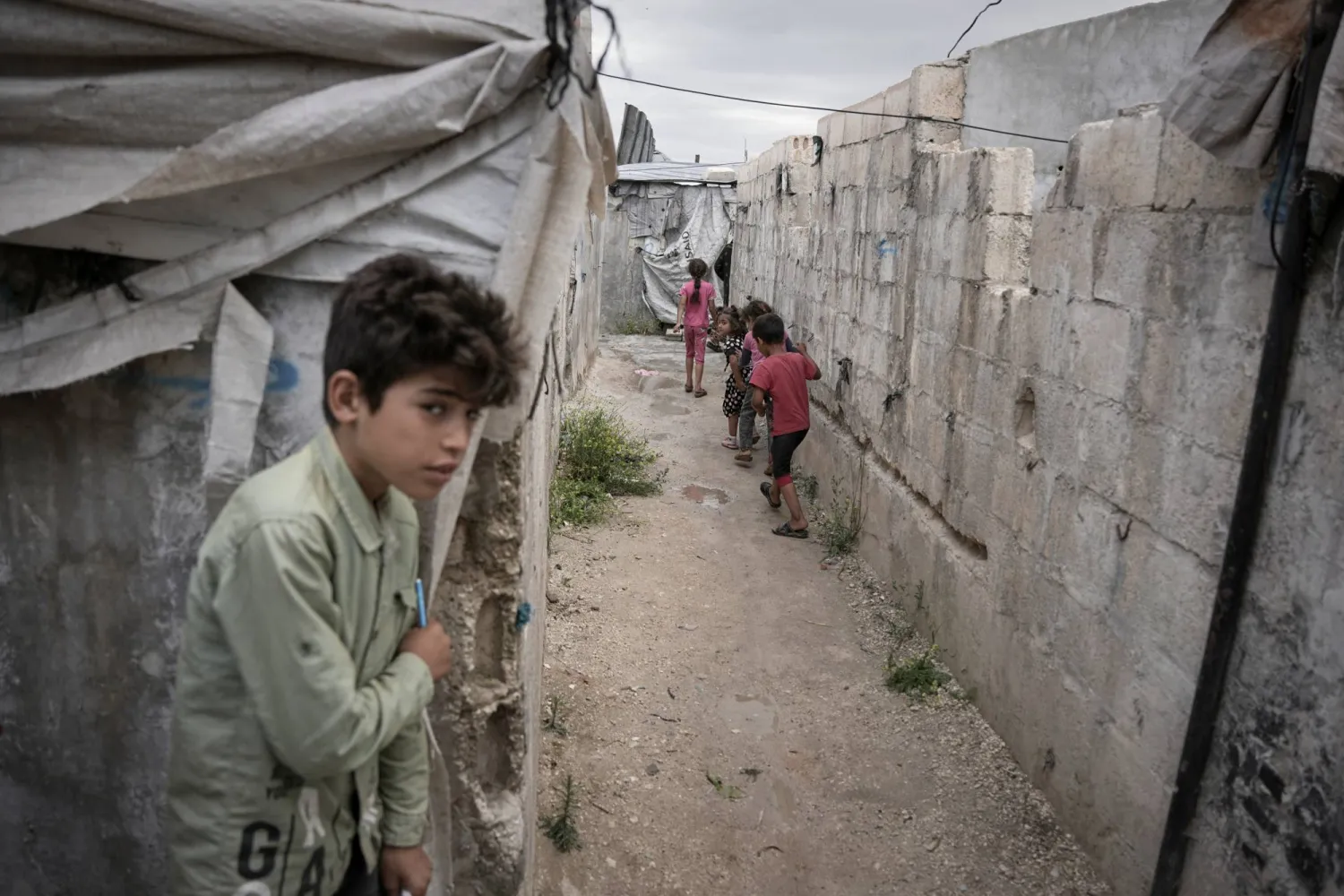
FILE - Children play through al-Karama camp, established in the early years of the Syrian conflict and built from scratch with light-brick structures covered with fabric to house internally displaced Syrians near the village of Atmeh, Idlib province, Syria, May 19, 2026. (AP Photo/Omar Albam, File)
TT

UNHCR Says Fewer People Displaced Worldwide in 2025 but Long-term Refugee Crisis Persists

FILE - Children play through al-Karama camp, established in the early years of the Syrian conflict and built from scratch with light-brick structures covered with fabric to house internally displaced Syrians near the village of Atmeh, Idlib province, Syria, May 19, 2026. (AP Photo/Omar Albam, File)

The number of people displaced worldwide by conflict and persecution fell in 2025 for the first time in a decade, but levels of refugees facing long-term displacement remain unacceptably high, a UN refugee agency report said on Thursday.

Last year, 5.4 million people fled their homes, bringing the total number of refugees or people in refugee-like situations worldwide to 41.6 million, including 6 million Palestinian refugees, UNHCR said.

At the same time, around 14.7 million refugees and internally displaced people returned home, a 50% increase on the previous year and the second-highest figure recorded since 1965, the agency found.

Most returns were to six countries: the Democratic ‌Republic of the Congo, ‌Sudan, Syria, Afghanistan, Ukraine and Myanmar, Reuters said.

However, many returned to difficult ‌conditions ⁠marked by limited access ⁠to basic services, widespread infrastructure damage and ongoing insecurity, raising concerns over the sustainability and safety of their return, UNHCR said. About 2.9 million Afghans returned in 2025, including 1.9 million refugees - five times higher than the previous year - driven mainly by stricter policies in neighboring Iran and Pakistan, with many reporting they had little choice but to leave, UNHCR found.

This sharp rise reduced the global Afghan refugee population from 5.8 million in 2024 to 3.7 million in 2025, ⁠the report said. Syria, which had been one of the world’s largest ‌displacement crises for more than a decade, saw around ‌1.3 million people return in 2025 - nearly triple the previous year - following the fall of Bashar al-Assad’s ‌government in December 2024. This reduced the global Syrian refugee population from 6 million ‌to 4.9 million by the end of 2025.

“However, many returnees face serious challenges, including insecurity, widespread destruction, weak economic conditions, limited services and jobs, and continued sporadic violence in parts of the country,” the report said. The report noted that the crisis in the Middle East has already shaped global displacement trends ‌in 2026. Around 3.2 million people have been temporarily displaced in Iran since joint US-Israeli strikes at the end of February, while ⁠about one million people ⁠have been forced from their homes in Lebanon since the start of the war on March 2, amid Israeli strikes and evacuation orders, UNHCR said.

HALVING REFUGEE NUMBERS

UNHCR says it aims to halve the number of refugees and others in protracted displacement requiring humanitarian assistance by 2035, by supporting job creation and education opportunities, particularly in low- and middle-income countries where most refugees are hosted.

Globally, 70% of refugees have been in exile for five years or more, often in countries such as Lebanon, Jordan, Türkiye and Iran.

“Asylum and protection are life-saving and not up for debate, but we cannot accept a future in which millions of refugees remain trapped for years or decades without realistic prospects of rebuilding their lives,” said UNHCR High Commissioner Barham Salih.

Part of the initiative includes promoting voluntary returns, as well as enabling refugees to access education and employment in host countries so they can financially support themselves and become less aid-dependent.



North Korea Vows Boost to Nuclear Buildup, Military Intelligence

North Korean leader Kim Jong Un reacts on the day of a cruise missile launch at an unknown location in North Korea, July 3, 2026, in this picture released July 5, 2026 by North Korea's official Korean Central News Agency. KCNA via REUTERS
TT

North Korea Vows Boost to Nuclear Buildup, Military Intelligence

North Korean leader Kim Jong Un reacts on the day of a cruise missile launch at an unknown location in North Korea, July 3, 2026, in this picture released July 5, 2026 by North Korea's official Korean Central News Agency. KCNA via REUTERS

North Korea will strengthen its nuclear force "both in quality and quantity" and expand the role of its military intelligence agency focused on South Korea, state media said Friday.

Pyongyang is under widespread sanctions over its nuclear programme, and the two Koreas remain technically at war as their 1950-53 conflict ended without a peace treaty.

The announcement comes after North Korea has repeatedly spurned South Korean President Lee Jae Myung's dovish overtures, labelling Seoul its "most hostile" enemy and declaring itself an "irreversible" nuclear state.

The issues were discussed during an enlarged meeting of the ruling party's central military commission on Thursday, Pyongyang's official Korean Central News Agency said.

The meeting decided on measures such as "bolstering up the nuclear force both in quality and quantity", the report said.

It also called for broadly expanding the functions and missions of the General Reconnaissance and Intelligence Bureau, Pyongyang's military intelligence agency tasked with operations involving South Korea.

The unit "plays a pivotal role in controlling the potential enemies' threats and gathering key information", KCNA said.

The meeting discussed ways to enhance the unit's "capability of military reconnaissance and intelligence activities in a radical way", it added.

Hong Min, a senior researcher at the Korea Institute for National Unification, said North Korea's latest move reflects Pyongyang's shift to treating the two Koreas as "two hostile states", potentially replacing the previous armistice-based framework.

"Military reconnaissance takes on a different meaning under a state-to-state approach, as intelligence activities targeting another sovereign state can carry diplomatic implications," he told AFP.

Experts have said that North Korea is likely aiming to acquire military technology, including surveillance satellites, in return for the troops it sent to aid Russia's war against Ukraine.

In 2023, the country successfully put a military spy satellite into orbit and claimed it was capturing images of major US and South Korean military sites.

South Korea's Unification Ministry told AFP it was "closely monitoring" any developments related to the North Korean unit's reported expansion.


Hundreds Flee Homes in Taiwan ahead of Biggest Typhoon in Decades

Bavi's strong-wind radius of 380 kilometers (240 miles) will make it the largest typhoon to hit Taiwan in more than 30 years. I-Hwa Cheng / AFP
TT

Hundreds Flee Homes in Taiwan ahead of Biggest Typhoon in Decades

Bavi's strong-wind radius of 380 kilometers (240 miles) will make it the largest typhoon to hit Taiwan in more than 30 years. I-Hwa Cheng / AFP

Hundreds of people in Taiwan have been evacuated from their homes, and many schools and offices closed, as the biggest typhoon in decades sweeps towards the region on Friday.

Typhoon Bavi is expected to pound Taiwan's north and east, as well as Japan's remote southwestern islands, on Friday and Saturday before smashing into China, which has been hit by deadly storms this week, said AFP.

Locals in the port city of Keelung, which is expected to be one of the hardest hit areas, stocked up on food, taped windows, and stacked sandbags at the entrances to street-level businesses, heeding warnings from authorities to take precautions.

"We're worried," said Samuel Fu, who works in a noodle shop in the coastal district of Bali, near Taipei.

"This is the first time we've experienced such a big typhoon... since we opened the shop," 20-year-old Fu told AFP.

"The signboard and the awning at the front could be blown off. If the winds get stronger, we'll bring everything inside."

After hitting Guam and the Northern Marianas on Monday as a super typhoon, Bavi was downgraded to a typhoon as it moved across the Pacific Ocean.

Bavi's maximum sustained wind speeds were 162 kilometers (100 miles) per hour, with gusts of around 198 kilometers per hour, on Friday -- slower than on Thursday -- the Central Weather Administration (CWA) said.

"The typhoon is likely to continue weakening because environmental conditions are not favorable," CWA forecaster Wang Ping-hsiang said.

"The greatest impact is expected in Taipei, New Taipei, Keelung and Yilan, while the heaviest rainfall is forecast for mountainous areas in central and northern Taiwan."

Bavi's strong-wind radius of 380 kilometers (240 miles) will make it the largest typhoon to hit Taiwan in more than 30 years.

Many schools and offices were shuttered on Friday across northern and eastern Taiwan, including Taipei.

In Keelung, locals flocked to a fresh food market to buy fruit and vegetables, street food vendors secured their stands, and a temple covered and tied down an outdoor statue ahead of the storm.

'Strong winds and heavy rain'

Bavi is expected to dump up to a meter of rain, raising concerns about potential flooding and landslides.

More than a thousand people have been evacuated from their homes, mostly in the mountainous county of Hualien in Taiwan's east where authorities are monitoring two barrier dams.

Taiwanese President Lai Ching-te urged people in areas likely to be most affected by Bavi to remain on "high alert"

"Although the typhoon has weakened slightly and is now classified as a moderate typhoon, its extensive wind field may still bring strong winds and heavy rain to various areas," Lai said on Facebook.

After sweeping past Taiwan, Bavi is expected to make landfall in eastern China over the weekend.

Extreme weather has already wreaked havoc on southern and central China this week, with storms leaving at least 39 dead and causing dozens of rivers to overflow and a reservoir dam to burst.


China Successfully Tests Sea-based Rocket Booster Recovery System

FILE PHOTO: A delivery driver looks at this phone as he rests on his electric bike in Beijing, China January 25, 2020. REUTERS/Thomas Peter
TT

China Successfully Tests Sea-based Rocket Booster Recovery System

FILE PHOTO: A delivery driver looks at this phone as he rests on his electric bike in Beijing, China January 25, 2020. REUTERS/Thomas Peter

China on Friday successfully tested an experimental rocket retrieval system using a net attached to a sea platform, state media reported, in the hopes of breaking ⁠US dominance in ⁠reusable rockets.

The Long March 10B rocket lifted off from the Hainan commercial ⁠space launch site in southern China and, about six minutes after separation of its booster and upper stage, the booster returned vertically and was recovered on ⁠an ⁠offshore platform, state broadcaster CCTV reported.

It marked China's first successful controlled recovery of a carrier rocket's booster, CCTV said.