Pope’s Plane in Spain Delayed by Technical Glitch

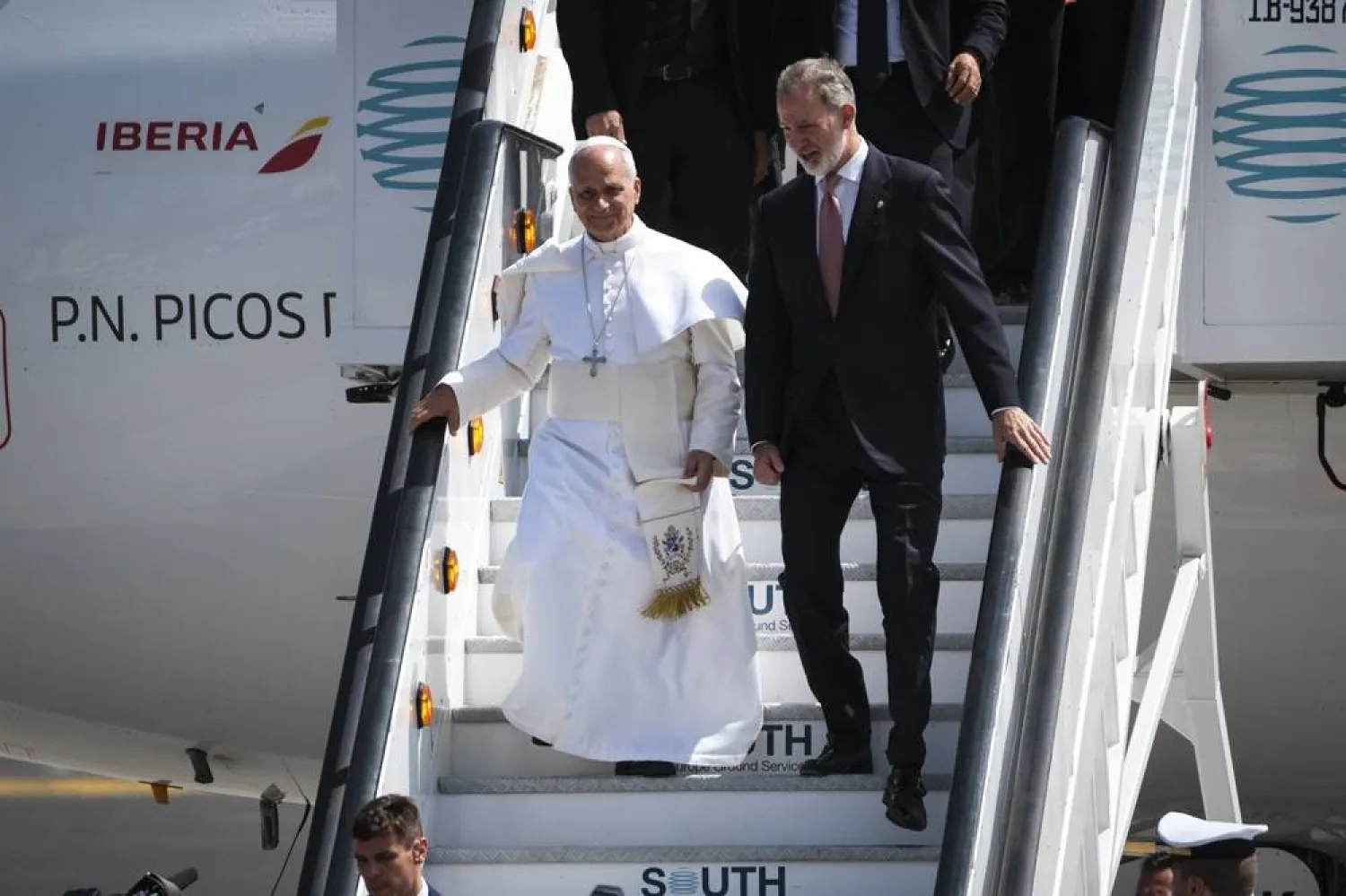
Pope Leo XIV (L) and King Felipe VI disembark from the plane that was supposed to take the pontiff back to Rome after his seven-day trip to Spain, due to technical problems preventing its takeoff from Los Rodeos Airport, Tenerife Island, Canary Islands, 12 June 2026. (EPA)
TT

Pope’s Plane in Spain Delayed by Technical Glitch

Pope Leo XIV (L) and King Felipe VI disembark from the plane that was supposed to take the pontiff back to Rome after his seven-day trip to Spain, due to technical problems preventing its takeoff from Los Rodeos Airport, Tenerife Island, Canary Islands, 12 June 2026. (EPA)

Pope Leo XIV's departure from Tenerife at the end of a week-long visit to Spain was delayed Friday by a technical problem with the plane which led him to disembark, according to an AFP reporter at the scene.

Spain's King Felipe VI, who had just said goodbye to the pontiff on the runway, boarded the Iberia airline plane and both disembarked and returned to the terminal.

About 80 journalists remained on the jet, along with Vatican officials and members of the clergy.

"The departure of the papal flight has been delayed by half an hour due to a technical problem with the aircraft," the communications service for the papal trip in Spain said in a brief statement at 1545 GMT.

The pilot initially told passengers there was a technical fault but later specified a "startup failure of the engine", which he said was likely caused by wind conditions.

"Our maintenance team suggests towing the aircraft, positioning it into the wind, and attempting a new engine start," the pilot told those on board.

"We will try this. If it is successful, we can depart."

Pope Leo XIV had been due to return to Rome after a seven-day trip to Spain.

He arrived on Friday in Tenerife in Spain's Canary Islands from the nearby island of Gran Canaria, where he had been since Thursday.


Myanmar Military Strike Kills 14 People at a Buddhist Monastery

Police stand guard as they wait for protests against coup in Yangon, Myanmar February 4, 2021. REUTERS/Stringer
TT

Myanmar Military Strike Kills 14 People at a Buddhist Monastery

Police stand guard as they wait for protests against coup in Yangon, Myanmar February 4, 2021. REUTERS/Stringer

An airstrike Friday by Myanmar’s military on a Buddhist monastery in Myanmar’s central Sagaing region killed 14 people who were taking part in a week-long meditation retreat, an opposition group and a resident said.

The attack is the latest in a series of frequent and deadly aerial strikes targeting armed pro-democracy forces and ethnic armed groups in the country. The strikes often cause civilian casualties.

The attack occurred Friday at 9 a.m. in Swel Le Oh village in Myaung township, about 75 kilometers (45 miles) west of Mandalay, the country’s second-largest city, according to Nway Oo, a spokesperson for the Civil Defence and Security Organization of Myaung Township, or CDSOM.

Nway Oo said 14 people, including three women, were killed and 20 others were wounded when a jet fighter dropped a bomb in the compound of the village’s monastery.

A villager who spoke on condition of anonymity also confirmed the death toll to The Associated Press. The villager said the jet fighter dropped two bombs 15 minutes apart, with the second bomb damaging a house near the monastery where more than 100 people were on a week-long retreat during Buddhist Lent.

The villager, who lost a relative in the airstrike, said that people fled to a nearby community after burying bodies of the victims.

Associated Press


Iran Vows 'Devastating' Response to US Threat to Cut off its Economic Lifelines

US and Iran flags are seen in this illustration taken June 18, 2025. REUTERS/Dado Ruvic/Illustration/File Photo
TT

Iran Vows 'Devastating' Response to US Threat to Cut off its Economic Lifelines

US and Iran flags are seen in this illustration taken June 18, 2025. REUTERS/Dado Ruvic/Illustration/File Photo

Iran said on Friday that its response to any new US threats would be "devastating" after Washington pledged to impose the toughest financial penalties in history with the aim of toppling the Iranian leadership.

Washington prepared for sanctions that US Treasury chief Scott Bessent said he would detail on Monday. President Donald Trump earlier warned of economic consequences against any country that provided "any type of lifeline to Iran."

The chief of staff of Iran's Armed Forces, Major General Ali Abdollahi, said the Islamic Republic's reaction would be broad and decisive.

"With preparedness across land, sea, air, air defense and cyberspace, Iran's armed forces will respond to the enemy's new threats with crushing, punishing and devastating responses," Abdollahi was quoted as saying by Iranian media.

The US and Iran have twice announced ceasefire deals, in April and June, aiming to restore the free flow of ships through Hormuz on a path towards ending the nearly six-month-old conflict, but both quickly crumbled.

Bessent told CNBC he would "talk about exactly what we're going to do" on Iran at a press conference on Monday.

"We are going to collapse this regime. It is time for our allies and the rest of the world to make a decision," he said, describing a naval blockade reimposed on Iran in July and the "toughest sanctions in history" as a "one-two punch".

Iran has weathered near-continuous economic sanctions for nearly 50 years, since the Islamic Revolution of 1979, but its people are suffering high inflation, a weakening currency and energy shortages along with damaged infrastructure.

Some Iranians interviewed by Reuters have said more economic punishment could increase hardship, weaken the clerical establishment and prompt unrest, although there has been no sign of that since a deadly crackdown on protests in January.

Before Bessent spoke, Iran's foreign ministry said US sanctions would not "create even the slightest hesitation in Iranians’ determination to safeguard Iran’s independence, dignity and national sovereignty."


Iran President Says Time to End War while in Position of Strength

Iranian President Masoud Pezeshkian (Reuters)
TT

Iran President Says Time to End War while in Position of Strength

Iranian President Masoud Pezeshkian (Reuters)

Iranian President Masoud Pezeshkian said Friday it was time to end the months-long Middle East war with the United States because Tehran appeared to be in a stronger position than Washington.

Tehran is keeping the key Strait of Hormuz partially shut and Washington is persisting with a naval counter-blockade of Iran.

"It is better that we bring the war to an end now as we are in a position of power and dignity," Pezeshkian said in a meeting with doctors.

"The whole world acknowledges our victory and emphasises that America has attacked our schools, hospitals and infrastructure in violation of all regulations and is hated around the world."

Pezeshkian also defended a memorandum of understanding agreed with the US in June aimed at ending the war, claiming it did not signal a defeat for Tehran.

"They cannot find even a single clause in this agreement that indicates capitulation. All the commitments concern the other side," he said.

His remarks come weeks after Iran's Supreme Leader Mojtaba Khamenei said he had approved the deal to end the war despite having "different views".

Hardline lawmakers in Iran's parliament have also criticized the government over the deal, accusing it of giving concessions to the US, mostly over the re-opening of the strategic Hormuz Strait.

According to reports in US media, the American navy has been organizing and protecting secret convoys of tankers through the southern sector of the Strait of Hormuz enabling between five and 10 million barrels a day of oil to be exported.

As Tehran claimed to be in the stronger position, the US has said it would ramp up sanctions to heap pressure on Tehran.

The American plan drew condemnation from Iran's foreign ministry, which accused the US of "economic terrorism" and "crimes against humanity".

"The perpetrators and instigators of these sanctions are deserving of trial and punishment for committing such heinous crimes," it said in a statement carried by state media.

US Treasury Secretary Scott Bessent on Thursday vowed Washington would "collapse" the Iranian regime with its threatened campaign nearly six months since their war began.

The comments underscored how the Trump administration is shifting to economic rather than military pressure on Tehran as the US president's unpopular war drags on.

China also criticized Washington's economic plan, saying that US "sanctions and pressure" would not resolve the Middle East conflict.