


Israel Concerned about US-Iran Deal but Does Not Want to Anger Trump

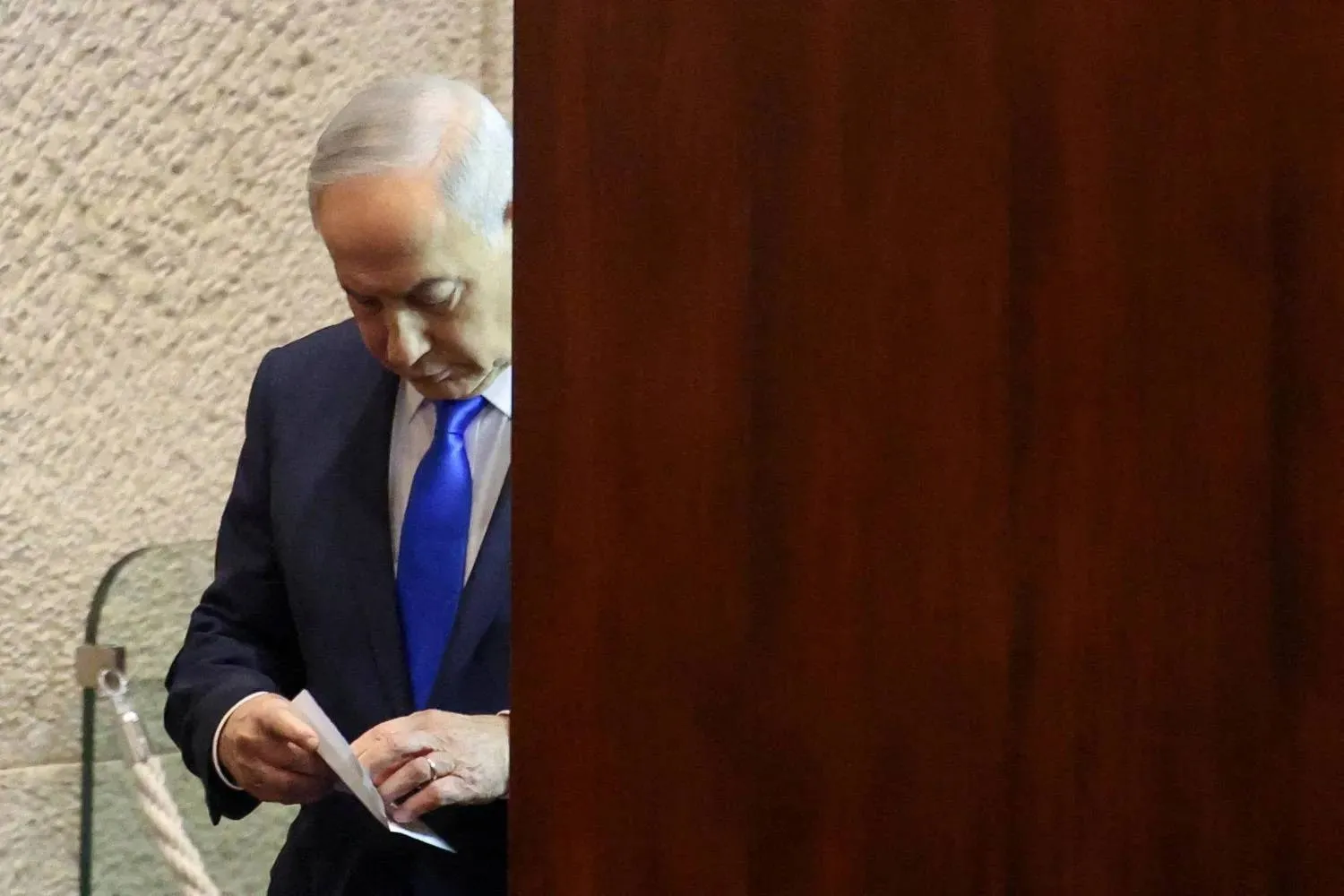
Israeli Prime Minister Benjamin Netanyahu seen at the Knesset on June 3. (Reuters)
TT

Israel Concerned about US-Iran Deal but Does Not Want to Anger Trump

Israeli Prime Minister Benjamin Netanyahu seen at the Knesset on June 3. (Reuters)

While Israeli Prime Minister Benjamin Netanyahu has been forced to praise the US-Iran deal and to choose words that appease US President Donald Trump, Israeli military and political officials expressed deep concern over the emerging agreement, likely to be officially signed next Friday.

Israeli officials fear the deal may fail to eliminate the threats posed by Iran's nuclear and ballistic missile programs and could also restrict Israel's freedom of action against Hezbollah in Lebanon.

Officials said Israel cannot return to the reality before the October 7, 2023, attack, when it says its hands were tied while threats built up along its borders.

Current Israeli government officials have said little about the Trump-Iran understanding, apparently for fear of upsetting the US leader. Instead, the Israeli military leaked statements on behalf of a “senior military source” expressing concern about the cessation of operations in Lebanon.

Israeli officials said the text of the agreement remains “an enigma,” not explicitly speaking about the dismantling of the Iranian nuclear program, the obliteration of Iran’s ballistic missile arsenal and production capacity, and Iran’s ability to connect itself to its proxies. They listed Israel’s five main problems with the proposal:

First, there are no clear answers regarding the treatment of Iran’s stockpile of enriched uranium, and not enough curbs on Iran’s nuclear program.

Second, the text of the deal does not clearly mention Iran’s intention to stop the production of ballistic missiles.

Third, the key unresolved question is how much funds Iran will receive. A compromise has been reached: Iran will not receive cash, but will be able to purchase medicine and food using frozen funds. The Americans insist that frozen assets will not be released before the uranium stockpiles are addressed, but that issue will be negotiated later.

Fourth, the deal lays out no clear mechanism for forcing Iran to halt its support for its proxy forces, including Hezbollah, the Houthis and Hamas.

Fifth, Israel had not been a party to the Trump administration’s negotiations with Iran and is being left out of the potential peace.

Yedioth Ahronoth quoted a senior Israeli official saying on Saturday evening that the agreement expected to be signed between the United States and Iran is “not a good deal,” warning that Israel has little ability to influence the process despite the direct impact it could have on its security.

The official said the deal would be followed by negotiations expected to last 60 days. The resources Iran would receive during the roughly two months of negotiations and afterward could, at least in theory, allow the regime to rebuild its nuclear project and its ballistic missile program.

The newspaper said the American president is acting according to his own political and US interests.

“The frequent calls between Netanyahu and Trump appear to have only marginal influence. Israel is not only failing to shape the talks, it also does not really know what is happening inside them,” it wrote.

Trump and Netanyahu spoke by phone about the emerging deal with Iran, according to the Prime Minister’s Office.

In a statement that intended to downplay the significance of the potential agreement, Netanyahu’s office said the two spoke about “the emerging memorandum of understanding with Iran regarding entry into negotiations.”

In the conversation, Netanyahu expressed a rather optimistic take on an agreement, according to his office.

“Although Israel is not a party to the memorandum of understanding,” his office said, “the prime minister expressed his appreciation for President Trump’s commitment that the final agreement reached at the conclusion of the negotiations will include the removal of enriched material, the dismantling of enrichment infrastructure, limitations on missile production, and the cessation of Iran’s support for its terrorist proxies in the region.”



Pentagon Inks Tomahawk Deal Amid Reports of Missile Shortfall

A visitor walks past Raytheon stand at the 53rd International Paris Air Show at Le Bourget Airport near Paris, France June 21, 2019. (Reuters)
TT

Pentagon Inks Tomahawk Deal Amid Reports of Missile Shortfall

A visitor walks past Raytheon stand at the 53rd International Paris Air Show at Le Bourget Airport near Paris, France June 21, 2019. (Reuters)

The Pentagon announced a $22.9 billion contract with Raytheon on Monday for Tomahawk missiles amid reports of a shortfall due to the war with Iran.

Acting US Navy Secretary Hung Cao said the contract will "accelerate Tomahawk missile delivery to our warfighters at unprecedented speed."

"Guaranteeing our naval and joint forces have the lethal firepower they need to deter aggression and protect the homeland is paramount," Cao said in a statement. "The Department is utilizing every available tool to meet the demands of our current operations."

An analysis by the Center for Strategic and International Studies (CSIS) think tank released last month found that US stocks of Patriot and THAAD air defense missiles have been slashed by the conflict with Iran.

Before it began in late February, the United States had more than 2,300 Patriot and more than 450 THAAD interceptors -- figures that CSIS estimated have been roughly halved or more in the subsequent months of war.

The Washington Post reported this month that President Donald Trump had demanded answers from Pentagon chief Pete Hegseth about munitions shortages at a recent cabinet meeting.

Trump and Hegseth both later denied that the United States was faced with dwindling missile stocks.

Tomahawk missiles are mainly launched from submarines and warships and can travel more than 1,600 kilometers (1,000 miles).


UN Laments ‘Unacceptable’ Toll of 350 Aid Workers Killed in 2025

UN Under-Secretary-General for Humanitarian Affairs and Emergency Relief Coordinator Tom Fletcher briefs the media about the humanitarian crisis in the Gaza Strip during a press conference at the European headquarters of the United Nations (UNOG), Geneva, Switzerland, Aug. 22, 2025. (EPA)
TT

UN Laments ‘Unacceptable’ Toll of 350 Aid Workers Killed in 2025

UN Under-Secretary-General for Humanitarian Affairs and Emergency Relief Coordinator Tom Fletcher briefs the media about the humanitarian crisis in the Gaza Strip during a press conference at the European headquarters of the United Nations (UNOG), Geneva, Switzerland, Aug. 22, 2025. (EPA)

The number of aid workers killed worldwide in 2025 reached 350, with the most fatalities in Gaza and Sudan, the United Nations said Monday, calling attacks on humanitarians "unacceptable."

The death toll, however, was slightly lower than that of 2024, when 377 aid workers were killed.

The UN Office for the Coordination of Humanitarian Affairs (OCHA) cited the figures from the research and advisory group Humanitarian Outcomes in a statement marking World Humanitarian Day.

Some 186 humanitarians were killed in Gaza -- the deadliest place for aid workers for the third year running -- followed by Sudan with 71 killed.

"More than 1,000 aid workers have been killed in just three years and that is utterly unacceptable," Tom Fletcher, under-secretary-general for humanitarian affairs, said in the statement.

"But just calling it out will not protect the next aid worker. States must uphold international humanitarian law and use every tool to protect civilians and our colleagues," he said. "And for those who break the rules, there must be real consequences."

Since the start of 2026, 82 more aid workers have been killed, 97 injured and 39 abducted worldwide.

OCHA voiced particular concern over the proliferation of armed drones "that are putting lethal power into ever more hands and sending more explosive weapons into towns and cities."

In Sudan, armed drones caused 80 percent of civilian deaths in the first four months of 2026, hitting markets and health facilities, the statement said, also noting casualties from drone attacks in the Russia-Ukraine war.

"Weaponized drones have become the new face of an old danger: the deliberate or reckless destruction of civilian life," Fletcher said.


Reports: UK PM Exchanged Messages with Trump Aide Imposter

Prime Minister Andy Burnham speaks with apprentices and staff at the met office during a visit on August 14, 2026 in Exeter, United Kingdom. (Reuters)
TT

Reports: UK PM Exchanged Messages with Trump Aide Imposter

Prime Minister Andy Burnham speaks with apprentices and staff at the met office during a visit on August 14, 2026 in Exeter, United Kingdom. (Reuters)

New British Prime Minister Andy Burnham exchanged messages with someone posing as Susie Wiles, the White House chief of staff, several media outlets reported on Monday.

According to Politico, which broke the story quoting anonymous sources, the British leader sent a "few messages" via an unspecified communication channel to a person he believed to be Wiles before becoming suspicious.

The incident was deemed serious enough for the British embassy in Washington to raise the matter with the White House, according to two sources cited by Politico.

Neither the date nor the content of the exchanges is known.

Burnham succeeded former Labour Party leader Keir Starmer as prime minister on July 20.

"We do not comment on national security matters," a spokesperson for Burnham's Downing Street office said, without denying the exchanges.

Burnham is not the first prominent British politician to fall victim to this type of hoax.

In 2024, the British government released a video of a phone call in which the then foreign minister David Cameron was duped by someone posing as former Ukrainian president Petro Poroshenko.

The Foreign Office explained at the time that it had disclosed the incident to preempt any attempt by the perpetrators to manipulate the footage.