


Israel Launches Fresh Airstrikes in Lebanon; Trump Says He Could Still Restart War

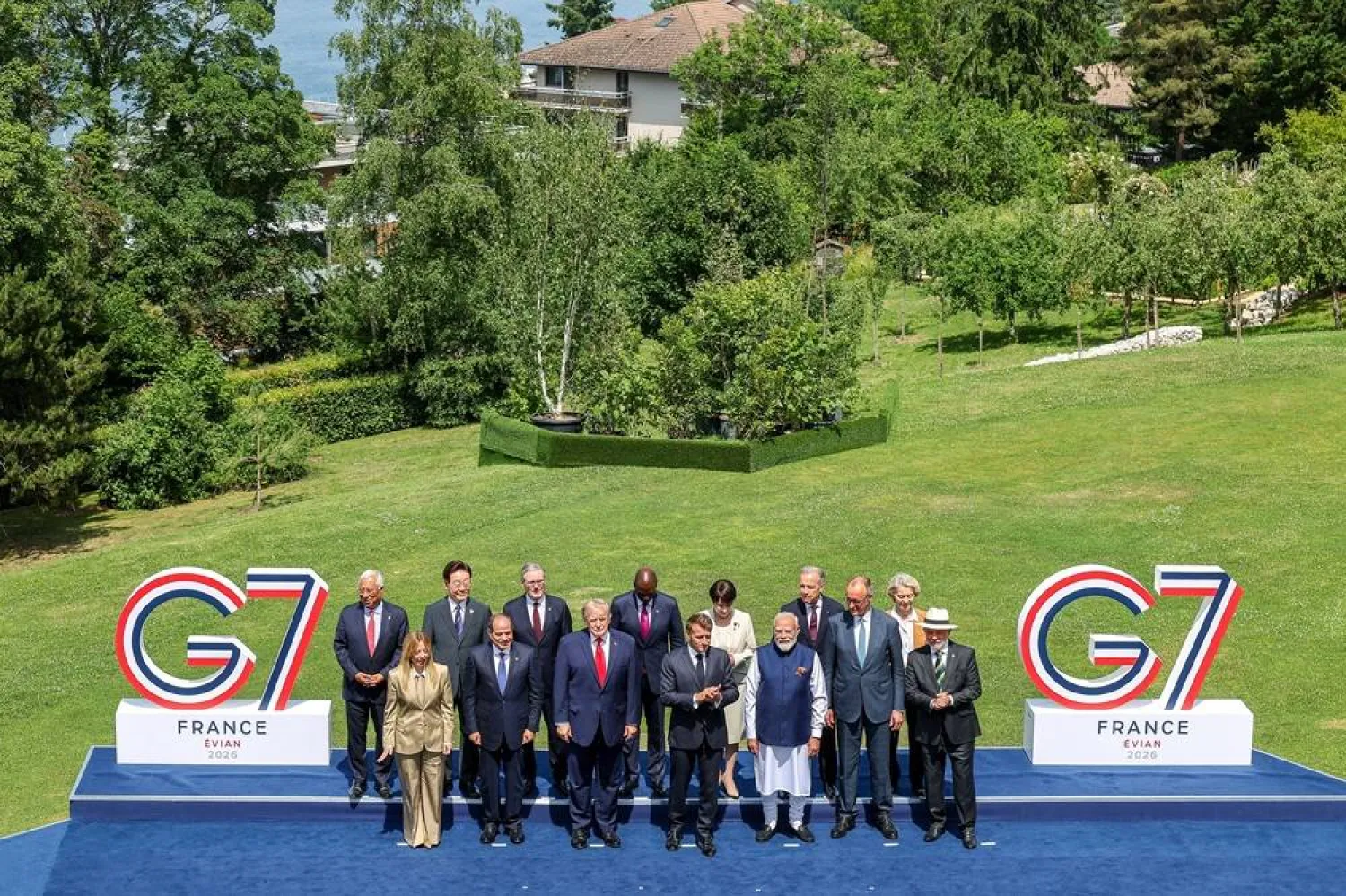
US President Donald Trump, French President Emmanuel Macron, Canadian Prime Minister Mark Carney, Italian Prime Minister Giorgia Meloni, Japanese Prime Minister Sanae Takaichi, European Commission President Ursula von der Leyen, European Council President Antonio Costa, German Chancellor Friedrich Merz, Egyptian President Abdel Fattah al-Sisi, South Korea's President Lee Jae Myung, India's Prime Minister Narendra Modi, Brazilian President Luiz Inacio Lula da Silva, Kenya's President William Ruto and British Prime Minister Keir Starmer pose during a family photo at the G7 summit in Evian, France, on Tuesday June 16, 2026. (Pool via Reuters)
TT

Israel Launches Fresh Airstrikes in Lebanon; Trump Says He Could Still Restart War

US President Donald Trump, French President Emmanuel Macron, Canadian Prime Minister Mark Carney, Italian Prime Minister Giorgia Meloni, Japanese Prime Minister Sanae Takaichi, European Commission President Ursula von der Leyen, European Council President Antonio Costa, German Chancellor Friedrich Merz, Egyptian President Abdel Fattah al-Sisi, South Korea's President Lee Jae Myung, India's Prime Minister Narendra Modi, Brazilian President Luiz Inacio Lula da Silva, Kenya's President William Ruto and British Prime Minister Keir Starmer pose during a family photo at the G7 summit in Evian, France, on Tuesday June 16, 2026. (Pool via Reuters)

US President Donald Trump said on Wednesday his new ceasefire agreement with Iran was not final and he could resume the war if he is unsatisfied, even as Israel launched fresh airstrikes in Lebanon where fighting threatens the wider truce. 

"It's a memorandum of understanding. And if I don't like it, we'll go back to shooting at them, dropping bombs on their head," Trump said at a G7 summit in France of the agreement, reached three days ago. 

"If I don't like it, if they don't behave, we'll go right back to dropping bombs right smack in the middle of their head, OK?" 

Leaders hailed the agreement at the summit, held in the French town of Evian-les-Bains, an hour's drive along the shore of Lake Geneva from where the Iran ceasefire memorandum is due to be signed at a ceremony across the Swiss border on ‌Friday. 

The leaders also demanded ‌an immediate ceasefire in Lebanon, where the memorandum calls for a halt to hostilities between Israel and ‌the ⁠Iran-backed Hezbollah group ⁠that have displaced more than a million people. 

Fighting there has abated but not ceased since the agreement was reached on Sunday, and Israel, which was not part of the negotiations, says it retains the right to use force. 

Lebanese state media reported fresh Israeli air strikes and artillery fire in several southern towns throughout Wednesday. Lebanese security sources said Hezbollah had also launched two drone attacks on Israeli forces in the south. The group did not publicly claim the attacks. 

Israel later said five of its soldiers had been injured in two Hezbollah drone attacks in southern Lebanon. 

Inside the southern Lebanese city of Nabatieh, below a mediaeval castle seized by Israeli forces, buildings had been blasted to ruins resembling the Gaza Strip. 

Khodr Kodeih, a member of the town council, told Reuters that some ⁠displaced residents had come back to check on their homes in recent days, but that the fresh ‌strikes were again keeping them away. 

"The city of Nabatieh emptied out again. We hope that ‌a safe environment can be secured so people can return, because the basic necessities of life are still not available," Kodeih said. 

The memorandum of understanding, yet ‌to be made public three days after it was signed by Washington and Tehran, extends a ceasefire announced in April by another 60 ‌days to allow them to negotiate a permanent truce. 

G7 LEADERS BACK DEAL 

The G7 summit gave Trump a chance to present his deal with Iran to allies Britain, Canada, France, Germany, Italy and Japan. 

They share Washington's concerns about Iran's nuclear program and other issues, but never endorsed his decision to go to war, and worry Tehran has gained leverage by withstanding the onslaught and asserting control over the strait. 

"We underline the need for the negotiation ... to address the threats posed by Iran in ‌the region and beyond and ensure that they never obtain a nuclear weapon," the G7 leaders said in a statement. 

They said they were ready to contribute to implementing the accord, with a coalition led ⁠by Britain and France set ⁠to help secure shipping once the Strait of Hormuz reopens. 

Oil prices fell again on Wednesday on prospects for the reopening of the Strait of Hormuz, with Brent crude futures below $80, at their lowest level since the opening salvos of the US-Iran conflict. 

MOST IRANIANS 'ARE IN SURVIVAL MODE' 

Trump appears to have achieved little of what he said he wanted at the outset of the war. Iran's theocratic government remains in place, its stockpile of highly enriched uranium has not been surrendered, its ballistic missile capabilities have not been destroyed and it has not ended its support for anti-Israel armed groups like Hezbollah in Lebanon. 

Trump says the agreement states that Iran will not have a nuclear weapon - a restatement of Iran's official position since the 1970s. US officials say further discussions will lead to the removal or destruction of its enriched uranium stockpile. 

But ending the war on such terms could still expose Trump to criticism, including from hawks within his own Republican party, ahead of midterm elections in November. 

The mood among ordinary Iranians, grappling with economic woes further exacerbated by months of war, remained grim, even as their leaders declared this week's interim deal a diplomatic victory for Tehran over Washington. 

"I think 99% of people are in survival mode and just living day by day," said Amir, 34, a media production company owner in Isfahan in central Iran, who declined to give his surname. 

"I don’t think anybody has any hopes anymore. I don’t think anybody has any visions of what the future might look like." 


US Supreme Court Lifts Limits on Third-country Deportations

The United States has deported thousands of migrants to so-called third-countries, including Liberia, as part of US President Donald Trump's immigration crackdown. Matthew Jacobs / AFP
TT

US Supreme Court Lifts Limits on Third-country Deportations

The United States has deported thousands of migrants to so-called third-countries, including Liberia, as part of US President Donald Trump's immigration crackdown. Matthew Jacobs / AFP

The US Supreme Court on Tuesday lifted restrictions on the deportations of immigrants to countries that are not their own, while agreeing to hear the issue on its merits in December.

The conservative-dominated high court granted an emergency request by the Trump administration to suspend a lower court ruling that restricted, but did not outright ban, so-called "third-country removals."

The lower court had said people targeted with deportation must be given effective notice ahead of time about where they are being sent to allow them to raise concerns about potential persecution, said AFP.

The three liberal justices on the nine-member bench said they would not have granted the administration's request.

President Donald Trump campaigned on promises to expel millions of undocumented migrants from the United States and has taken several actions aimed at speeding up deportations since returning to the White House in 2025.

The Trump administration has defended third-country deportations as necessary since the home nations of some of those who are targeted for removal sometimes refuse to accept them.

In a brief to the Supreme Court, opponents of lifting the restrictions argued that the lower court ruling did not fully block all third-country deportations, "it simply requires them to do so lawfully."

Trump's solicitor general, John Sauer, meanwhile told the court that the rapid deportation to third countries was "an essential tool to remove certain aliens, including some of the worst criminal aliens."

The lower court ruling "created substantial logistical problems" with removals, he said.

- 'Indefensible' -

An AFP investigation found that the US has offered multimillion-dollar deals and threatened visa restrictions in a bid to get "third countries," especially in Africa, to take such deportees.

Once in these countries -- and outside US jurisdiction -- deportees have been subject to abuse by local guards, indefinite detention, or quickly re-deported to their home countries.

According to an investigation published last week, the United States has deported more than 25,000 people under secretive agreements with 35 countries to take migrants with no ties to those nations.

The investigation by Forbidden Stories found the administration has earmarked $410 million to be paid directly to the receiving countries, or to United Nations agencies to facilitate the returns.

The vast majority of the deportees -- around 20,000 -- were sent to Mexico, but the rest were dispersed to 27 other countries across Latin America, Africa, and the Pacific, and agreements have been finalized with seven more.

Congress has made it US policy not to deport people to countries where their lives would be in danger or they could be subject to torture.

After the high court's ruling, some Democratic lawmakers were calling for more formalized steps to prevent such deportations and uphold due process.

"Congress must step in. No one should be shipped off to a country that is not their own without basic due process and a meaningful opportunity to raise legitimate fears for their safety," House Democrat Lois Frankel said on X.

Rob Menendez, another congressional Democrat, called the Supreme Court's decision "indefensible."

"Taxpayers shouldn't fund tearing people from the only home they've ever known, nor should our legal system fast-track these unilateral deportations."


US Withdraws from European Anti-Corruption Panel

FILE PHOTO: A general view of a US State Department sign outside the US State Department building in Washington, DC, US, July 11, 2025. REUTERS/Annabelle Gordon/File Photo
TT

US Withdraws from European Anti-Corruption Panel

FILE PHOTO: A general view of a US State Department sign outside the US State Department building in Washington, DC, US, July 11, 2025. REUTERS/Annabelle Gordon/File Photo

The Trump administration has withdrawn the United States from a top European anti-corruption watchdog as it forges ahead with plans to disengage from international and multilateral organizations that it accuses of exceeding their mandates, being inefficient or not adapting to US policies.

The Council of Europe said Tuesday that the US formally notified it a day earlier that it would leave the Group of States against Corruption, or GRECO. Only two other countries have left GRECO before — Russia and Belarus.

The State Department confirmed the move, saying that US participation, which requires an annual monetary contribution, “does not provide tangible benefits to US national security.”

“The era of writing blank checks to international bureaucracies is over,” it said. “The department is instead prioritizing higher-impact tools to combat corruption, such as visa restrictions, sanctions, and targeted foreign assistance to strengthen foreign criminal investigations into corruption directly threatening US security and prosperity.”

The Strasbourg-based Council of Europe said the US had been “a valuable contributor” to GRECO "and to the exchange of experience and good practice in preventing and combating corruption.”

“GRECO remains open to resuming cooperation with the United States in the future in support of shared efforts to prevent corruption, strengthen integrity and uphold the rule of law,” it said in a statement.

The decision was announced a week after the Organization for Security and Cooperation in Europe said the US had declined to invite its members to observe November’s congressional midterm elections, a sharp break from past practice.

The US has already withdrawn from a number of European-based UN and multilateral agencies, including the World Health Organization and the UN Human Rights Council, and is weighing further such steps.

The US withdrew in January from another Council of Europe panel — the Venice Commission, which is an advisory body on constitutional law.

GRECO was created in 1999 by the Council of Europe to monitor compliance with the organization’s anti-corruption standards. Membership is not limited to European Union members, and the United States joined a year after its founding.


Iran Hangs Two Anti-government Protesters

The Iranian flag waves in front of the International Atomic Energy Agency (IAEA) headquarters, amid the coronavirus disease (COVID-19) pandemic, in Vienna, Austria May 23, 2021. (Reuters)
TT

Iran Hangs Two Anti-government Protesters

The Iranian flag waves in front of the International Atomic Energy Agency (IAEA) headquarters, amid the coronavirus disease (COVID-19) pandemic, in Vienna, Austria May 23, 2021. (Reuters)

Iran's judiciary announced that two men were hanged on Wednesday over charges relating to anti-government protests that peaked in January, having begun a month earlier over economic grievances.

The two, Ali Hemmati and Majid Nik-Andish, were found guilty of involvement "in the riots of January that resulted in the martyrdom of four security personnel" in the northeastern city of Mashhad, said the judiciary's Mizan Online website.

It added that they also "inflicted extensive damage on public property by setting fire to shops, banks, buses, etc, and even torching trees".

They "were executed by hanging early Wednesday, following the Supreme Court's confirmation of their sentences".

In late December, a protest movement initially sparked by the high cost of living rapidly evolved into widespread anti-government demonstrations that peaked on January 8 and 9.

Iranian authorities reported more than 3,000 deaths, attributing the violence to "terrorist acts" orchestrated by the United States and Israel, while foreign-based NGOs maintain that security forces fired on protesters, said AFP.

US President Donald Trump had threatened at the time to intervene militarily in Iran, before the United States and Israel launched a joint attack on Iran on February 28, triggering the Middle East war.

Since then, arrests and executions have multiplied in the country, linked both to the conflict and to the protests that took place earlier in the year.

In 2025, Iran executed at least 1,639 people, the largest number for any year since 1989, according to the NGOs Iran Human Rights and Together Against the Death Penalty.

According to Amnesty International, Iran is responsible for the second most executions of any country, after China.
