


Key Points from the US-Iran Memorandum

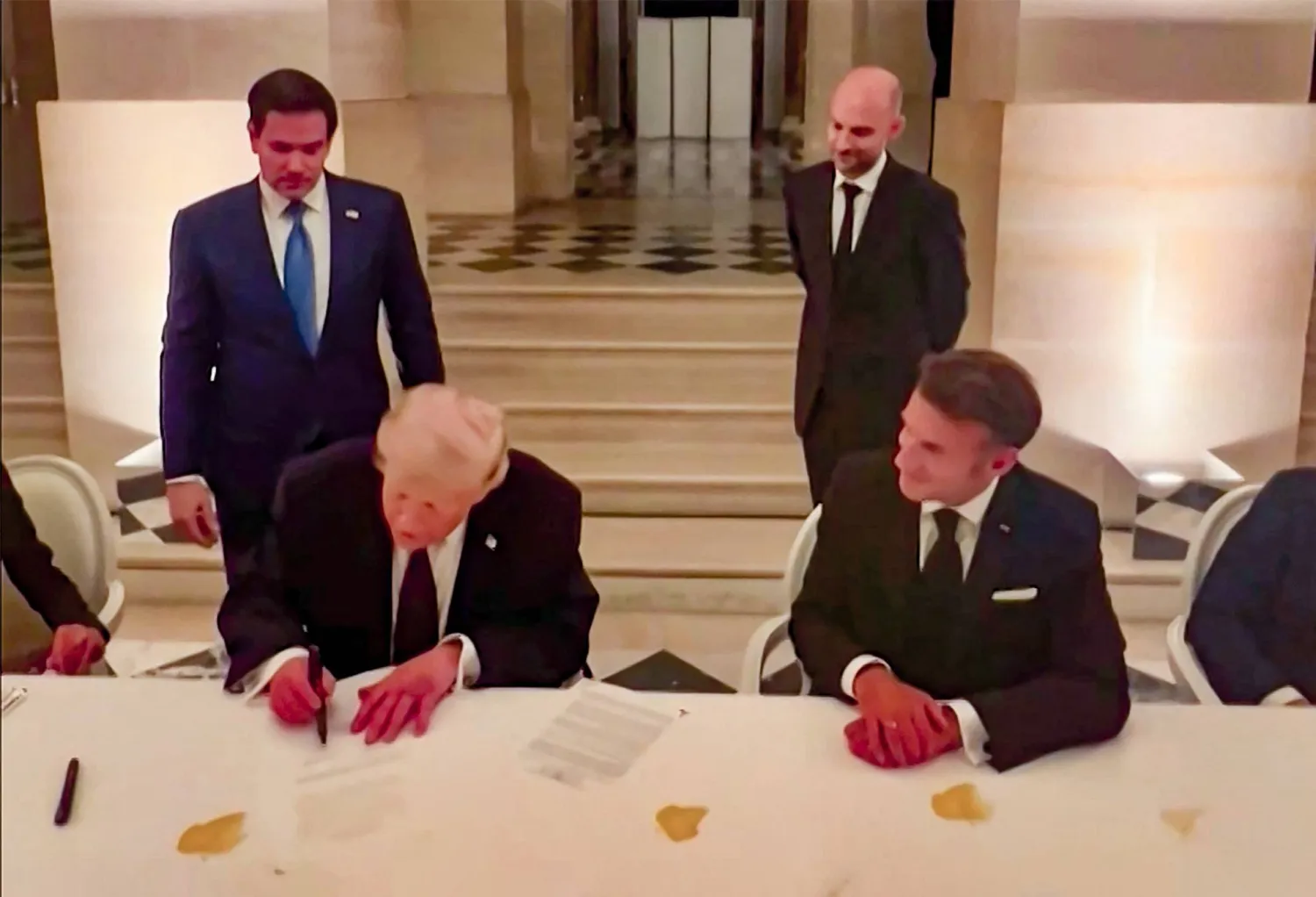
This videograb from footage made available on June 18, 2026, from the X account of French President Emmanuel Macron shows US President Donald Trump (C) and France's President Emmanuel Macron (L) during the signing of a deal with Iran to end the Middle East war, inside Chateau de Versailles, in Versailles southwest of Paris on June 17, 2026. (Photo by @EmmanuelMacron (X account of France's President Emmanuel Macron)
TT

Key Points from the US-Iran Memorandum

This videograb from footage made available on June 18, 2026, from the X account of French President Emmanuel Macron shows US President Donald Trump (C) and France's President Emmanuel Macron (L) during the signing of a deal with Iran to end the Middle East war, inside Chateau de Versailles, in Versailles southwest of Paris on June 17, 2026. (Photo by @EmmanuelMacron (X account of France's President Emmanuel Macron)

Here are the main points from the memorandum of understanding signed between the United States and Iran to end the Middle East war, the text of which was made public by Washington and Tehran:

- Permanent end to hostilities -

The United States, Iran and their respective allies "declare an immediate and permanent termination of military operations on all fronts, including in Lebanon".

They undertake "not to initiate any war or any military operation against each other and to refrain from the threat or use of force against each other and ensuring the territorial integrity and sovereignty of Lebanon".

- Final agreement within 60 days -

Iran and the United States commit to "negotiating and achieving the final deal in maximum 60 days, extendable with mutual consent".

- Lifting US blockade -

The United States will "immediately" begin the removal of its blockade of Iranian ports, which it imposed on April 13, and will bring it to an end within 30 days.

The United States also undertakes to "remove its forces from the proximity of the Islamic Republic of Iran within 30 days after the final deal".

- Reopening the Strait of Hormuz -

Iran will make best efforts to ensure the safe passage of commercial vessels with no charge, for 60 days only, from the Arabian Gulf to the Sea of Oman, and vice versa. The traffic of commercial vessels will immediately start and be fully restored within 30 days, once the Hormuz Strait has been cleared of mines.

- $300 billion plan -

The United States and its regional partners will draw up a plan with "at least" $300 billion "for the reconstruction and economic development" of Iran.

- Lifting sanctions -

The United States undertakes to "terminate all types of sanctions against" Iran, and to make fully available for use the frozen or restricted funds and assets of the Iranian Republic of Iran upon the implementation of this MOU.

The US Treasury will "issue waivers for the export of Iranian crude oil, petroleum products and derivatives, and all associated services, including banking transactions, insurances, (and) transportation" with immediate effect, until the sanctions are lifted.

- Nuclear -

Iran reaffirms that "it shall not procure or develop nuclear weapons".

The disposition of Tehran's enriched uranium will be resolved by "a mechanism that will be mutually agreed upon... with the minimum methodology to be down-blending on site under the supervision of the IAEA".

Pending the final deal, Iran will "maintain the current status quo of its nuclear program", and the United States "will not impose any new sanctions, and will not deploy additional forces in the region".

- Signing -

Pakistan's Prime Minister Shehbaz Sharif, who was involved in the mediation, said the memorandum was electronically signed on Thursday, Islamabad time, by US President Donald Trump and Iran's leader Masoud Pezeshkian.

A ceremony will be held in Switzerland on Friday to "commemorate this landmark event and commence with the technical level talks", according to Sharif.

- UN resolution -

The final agreement will be endorsed by a binding resolution of the United Nations Security Council.



Groups Sue Trump Administration Over Its Targeting of International Criminal Court

An exterior view of the International Criminal Court in the Hague, Netherlands, March 31, 2021. (Reuters)
TT

Groups Sue Trump Administration Over Its Targeting of International Criminal Court

An exterior view of the International Criminal Court in the Hague, Netherlands, March 31, 2021. (Reuters)

Human Rights Watch and three other advocacy groups sued the Trump administration on Tuesday to challenge its campaign against the International Criminal Court, arguing that sanctions against ICC judges and prosecutors are undermining the ability to prosecute people responsible for humanity’s worst crimes.

The complaint — filed in the Southern District of New York — says that President Donald Trump's executive order last year targeting the Hague-based criminal court and the US sanctions issued against a UN human rights expert and three Palestinian rights groups represent a “blatantly illegal attack on international justice and should be struck down," according to a press release.

The lawsuit is the latest example of organizations pushing back on what they call the Trump administration’s efforts to undermine international law and prevent efforts to combat impunity by governments around the world.

“The fact that so many leading human rights and humanitarian organizations have come together to challenge Trump’s unlawful executive order demonstrates the widespread harm it is causing across civil society groups dedicated to bringing those responsible for grave crimes to justice,” said Andrew Loewenstein of Foley Hoag LLP, the lead counsel representing the plaintiffs.

The groups assert that the financial and legal penalties against the ICC have forced them to “curtail a wide range of human rights and legal work in violation of their First and Fifth Amendment rights under the US Constitution and under the Religious Freedom Restoration Act.”

Other organizations joining the lawsuit are the American Friends Service Committee, the Center for Constitutional Rights and the Open Society Institute. The State Department did not immediately respond to a request for comment.

Efforts to retain the global tribunal's power come as the ICC faces enormous pressure, both internally and from its more than 120 member states. Among those sanctioned by the US last year was Karim Khan, who was the ICC’s chief prosecutor until he was removed from the post last month, nearly two years after sexual misconduct allegations against him first emerged, as detailed in stories by The Associated Press.

The Trump administration had issued those sanctions against Khan and a dozen other ICC staff in retaliation for warrants the court has issued for top Israeli officials, including Prime Minister Benjamin Netanyahu, over the war in Gaza and investigations into US personnel in Afghanistan.

“The Trump administration seeks a get out of jail free card for whomever it chooses. And with this case, we say no,” Liz Evenson, international justice director at Human Rights Watch, said during a press conference Tuesday.

Last month, US Secretary of State Marco Rubio announced that the US was launching a “sweeping campaign to dismantle the threat posed by the International Criminal Court to US sovereignty.”

In a video message, Rubio said the US would pressure member states to withdraw from the institution, sanction organizations that work with the court and ban staff from traveling to the United States. Countries that “enjoy the benefits of the US security umbrella” will be called upon to reject the court’s jurisdiction over US citizens, he added.

Several countries, including US-allied Venezuela, announced they would withdraw from the court shortly after Rubio's statements and Khan's removal.


Israel’s Former Mossad Chief Says Spies ‘Toured’ Iran Nuclear Site

A satellite view shows an overview of Fordow underground complex, before the US struck the underground nuclear facility, near Qom, Iran June 20, 2025. (MAXAR TECHNOLOGIES/Handout via Reuters)
TT

Israel’s Former Mossad Chief Says Spies ‘Toured’ Iran Nuclear Site

A satellite view shows an overview of Fordow underground complex, before the US struck the underground nuclear facility, near Qom, Iran June 20, 2025. (MAXAR TECHNOLOGIES/Handout via Reuters)

A former head of Israel's Mossad intelligence agency on Tuesday said its spies had visited Iran's Fordow nuclear site "many times" in the past in order to better understand the facility.

In June last year, Israel launched a war against its arch-foe Iran with the stated goal of degrading its nuclear and ballistic missile programs, which it said posed an "existential threat".

The United States military briefly joined Israel during the 12-day conflict, and used its advanced aircraft to bomb three Iranian nuclear facilities at Fordow, Natanz and Isfahan.

"We toured the Fordow nuclear site many times to understand the site," Yossi Cohen, who led the Mossad between 2015 and 2021, said during a conference of local authorities on Tuesday, Israeli media reported.

He didn't elaborate on when exactly the visits took place or who made them.

According to Israeli media, Cohen said "the bombing of the site by the Americans was the fulfillment of all my dreams".

Iran's nuclear program has long been a major point of contention between it and the West, including in negotiations aimed at ending the current war that Israel and the US launched against it in February.

Tehran has denied that it is seeking to produce a nuclear bomb.

Cohen, who is close to Israeli Prime Minister Benjamin Netanyahu, played a prominent role during his time in office in achieving US-brokered normalization deals between Israel and the United Arab Emirates, Bahrain and Morocco.

Sudan also signed on to the Abraham Accords, but later descended into war and has never ratified or implemented them.

Cohen was linked to Israel's killing in 2020 of Iranian nuclear scientist Mohsen Fakhrizadeh, although Israel has not commented on the incident.

After finishing his term at the helm of the agency, he has remained in the public eye, giving frequent interviews to Israeli media and repeatedly hinting at a possible foray into politics, which has not yet occurred.


Pakistan Says US and Iran Close to ‘Some Sort’ of Deal Despite Attacks on Shipping

Vessels are seen in the Strait of Hormuz, off the port city of Bandar Abbas in southern Iran on August 10, 2026. (AFP)
TT

Pakistan Says US and Iran Close to ‘Some Sort’ of Deal Despite Attacks on Shipping

Vessels are seen in the Strait of Hormuz, off the port city of Bandar Abbas in southern Iran on August 10, 2026. (AFP)

Pakistan said on Tuesday the United States and Iran were close to "some sort" of deal, and fellow mediator Qatar said talks on managing the Strait of Hormuz were at an advanced stage, despite reports of new attacks on shipping in regional waters.

The comments offered some hope that Iran and the US can end a stalemate that has in effect blocked the vital waterway, through which a fifth of global oil and liquefied natural gas flowed before the war. Prospects for a deal had appeared to dim on Monday after the sides' latest remarks and demands.

In an interview with Bloomberg News, Pakistani Defense Minister Khawaja Asif said "things are shaping up again in favor of a peace arrangement or a deal."

"The signals in the last two three days are that we are close to some sort of an arrangement."

Iranian Foreign Minister Abbas Araghchi met Pakistani Interior Minister Mohsin Naqvi in Tehran on Tuesday, Araghchi’s Telegram channel said on Tuesday, without providing further details.

Qatar's Foreign Ministry spokesperson told a ‌briefing earlier on Tuesday ‌that separate discussions between Oman and Iran over management of the Strait of Hormuz were at ‌an ⁠advanced stage.

Iran's Foreign Ministry's ⁠Public Relations Office did not immediately respond to a call for comment.

Pakistan and Qatar have been the main mediators in the conflict in which thousands have been killed — mainly in Iran and Lebanon — since US and Israeli attacks on Iran on February 28. Iran has hit back by striking Gulf countries, Jordan and Israel.

OIL PARES GAINS ON DEAL HOPES

Oil fell back on Tuesday after hitting a one-week high earlier in trading although it remains much higher than before the war.

Iran said on Sunday it was nearing a final pact with Oman defining new shipping lanes in the Strait of Hormuz, which runs between them, but said that in itself would not ⁠open the waterway unless the US met certain conditions.

Those conditions were largely in line with a ‌memorandum of understanding to end the conflict that was reached between Washington and Tehran in June ‌and included compensation and an end to sanctions and military threats.

Araghchi said on Sunday that Tehran and Washington were not holding ‌direct talks, but that messages were being exchanged through intermediaries.

US President Donald Trump responded on Monday night, making new demands, saying he was ‌seeking his own reparations from Tehran, seemingly leaving the two sides deadlocked.

"We're going to ask for money for the damage they've done over a 50-year period," Trump said at the White House, saying payments would cover deaths among both civilian demonstrators and US forces in the region.

"So, if there's damages to be paid, I think Iran should pay those damages," Trump said.

TWO VESSELS STRUCK

Despite tentative signs of progress in diplomacy, there were reports of new attacks on shipping ‌in the Gulf of Oman and the Red Sea, highlighting the widening threat to maritime trade.

Four crew members were killed in a suspected attack by Yemen's Iran-backed Houthis on a small cargo ⁠vessel in the Bab el-Mandeb strait ⁠on Tuesday, Yemen's Transport Ministry said.

The fatalities aboard the Egyptian-owned Tihamah, if confirmed, would be the first deaths in a Houthi strike on shipping since the Iran war began. The Houthis have not claimed the attack.

A container ship was also hit by a missile off Pakistan, while sailing through the Gulf of Oman in a suspected US attack, sources said.

The Wall Street Journal reported a US official as saying that the ship had been hit by a US military helicopter after its crew ignored warnings from personnel working to enforce a naval blockade on Iranian ports.

The US first announced a blockade of shipping trying to reach Iran's ports in April and reimposed it in July after the June peace accord crumbled.

Trump is under pressure to end a war that US polls show is deeply unpopular with the US electorate, just months before key midterm elections in which his Republican Party risks steep losses with high gasoline prices a key pain point.

So far, a months-long US military campaign, including a two-week campaign of strikes in July, has not broken Iran's grip on the strait, despite Trump saying the strait was open and that the "only one that has control of the Strait of Hormuz right now is the United States Navy."